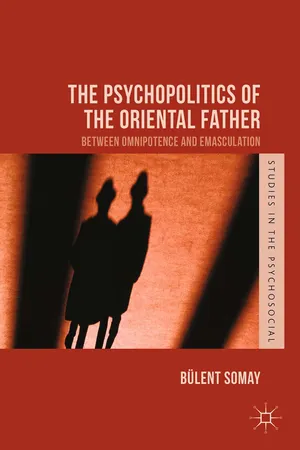
- English
- ePUB (mobile friendly)
- Available on iOS & Android
eBook - ePub
About this book
With a foreword by Slavoj Žižek, this book explores the Father Function in the East in the process of 'Modernisation', arguing that 'Modernisation' and 'Westernisation' are euphemisms for the advent of capitalism in Asiatic and African societies which lead to fatal transformations of the cultural and political incarnatations of the Oriental Father.
Information
1
Is East East and West West?
Oh, East is East, and West is West, and never the twain shall meet,
Till Earth and Sky stand presently at God’s great Judgment Seat;
Rudyard Kipling, The Ballad of East and West
1. Differences: essential and fundamental
There are three main themes insistently pursued throughout the course of this book, in an endeavour to provide evidence for a critique of the seemingly self-evident and ‘essential’ East/West dichotomy. The first is that there is no such thing as the Orient (a variation on/perversion of the famous/notorious Lacanian statement that ‘La femme n’existe pas’ [‘The Woman does not exist’]); the second is that insofar as the Orient ‘exists’, it is, just like its inevitable opposite twin, the Occident, nothing but a performative (a variation on/perversion of Judith Butler’s assertion that ‘Man’ and ‘Woman’ as genders are performatives); the third is that the Oriental and Occidental performatives chronically create a third one, that of the Oriental Transvestite, akin to that of the child or, alternatively, the drag, also a variation on Butler’s assertion of the drag as a transgressive (although not necessarily a subversive) performance. As becomes instantly apparent, these claims seem to rely heavily on a categorical analogy between the Orient and femininity (and the West and masculinity), which is already present in the germinal critique of Orientalism, namely, in Edward Said’s path-breaking book, Orientalism:
The Orient was Orientalized not only because it was discovered to be ‘Oriental’ in all those ways considered commonplace by an average nineteenth-century European, but also because it could be—that is, submitted to being—made Oriental. There is very little consent to be found, for example, in the fact that Flaubert’s encounter with an Egyptian courtesan produced a widely influential model of the Oriental woman; she never spoke of herself, she never represented her emotions, presence, or history. He spoke for and represented her. He was foreign, comparatively wealthy, male, and these were historical facts of domination that allowed him not only to possess Kuchuk Hanem physically but to speak for her and tell his readers in what way she was ‘typically Oriental.’ My argument is that Flaubert’s situation of strength in relation to Kuchuk Hanem was not an isolated instance. It fairly stands for the pattern of relative strength between East and West, and the discourse about the Orient that it enabled.
(Said 2003, pp. 5–6)
We can also find the literary expressions of the same analogy in many Westernised/Oriental artists. One of the most obvious examples is David Henry Hwang’s M. Butterfly which was later made into a major film by Canadian director David Cronenberg in 1993:
Song Liling: The West thinks of itself as masculine—big guns, big industry, big money—so the East is feminine—weak, delicate, poor . . . but good at art, and full of inscrutable wisdom—the feminine mystique. Her mouth says no, but her eyes say yes. The West believes the East, deep down, wants to be dominated—because a woman can’t think for herself.
(cited in Garber 1992, p. 240)
Flaubert’s Kuchuk Hanem (actually, Küçük Hanım in Turkish, meaning ‘Little Lady’) was not only exemplary of the Oriental Woman, but of the Orient as Woman (or, of the Woman as Orient) as well, of the subject who is unable to speak, but has to be spoken for, to be represented. The passage from Said suggests, even though he does not openly pronounce it, that Küçük Hanım’s Oriental-ness and her femininity not only reinforce each other to redouble her subalternity, but are also metaphors for each other, depending on the context: in a critique of Orientalism, her femininity stands as a metaphor for her Oriental-ness; in a feminist critique, her Oriental-ness stands as a metaphor for her femininity. There is another and more roundabout route through which we can arrive at the presence of the same analogy, but this time quite unconscious, that is, independent of its authors’ intentions. In Colonial Desire, Robert J. C.
Young cites a table prepared by Henry Hotze to summarise Gobineau’s outline of racial characteristics (Table 1.1):
Table 1.1 Gobineau’s racial characteristics according to Hotze (Young 1995, p. 98)

This table, dating back to 1856, makes a three- (instead of two-) way distinction between races, not only between White European vs. the rest of the world, but between White and Yellow races (which should include the Brown races as well, since they seem to fit Gobineau’s description of ‘Yellow Races’ rather than ‘Black’ or ‘White’), with Black races almost at the fringes of humanity.1 The distinction between White and Yellow races indicates a definite hierarchy, and therefore a structure of domination. The distinction between White and Black races, however, does not allow for even that: it is as though the White races should be appointed guardians for the Black ones, to help develop their ‘intellect’ and ‘moral manifestations’, and keep in check their ‘very strong animal propensities’. The Black races in this equation are not only subjected to White rule, but are almost rendered non-existent as human beings. At closer inspection, we can see that this three-way distinction almost seamlessly overlaps with another three-way distinction very much in effect in mid-19th century, that of gender/family. If we make a slight alteration in Hotze’s table, we discover that one of the most commonplace assumptions of 19th-century male-dominant ideology as regards gender is already there (Table 1.2):
Table 1.2 Hotze’s table rearranged for gender characteristics

Faced with beings ‘alike, but not quite’, that is, races which on the surface look ‘human’ (that is, White European), but at the same time different as regards their physical features, language and cultural characteristics, the proponents of the reigning male-dominant ideology of 19th-century Europe fell back on the most vividly developed structure of discrimination they could get hold of. Young argues that:
The ‘natural’ gender relations of European society are once again used to establish the authority of the natural laws that determine the relations between the races. Just as the white male rules at home, so he also lords it abroad. The orthodox hierarchy of gender is confirmed and reaffirmed at the level of race, which then in turn feminizes males and females alike in the black and yellow races. All hierarchies, together with their cultural values, can, it seems, be assimilated, so long as the white male remains at the top.
(Young 1995, p. 104)
The structure Hotze invokes is the Judeo-Christian model of the ‘modern’ family based on gender and age-group discrimination, thereby reading the relation between races as elements of a ‘family tragedy’. The legitimacy of making such an analogy is of course questionable, but not entirely out of the ordinary. Lynn Hunt, for instance, reads the French Revolution as a narrative reiterating Freud’s concept of ‘family romance’:
Rather than using this term in the strict Freudian sense as applying to the individual psyche, I use it to refer to the political—that is, the collective—unconscious, and I give the term a positive connotation. By family romance I mean the collective, unconscious images of the familial order that underlie revolutionary politics.
(Hunt 1992, p. xiii)
I intend to make a similar reading for the modernisation/Westernisation process of the Orient, using the concept of ‘family tragedy’ or ‘failed Oedipal bargain’2 instead of Hunt’s ‘family romance’, and without the positive connotation. Keeping in mind that gender discrimination and domination within the family existed way before societies were divided into classes,3 and that ‘the woman’ had already been considered an ‘other’ much before the differences between groups of people of various localities, skin colours or languages were promoted into an hierarchical ‘otherness’ (of ethnicities and races) from being mere differences, we can see how the gender/family scheme could serve as a model for this new world order of race hierarchies.
The reapplication of the gender/family scheme gives the ideologues of the male/Western world all the excuse they need to keep the Yellow and Brown races under White domination, and place the Black races under White guardianship. Since the gender/family scheme was a structure these races were accustomed to for millennia, they too were steeped in the gender- and age-group domination just like the White race. This point will be of crucial importance throughout the remainder of this study, that both the dominant and subjected races share a common history of male (or father-) domination (although under slightly differing forms), and therefore when European domination of the Orient became an established fact, borrowing the hegemonic narrative structure from gender/power relations, it was not something ‘alien’ to the male populations of the subjected races. It only shifted their position in the power structure: while remaining hegemonic vis-à-vis their females and children, they had to submit to the hegemony of the Western masters, a structurally conflicted position which appeared to them as essentially (because they imagined gender difference as essential) effeminating/emasculating; yet another instance of the apparent analogy between femininity and the Orient. The importation of the gender/family structure to racial relations, therefore, both invents the metaphor and literalises it in a single stroke.
In order for the male/Western dominant ideology to ‘invent’ a Femme/Orient within the confines of the symbolic order (Lacan), and to authorise (both inscribe and dictate) a Female/Oriental performative onto its other (Butler), there has to be an initial fundamental difference to build this invention/performative upon, since it is impossible to charge a structure with a hierarchical asymmetry when there is no actual difference. In the case of ‘the Woman’, it is easy to recognise this fundamental difference, that is, the genetic/biological one. In the case of ‘the Orient’, though, the difference is a little more complex, but this complexity also reveals the historical (and therefore transitory and transformable) character of the difference more readily than the straightforward genetic/biological difference underlying gender, which is easily (and usually) mistaken for an essential one. The difference between an essential and a fundamental difference is that while the former is constructed as eternal, absolute and immutable, residing in the ‘nature of things’, the latter is, however crucial, still historical, transitory and transformable. The genetic/biological difference between male and female appears at a definite historical moment in evolution, when gamogenetic reproduction appears alongside the agamogenetic one, and therefore it is by no means essential, although still fundamental.
It is important to note, however, that the fundamental difference these performatives are structured upon and the performative difference itself are by no means identical, although any narrative treating these performatives as self-evident and essential automatically assumes that they are. The performatives themselves lack internality (an ‘essence’, so to speak), and are mere positions (both in the sense of posing/posturing and location), and therefore can be filled by any entity able to occupy this location and pose as the said performative. This is how the Lacanian ‘Father function’ may as well be fulfilled by a biological female (the paternal grandmother in some traditional Oriental communities, for instance), or how a performance such as ‘maternal/mother-like father’ is even possible. Most important of all, however, is Butler’s ‘drag’, who, by her/his mere presence demonstrates the essential lack (the non-essentiality) of the performances of ‘Man’ and ‘Woman’ (Butler 1999).
By the same token, we can assert that the difference between ‘the Orient’ and ‘the Occident’ appeared at a certain moment in human history, and played a fundamental role, culminating in the 19th-century European domination of the more or less accessible parts of the planet, and later, in the late 20th-/early 21st-century conflict of the so-called ‘clash of civilisations’. This difference, however, although crucial and significant, is by no means essential to the human race, and is, therefore, transitory and mutable, although, again using the gender scheme as a model, the male/Western symbolic order constructs a narrative in which the differences between races appear as essential, pertaining to the ‘nature of things’, either dictated by nature, or primordially ordained by a god, who is himself imagined to be male and white.
2. Not only, but also . . .
Irvin Schick (1999, pp. 4–5) argues that the parallelism drawn between gender and colonialism may be helpful in conceptualising ‘a geography of contrasts’, insofar as it is done to capture ‘instances of a multifaceted totality’ rather than to illustrate mere ‘reversals’. He criticises Helen Carr, for instance, who, after rightly pointing out that ‘the model of the power relationships between men and women has been used to structure and articulate the relationship’ (Carr, quoted in Schick 1999, p. 4), stops short of trying to depict these ‘instances of a multifaceted totality’. Schick goes on to state that:
[I]t is not that the Orient/Other was as a rule feminized (although this happened often enough), but rather that gender and sexuality were deployed in various ways in colonial discourse, to construct ‘the imaginative spaces that non-Western peoples occupy and the tropes and stories that organize their existence in Western minds’ (Lutz and Collins, 1993: 2). In this way, a geography of contrasts was created that served both Europe’s self-definition and its imperial agenda.
(Schick 1999, p. 5)
Instead of simply using Woman/Man and East/West dualistic structures as metaphors for each other (which as such makes enough sense but not much beyond a rhetorical tool), we should delve deeper into this very dualism inherent in both cases, in order to catch a better glimpse of the ‘multifaceted totality’ Schick refers to.
Although in the practicality of everyday life both Woman/Man and East/West dichotomies function, and are indeed unavoidable if we are to make convenient, matter-of-fact decisions in the course of our dayto-day existence, are they not, as in every dualistic structure, closely interwoven with a given discursive framework? Foucault suggests that this dualistic structure in the matters of gender and culture is already a creation of the ‘Western’ way of thinking (the ‘Western ratio’) and is usually accompanied by a third one, Insane/Sane:
In the universality of the Western ratio, there is this division which is the Orient: the Orient, thought of as the origin, dreamt of as the vertiginous point from which nostalgia and promises of return are born, the Orient offered to the colonising reason of the Occident, but indefinitely inaccessible, for it always remains the limit. [ . . . ] It will also be necessary to write the history of sexual prohibitions, and not simply in terms of ethnology: and speak, in our culture itself, of the continuously mobile and obstinate forms of repression, not to write a chronicle of morality or tolerance, but to reveal, as a limit of our Occidental world and the origin of its morality, the tragic division of the happy world of desire. Finally, and firstly, we must speak of the experience of madness.
(Foucault 2006, p. xxx)
The profound schisms between genders and cultures that seem to be self-evident, then, are only so if considered from the point of view of the Western ratio, which is in itself a historical product. In his Discipline and Punish: The Birth of the Prison, Foucault adds to these three another dualism, Criminal/Lawful, still another one, Infirm/Healthy, in The Birth of the Clinic, and we can construe from the bulk of his work yet a sixth one, suggested although not separately developed (or ‘genealogised’) by h...
Table of contents
- Cover
- Title Page
- Copyright
- Contents
- List of Illustrations
- Foreword: If Praying and Shopping Is Not Enough, Read This Book!
- Acknowledgements
- Introduction: Ł’Orient n’existe pas
- 1. Is East East and West West?
- 2. The Function of the Father in the East and the West
- 3. The First Triangulation: Desire, Mimicry, Revolt
- 4. The Second Triangulation: Desire, Özenti, Envy
- 5. Europeanness as Masquerade
- 6. The Primordial Father Reborn
- 7. The Invention of (Re)Covering
- Conclusion: Prolegomena for Another Modernity/Authenticity
- Notes
- Bibliography
- Index
Trusted by 375,005 students
Access to over 1.5 million titles for a fair monthly price.
Study more efficiently using our study tools.
Frequently asked questions
Yes, you can cancel anytime from the Subscription tab in your account settings on the Perlego website. Your subscription will stay active until the end of your current billing period. Learn how to cancel your subscription
No, books cannot be downloaded as external files, such as PDFs, for use outside of Perlego. However, you can download books within the Perlego app for offline reading on mobile or tablet. Learn how to download books offline
Perlego offers two plans: Essential and Complete
- Essential is ideal for learners and professionals who enjoy exploring a wide range of subjects. Access the Essential Library with 800,000+ trusted titles and best-sellers across business, personal growth, and the humanities. Includes unlimited reading time and Standard Read Aloud voice.
- Complete: Perfect for advanced learners and researchers needing full, unrestricted access. Unlock 1.5M+ books across hundreds of subjects, including academic and specialized titles. The Complete Plan also includes advanced features like Premium Read Aloud and Research Assistant.
We are an online textbook subscription service, where you can get access to an entire online library for less than the price of a single book per month. With over 1.5 million books across 990+ topics, we’ve got you covered! Learn about our mission
Look out for the read-aloud symbol on your next book to see if you can listen to it. The read-aloud tool reads text aloud for you, highlighting the text as it is being read. You can pause it, speed it up and slow it down. Learn more about Read Aloud
Yes! You can use the Perlego app on both iOS and Android devices to read anytime, anywhere — even offline. Perfect for commutes or when you’re on the go.
Please note we cannot support devices running on iOS 13 and Android 7 or earlier. Learn more about using the app
Please note we cannot support devices running on iOS 13 and Android 7 or earlier. Learn more about using the app
Yes, you can access The Psychopolitics of the Oriental Father by B. Somay in PDF and/or ePUB format, as well as other popular books in Social Sciences & European Politics. We have over 1.5 million books available in our catalogue for you to explore.