- English
- ePUB (mobile friendly)
- Available on iOS & Android
eBook - ePub
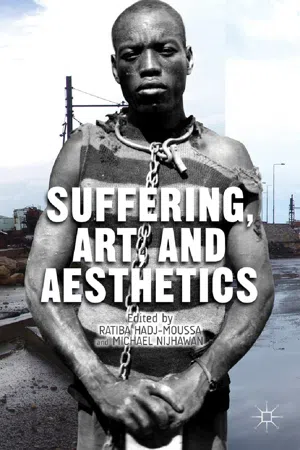
Suffering, Art, and Aesthetics
About this book
How do we conceptualize the relationship between suffering, art, and aesthetics from within the broader framework of social, cultural, and political thought today? This book brings together a range of intellectuals from the social sciences and humanities to speak to theoretical debates around the questions of suffering in art and suffering and art.
Information
Topic
SozialwissenschaftenSubtopic
Kunst AllgemeinCHAPTER 1

IN PRAISE OF AMBIGUITY: ON THE VISUAL ECONOMY OF DISTANT SUFFERING
Fuyuki Kurasawa
In the first part of his remarkable Histoire(s) du cinéma, Jean-Luc Godard comments that Second World War newsreels returned a certain lost dignity to filmmaking because their restrained realism did not make suffering into a star (Godard 1998, 121). Casting a glance back at that epoch, contemporary audiences cannot help but be struck—as Godard was—by the mutual dependence between the quaint visual timidity and the explosive iconographic power of these newsreels, which documented the horrors unfolding in Europe without falling into the pornographic excesses of much present-day representations of disasters from around the world. Today, suffering is nothing if not a star in visual material, but such stardom has been achieved at the cost of emptying the former condition of substance and effectiveness in the public sphere, by mediatizing it to the point of overexposure and clichéd banality. How, then, are we going to counter the further conversion of suffering into spectacle, so that images of grave crises occurring in the global South can retain—or perhaps acquire in the first place—a political and normative capacity to inform citizens and mobilize public opinion? In other words, how can the visual representation of distant suffering be incorporated into a critique of the existing world order, rather than becoming trivial objects or simple commodities?
In order to try to respond to this problem, this chapter is organized in three parts. It begins by proposing an analytical model of what I term the visual economy of distant suffering, which includes both an iconographic dimension (the symbolic structure of the image) and its institutional counterpart (the networks of circulation of the image). After discussing the perils of saturation and spectacularization that plague the reception of visual material about distant suffering in our age, the second part of the chapter considers the potential of visual ambiguity to interrupt these common processes and thereby act as a catalyst for different forms of engagement with images. However, since ambiguity is incomplete and politically indeterminate in itself, the last section examines two interpretive practices of the visual, phenomenological intensification and structuralist expansion, which can sustain critical reflection on the experience of distant suffering and its systemic causes.
Before moving on, a few terminological specifications should be put forth. Throughout the chapter, I employ the notion of a “visual economy” (Poole 1997, 8–11) to designate the distribution and circulation of relations of power that produce and organize a specific socio-visual field, resulting in a historically established system of representational conventions and typifications consistently reproduced in images of similar events or situations. A visual economy is composed of two mutually constitutive dimensions, the iconographic and the institutional.1 In the first instance, an economy of visuality includes an ensemble of iconographic tropes and patterns that configure images and frame their interpretation, a sociopolitically constructed symbolic structure that accounts for representations’ indexical qualities and generates their range of meanings. Second, this iconography functions within a visual economy’s institutional aspect, which designates the networks of social actors and organizations through which images circulate, in both their production and reception. In analytical terms, the dual nature of an economy of visuality signifies that neither iconographic nor institutional dimension determines the other, but, just as importantly, that neither operates independently of the other nor can be understood apart from the other. Succinctly put, the symbolic structure of images affects how, where, and to what extent they circulate, while their circulation affects how producers aim to create a symbolic structure and viewers make sense of the latter.2 Another phrase used in this chapter is “distant suffering,” which refers to instances of mass and extreme situational and structural violence perpetrated outside of the North Atlantic region (or at least involving non-Euro-American subjects) and visually represented via the media; it includes various humanitarian crises in the global South, from genocides and famines to chronic poverty and epidemics (Boltanski 1993). Accordingly, the set of representational tropes and institutional relations that constitute and supply meaning to images of humanitarian crises can be termed the visual economy of distant suffering.
UNPACKING THE VISUAL ECONOMY OF DISTANT SUFFERING
While it would be well beyond the scope and purpose of this chapter to provide a detailed history of how suffering has been portrayed in Euro-American art, there is little doubt that contemporary images of distant suffering in the Western media extensively and freely draw upon a representational template composed of visual tropes created and reproduced over the course of centuries. Among the best-known epochal landmarks in this respect would be ancient Greek and Roman sculpture, Byzantine iconic painting, as well as the visual arts of the Northwestern European Renaissance, all of which concentrate on representing the suffering of divine, noble, or heroic beings. In particular, depictions of what are designated in Christianity as the “stations of the cross” and “the passion of Christ”—the final stages of Jesus’ life and, most importantly for our purposes, the moment of his crucifixion and that of his dead body’s removal from the cross—have produced symbolic typifications that recur in the visual economy of distant suffering to this day.3 Perhaps the most influential of these icons is La Pietà (the scene of Mary cradling Jesus’s dead body),4 whose visual conventions continue to impact how images of suffering, whether distant or proximate, are produced and received in our age. Indeed, the Pietà’s symbolic structure is repeated in numerous salient photographs from the past few decades: a 1992 Benetton advertising campaign that used an image of David Kirby, a US AIDS activist, on his deathbed surrounded by family members5; a photograph of Oum Saâd, a woman in the throes of anguish in the aftermath of a massacre of civilians in Bentalha, Algeria, on September 23, 1997 (designated as the “Algerian Madonna” or the “Madonna of Bentalha” by the Euro- American press);6 a September 11, 2001, picture of Mychal Judge, a Catholic priest whose lifeless body is being carried out of the World Trade Center in New York City by emergency responders (which has been dubbed an “American Pietà”); and an image by the celebrated photojournalist James Nachtwey of a young man being tended to by an older woman in Darfur, Sudan, during the genocide, which was published on the cover of the October 4, 2004, issue of Time magazine. The striking resemblances between these four photographs are not simply coincidental or a matter of elective affinity between them. On the contrary, the Pietà and other foundational icons of suffering possess an indexical quality inscribed in the visual tropes and formal conventions that they contain, a symbolic repertoire that functions at two levels of the circulation of images: producers of the latter (such as photojournalists, documentary filmmakers, and photo or film editors) consistently draw upon this repertoire when capturing or framing humanitarian crises, and audiences refer to it when viewing such images because it provides them with a set of familiar symbols with which to help make sense of what and who is being represented.7
Returning to a point made above, then, the visual economy of distant suffering is comprised of an iconographic dimension, a symbolic structure that includes situational components (the roles of subjects and functions of objects in relation to the situation or event being represented), as well as formal, compositional elements (the positions of subjects in the frame and in relation to each other). This can best be summarized through Figure 1.1.
Beginning at the center of the figure, images of distant suffering represent and contribute to the sociopolitical constitution of a specific situation or event designated as a humanitarian crisis, which is itself contextualized and given form through an iconography of suffering freely and selectively referencing symbolic motifs in the history of Western visuality (e.g., La Pietà or the Holocaust) and recognized visual conventions of a large-scale disaster (mounds of dead bodies, destroyed buildings, an arid landscape, etc.). Such representations depict subjects ascribed certain positions and playing distinct roles that visually construct an emergency situation. Foremost among these are “victims” (whether dead or surviving, and, more often than not, symbolically racialized and gendered figures), who are indispensable components of this visual economy; without them, such a crisis is unrepresented because invisible in Euro-American public spheres while becoming unrepresentable because lacking a conventional iconographic structure. While not necessarily present in, and thus less significant to, this iconographic structure—which is why Figure 1.1 includes them in parentheses—other positions and roles exist in images of distant suffering: perpetrators of situational or structural violence are sometimes portrayed, as are emergency aid workers (especially in the case of photographs or video footage produced and/or used by Western nongovernmental organizations), victims’ kin or friends, and “third-party” bystanders. I have also incorporated eyewitnesses who produce images of distant suffering (such as photojournalists and documentary filmmakers) into the figure, for while they are not necessarily visible in the frame, subjects cannot but be reflexive about being filmed or photographed in an age where visual recording devices have become ubiquitous globally. Perpetrators of forms of mass violence, for instance, may want to avoid being caught in the act or, alternatively, may view this possibility—and the attendant publicizing of their cause globally—as a catalyst to carry out atrocities; the camera’s presence is a major representational factor. Hence, we should consider those who visually depict scenes of distant suffering as integral to these images’ symbolic structure rather than outside of or peripheral to it.

Figure 1.1 The symbolic structure of the image (Kurasawa)
Continuing with Figure 1.1, the roles represented in the image are linked to each other and to the situation or event via a vast field of symbols, which take the form of visual metaphors or metonyms (figuration and shape of bodies, facial expressions, clothing, objects, etc.). As previously suggested, two kinds of symbols exist: situational symbols (S1–S4) construct meaning by indicating social actors’ contrasting relationships to the humanitarian crisis being portrayed (including the natural or human-built environment), whereas compositional symbols (S5–S7) produce meaning by suggesting the contrasting positions and roles of these actors in relation to one another (so that a particular position or role is attributed in opposition to all the others in the image). The relations between situational and compositional symbols, as well as among those of the same kind, undergird the symbolic structure of visual representations of distant suffering. In addition, this structure is what explains how and why viewers of images associate subjects with specific roles, as the situational and compositional symbols relate these subjects to the situation or event and the other actors portrayed in the visual frame. We can thus speak of visual typifications for each role, which contains a set of conventions that, given their centrality to the humanitarian imaginary, tend to be consistently present: “victims” are depicted as powerless, innocent, and afflicted by physical, mental, and/or emotional pain; aid workers are depicted as compassionate or heroically assiduous in their rescue efforts; and so on. What results, then, on the part of producers and audiences alike, is a phenomenon akin to typecasting for cinematic actors, given that particular symbols are exclusively associated with certain roles and that representational clichés proliferate. Visual subjects must conform to established types in order to be recognized in specific roles, and going against type becomes impossible.8
To qualify what might appear as the rigidly structuralist stance of this iconographic model, I want to make three remarks about it. In the first instance, the model is intended to be diachronic rather than synchronic, since it integrates possible transformations in the image’s symbolic structure over time as new components are added and existing ones are either modified or disappears. Second, the model is based on a principle of similarity or general correspondence instead of identity among cases. Not all elements of Figure 1.1 are present in every image of distant suffering—which is why some components are placed in parentheses—and some variations across cases occur. Nevertheless, the core symbolic structure (which consists of the event or situation, “victims,” the iconography of suffering, the sociocultural or natural environment, and the situational and compositional symbols) is found in virtually all visual representations of humanitarian crises. Third, unlike structuralist strands of semiotics, I do not believe that this symbolic structure reveals a single, buried code to be unearthed and deciphered. Instead, the model proposed here is grounded in hermeneutically based practices of visual sense-making and thereby underline the multiplicity of possible interpretations of an image as well as its inherently contested meaning.
Although less significant for this chapter, the institutional dimension of the visual economy of distant suffering can be explained via Figure 1.2:

Figure 1.2 The circulation of the image (Kurasawa)
From the outset, I want to note that the organizational networks of circulation of the image are growing ever tighter and increasingly intertwined, to the extent that the distinctions between the three levels noted here are much more heuristic than temporal in nature. That is to say that, in the era of live, instantaneous broadcasts of still or moving images via smartphones and webcams with wireless Internet, little or no delay exists between the moment of occurrence of a humanitarian crisis, its representation by various parties, and its reception by audiences around the world. If, for analytical purposes, we begin from the bottom of the figure, the first level (that of the event or situation itself) requires little explanation in light of its correspondence to the actors described in the previous figure. The institutional aspects of the intermediate level of the image’s circulation, that of the representation of the event or situation, warrant mention because of their indispensable role in the diffusion of visual depictions of moments of distant suffering beyond the place where they occurred. Whether through print, televised, or electronic coverage of humanitarian crises, media organizations are obvious actors in this respect. Yet, increasingly, such depictions are also entering public spheres through the work of carrier groups in global civil society, notably nongovernmental organizations lending assistance to survivors of a large-scale disaster and social movements supporting these survivors and advocating on their behalf. Carrier groups directly represent a humanitarian crisis to audiences by broadcasting images of it via their own publications and websites,9 and they do so indirectly, shaping media portrayals of such a crisis by providing television reporters, documentary filmmakers, and photojournalists with their own footage and photographs or with access to the sites where the operate (such as refugee camps and feeding centers). Finally, the reception of images completes the circuit of circulation, as representational actors aim to disseminate their visual material to informal audiences (groups and persons in national and global civil societies as well as citizens in public spheres) and their formal, officially recognized counterparts (national governments and international organizations).
According to the framework proposed here, reception cannot be reduced to a process whereby these audiences passively view images of distant suffering transmitted to them by the media or carrier groups, nor is it akin to the task of deciphering whatever single semiotic code these images are supposed to contain. Instead, seeing these images consists of a complex, multilayered set of practices of visual interpretation that audiences perform. As I have already noted, the latter give an image meaning by working to make sense of, and being influenced by, its formal symbolic structure—including the historical iconography of suffering. At the same time, viewers’ perceptions of represented situations and subjects are far from being determined by this symbolic structure, since their interpretive practices are equally shaped by their lifeworlds (notably their past experiences and value systems) as well as by the sociocultural characteristics of the groups to which they belong (gender, nationality, class, age, etc.). Moreover, fundamentally, visual material about an instance of distant suffering can only have significance for audiences—and thus mean something to them—if a process of “symbolic extension” (Alexander 2003, 59) takes place, whereby they come to identify with the victims being portrayed (through partial transposition) or, minimally, experience a sense of empathy for them (through the triggering of the moral imagination). In visual terms, this kind of extension is made possible by the functioning of symbolic substitution, that is to say the extent to which different audie...
Table of contents
- Cover
- Title Page
- Copyright
- Contents
- List of Figures
- Acknowledgments
- Introduction: Suffering in Arts: Rethinking the Boundaries
- 1. In Praise of Ambiguity: On the Visual Economy of Distant Suffering
- 2. Denial and Challenge of Modernity: Suffering, Recognition, and Dignity in Photographs by Sammy Baloji
- 3. Event, Image, Affect: The Tsunami in the Folk Art of Bengal
- 4. Vocalizations of Suffering
- 5. The Art of Suffering: Postcolonial (Mis)Apprehensions of Nigerian Art
- 6. The Past’s Suffering and the Body’s Suffering: Algerian Cinema and the Challenge of Experience
- 7. The Diasporic Rasa of Suffering: Notes on the Aesthetics of Image and Sound in Indo-Caribbean and Sikh Popular Art
- 8. The Art of Inflicting Suffering: Animals and Spectators in the Crucible of Contemporary Art
- Notes on Contributors
- Index
Trusted by 375,005 students
Access to over 1.5 million titles for a fair monthly price.
Study more efficiently using our study tools.
Frequently asked questions
Yes, you can cancel anytime from the Subscription tab in your account settings on the Perlego website. Your subscription will stay active until the end of your current billing period. Learn how to cancel your subscription
No, books cannot be downloaded as external files, such as PDFs, for use outside of Perlego. However, you can download books within the Perlego app for offline reading on mobile or tablet. Learn how to download books offline
Perlego offers two plans: Essential and Complete
- Essential is ideal for learners and professionals who enjoy exploring a wide range of subjects. Access the Essential Library with 800,000+ trusted titles and best-sellers across business, personal growth, and the humanities. Includes unlimited reading time and Standard Read Aloud voice.
- Complete: Perfect for advanced learners and researchers needing full, unrestricted access. Unlock 1.5M+ books across hundreds of subjects, including academic and specialized titles. The Complete Plan also includes advanced features like Premium Read Aloud and Research Assistant.
We are an online textbook subscription service, where you can get access to an entire online library for less than the price of a single book per month. With over 1.5 million books across 990+ topics, we’ve got you covered! Learn about our mission
Look out for the read-aloud symbol on your next book to see if you can listen to it. The read-aloud tool reads text aloud for you, highlighting the text as it is being read. You can pause it, speed it up and slow it down. Learn more about Read Aloud
Yes! You can use the Perlego app on both iOS and Android devices to read anytime, anywhere — even offline. Perfect for commutes or when you’re on the go.
Please note we cannot support devices running on iOS 13 and Android 7 or earlier. Learn more about using the app
Please note we cannot support devices running on iOS 13 and Android 7 or earlier. Learn more about using the app
Yes, you can access Suffering, Art, and Aesthetics by R. Hadj-Moussa, M. Nijhawan, R. Hadj-Moussa,M. Nijhawan in PDF and/or ePUB format, as well as other popular books in Sozialwissenschaften & Kunst Allgemein. We have over 1.5 million books available in our catalogue for you to explore.