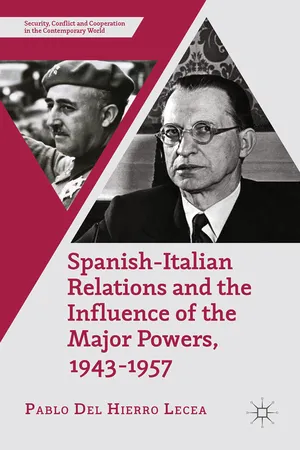
Spanish-Italian Relations and the Influence of the Major Powers examines complex relations between Spain and Italy, beginning in 1943 and continuing until 1957, contending that the relationship cannot be examined in isolation and must be understood in its broader context.
eBook - ePub
Spanish-Italian Relations and the Influence of the Major Powers, 1943-1957
- English
- ePUB (mobile friendly)
- Available on iOS & Android
eBook - ePub
Spanish-Italian Relations and the Influence of the Major Powers, 1943-1957
About this book
Information
1
A Question of Pragmatism: Spanish-Italian Relations after the Collapse of the Mussolini Regime, 1943–1945
On 15 November 1944, the Spanish Association of the Press organized a banquet in Madrid to celebrate the 15th edition of the book Italia fuera de combate, written by Ismael Herráiz, the correspondent in Rome for the Fascist newspaper Arriba! since the spring of 1942. In it, the Spanish journalist narrated the events which took place in Italy during the summer of 1943, from the fall of Mussolini on 24 July, until the signing of the armistice with the Allies on 8 September, but he did it with a very critical tone. According to Herráiz, in fact, the delicate international situation in which the country had been left was caused by the cowardice and the incompetence of the Italian people and the political class, including the monarchy, Marshall Pietro Badoglio and the military elite. The only figure that was somehow exonerated in this diatribe was Mussolini, ‘a man who has managed to earn the love and the recognition of the Spanish people’.1 Even though the Spanish Ministry of Foreign Affairs tried to distance itself from the celebration of such a pamphlet, the banquet turned into a big social event also thanks to the presence of some of the most prominent figures inside the Francoist regime, including the Vice President of the Parliament, José María Alfaro, and the Undersecretary of Education, Gabriel Arias Salgado.2
Evidently, the magnitude of the banquet and the permissive attitude displayed by some members of the Spanish Government towards it provoked angry reactions from the authorities of the Kingdom of Italy who believed that this kind of event reflected the ‘real attitude – from an ideological perspective – of Franco’s Spain towards the new Italy’.3 However, and despite this unfriendly gesture, the government now headed by Ivanoe Bonomi decided not to modify its policy towards the Francoist regime whose main goal remained the normalization of diplomatic relations. In fact, only one day after the banquet in honour of Herráiz, the Italian Undersecretary of Foreign Affairs, Giovanni Visconti Venosta, again requested the Spanish Ambassador to the Vatican, Domingo de las Bárcenas, to rapidly appoint a new ambassador in Rome, a position that had remained vacant since the summer of 1943.4
This anecdote is very meaningful and reflects perfectly the evolution of Spanish-Italian relations between the fall of the Mussolini regime and the end of the Second World War. On the one hand, the RSI and the Kingdom of Italy endeavoured to maintain friendly diplomatic relations with the Francoist regime. On the other hand, the Spanish authorities rejected these approaches in an attempt to maintain a balanced policy not only towards the two ‘Italies’, but also towards the Axis and the Allies. This attitude raises a number of questions and perplexities. In fact, it might appear as paradoxical for the Kingdom of Italy to try to normalize diplomatic relations with the Francoist regime when it was struggling to leave behind its fascist past as quickly as possible. At the same time, the Spanish decision to adopt a balanced policy towards both the Kingdom of Italy and the RSI might appear as illogical if one considers the evolution of the Second World War. The main objective of this chapter will thus be to address these questions and explain the motivations behind the main actors involved. In order to do so, the present chapter will analyse two crucial events in Spanish-Italian relations during this period: the struggle between the Italian Kingdom and the RSI for official recognition by the Spanish Government, and secondly the question of the Italian fleet that was interned in Spanish ports from September 1943.
Through the analysis of these two events, this chapter will contribute to understanding the impact of the fall of the Mussolini regime on the Francoist foreign policy towards the two ‘Italies’ by showing that the latter was mainly not determined by ideological factors, as historiography has traditionally propounded, but by material issues which were mostly related with the evolution of the Second World War.5 Secondly, it will show that the Kingdom of Italy needed to improve relations with Franco’s regime also for pragmatic reasons: to recover part of their lost sovereignty, to alleviate the catastrophic situation of its economy, and to protect its great number of interests (economic, social and cultural) present in Spain. Thirdly, it will contribute to assessing the room for manoeuvre held by the Spanish and Italian Governments and to understanding the role played by the Allies in bilateral relations after the armistice. In this regard, this chapter will contend that both Britain and the United States formed a common front to deal with Spanish and Italian affairs, which proved to be crucial in the evolution of bilateral relations during this period. Finally, this chapter will also contribute to the existing historiographical debates about hegemony in Europe and Anglo-American relations after the Second World War. In this sense, these pages will postulate that Britain endeavoured to maintain its hegemony in the south of Europe during the last years of the war. However, this became problematic from the beginning of 1944, the moment in which the US Government started to adopt increasingly independent policies towards Spain and Italy that clashed with British interests in the zone.6
The impossible choice: the Allies, Germany and Spanish Policy towards the two ‘Italies’
The collapse of the Mussolini regime: a turning point in Spanish foreign policy?
In 1985, Javier Tusell and Genoveva García published their book Franco y Mussolini: La política española durante la segunda guerra mundial, where they argued that the collapse of the Mussolini regime had had an enormous impact on the Francoist regime, to the extent of radically modifying Spanish foreign policy.7 Ever since, this interpretation has been followed and incorporated by the vast majority of historians working on Spain during the Second World War.8
However, the analysis of the Spanish documentation shows that the impact of Mussolini’s fall in Spain should be downplayed and, as a result of this, that Tusell and García’s interpretation should be reviewed. In this case, what was the real impact of the collapse of the Mussolini regime in Spain? In order to answer to this question, it is necessary to analyse the initial Spanish reactions to the events in Italy during the summer of 1943.
In the first place, the Spanish authorities tried to collect all possible information through their embassies in the Vatican and the ‘Quirinale’. Obviously, this was a normal reaction, considering that relations between Italy and the Francoist regime had been very close since Mussolini’s intervention in favour of Franco’s armies during the Spanish Civil War. On the morning of 25 July, the day on which Mussolini was officially removed, General Gastone Gambara, an Italian general during the Spanish Civil War and the Second World War, informed the Spanish Ambassador, Raimundo Fernández Cuesta, of the events that would take place that very day in the ‘Gran Consiglio Fascista’. It should be remembered that by 1943 Mussolini had lost the support of the Italian population given the disastrous results of the war effort that he had led and which culminated in July 1943 with the invasion of Sicily by the Allies. The gravity of the situation led King Vittorio Emmanuele III, and even some members of the Fascist party to support Mussolini’s removal. The first stage of his ousting took place precisely when Gambara had announced it, during the Fascist party’s Grand Council. On 25 July, Vittorio Emmanuele III officially removed Mussolini from the post of Prime Minister and replaced him with Marshal Pietro Badoglio. Upon his forced resignation, Mussolini was immediately arrested. After the news of the arrest, many of Mussolini’s fellow Fascist leaders fled Rome. Italians and Germans alike remained silent as the new Badoglio Government proclaimed that the war would continue. Even with this proclamation, many Italians began to cheer the ousting of Mussolini.9
The day after these events, Fernández Cuesta telegraphed the Spanish authorities three times in order to report all the news concerning the political situation. On 27 July, the Spanish Ambassador even met the person who was behind the fall of Mussolini and who had become one of the most important figures of the moment, Dino Grandi. The Italian politician tried to transmit a positive image of the change, insisting that it was not a coup d’état but a constitutional movement necessary for the country at that juncture, and he asked Ambassador Fernández to transmit these impressions to Madrid.10 From this moment on, the Spanish Ambassadors to the Vatican and to the ‘Quirinale’ sent regular telegrams updating Madrid on the evolution of the Italian political situation: it was clear that the Spanish authorities were very interested in the Italian events and put an emphasis on being very well informed.11 It is important to explain that most of this information that was collected by the Spanish diplomats during the summer of 1943 came from Dino Grandi himself. In fact, the Italian fascist became in that period a type of unofficial informant to the Spanish Embassy, owing to his political predominance after the arrest of Mussolini and also thanks to his friendship with Ambassador Fernández, with whom he had substantial political affinities.12 Eventually, these Spanish contacts would become very useful for Grandi; when the Salò Government was constituted and he was sentenced to death in absentia on 8 January 1944, Grandi managed to escape the RSI and take refuge in Spain, just like many other Italian fascists during the last years of the Second World War.13
During the frequent encounters which the two Spanish Ambassadors held with Grandi and other Italian authorities in this frantic period of diplomatic activity, the latter always tried to present an image of normality: the substitution of Mussolini did not necessarily imply Italy’s exit from the war or the alteration of bilateral relations with Franco’s regime. Italy was still the same reliable ally that it had been since its intervention in the Spanish Civil War.14
In spite of the Italian assurances, the Spanish authorities reacted with the utmost caution. Officially, the Spanish Government recognized and accepted the new political situation in Italy.15 Howe...
Table of contents
- Cover
- Title
- Copyright
- Dedication
- Contents
- List of Figures and Tables
- Acknowledgements
- List of Abbreviations
- Introduction
- 1 A Question of Pragmatism: Spanish-Italian Relations after the Collapse of the Mussolini Regime, 1943–1945
- 2 Allies in the Post-war Era? Spanish-Italian Relations and the Major Powers, 1945–1947
- 3 Towards the Cold War: Spanish-Italian Relations and the Rising Tensions between the Western Allies and the Soviet Union
- 4 1949: A Year of Important Approaches
- 5 A ‘Flirt’ between Madrid and Rome: The Spanish-Italian Rapprochement and the Role of the Western Powers, 1951–1955
- 6 The Limits of Rapprochement: In Search of Political Cooperation, 1955–1957
- Conclusions
- Bibliography
- Index
Trusted by 375,005 students
Access to over 1.5 million titles for a fair monthly price.
Study more efficiently using our study tools.
Frequently asked questions
Yes, you can cancel anytime from the Subscription tab in your account settings on the Perlego website. Your subscription will stay active until the end of your current billing period. Learn how to cancel your subscription
No, books cannot be downloaded as external files, such as PDFs, for use outside of Perlego. However, you can download books within the Perlego app for offline reading on mobile or tablet. Learn how to download books offline
Perlego offers two plans: Essential and Complete
- Essential is ideal for learners and professionals who enjoy exploring a wide range of subjects. Access the Essential Library with 800,000+ trusted titles and best-sellers across business, personal growth, and the humanities. Includes unlimited reading time and Standard Read Aloud voice.
- Complete: Perfect for advanced learners and researchers needing full, unrestricted access. Unlock 1.5M+ books across hundreds of subjects, including academic and specialized titles. The Complete Plan also includes advanced features like Premium Read Aloud and Research Assistant.
We are an online textbook subscription service, where you can get access to an entire online library for less than the price of a single book per month. With over 1.5 million books across 990+ topics, we’ve got you covered! Learn about our mission
Look out for the read-aloud symbol on your next book to see if you can listen to it. The read-aloud tool reads text aloud for you, highlighting the text as it is being read. You can pause it, speed it up and slow it down. Learn more about Read Aloud
Yes! You can use the Perlego app on both iOS and Android devices to read anytime, anywhere — even offline. Perfect for commutes or when you’re on the go.
Please note we cannot support devices running on iOS 13 and Android 7 or earlier. Learn more about using the app
Please note we cannot support devices running on iOS 13 and Android 7 or earlier. Learn more about using the app
Yes, you can access Spanish-Italian Relations and the Influence of the Major Powers, 1943-1957 by Kenneth A. Loparo,Pablo Del Hierro Lecea in PDF and/or ePUB format, as well as other popular books in History & European History. We have over 1.5 million books available in our catalogue for you to explore.