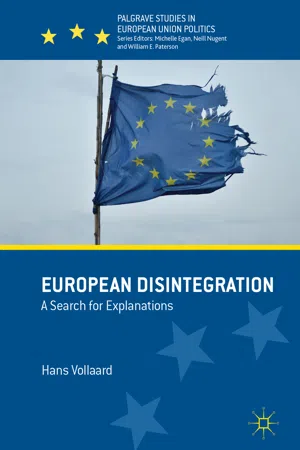
This book accounts for whether and how the path of the European Union (EU) has developed towards potential disintegration. These questions have become particularly relevant since the outbreak of the debt crises in the Eurozone and the Brexit referendum. The author critically subverts theories of European integration and analyses the rise and fall of federations, empires and states in a comparative perspective. The most promising theory presented here indicates that Brexit is not likely to be followed by other member states leaving the EU. Nevertheless, the EU has been undermined from within as it cannot adequately address Eurosceptic dissatisfaction from both the left and right. This book is an essential read for everyone interested in the EU and its future.
- English
- ePUB (mobile friendly)
- Available on iOS & Android
eBook - ePub
About this book
Information
© The Author(s) 2018
Hans VollaardEuropean DisintegrationPalgrave Studies in European Union Politicshttps://doi.org/10.1057/978-1-137-41465-6_11. Introduction
Hans Vollaard1
(1)
Utrecht University, Utrecht, The Netherlands
Keywords
European disintegrationTheorising European disintegration1.1 The Need for Explanations of European Disintegration
How far in advance would you really be able to tell that the European Union (EU) is disintegrating or has disintegrated? Would you actually be aware of European disintegration if it were to occur? Is it just a matter of formally dissolving the EU or is it a process that is out of the control of decision-makers? What should you look for as an indication of the current state of European (dis)integration at this moment? And which factors do you think are fundamental to explaining the present and future course of European (dis)integration? These are crucial questions for any political observer of EU politics, whether they work as a risk manager, a journalist, a policy strategist, or a political scientist. These questions have become particularly relevant since the outbreak of the debt crises in the Eurozone and the Brexit referendum. The scenario of European disintegration has featured prominently in public debates, but confusion about the fate of the EU and the process of European integration more generally abounds. Some argued that the expulsion of Greece , for example, would have strengthened the Eurozone, as it would limit the economic disparities within the European monetary union and as such the need for financial transfers between member states reluctant to share. Others contended that a possible Grexit would precipitate the departure of other member states from the Eurozone due the pressure of the financial markets betting on further exits. Some perceived the rescue of the Euro as essential to maintaining the political underpinnings of the entire process of European integration. Others advocated the dissolution of the Economic and Monetary Union (EMU), as the solution required to preserve the Euro—a sizeable EU budget, EU taxes, and EU transfers—would only fuel the Eurosceptic call for the dissolution of the entire EU. Some have thought of the debt crises as just part of a series of recurring crises in the process of European integration, whereas others have considered it to be a fundamental crisis of European integration.
Contradictory analyses of the state of the EU and European integration more generally have also cropped up in other discussions. Will the end of British EU membership allow the EU to act more coherently in light of less disagreement on issues such as the Euro, social policy, Schengen, and foreign policy? Or would a Brexit cripple the EU’s influence in international politics, making membership less attractive to present and future member states? And do the attempts to constrain so-called “welfare tourism” help to maintain support for the EU within the Eurosceptic parts of the population, or do they constitute a step towards the end of the free movement of persons in the internal market, a fundamental element of the European integration process thus far? Is the rise of Euroscepticism at the level of the European Parliament and some national parliaments a sign of the end of the EU or of the growing involvement of even anti-system parties and citizens in EU politics? Is a stronger EU essential to the process of European integration, or can it do without (Zielonka, 2014)? Scenarios of the EU’s future range from full-scale federalisation, a stronger core Europe with some exits, muddling through with the present EU’s institutions, a combination of the EU becoming paralysed, neglected, and obsolete, to its complete collapse (see, for instance, European Commission, 2017; King Baudouin Foundation et al., 2013; Krastev, 2012; Rabobank, 2017). Confusion and contradictions are thus rife in perspectives on the course of European (dis)integration.
Academic analysis can help us to move beyond the cursory reflections of the day. It enables us to make explicit the various ways of thinking about European disintegration, and it can offer us a better understanding of the definition, indicators, factors, mechanisms, outcome and likelihood of European disintegration. First and foremost, academic analysis helps us to make sense of political dynamics by being selective. Theories are an important tool in this respect. They structure our observations of phenomena like European disintegration, order existing knowledge and steer our attention, sensitise us to the structural dynamics below the surface of daily events reported in the media, raise research questions for subsequent inquiry, executed in a systematic, coherent, consistent, and thorough manner (Peters, 1998, p. 110; Rosamond, 2000, p. 4, 9). In this way, theories could help us to recognise and explain European disintegration in a more orderly fashion, showing us what choices can be made more and less easily (cf. Peters, Pierre, & Stoker, 2010). To be sure, theories may be proven wrong. It is, therefore, important to present theories in the form of testable statements to see whether they hold up to empirical evidence. This book adopts an explanatory approach, and will not discuss whether or not political developments like European disintegration are a good or a bad thing.
Given the confusion in the public debate on European disintegration, now is the right time to seek academic reflection on the subject. So, which theories are currently available to explain European disintegration? At first glance, there are next to none, even in the field of EU studies (Eppler & Scheller, 2013a; Glencross, 2009, p. 2; Jones, 2016; Webber, 2013; Zielonka, 2014). Theories of regional integration or more specifically of European integration have largely focused on just that: integration, not disintegration. A variety of recent challenges to European integration have certainly been studied, but they have not provided an explanation of European disintegration either. Analyses of Euroscepticism have primarily discussed its definition and origins, rather than its disintegrative potential (Brack & Startin, 2015, p. 241; Leconte, 2010). Enlargement studies have explored the relationship between widening and deepening as well as the impact of European integration on candidate and new member states. Thorough reflection on the EU’s overstretched absorption capacity has been limited, however (though see Delhey, 2007; Toshkov, 2017; Vobruba, 2003). And even though enlargement has led to a profound examination of differentiated integration, it only refers to a situation in which not all member states join in in future efforts to forward the process of European integration, not how enlargement could instead lead to less integration (see, e.g., Leuffen, Rittberger, & Schimmelfennig, 2012). Many analyses have also been executed on the financial, legitimacy, monetary, economic, and refugee crises the EU experienced. They yet rather explored the impact of these crises on policies, policy-making process, institutional relations, citizens’ opinions and identities, and divisions between and within member states than the very existence of the EU (Falkner, 2016; Fossum & Menéndez, 2014; Rittberger & Schimmelfennig, 2015; Trenz, Ruzza, & Guiraudon, 2015).
EU studies, or the study of international relations, comparative politics, political history, and political economy more generally, may be excused for their limited attention to European disintegration given the fact that European integration has always increased in terms of institutions, competences, policy areas, and legislative output. It has also continuously widened its geographical scope, with the exception of Algerian departments of France (1962) following Algeria’s independence in 1962, Greenland (1985) after it obtained home rule from Denmark , and the island of Saint Barthélemy (2012) in the aftermath of its secession from the French overseas department of Guadeloupe. Continuous integration has even been the case in the context of the Eurozone crisis: the EU has gained more say in national economic policies and Croatia joined in 2013 as the union’s 28th member state. Problematic, however, is the fact that most present-day EU theories would likely fail to recognise disintegration if it were occurring because they have shifted their focus from grand-theorising the transformation of the entire EU system towards exploring bits and pieces of EU governance, and the impact of European integration on EU member states (Taylor, 2008, p. 109). Thus, students of the EU have lost sight of the big picture in the context of (dis)integration. And what cannot be properly recognised and described cannot be properly explained.
1.2 The Search for an Explanation of European Disintegration
One of the few publications with the explicit goal of conceptualising European disintegration is therefore a most welcome contribution (Eppler & Scheller, 2013b). The authors emphasise the multi-dimensional nature of European (dis)integration, from its economic, institutional, and territorial aspects, to socio-cultura...
Table of contents
- Cover
- Front Matter
- 1. Introduction
- 2. Neo-functionalism and European Disintegration
- 3. Realism, Intergovernmentalism, and European Disintegration
- 4. Federalism and European Disintegration
- 5. Comparative Imperialism and European Disintegration
- 6. Towards a Proper Explanation of European Disintegration
- 7. How European Integration Started Despite Ever-Present Disintegrative Forces
- 8. How European Integration Has Continued, Despite the EU’s Limited Locking-in Capacity
- 9. The External De-consolidation of Member States Increases Dissatisfaction with the EU
- 10. Disintegration or Not?
- Back Matter
Trusted by 375,005 students
Access to over 1.5 million titles for a fair monthly price.
Study more efficiently using our study tools.
Frequently asked questions
Yes, you can cancel anytime from the Subscription tab in your account settings on the Perlego website. Your subscription will stay active until the end of your current billing period. Learn how to cancel your subscription
No, books cannot be downloaded as external files, such as PDFs, for use outside of Perlego. However, you can download books within the Perlego app for offline reading on mobile or tablet. Learn how to download books offline
Perlego offers two plans: Essential and Complete
- Essential is ideal for learners and professionals who enjoy exploring a wide range of subjects. Access the Essential Library with 800,000+ trusted titles and best-sellers across business, personal growth, and the humanities. Includes unlimited reading time and Standard Read Aloud voice.
- Complete: Perfect for advanced learners and researchers needing full, unrestricted access. Unlock 1.5M+ books across hundreds of subjects, including academic and specialized titles. The Complete Plan also includes advanced features like Premium Read Aloud and Research Assistant.
We are an online textbook subscription service, where you can get access to an entire online library for less than the price of a single book per month. With over 1.5 million books across 990+ topics, we’ve got you covered! Learn about our mission
Look out for the read-aloud symbol on your next book to see if you can listen to it. The read-aloud tool reads text aloud for you, highlighting the text as it is being read. You can pause it, speed it up and slow it down. Learn more about Read Aloud
Yes! You can use the Perlego app on both iOS and Android devices to read anytime, anywhere — even offline. Perfect for commutes or when you’re on the go.
Please note we cannot support devices running on iOS 13 and Android 7 or earlier. Learn more about using the app
Please note we cannot support devices running on iOS 13 and Android 7 or earlier. Learn more about using the app
Yes, you can access European Disintegration by Hans Vollaard in PDF and/or ePUB format, as well as other popular books in Politics & International Relations & Comparative Politics. We have over 1.5 million books available in our catalogue for you to explore.