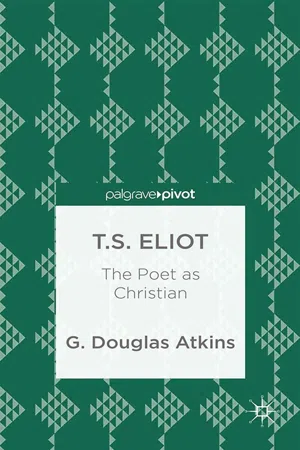
- English
- ePUB (mobile friendly)
- Available on iOS & Android
eBook - ePub
About this book
By comparing and contrasting the pre-conversion and the post-conversion poetics and poetic practices of T.S. Eliot, this book elucidates the responsibilities and opportunities for a poet who is also Christian. This book is the second in a trilogy which includes T.S. Eliot, Lancelot Andrewes, and the Word.
Information
Topic
Teologia e religioneSubtopic
Critica letteraria europea1
Toward “a full juice of meaning”: Eliot’s Christian Poetics in Practice
Abstract: Eliot’s poetics, being thoroughly Incarnational post-conversion to Anglo-Catholicism in 1927, center around words, their precise meaning, and their relation to one another. Eliot takes from Lancelot Andrewes the idea and necessity of “squeezing and squeezing a word until it yields a full juice of meaning which we should never have supposed any word to possess” and makes it the center of his own writing in verse. Before 1927 his poems are not made of such “squeezing and squeezing” of individual words. A change appears in Journey of the Magi (1927) and is fully developed in Ash-Wednesday: Six Poems (1930). What is perhaps merely inchoate early becomes fulfilled later, as the New Testament fulfills the Old, the Incarnation the pattern or structure named Incarnation.
Atkins, G. Douglas. T.S. Eliot: The Poet as Christian. New York. Palgrave Macmillan, 2014.
DOI: 10.1057/9781137444462.0003.
DOI: 10.1057/9781137444462.0003.
I
Words are the poet’s tools, and his medium—a most burdensome condition. Perhaps no recent poet has been more acutely conscious of—and responsive to—this situation than T.S. Eliot, and that in part because he was a trained philosopher as well as a wordsmith with a working knowledge of several languages and a commitment to writing in his blood.
The first poem of his masterpiece Four Quartets (1943) poignantly and powerfully represents the burden that words enact: under that burden, they “strain, / Crack and sometimes break”; under the entailed “tension,” they “slip, slide, perish, / Decay with imprecision, will not stay in place,” simply refusing to “stay still,” an ability that the speaker in Ash-Wednesday prays to have himself “even among these rocks.”1 The difficulty is, then, not just inherent in the nature of the tool, the medium; there is the additional liability that words suffer abuse in unscrupulous and irresponsible hands, with their “Shrieking voices / Scolding, mocking, or merely chattering,” but always “assail[ing] them.” Significantly, Eliot immediately moves from words to “the Word” and specifically that Word that is the God-man Jesus Christ “in the desert”: “most attacked by voices of temptation” (“Burnt Norton”).
In Ash-Wednesday: Six Poems (1930), Eliot represents dramatically the condition and the plight of words, by imitating, and parodying, the voice of an irresponsible and incapacious poet(aster), equally maladroit at diction, rhyme, meter, and management of the poetic line. The rhyme in the larger, ideational sense, referring to relation, analogy, and echo, may be on target, but the “verse” is sadly off the mark. “Where shall the word be found,” this second paragraph begins, “where will the word / Resound?” The response is that it will not be “here,” for here “there is not enough silence / Not on the sea or on the islands, not / On the mainland, in the desert or the rain land.” This is so “For those who walk in darkness / Both in the day time and in the night time.” It is simply that “The right time and the right place are not here / No place of grace for those who avoid the face / No time to rejoice for those who walk among noise and deny the voice.”
Eliot’s own poetic voice, point of view, and artistic difference emerge from the obvious comparison and contrast of this pathetic effort with the just-preceding verse paragraph. Ironically, it appears, at first blush, as verbal indulgence, jibberish, and pedantic philosophical or theological lucubration: “If the lost word is lost, if the spent word is spent, / If the unheard, unspoken / Word is unspoken, unheard, / Still is the unspoken word, the Word unheard.” The line endings here tell, and in the following verses the placement of the coordinate conjunction at both the beginning and the end of a line bears striking thematic value (as we shall soon see). The focus has become “the Word,” the Logos, that “Word without a word, the Word within / The world and for the world.” As a result of that incarnation, the Word works in and for the world, “And the light shone in darkness and / Against the Word the unstilled world still whirled / About the centre of the silent Word.”
“Sovegna vos,” Eliot had said in the previous poem: be mindful. Mindful and attentive, the reader immediately becomes aware of the meaningful play of “Word” and “word” and of the utter necessity to attend every word—to the point of squeezing and squeezing every word, for the words appear so ripe and full of meaning, this because of the far-from-indulgent repetitions, strategic placements, and judicious rhymes (in both the micro- and the macro-sense, as defined above and in play throughout this book). This is “the theology of the Word.”
The Word is, as I said, the incarnation of God in human flesh, fully one and fully the other: an “impossible union” (“The Dry Salvages”) reflected as well in the timeless now being in time, spirit in body, transcendence in immanence. As Eliot himself acknowledges in “The Dry Salvages,” this union is a mystery next to impossible for ordinary humans to comprehend; it has always proven so for students in my classes, and for readers of Eliot in general. Perhaps a pause here is thus in order to try to elucidate the central Christian dogma of the Incarnation.
* * *
As Davidson R. Morse has written, “The mystery of the Incarnation concerns how it could be that one person might be both divine and human at the same time, without confusion, yet without division.”2 In an essay on Pascal, Eliot writes of the stumbling block for some of “parthenogenesis”; add to that “the balance of emphasis between [Christ’s] two natures,” and the mystery is deep, indeed.3 It means, in any case, that, in Christ, “in time and for all time, Heaven and Earth are joined together, never to be divided.”4 As Eliot averred, the Incarnation is “of central importance” to Lancelot Andrewes, on whom Eliot so often drew, and it is, writes Barry Spurr in the authoritative study of the position that the poet identified as his, “the doctrine which inspired Anglo-Catholicism from the beginning.”5 Nearly a hundred years ago, Sheila Kaye-Smith identified the Incarnation as one of two “distinguishing marks” of the position: “the use and sanctification of matter by spirit, the inward working through the outward by virtue of the Incarnation of the Son of God; in other words, the Sacramental System.”6 Spurr thus concludes that the Incarnation was “central to Eliot’s Anglo-Catholic faith,” and Eliot wrote, in a 1937 essay, “I take for granted that Christian revelation is the only full revelation; and that the fullness of Christian revelation resides in the essential fact of the Incarnation, in relation to which all Christian revelation is to be understood.”7
Eliot’s poetics, post-conversion to “anglo-catholic” Christianity in 1927, revolve around (individual) words, their ripeness and fullness, and the poet’s effective use of their potency and the reader’s obligation to mirror the poet’s embrace and exploitation. Although it has not been adequately acknowledged in the published commentary, Eliot’s Christian poetics owe a significant debt to, and to a great extent derive from, his reading in Lancelot Andrewes, the eminent Divine (1555–1626), whom he rescued from relative oblivion with his 1928 volume For Lancelot Andrewes: Essays on Style and Order. The lead essay in that seminal collection reintroduces Bishop Andrewes, author of Preces Privatae, master sermon-maker to the Court, and head of one of the companies of translators who produced the King James Bible. In the course of a few pages, Eliot establishes Andrewes’s importance in both theology and literature, effectively comparing him with (“the more modern”) John Donne, and offering succinct, resonant, and charged analyses of Andrewes’s “style” that reflect an “order” in understanding with at least the potential for a poetics of both writing and reading.8
Eliot’s own analyses owe much to F.E. Brightman and his 1903 edition of Bishop Andrewes’s Private Prayers. The Modernist poet-critic quotes “in full” a paragraph of Canon Brightman’s admirable and acute commentary: “the structure is not merely an external scheme or framework,” a telling series of words bearing enormous implications. Eliot continues quoting, and his own procedures will mirror, we will see, those of the Divine:
Andrewes develops an idea he has in his mind: every line tells and adds something. He does not expatiate, but moves forward: if he repeats, it is because the repetition has a real force of expression; if he accumulates, each new word or phrase represents a new development, a substantive addition to what he is saying. He assimilates his material and advances by means of it. His quotation is not decoration or irrelevance, but the matter in which he expresses what he wants to say. His single thoughts are no doubt often suggested by the words he borrows, but the thoughts are made his own, and the constructive force, the fire that fuses them, is his own.9
Eliot proceeds to draw out the broad implications of Andrewes’s words. He writes, thus, in a brief but illuminating analysis cum comparison (“the tools of criticism,” he had said earlier in The Sacred Wood: Essays on Poetry and Criticism [1920]), in which it becomes increasingly hard to distinguish Andrewes’s way of writing and of reading.10 Both of them, if they are to be responsible, entail surrender of “personality,” a focus of such earlier essays as “Tradition and the Individual Talent”:
When Andrewes begins his sermon, from beginning to end you are sure that he is wholly in his subject, unaware of anything else, that his emotion grows as he penetrates more deeply into his subject, that he is finally “alone with the Alone”, with the mystery which he is seeking to grasp more and more firmly. . . . Andrewes’s emotion is purely contemplative; it is not personal, it is wholly evoked by the object of contemplation, to which it is adequate; his emotion wholly contained in and explained by its object. But with Donne there is always the something else. . . . Donne is a “personality” in a sense in which Andrewes is not: his sermons, one feels, are a “means of self-expression”. He is constantly finding an object which shall be adequate to his feelings; Andrewes is wholly absorbed in the object and therefore responds with the adequate emotion. (Italics added)11
As important and suggestive as this statement is, it pales beside the following, the last of Eliot’s elucidations of Lancelot Andrewes’s ways of writing and reading, which here appear as inseparable:
Bishop Andrewes . . . tried to confine himself in his sermons to the elucidation of what he considered as essential in dogma. . . . The Incarnation was to him an essential dogma, and we are able to compare seventeen developments of the same idea. Reading Andrewes on such a theme is like listening to a great Hellenist expounding a text of the Posterior Analytics: altering the punctuation, inserting or removing a comma or semi-colon to make an obscure passage suddenly luminous, dwelling on a single word, comparing its use in its nearer and in its most remote contexts, purifying a disturbed or cryptic lecture-note into lucid profundity. (Italics added, other than the translated Greek title)12
The crucial points that Eliot adumbrates include the goal of commentary as elucidation of texts, the bringing to light of what might well otherwise go unnoticed or under-appreciated, philological-like concentration on individual words, intensive comparisons of words in their repetitions and their contexts, thus a focus on even the seemingly most minute textual matters.
At this point, Eliot importantly veers from literary to cultural commentary, his move reflecting the strategy that the latter commentator would do well to follow, proceeding in, through, and by means of the former. The single sentence is uncharacteristically long, winding, convoluted. It attests, thereby, to the strength of Eliot’s feeling. We must always start ...
Table of contents
- Cover
- Title
- 1 Toward a full juice of meaning: Eliots Christian Poetics in Practice
- 2 The Present Unattended: The Love Song of J. Alfred Prufrock and The Waste Land
- 3 For thy closer contact: Gerontion, The Hollow Men, and Ash-Wednesday: Six Poems
- 4 On Turning and Not-Turning: Ash-Wednesday: Six Poems and A Song for Simeon
- 5 The Letter, the Body, and the Spirit: Animula and Ash-Wednesday: Six Poems
- 6 The Ecstasy of Assent (and Ascent): Marina, Triumphal March, and The Cultivation of Christmas Trees
- Bibliography
- Index
Trusted by 375,005 students
Access to over 1.5 million titles for a fair monthly price.
Study more efficiently using our study tools.
Frequently asked questions
Yes, you can cancel anytime from the Subscription tab in your account settings on the Perlego website. Your subscription will stay active until the end of your current billing period. Learn how to cancel your subscription
No, books cannot be downloaded as external files, such as PDFs, for use outside of Perlego. However, you can download books within the Perlego app for offline reading on mobile or tablet. Learn how to download books offline
Perlego offers two plans: Essential and Complete
- Essential is ideal for learners and professionals who enjoy exploring a wide range of subjects. Access the Essential Library with 800,000+ trusted titles and best-sellers across business, personal growth, and the humanities. Includes unlimited reading time and Standard Read Aloud voice.
- Complete: Perfect for advanced learners and researchers needing full, unrestricted access. Unlock 1.5M+ books across hundreds of subjects, including academic and specialized titles. The Complete Plan also includes advanced features like Premium Read Aloud and Research Assistant.
We are an online textbook subscription service, where you can get access to an entire online library for less than the price of a single book per month. With over 1.5 million books across 990+ topics, we’ve got you covered! Learn about our mission
Look out for the read-aloud symbol on your next book to see if you can listen to it. The read-aloud tool reads text aloud for you, highlighting the text as it is being read. You can pause it, speed it up and slow it down. Learn more about Read Aloud
Yes! You can use the Perlego app on both iOS and Android devices to read anytime, anywhere — even offline. Perfect for commutes or when you’re on the go.
Please note we cannot support devices running on iOS 13 and Android 7 or earlier. Learn more about using the app
Please note we cannot support devices running on iOS 13 and Android 7 or earlier. Learn more about using the app
Yes, you can access T.S. Eliot: The Poet as Christian by G. Atkins in PDF and/or ePUB format, as well as other popular books in Teologia e religione & Critica letteraria europea. We have over 1.5 million books available in our catalogue for you to explore.