- English
- ePUB (mobile friendly)
- Available on iOS & Android
eBook - ePub
About this book
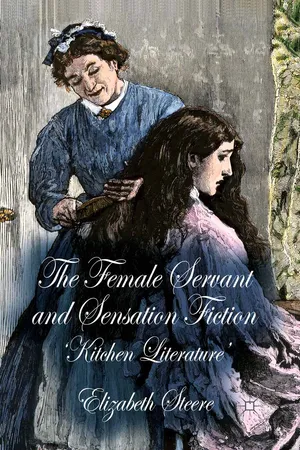
The Female Servant and Sensation Fiction: 'Kitchen Literature' explores why Victorian sensation fiction was derided as literature fit only for maids and cooks and how the depictions of fictional female domestics, from Jane Eyre to Neo-Victorian novels, reflect contemporary social concerns about the blurring of the boundaries of class and gender.
Information
1
‘Let nothing ever induce you to read novels’: Servants and Sensationalism in the Mid-Nineteenth Century
By the mid-1870s, after the initial popularity of sensation novels had waned, The Examiner had largely retired the term ‘kitchen literature’ as a byword for sensation fiction. By 1874, the term had found a new meaning, as evidenced by a Morning Post review of a reference book titled Things a Lady Would Like to Know Concerning Domestic Management and Expenditure. The review describes the book as ‘kitchen literature,’ noting that ‘[t]he “angels of our household” are taught in it not only how to cook, but how to pray; how to go to market, and how to marry; how to travel, and how to dress; how to attend to a garden, and how to set a good example’ (‘Things’ 3). Still, in other contexts, contemporary critics continued to accuse the sensational ‘kitchen literature’ of the previous decade of poisoning its own readership of ‘angels of [the] household’ by teaching sinful behavior and instilling bad morals.
Many critics feared that rather than teaching women how to cook, pray, and marry, sensation novels were a source of information on crimes such as bigamy, adultery, and murder. In 1864, the Christian Remembrancer denounced the ways that the sensation novel ‘stimulates a vulgar curiosity, weakens the established rules of right and wrong, touches, to say the least, upon things illicit, raises false and vain expectations, and draws a wholly false picture of life’ (‘Our Female’ 210). Sense and Sensation, a ‘modern morality play’ from that same year, depicted ‘Sensation’ as a devil reigning from a ‘throne of fire,’ commanding demons named for the seven deadly sins to send the ‘female mind’ to its ‘doom[]’ (T. Taylor 1.1).
One review of Mary Elizabeth Braddon’s Aurora Floyd (1863) explicitly voiced the fear that readers might begin to imitate the shocking behaviors depicted in such novels:
[W]e foresee that the effect of familiarizing the public mind with highly wrought scenes of misdirected passion, will in all probability lead to the extension of sensation plots into a region of social experiences at present almost entirely appropriated by French authors. (‘Review: Aurora Floyd’ 176)
This danger is said to be particularly great due to the vulnerability of sensation fiction’s readership, since ‘the influence of a pernicious literature, however well disguised, cannot fail to have an insidious effect upon the class of minds chiefly devoted to sensation reading’ (‘Review: Aurora Floyd’ 176). As seen here, the ‘class’ of sensation novel readers is often invoked, and it is somewhat surprising how often the class of the author is cited as well as evidence of the genre’s degeneracy.
As evidenced by the review of her portrait at the 1865 Exhibition, Mary Elizabeth Braddon in particular was often attacked on the basis of class. Contemporary critics variously characterized her as a servant, a spy, and a criminal. W. Fraser Rae, for example, claims that Braddon ‘is evidently acquainted with a very low type of female character, or else incapable of depicting what she knows to be true’ (98). Margaret Oliphant too thinks that writers such as Braddon ‘might not be aware of how young women of good blood and good training feel’ (‘Novels’ [1867], 260).1
In an 1865 article on Mary Elizabeth Braddon, Henry James conflates what he perceives as the ‘lower class’ characteristics of the author’s work with the character of the author herself. He claims that Braddon’s novels
betray an intimate acquaintance with that disorderly half of society which becomes every day a greater object of interest to the orderly half. They intimate that, to use an irresistible vulgarism, Miss Braddon ‘has been there.’ The novelist who interprets the illegitimate world to the legitimate world, commands from the nature of his position a certain popularity. Miss Braddon deals familiarly with gamblers, and betting-men, and flashy reprobates of every description. She knows much that ladies are not accustomed to know, but that they are apparently very glad to learn. The names of drinks, the technicalities of the faro-table, the lingo of the turf, the talk natural to a crowd of fast men at supper, when there are no ladies present but Miss Braddon, the way one gentleman knocks another down—all these things … our sisters and daughters may learn from these works. (115–16)
James sees the books as the instigators of dangerous blurring between opposing cultural boundaries. He suggests that the books offer middle-class readers a fairly unprecedented (and vulgar) ‘intimacy’ with the lower classes, with the suggestion of criminality and vice inherent to the latter group. The lower classes, like the books that depict them, are ‘illegitimate’ and uncivilized. Equally shocking, the books will provide female readers with forbidden knowledge of male behavior. James suggests that Braddon reveals her own immorality through her books’ content, which may poison other, more respectable women too.
James’ worries were echoed by other critics of the time as well. One 1868 review opines that female authors who write sensation novels have transgressed the boundaries of their sex and their original class. The critic further expresses the fear that respectable ‘wives’ and ‘sisters’ too may be de-classed and de-sexed by virtue of reading these unsavory novels.
Some years ago it was discovered—the honour of discovery may be chiefly awarded to Mr Wilkie Collins—that tales of crime and horror, which had hitherto thrilled the hearts of scullery-maids, might, if more artistically treated, be rendered acceptable in the drawing-room. The world of fashion ate eagerly of these highly-spiced dishes. Sensation became the rage, and new sensations were demanded every hour. The female pen, though seldom able to originate, is skilful in imitation. Mr Collins had sown the dragon’s teeth, and speedily a phalanx of lady-novelists sprang up, armed at all points; armed with the ‘Newgate Calendar,’ the Annals of Divorce Court, the gossip of the smoking-room, and the argot of the race-course. They appeared to know everything that men knew. Formerly, we respected and admired our wives and sisters all the more for their innocent ignorance on certain topics, and now the most rustic maiden of sixteen, may by a diligent perusal of the works of her literary sisters, attain an almost perfect knowledge of every vice that festers beneath the sun. (‘Women’s Novels’ 505)
As evidenced by the above review, the fact that many of the most popular authors of sensation novels were women gave fuel to some of the genre’s most damning critics. Female-penned works may be popular, such reviews suggested, but they were derivative of superior texts originally written by men. Successful women writers were a source of anxiety, so they became the targets of ridicule or horror.
An example of the latter treatment can be found in the Afterword to Frederick Paget’s parody Lucretia: The Heroine of the Nineteenth Century (1868), in which Paget expresses his abhorrence of female authors:
[T]he writers of these books, ay, the very foulest of them,—authors who have put forth confessions of the darkest profligacy that an utter reprobate could make, and who have degraded woman’s love into an animal propensity so rabid and so exacting, as to profess an opinion that its gratification would be cheaply purchased at the cost of an eternity in hell,—these writers are, some by their own admission, some by internal evidence (where the publication is anonymous,) women; and the worst of them, UNMARRIED WOMEN! (qtd. in Maunder, Varieties 215, emphasis original)
Again, the treatment that Mary Elizabeth Braddon in particular received at the hands of her critics provides an excellent example of the classist and gendered terms used to attack female authors of the genre. An Examiner review of Braddon’s Henry Dunbar (1864) declared the novel to be ‘a highly-seasoned dish of tainted meat that has been already contrived and served up for a kitchen dinner by the great chef of the kitchen maids, and is now brought upstairs for the delectation of coarse appetites in the politer world’ (‘Kitchen Literature’ 404).2 The language in the description of Braddon as ‘the great chef of the kitchen maids’ is particularly telling. In a review of a novel about a servant who steals the identity of his former master, Braddon is explicitly figured as a servant herself, cooking ‘tainted meat’ for her fellow servants as well as the gentry. The class-bending content of the novel’s plot is used as evidence of the author’s class-climbing and the genre’s class-corrupting potential. Even decades after the heyday of sensation fiction, Braddon was conflated with the class-crossing genre with which she was most identified. The 1887 Blackburn Standard article ‘Miss Braddon At Home’ describes how ‘Miss Braddon is not only a novelist, she is a house-keeper; her controlling hand is seen and felt in the kitchen as well as in the drawing-room of Lichfield-house’ (2). The phrasing here seems to deliberately echo W. Fraser Rae’s famous claim from 1865 that sensation fiction ‘[made] the literature of the Kitchen the favourite reading of the Drawing-room,’ suggesting that Braddon herself similarly straddles both worlds in her roles as both ‘novelist’ and ‘house-keeper’ (with the dual connotations of the latter word meaning either the lady of the house or a domestic servant).
The figure of the domestic servant-cum-writer became something of a cliché in the 1860s, and governesses were considered to be especially prone to frivolous fiction writing. An 1866 article detailing ‘Homicidal Heroines’ concludes that
[t]he young lady who is kind enough to teach one’s daughters French and music looks and talks like an ordinary human being; but it is very likely, if we only knew all, that she has got a murderess in manuscript in her bedroom, at the elaboration of whose career she is working all her spare hours, and through the vivid delineation of whose amatory and homicidal performances she hopes herself to attain literary fame. (403–04)
As late as the twentieth century, critics still used highly classed terminology when describing the sensation phenomenon; one 1920 literature survey described sensation novels as a ‘species of absurd fiction’ featuring ‘simple-minded plots’ and a ‘governess mentality’ (Elton 220, qtd. in Radford 25).
Female Servants in the Era of Sensation Fiction
During the genre’s heyday, there was a prevalent anxiety in England over what domestic servants would see and say. Anthea Trodd even suggests that it was ultimately the desire to maintain privacy that caused the demand for live-in servants to decline after the initial boom from the 1850s to the 1870s (Domestic 50). Part of the increased visibility of servants in sensation fiction can be attributed to contemporary social changes in England. Domestic service was a common profession for women at the time, and the greatest leap in the nineteenth-century British servant population occurred during the height of sensation fiction’s popularity. From 1851 to 1861, the domestic servant population in England increased by nearly a quarter, and by the end of that period, the estimated 1,123,428 domestic servants accounted for 14.3 per cent of the labor force (McBride 142). Between 1861 and 1871, the servant population increased nearly as much again, and by the end of this decade, an estimated 1,387,872 servants made up 15.3 per cent of the work force (McBride 142). By 1871, one out of every eight women in England and Wales was a domestic servant (Jordan, ‘Domestic’ 80).
During these decades of growth of the servant population, more attention was being paid to servant welfare, and laws were passed to ensure good treatment of domestic employees. In 1851, the Poor Law Board passed an amendment requiring that masters treat servants or apprentices humanely and provide ‘necessary Food, Clothing, or Lodging’ or face imprisonment (Horn 120; Poor Law Board 19). Harriet Martineau’s 1859 essay ‘Female Industry’ called attention to the bleak working conditions of employed women, paying particular attention to female servants. She describes how difficult it is for a female domestic to marry and leave her station and even suggests that the hard labor and low wages of their work drives them mad, claiming:
The physician says that, on the female side of the lunatic asylums, the largest class, but one, of the insane are maids of all work (the other being governesses). The causes are obvious enough: want of sufficient sleep from late and early hours, unremitting fatigue and hurry, and, even more than these, anxiety about the future from the smallness of the wages. (Martineau, ‘Female’ 307)
Several new laws and social changes of the 1860s attempted to redress the grievances of domestic employees and other members of the working class. The first attempted ‘servant union,’ the London and Provincial Domestic Servants’ Union, was formed in 1861 (Huggett 160).3
This was also a time of political unrest: one key issue was suffrage for women and members of the working class. In 1866, the National Society for Women’s Suffrage was established, indicating the growing dissatisfaction with the status quo among those disenfranchised not only through the demarcations of class but gender. The female servant was doubly disenfranchised. The Reform Act of 1867 extended the voting rights of the upper and middle classes to the working class, a crucial recognition of equal legal rights across class boundaries, although voting remained a male-only privilege.
Gender and class issues remained at the forefront of debates about employment and education reform. In her 1868 tract ‘The Education and Employment of Women,’ for example, Josephine Butler insists on the need for more job opportunities for women outside of domestic service in order to decrease competition and improve the working conditions for current domestic workers. Butler describes the ‘surprise’ and ‘despair’ she feels on learning that ‘three hundred women’ answered an advertisement for an ‘unpaid’ nursery governess position (3, emphasis original). Women were often perceived as qualified to do little else, and there were few other positions they could take and still be considered respectable. After the 1870 Education Act, however, improvements in educational opportunities superseded the former appeal of the ‘education’ that employment as a domestic servant offered, and within a decade, the numbers of domestic employees began to fall (Horn 25). In the 1870s, one proposed (but rarely implemented) solution to servant scarcity was the recruitment of ‘lady helps,’ women from the upper class who were willing to work as high-ranking servants (Horn 29). Part of the unpopularity of this concept may be due to the ambiguous nature of a ‘lady help’—despite the terminology, in a world of strict class boundaries, one cannot simultaneously be both ‘the lady’ and ‘the help’ within a household.
Throughout the nineteenth century, governesses present a similar quandary, being genteel ladies yet household employees, a key plot point in both Jane Eyre and East Lynne. The problem is addressed in Elizabeth Rigby’s review of Jane Eyre for the Quarterly Review; she claims that ‘the real definition of a governess, in the English sense, is a being who is our equal in birth, manners, and education, but our inferior in worldly wealth’ (507). Even if the governess is recognized as the master’s ‘equal in birth,’ as Rigby claims, her servant status undermines her former claims to gentility. Thus, in John Brougham’s 1849 play adaptation of Jane Eyre, when Rochester announces his plan to marry ‘the governess,’ members of the aristocratic Ingram family declare the very idea ‘“revolting!”’ (101).
The anxieties about women’s class mobility also had political origins. While romance and marriage between master and servant is one of the more sensational tropes of sensation fiction, it should be noted that at the time, wifehood itself was often likened to servitude. Harriet Taylor and John Stuart Mill used the servant as a metaphor for the limited and subservient role expected of the Victorian wife. In an 1851 Westminster Review article, Harriet Taylor describes the ‘affection’ a man claims to have for his wife as akin to the ‘feelings [that] often exist … between a master and his servants’ (307). Similarly, in On the Subjection of Women (1869), John Stuart Mill sees ‘the wife [as] the actual bond servant of her husband: no less so, as far as legal obligation goes, than slaves commonly so called’ (57). Wilkie Collins’ fiction at this time also draws comparisons to married women and slaves, citing the lack of rights and the prevalence of unwarr...
Table of contents
- Cover
- Title
- Introduction: ‘Kitchen Literature’
- 1 ‘Let nothing ever induce you to read novels’: Servants and Sensationalism in the Mid-Nineteenth Century
- 2 ‘Merely telling the truth’: Servants’ Stories in Jane Eyre and Wuthering Heights
- 3 ‘No human being ever was created for this’: The Servant Victim in the Works of Wilkie Collins
- 4 ‘Privileged spies’: The Criminal Servant in Lady Audley’s Secret
- 5 ‘She had her rôle to play’: East Lynne and the Servant Actress
- 6 ‘We will still be husband and wife’: The Servant as Spouse in Gaskell’s ‘The Grey Woman’
- 7 ‘The stuff of lurid fiction’: Sensation Fiction in the Twenty-First Century
- Notes
- Works Cited
- Index
Trusted by 375,005 students
Access to over 1.5 million titles for a fair monthly price.
Study more efficiently using our study tools.
Frequently asked questions
Yes, you can cancel anytime from the Subscription tab in your account settings on the Perlego website. Your subscription will stay active until the end of your current billing period. Learn how to cancel your subscription
No, books cannot be downloaded as external files, such as PDFs, for use outside of Perlego. However, you can download books within the Perlego app for offline reading on mobile or tablet. Learn how to download books offline
Perlego offers two plans: Essential and Complete
- Essential is ideal for learners and professionals who enjoy exploring a wide range of subjects. Access the Essential Library with 800,000+ trusted titles and best-sellers across business, personal growth, and the humanities. Includes unlimited reading time and Standard Read Aloud voice.
- Complete: Perfect for advanced learners and researchers needing full, unrestricted access. Unlock 1.5M+ books across hundreds of subjects, including academic and specialized titles. The Complete Plan also includes advanced features like Premium Read Aloud and Research Assistant.
We are an online textbook subscription service, where you can get access to an entire online library for less than the price of a single book per month. With over 1.5 million books across 990+ topics, we’ve got you covered! Learn about our mission
Look out for the read-aloud symbol on your next book to see if you can listen to it. The read-aloud tool reads text aloud for you, highlighting the text as it is being read. You can pause it, speed it up and slow it down. Learn more about Read Aloud
Yes! You can use the Perlego app on both iOS and Android devices to read anytime, anywhere — even offline. Perfect for commutes or when you’re on the go.
Please note we cannot support devices running on iOS 13 and Android 7 or earlier. Learn more about using the app
Please note we cannot support devices running on iOS 13 and Android 7 or earlier. Learn more about using the app
Yes, you can access The Female Servant and Sensation Fiction by E. Steere in PDF and/or ePUB format, as well as other popular books in Literature & Literature General. We have over 1.5 million books available in our catalogue for you to explore.