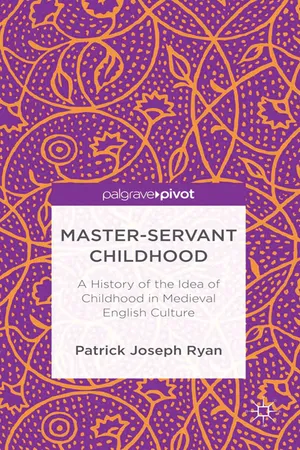
eBook - ePub
Master-Servant Childhood
A History of the Idea of Childhood in Medieval English Culture
- English
- ePUB (mobile friendly)
- Available on iOS & Android
eBook - ePub
About this book
An interdisciplinary synthesis that offers a new understanding of childhood in the Middle Ages as a form of master-servant relation embedded in an ancient sense of time as a correspondence between earthly change and eternal order.
Information
1
Husbands, Wives and the Language of Patriarchy
Abstract: The language of medieval family life and marriage positioned males by property status and females by sexual experience, sexual availability, marital status, and motherhood. This vocabulary aligned land, sex, and lineage in ways that were insensitive to the age of persons, and unsuited to express the idea of a romantic conjugal unit, or the modern family. The result was a strong sense of patriarchal possession, constrained by reciprocal duties. Patrimonial land was a living gift held in stewardship, signifying permanent relationships between people.
Ryan, Patrick Joseph. Master-Servant Childhood: A History of the Idea of Childhood in Medieval English Culture. Basingstoke: Palgrave Macmillan, 2013. DOI: 10.1057/9781137364791.
A distinctive European family pattern seems to have emerged during the Middle Ages defined by an aversion for the “joint-family”, or co-residing, married siblings.1 Parents might live with one of their married children in a “stem-family” arrangement, but siblings established their own households if they could. They delayed marriage during this effort, and often served within the households of others in the process.2 The more frequently separate households were established for sons and daughters, the less frequently would elderly parents have been available for people to even consider three-generational arrangements.3 Under such conditions, two-generational households were typical. As we shall see, this does not mean that European agrarian households of the millennium prior to 1600 fostered individualism according to modern middle-class family ideals.
There is an existing debate over regional variations in Europe, but it seems well-established that the pursuit of smaller, separate households was strong in northwestern Europe.4 In these areas, since at least the late Middle Ages, women have married approximately ten years later than their counterparts in other agricultural societies. The possible causes and consequences of delaying marriage are debatable, but we know that late-marriage and small households emerged before the industrial revolution. They could not have stemmed from the spirit of commercial capitalism that came with the early-modern Atlantic world.5 It seems reasonable to argue that the reverse happened: a distinctive household pattern preceded and encouraged other, later political and economic transformations.6 Perhaps smaller households were indirectly advanced by Christianity’s insistence on monogamy and exogamy (marriage outside the family). So too, the European family pattern may have been fostered by a decline in Roman slavery and the propagation of new forms of religious devotion to same-sex community in late-antiquity.7
The history of the vocabulary of family relations in English is consistent with the thesis that the pursuit of smaller, separate households which delayed marriage among commoners was an important, broadly shared feature of European cultures for nearly a millennium prior to the sixteenth century. Take the Old English husbonde and its Old Norse cognate húsbóndi, both referred to men as masters of households. Husband was formed out of words for house (hus), and land-owning peasant (bunda).8 Its variants became more common within Middle English, as the words associated with husband connected householding and the possession of land as pre-requisites for marriage – a status that many would attain late or not at all.9
In Middle English, husband became a conceptual umbrella for the complex position of “householder” as other terms in the Anglo-Saxon lexicon for men were being displaced. For example, the words ceorl (man, married man, lowest freeman) and wer (man, married man) both stood for married men in the Anglo-Saxon Gospels (995), but these words were not used to name householders.10 In passages naming the heads of households, variations of the more august term ealdor were used – giving the sense of one with authority: a superior, a parent, an elder, a primogenitor. Four hundred years later, in Wycliffe’s Middle English translation (1395), versions of husband filled all three positions.11
As the Middle English husband came to mean married man first, and householder secondarily, both senses continued to carry the connotation of working and possessing the land. We get this in the lowland Scotch term husbandland. It named a section of tillage (a virgate) farmed by tenants, as opposed to land worked by the lord’s own bondsmen (villeins or famuli). Husbandmen were not servile, bound serfs tied directly on the domain of the Manor (demesne). They were tenant farmers and freeholders without nobility, similar to yeomen (14C, from Anglo-Saxon words for young + man) and franklins (12C, medieval Latin, free + ling). Yeomen and franklins were just beneath the lowest class of noble birth – later called gentlemen.
Husbandmen occupied a space between gentry and bondsmen, whether they were freeholders (yeoman or franklin) or tenant farmers, and they obtained power by possessing and working land with their families and servants.12 They were able to mount their own households, pay the tithes and taxes, and secure privileges by paying fees – such as merchet, the duty owed to the lord for permission to marry a servile woman. In turn, securing a good marriage would advance the strength and independence of a husbandman’s house through the immediate addition of his wife’s labour. Her familial ties and the children she bore would also improve their household position. In its various uses by the late-medieval period, husband carried connotations of masculine power to claim women, to sire children, to craft tools, to erect structures, and above all, to till the land.
Husband and its offshoots were part of a land-sex-marriage word complex consistent with a pattern of families vying to create small sustainable households. Siblings preferred not to co-reside with each other as adults, and the marriage system was relatively open, but it usually depended on making a household upon the land. It was only one of many terms (as will be shown) that established a language of patriarchy diffused among ordinary fathers, rather than one relying upon a claim to a noble lineage.
Small households relied upon family networks. Kinship provided security and material benefits that were necessary for survival. Unsurprisingly, those already vested with some property, skills, and connections were in a better position to expand their familial network. Among late-medieval English commoners, free and tenant husbandmen (87%), along with artisans/merchants (80%), achieved marriage far more often than men without their own land or shops: labourers (62%) and servants (30%). If their houses were productive, these small-holders would be able to pay heriot, the duty due the Lord whenever property changed hands (by death, inheritance, or sale). They could pass holdings onto to children or other kinsmen, gratified in their sense of belonging to kin who would remember and pray for them after death.
Husbandmen were less mobile, their households contained more servants and their young-adult children resided longer with them than most Englishmen.13 It is not difficult to explain why. By definition, husbandmen held “sufficient property to support a family”. Social historians have imagined these small farmers as the “backbone” of the medieval governing order overseeing the reciprocity between householding, the possession of the land, the rights of marriage and legitimate kinship.14 This is not said to imply that the patriarchal assumptions which framed the husbandman’s position fostered contented simplicity without struggle.15 Quite the reverse, the possibility that a family could achieve the status of husbandmen set them the task of vying with others and among themselves. Nor is it said to imply that men created households alone. Women strove to create and recreate these households with men, or to secure a household without them when this was possible.16
Historical calculations suggest that no more than half of the husbandmen of medieval England would have held land adequate to support a family.17 It is reasonable to imagine that most small householders struggled, improvised, compromised, and often failed in their attempts to achieve an adequate (the early-modern word is competent) household. If no one was “free” from the structures of feudalism, husbandme...
Table of contents
- Cover
- Title
- Wickbergs Door: Childhood and Structures of Thought
- 1 Husbands, Wives and the Language of Patriarchy
- 2 Boys, Girls and the Practices of Servitude
- 3 Childhood Without Adulthood
- 4 Generation, Age and the Logic of Correspondence
- 5 The Master-Servant Sense of Being in Time
- Select Bibliography
- Index
Trusted by 375,005 students
Access to over 1.5 million titles for a fair monthly price.
Study more efficiently using our study tools.
Frequently asked questions
Yes, you can cancel anytime from the Subscription tab in your account settings on the Perlego website. Your subscription will stay active until the end of your current billing period. Learn how to cancel your subscription
No, books cannot be downloaded as external files, such as PDFs, for use outside of Perlego. However, you can download books within the Perlego app for offline reading on mobile or tablet. Learn how to download books offline
Perlego offers two plans: Essential and Complete
- Essential is ideal for learners and professionals who enjoy exploring a wide range of subjects. Access the Essential Library with 800,000+ trusted titles and best-sellers across business, personal growth, and the humanities. Includes unlimited reading time and Standard Read Aloud voice.
- Complete: Perfect for advanced learners and researchers needing full, unrestricted access. Unlock 1.5M+ books across hundreds of subjects, including academic and specialized titles. The Complete Plan also includes advanced features like Premium Read Aloud and Research Assistant.
We are an online textbook subscription service, where you can get access to an entire online library for less than the price of a single book per month. With over 1.5 million books across 990+ topics, we’ve got you covered! Learn about our mission
Look out for the read-aloud symbol on your next book to see if you can listen to it. The read-aloud tool reads text aloud for you, highlighting the text as it is being read. You can pause it, speed it up and slow it down. Learn more about Read Aloud
Yes! You can use the Perlego app on both iOS and Android devices to read anytime, anywhere — even offline. Perfect for commutes or when you’re on the go.
Please note we cannot support devices running on iOS 13 and Android 7 or earlier. Learn more about using the app
Please note we cannot support devices running on iOS 13 and Android 7 or earlier. Learn more about using the app
Yes, you can access Master-Servant Childhood by P. Ryan in PDF and/or ePUB format, as well as other popular books in Politics & International Relations & European Medieval History. We have over 1.5 million books available in our catalogue for you to explore.