Based on extensive research, this book is a fundamental critique of psychiatry that examines the foundations of psychiatry, refutes its basic tenets, and traces the workings of the industry through medical research and in-depth interviews.
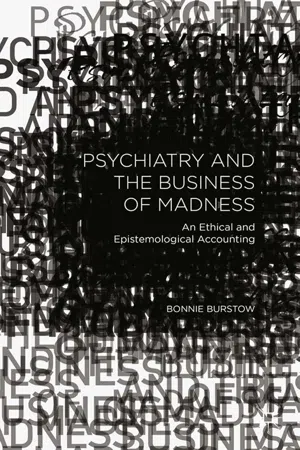
eBook - ePub
Psychiatry and the Business of Madness
An Ethical and Epistemological Accounting
- English
- ePUB (mobile friendly)
- Available on iOS & Android
eBook - ePub
About this book
Information
Topic
Ciencias socialesSubtopic
Psiquiatría y salud mentalCHAPTER 1
Introduction to the Study: Unveiling the Problematic
This is a study of psychiatry. It is a study of an area officially a branch of medicine and overwhelmingly seen as legitimate, benign, progressive, and effective. That psychiatry is typically so viewed is readily apparent and may seem a “no-brainer.” Doctors specialize in it. It is covered by our health insurance, overseen by ministries of health. A high percentage of the population uses its treatments. People encourage their loved ones to consult a psychiatrist when encountering “personal problems.” And the media routinely report its “discoveries” and “improvements,” much as they report “breakthroughs” in the treatment of cancer. But what if society had it wrong? What if this were not legitimate medicine? What if psychiatry’s fundamental tenets and conceptualizations were inherently faulty? Indeed, what if—despite some helpful practitioners—it does far more harm than good? Such is the position of this book. While, on the face of it, this position may sound bizarre, it is important to note that for decades now scholars have indeed demonstrated fundamental and overwhelming problems both with the treatments and with the underlying conceptualizations (see, e.g., Szasz, 2007/2010; Breggin, 1991a; and Woolfolk, 2001). Correspondingly, unlike with any other branch of medicine, there is a long-standing international movement (largely comprised of folk that it has allegedly served) protesting most everything about it.1
While I in no way dispute the very real abyss of agony and confusion into which human beings sink, nor the enormous importance of support, what makes this book a challenge is that it invites the reader to take an about-turn or, minimally, to hold in abeyance the seemingly indisputable truths about psychiatry that they may have taken for granted all their lives—that whatever its shortcomings, for instance, it is benign and scientifically valid. I ask you more fundamentally to be open to questioning the very concept of mental illness on which psychiatry rests, a counterintuitive thing to do given that mental illness appears to be all around us—in the rambling of the street person, on billboards, in hospitals—and, as such, seems as real as the air we breathe. What is involved here, to be clear, is revisiting what seems to be cut-and-dry, stepping outside the circle of certainty that has bit by bit been built up around this institution and daring to rethink.
This is a foundational study, a critical archeology, as it were.2 The ultimate purpose of the study is to awaken and to disturb. Not an easy task for in part psychiatry has the power that it does precisely because it is reassuring, in other words, precisely because we do not wish to be “disturbed.” We want to know that the people whose being-in-the-world particularly trouble us are elsewhere or are someone else’s problem. At the same time, we want to know that there are creditable people with answers—and on the surface minimally, who could be more credible than the people entrusted with the health of society? We want to know that our ways of life are reasonable. We want to know that both those who strike us insane and those who just need a “tune-up” can be helped, that there are concrete and discrete diseases at the root of the misery that people face, that we as a civilization have progressed tremendously, that there are now expert, enlightened, and indeed humane solutions to human unhappiness, misery, and confusion.
Fear, of course, underlies much of this need for comforting answers. While we may have trouble accessing this level, on a deep level, to varying degrees, it is ourselves that we fear; and it is reassuring that there are experts at hand that can keep us from losing our grip. We may also be authentically frightened and wanting to protect people dear to us who are in obvious distress. The medical paradigm in this regard acts like a metaphoric tranquilizer in its own right. Behind the medical language and commitment lies a deep-seated angst. We fear the subterranean parts of ourselves—the part that thinks or acts in ways that appear out of step; we fear for those close to us, all the more so if they strike us as vulnerable. In the process, we essentially “other” what does not strike us as rational, as “okay,” as “normal.” Correspondingly, we fear the “other,” the person who is not like us, or who we fervently pray is not like us. If the person is uttering words that we cannot wrap our minds around, if they are muttering to themselves, if their appearance is decisively outside our comfort zone, we are especially likely to surmise that they present a danger to the community and “need” to be under control. Except when they are our loved ones—and often not even here, for note, it is kin who most commonly turn to psychiatry—the compassion that we often feel in the process generally does not alter this judgment, for we are convinced, indeed are continually primed to be convinced, that such measures are for their own good.
This depiction, of course, overgeneralizes for the purpose of making a point. Without question, there are many people—kin, fellow survivors, even relative strangers—who struggle authentically to help distressed or distressing others irrespective of their own position on psychiatry. More to the point, there are some—myself included—who view psychiatry differently. Throughout the world, nonetheless, though most especially in the West, there has been a huge acceptance of psychiatry. Country after country has mental health laws, has places of detention called “mental hospitals.” Correspondingly, the general populace speaks readily of “mental illness,” of “schizophrenia.” The buy-in progressively, in other words, is enormous. From the vantage point of this book, that is the bad news.
The good news is, however profound the buy-in, there are fissures in most people’s acceptance of psychiatry, and these can be seen in the everyday world. Take those moments that come upon us unaware. Occasionally when watching a television program, we witness a fictional judge responding to the testimony of a fictional “mental health expert” with a degree of ridicule, maybe a touch of irony, and without necessarily intending to do so, we begin to nod in acknowledgment. We may be concerned by how cloudy our next door neighbor’s thoughts have become since starting Prozac and find ourselves expressing the thought that some people are “overmedicated.” Even some medical model psychiatrists (psychiatrists who believe that biological abnormities underlie what they call “mental disorders”) exhibit such doubt. That is, while regarding old standbys like “bipolar” as unquestionable—for it seems impossible to question the legitimacy of this category—there are medical model psychiatrists themselves who are uncomfortable with several of the “disorders,” moreover who express dismay over how readily “distress” is conflated with “disorder” (e.g., Horwitz, 2002). Herein lies the beginning of critique. That we all have such glimpses, or to put it another way, that we all experience such moments of disjuncture, I would add, is important for they are a base from which to proceed. Moreover, it is urgent that they be attended to, for as researchers such as Whitaker (2010) have amply demonstrated, we are facing a virtual epidemic of iatrogenic diseases (diseases caused by medicine, in this case, by psychiatry); the alleged progress in which society takes comfort is dubious; indeed, we have allowed something which is arguably highly problematic even on a small scale to mushroom out of control; and as members of society, we have reason to be concerned.
The Focus of This Book
The business/institution of psychiatry is the focus of this book. By this I mean not only psychiatry as a discipline and profession per se, albeit that is most focal. I mean all that surrounds it, make it possible. Insofar as they facilitate the work of psychiatry, I include here the various apparatuses of the state—courts, mental health laws, ministries which provide funding, mechanisms of enforcement, mechanisms of oversight. I include industries that feed it and which are in turn fed by it, such as the pharmaceutical industry and the medical research industry. I include the army of professionals that contribute to the work of psychiatry—nurses, doctors, social workers, psychologists, caseworkers, academic researchers, occupational therapists, policemen. While it most assuredly is not focal, for the work involved is typically contractual and largely of a different order, naturally I include as well the branch of psychiatry known as psychoanalysis, but only peripherally—that is, only to the extent that it is part of, buys into, depends on, or contributes to the work of the larger institution. The question is, how are we to understand this institution? How does it work? What is it genus? Its nature?
Starting the Work: Beginning to Bring the Institution into View
A few facts become obvious once we step back far enough to get to a good look at this institution. To begin with, psychiatry is prestigious. It is, of course, largely because medicine per se is prestigious—hence the significance of its being a branch of medicine or being seen as medical. Insofar as psychiatry is prestigious, it exercises power. The point is that people believe what medical doctors state and what medicinal doctors recommend. At least as significant as its power to persuade and hardly separable from this is its power to act and to enforce. The bottom line is that psychiatry is sanctioned by the state, is funded by the state, is authorized to act by the state. Moreover, it is given authority to intrude in highly personal ways in the private lives of others (generally when at their most vulnerable)—even authority to strip people of what normally is thought of as basic human rights—freedom of movement, freedom of association, freedom of thought itself. In this regard, as everyone who has been picked up and dragged to an institution against their will knows only too well, psychiatry is essentially a coercive, an almost “above the law” institution, backed by the power of the state and facilitated by other agents of the state. Even on a seemingly tame level, it is enabled to do what it would be blatantly illegal for anyone else to do. For example, its members are authorized to prescribe psychedelic drugs that are listed as addictive, whereas others who dispense similar substances face criminal charges. On a more obviously problematic level, it is not only mandated to incarcerate involuntarily, it is the only profession that can as a matter of course utterly take away the freedom of people who have committed no crime. Correspondingly, both directly and indirectly, it may force people to imbibe substances which they vehemently do not want—substances which dramatically alter their very being-in-the-world—all this in the name of help. As such, it is not only a regime of ruling, to employ the language of institutional ethnographer Dorothy Smith (2006, 2005, and 1987), it is a particularly formidable one.
As is the case with most institutions, to a large extent, psychiatry operates through discourse, through language, through speech. There is something very special about its language, however, something critical to understanding it. Significantly, a high percentage of its speech is what philosopher J. L. Austin (1979) calls “performative.” That is, its words have the force of law and are “true” because someone in the profession utters them. In this regard, it is in many ways akin to the speech of kings in earlier eras. Just as a nobleman or peasant in a bygone era would have been exiled by the sheer fact of the reigning king stating they are in exile, someone is officially “mentally ill” or “of danger to self or others” by virtue of the fact that they have been pronounced so by psychiatry. To use a more obvious example, someone is in effect committed involuntarily to an institution by virtue of two psychiatrists having signed a document so declaring it.3 Once such a document is signed, significantly, it would make no more sense asking if the person were “really committed” than it would asking if a person is “really exiled” after the ruling monarch has pronounced them so. The very fact that two psychiatrists have signed to this effect makes it so. On a different level, what likewise adds to psychiatry’s power, its core concepts and words—words like “schizophrenia,” “mentally ill”—are hegemonic, that is, are dominant, are accepted far and wide as valid, indeed, have become so much a part of everyday life that the fact that they are intrinsically ideological escapes detection. By the same token, they are accepted as authoritative in courts of law. So are the pronouncements based on them. By this I do not mean that they cannot be challenged, but the challenge must be part of the same discourse, must obey the same rules. To be clear, while a psychiatric pronouncement such as “Jill is schizophrenic” may be called into question, only on the basis of the words of other psychiatrists—people, significantly, who have undergone comparable training, overwhelmingly believe in the same concepts, apply the same texts, are granted the same credibility.4 As such, this powerful system is additionally a closed system, a circular system, with every part reinforcing every other, and with little or no room afforded to other “expertise,” certainly not the expertise of the “patient” or friend or parent who may understand things differently.
Gaining a Concrete Feel for the Regime
As institutional ethnographers such as Smith (2005 and 2006) have pointed out, we understand regimes of ruling best not so much by looking at examples as by finding entry points in the everyday world, points of disjuncture in real people’s lives, then using that disjuncture as a way to open up the regime. Roughly speaking, a “point of disjuncture” is a rupture in the fabric of our daily existence—one which we have no easy way of comprehending or addressing, for it largely originates from “elsewhere and elsewhen.” A simple example would be taking our children for their weekly walk to the park only to discover a bulldozed site where the local park used to be.
An entry point that I would pursue now for the purposes of initial understanding is the situation of an unfortunate young man, a horrified mother, a “suicide,” and an official complaint. Something horrific has happened. Devastated, a young man has killed himself. A profound disjuncture for the young man and for his mother. The mother has filed a complaint with the College of Physicians and Surgeons of Ontario. It is this complaint (my first knowledge of the situation) which is our entry into the regime. As we follow the leads provided, fundamental truths about the institution surface, with those truths shedding light on the case just as the case sheds light on the institution as a whole.
While I will be anonymizing them for reasons of confidentiality, a number of documents related to the complaint are sitting on the desk in front of me. One which is particularly instructive is called “Reasons Supporting Review of CPSO Inquiries, Complaints and Reports Committee Decisions: #__________” (identifying number of complaint deleted). Start reading it and it becomes clear the claimant Julia James (an interviewee for my research) filed a complaint charging psychiatrist Dr. R. W. Hunt with incompetence following the suicide of her son Kevin James (all pseudonyms). It is also clear that while the College had concerns about some of Dr. Hunt’s actions and so ordered some minor remedial measures, it did not find Dr. Hunt guilty of incompetence. It is clear, correspondingly, that Julia is appealing that decision.
I also have on my desk the formal decision of the Inquiries Complaints and Reports Committee (named “Inquiries, Complaints and Reports Committee Decisions and Reasons”). Examples of related documents likewise on my desk are: (a) two summary statements of the chronology of events that culminated in the complaint; (b) a psychiatric admission order file dated September 17, 2004, from the Department of Psychiatry in a general hospital, hereafter referred to as “General Hospital”; (c) a “Consultation Report” from the General Hospital; (d) a document entitled “Clinical Conference Summaries” from that same hospital, dated September 20, 2004; (e) a clinical summaries report from the General Hospital, dated September 23, 2004; (f) a patient registration record for Kevin James from the General Hospital, dated March 22, 2005; (g) a patient discharge sheet from the General Hospital, dated March 23, 2005; and (h) what is called “Psychiatric Note”—the report of a consultation from a Dr. J., dated November 7, 2005.
Trace where these documents lead and listen to the expert knowledge of the claimant who navigated this system, and a huge bureaucracy involving complaints comes into view, one that would appear to place the claimant at a distinct disadvantage. Salient facts here include: Regulations restricting what can be used as evidence prevented Julia from using statements unearthed in a related complaint against a second psychiatrist; claimants are provided with little information about the process; neither claimants nor their lawyers may cross-examine the physician being charged. Correspondingly, the deliberating panel was largely stacked with psychiatrists—a seeming conflict of interest, yet a standard one for it is policy that the doctors on these panels come from the same discipline as the physician being charged. Nor was the claimant apprised of what would appear to be important information—former complaints against this psychiatrist and a previous finding of misconduct.
The issue of what is interpreted as evidence or good evidence presents further problems. What is not surprising given the constitution of the panel, good evidence appears to be conflated with what psychiatrists say and associated with very little else. Indeed the very fact the psychiatrists have written something on an official document tends to give their opinions or their beliefs the status of fact, even when there is good reason to believe that psychiatrists have gotten the story wrong. By way of...
Table of contents
- Cover
- Title
- 1 Introduction to the Study: Unveiling the Problematic
- 2 The Evolution of “Madness”: A Journey “through Time,” Part One
- 3 Modernity (1890–2014): A Journey through Time, Part Two
- 4 Probing the Boss Text: The DSM—What? Whither? How? Which?
- 5 The Beast/In the Belly of the Beast: Pinioned by Paper
- 6 The Psychiatric Team
- 7 Marching to “Pharmageddon”: Psychopharmacy Unmasked
- 8 Electroshock: Not a “Healing” Option
- 9 Dusting Ourselves Off and Starting Anew
- Notes
- References
- Index
Trusted by 375,005 students
Access to over 1.5 million titles for a fair monthly price.
Study more efficiently using our study tools.
Frequently asked questions
Yes, you can cancel anytime from the Subscription tab in your account settings on the Perlego website. Your subscription will stay active until the end of your current billing period. Learn how to cancel your subscription
No, books cannot be downloaded as external files, such as PDFs, for use outside of Perlego. However, you can download books within the Perlego app for offline reading on mobile or tablet. Learn how to download books offline
Perlego offers two plans: Essential and Complete
- Essential is ideal for learners and professionals who enjoy exploring a wide range of subjects. Access the Essential Library with 800,000+ trusted titles and best-sellers across business, personal growth, and the humanities. Includes unlimited reading time and Standard Read Aloud voice.
- Complete: Perfect for advanced learners and researchers needing full, unrestricted access. Unlock 1.5M+ books across hundreds of subjects, including academic and specialized titles. The Complete Plan also includes advanced features like Premium Read Aloud and Research Assistant.
We are an online textbook subscription service, where you can get access to an entire online library for less than the price of a single book per month. With over 1.5 million books across 990+ topics, we’ve got you covered! Learn about our mission
Look out for the read-aloud symbol on your next book to see if you can listen to it. The read-aloud tool reads text aloud for you, highlighting the text as it is being read. You can pause it, speed it up and slow it down. Learn more about Read Aloud
Yes! You can use the Perlego app on both iOS and Android devices to read anytime, anywhere — even offline. Perfect for commutes or when you’re on the go.
Please note we cannot support devices running on iOS 13 and Android 7 or earlier. Learn more about using the app
Please note we cannot support devices running on iOS 13 and Android 7 or earlier. Learn more about using the app
Yes, you can access Psychiatry and the Business of Madness by B. Burstow in PDF and/or ePUB format, as well as other popular books in Ciencias sociales & Psiquiatría y salud mental. We have over 1.5 million books available in our catalogue for you to explore.