eBook - ePub
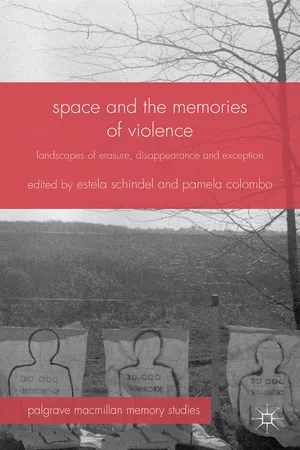
Space and the Memories of Violence
Landscapes of Erasure, Disappearance and Exception
- English
- ePUB (mobile friendly)
- Available on iOS & Android
eBook - ePub
Space and the Memories of Violence
Landscapes of Erasure, Disappearance and Exception
About this book
Authors from a variety of disciplines dealing with diverse historical cases engage with the spatial deployment of violence and the possibilities for memory and resistance in contexts of state sponsored violence, enforced disappearances and regimes of exception. Contributors include Aleida Assmann, Jay Winter and David Harvey.
Information
Topic
GeschichteSubtopic
HistoriographiePart I
Spatial Inscriptions of Annihilation
1
Violent Erasures and Erasing Violence: Contesting Cambodia’s Landscapes of Violence
James A. Tyner
All that remains of Keat Sophal is a photograph (Figure 1.1). We know little about her death, and even less about her life. Documentary evidence indicates that she was arrested on 13 April 1977. She was detained at Tuol Sleng, the infamous ‘security center’ code-named ‘S-21’, for 99 days until the day of her ‘termination’ on 22 July 1977. Her remains have never been identified; it is not known if anyone remembers her in life.
We know that she was Khmer Rouge cadre; her job was to take care of children. No information has been forthcoming about her family or what she did prior to the time of the genocide. Nor do we know why she was arrested or killed or what she experienced while detained at Tuol Sleng. In all likelihood, she was interrogated and tortured; perhaps she was raped. No confession or record of her ‘crimes’ remain. Was she found ‘guilty’ of traitorous activities to the state? Was she found ‘delinquent’ in her patriotic duties? Or was Sophal simply arrested because she was associated with someone else charged of a crime? It is not known. It is also not known whether she died at S-21, or was taken to the nearby killing fields, Choeung Ek, to be killed.
Two dates – a date of arrest and a date of termination – and a photograph. This is all that remains of the life and death of Keat Sophal. Her facial expression suggests resignation. As a Khmer Rouge cadre, Sophal most likely knew of her eventual fate. By the summer of 1977, she had probably witnessed many deaths and was well aware that once accused by Angkar her fate was sealed. In Cambodia, during the time of the genocide, to be accused was to be guilty; to be guilty was to be sentenced to death. Keat Sophal was one of approximately two million people who died throughout the Cambodian genocide. And in certain respects, her legacy – and photograph – raises a disturbing question for our subsequent remembrance and memorialization of genocide. As Bronfen asks, ‘Do we see the real, while denying the representation or do we see the representation, thus putting the real under erasure?’ (Bronfen, 1990, p.304).

Figure 1.1 Mugshot of Keat Sophal, arrested on 13 April 1977. She was detained for 99 days until she was executed on 22 July
Courtesy of Documentation Center of Cambodia.
Courtesy of Documentation Center of Cambodia.
In Cambodia, we see clearly that how we understand the past – and how the past is spatially inscribed – matters. It matters, as Elizabeth Lunstrum writes, ‘for who has access to and who can legitimately claim ownership of certain spaces; it matters for whether and how certain spaces can be transformed and reinvented; and it matters for who can reap the benefits of these transformations and equally who must make sacrifices to enable them’ (Lunstrum, 2010, pp.131–132). During the Cambodian genocide, the Khmer Rouge sought to erase space in an attempt to construct a communal utopia. In the process, however, the Khmer Rouge produced a ‘non-place’, an alienated and inauthentic place. Forty years later the coordinates of this place are barely legible, hidden from view, ironically, by the ongoing attempts to bring those responsible to justice. In this chapter I contrast the violent erasure of space during the genocide with the repeated attempts to (selectively) erase violence from the contemporary landscape. Situating the ongoing memorialization of Cambodia’s recent genocidal violence within the context of a spatially informed ‘politics of memory’, I highlight that current efforts to remember the genocide are spatially, temporally and socially bounded; and that this bounding serves to construct a particular, officially sanctioned narrative while simultaneously limiting the emergence of counter-narratives.
Cambodia and the politics of memory
Memory is spatially constituted; it is ‘attached to “sites” that are concrete and physical – the burial places, cathedrals, battlefields, prisons that embody tangible notions of the past – as well as to “sites” that are non-material – the celebrations, spectacles and rituals that provide an aura of the past’ (Hoelscher and Alderman, 2004, p.349). However, memorials and monuments are also political. As Dwyer explains, memorials and monuments ‘are inextricably entwined in the production of the past’; however, these ‘landscapes seek to present in tangible form the past itself, not the processes through which the “past” is produced’ (Dwyer, 2004, p.425). In short, landscapes represent, and are represented by, political processes: a politics of memory. A politics of memory thus highlights the observation that what is commemorated is not synonymous with what has happened in the past (Dwyer and Alderman, 2008, p.167). Rather, the past – that which is potentially remembered – becomes subject to dominant power relations that determine what, if anything, is memorialized.
A politics of memory is intimately connected to the ‘production of space’. Following Henri Lefebvre, every society produces its own space. He argued that every system of economic organization, whether feudalism or slavery, mercantilism or industrial capitalism, is manifest on the landscape. However, space is neither an ‘a priori condition’ of institutions or structures, nor is it ‘an aggregate of the places of locations’ of phenomena or products. Space, according to Lefebvre, is produced via competing discursive claims and material practices. However, since each mode of production has its own particular space, the shift from one mode to another must entail the production of new space. Landscapes of feudalism give way to landscapes of merchant capitalism; landscapes of merchant capitalism are refashioned into landscapes of industrial capitalism. In an ongoing process of dialectical materialism, as revolutions transform one economic system into another, the landscape reflects the accumulated sedimentation of previous economic systems. Lefebvre also theorized that as social space is produced and reproduced in connection with the forces of production, these forces, as they develop, do not take over pre-existing, empty or neutral space. Rather, dialectically, new forms of socio-economic organization are secreted onto the remnants of earlier forms.
In 1975 the material landscape of Cambodia would have revealed vestiges of its past histories and geographies. It would have reflected an ‘indigenous’ pre-colonial Khmer society; but also present, unevenly, would have been the trappings of French colonialism and, to a lesser extent, an American presence. For the Khmer Rouge, however, in accordance with their understanding of ‘total revolution’, it was not acceptable to simply build on earlier foundations. For the Khmer Rouge, the planned and organized spaces of Democratic Kampuchea were not to be tainted by any association with Cambodia’s pre-existing spaces. Instead, the Khmer Rouge explicitly sought to erase time and space to create (in their minds) a pure utopian society. This is seen in the Khmer Rouge’s decision to evacuate Phnom Penh and other urban areas; it is seen also in the elimination of those people who were previously associated with Western society: doctors, nurses and teachers. The intent of the Khmer Rouge leadership was not to re-create the indigenous spaces of the Angkorian Kingdom (approximately the ninth to the fourteenth centuries) but instead to make an entirely new, modern, productive communal society. This transformation entailed wiping clean the slate that was Cambodia. Not only did 17 April 1975 mark, in the words of the Khmer Rouge, ‘Year Zero’; it also marked ‘Ground Zero’. Both time and space were to begin anew.
But what ‘place’ emerged as a result of Khmer Rouge practice? I suggest that Democratic Kampuchea became a site of placelessness. Following Edward Relph, it is not just the identity of a place that is important, but also the identity that a person or group has with that place, in particular whether they are experiencing it as an insider or an outsider (Relph, 1976). Relph’s argument conforms to existing literature on genocide, and specifically how different groups are considered to be ‘outsiders’ and thus socially excluded. Relph, however, expands our understanding through a discussion of various levels of intensity of the experience of outsideness and insideness in places. Specifically, he develops a seven-fold typology in an attempt to flesh out the various ‘experiences’ of being an outsider or an insider in any given place. Here, I draw on two of these relationships: ‘objective outsideness’ and ‘existential insideness’. According to Relph, objective outsideness is a perspective whereby all places are viewed scientifically and passively; accordingly, it dovetails readily with Lefebvre’s theorization of representations of space. Objective outsideness involves a deep separation of person and place, and has a long tradition in both military and urban planning. Such a perspective reduces places either to the single dimension of location, or to a space of located objects and activities. Conversely, existential insideness constitutes the most fundamental and ‘intense’ relationship of experience to place. To experience a place as an existential insider, one experiences place without deliberate or self-conscious reflection, yet all the while knowing that the place is full of significance. For Relph, this is an insideness that most people experience when ‘at home’: places ‘are lived and dynamic, full with meanings . . . that are known and experienced without reflection’ (1976, p.61).
The Khmer Rouge leadership approached the revolution from the standpoint of ‘objective outsiders’. This may strike some as odd, given that the Khmer Rouge must certainly be seen as ‘insiders’ to Cambodia; indeed, the genocide of Cambodia has repeatedly been re-presented as an ‘autogenocide’. The Khmer Rouge were not ‘foreigners’ who came to Cambodia; they did not consider themselves as a separate people – as was the case in the Holocaust, Rwanda or the former Yugoslavia. However, many of the CPK leadership came from Cambodia’s elite. They had little or no exposure to the day-to-day lives of the peasantry. They did not experience Cambodia as ‘existential insiders’; they were not necessarily privy to the deeply felt emotional bonds between the people and their lands. Furthermore, many of the CPK leaders were schooled in French institutions. On the one hand, this further instilled a separation between the revolutionaries and the people of Cambodia. On the other hand, much of their French-based education – including their schooling in Marxism – was positivist in orientation. Marx, of course, proposed a scientific and objective interpretation of revolution. I argue that the Khmer Rouge looked upon Cambodia as detached observers; they were the planners and designers of a revolution and of a place. Such a perspective is evident in the various policies and practices produced by the Khmer Rouge (for example, the Party’s Four-Year Plan), whereby they provided a pragmatic understanding of the revolution. The Khmer Rouge behaved much as ‘scientists’ or ‘regional planners’ might approach their tasks, delimiting the problem, establishing parameters and identifying solutions. Khmer Rouge documents are devoid of any qualities that might be considered as displaying an existential (or even empathetic) insideness. The Khmer Rouge who prepared these documents – notably Pol Pot, Nuon Chea and Ieng Sary – were not interested in how places were to be experienced emotionally, of how different regions might exhibit different meanings and experiences. Rather, in their violent pursuit of conformity, the Khmer Rouge deliberately sought to eliminate the ‘individualized’ or ‘personalized’ attachment to place.
The conformity sought by the Khmer Rouge is well-established. They attempted to promote a singular sameness of people, one based on an idealized imaginary of the peasantry. All people were to dress and groom alike. Men and women were to wear black peasant garb; colourful clothing was banned. Hairstyles were regulated, with short hair imposed on all. People were to eat collectively, in communal dining halls. Marriages, likewise, were to be arranged by the Party, for the collective utility of the state. Such conformity, I argue, relates directly to Relph’s thesis of ‘placelessness’. Relph suggested that a ‘sense of place’ may be authentic and genuine, or inauthentic and artificial. An authentic sense of place suggests a belonging to a place and of knowing this without having to reflect on it. Such an authentic and unselfconscious sense of place remains important, for it provides a significant source of identity to individuals and communities. Conversely, an ‘inauthentic’ sense of place entails a weakening of the identity of places. The Khmer Rouge, in their attempts to promote uniformity and conformity, produced a landscape of placelessness and inauthenticity. The Khmer Rouge sought to impose a radical and utopian geographical imaginary. The Khmer Rouge, through their annihilation of space, their destruction of cities, their severing of social relations, their violent enforcement of conformity and obedience, attempted to obliterate all that was known, felt and lived. Consequently, just as the Khmer Rouge sought to erase the previous spatial practices embedded within the landscapes of Cambodia, so too did they attempt to produce a new place that was conceived and designed to serve the revolution. Just as people were expected to serve the revolution – with a rifle in one hand and a hoe in the other – so too were places to serve the revolution.
The politics of memory in post-democratic Kampuchea
On 25 December 1978 Vietnamese forces totalling over 100,000 surged into Democratic Kampuchea. They were joined by approximately 20,000 Cambodians, many of whom were former Khmer Rouge cadre who had established a government-in-exile known as the National Salvation Front. After years of escalating tension and sporadic fighting, the move by Vietnam was portrayed as an act of liberation: to bring an end to nearly four years of genocide. For many other states – including both Democratic Kampuchea and the United States, Vietnam’s intervention was portrayed as an invasion.
The disorganized forces of the Khmer Rouge were ill prepared to withstand the Vietnamese onslaught and, on 7 January, Phnom Penh fell. Soon thereafter, the leaders of the Hanoi-backed National Salvation Front declared the People’s Republic of Kampuchea (PRK). Just as Cambodia ceased to exist, so too did Democratic Kampuchea. However, unlike Cambodia, which was erased by the Khmer Rouge, Democratic Kampuchea was not to be erased, but rather re-presented as one might alter a photograph. Such a production was necessary, in part, because of the broader geopolitical context. The PRK was viewed by the international community as a Vietna...
Table of contents
- Cover
- Title Page
- Copyright
- Contents
- List of Figures
- Preface
- Notes on Contributors
- Introduction: The Multi-Layered Memories of Space
- Part I: Spatial Inscriptions of Annihilation
- Part II: The Representation of Violence: Spatial Strategies
- Part III: Haunted Spaces, Irrupting Memories
- Part IV: Spaces of Exception, Power and Resistance
- Index
Trusted by 375,005 students
Access to over 1.5 million titles for a fair monthly price.
Study more efficiently using our study tools.
Frequently asked questions
Yes, you can cancel anytime from the Subscription tab in your account settings on the Perlego website. Your subscription will stay active until the end of your current billing period. Learn how to cancel your subscription
No, books cannot be downloaded as external files, such as PDFs, for use outside of Perlego. However, you can download books within the Perlego app for offline reading on mobile or tablet. Learn how to download books offline
Perlego offers two plans: Essential and Complete
- Essential is ideal for learners and professionals who enjoy exploring a wide range of subjects. Access the Essential Library with 800,000+ trusted titles and best-sellers across business, personal growth, and the humanities. Includes unlimited reading time and Standard Read Aloud voice.
- Complete: Perfect for advanced learners and researchers needing full, unrestricted access. Unlock 1.5M+ books across hundreds of subjects, including academic and specialized titles. The Complete Plan also includes advanced features like Premium Read Aloud and Research Assistant.
We are an online textbook subscription service, where you can get access to an entire online library for less than the price of a single book per month. With over 1.5 million books across 990+ topics, we’ve got you covered! Learn about our mission
Look out for the read-aloud symbol on your next book to see if you can listen to it. The read-aloud tool reads text aloud for you, highlighting the text as it is being read. You can pause it, speed it up and slow it down. Learn more about Read Aloud
Yes! You can use the Perlego app on both iOS and Android devices to read anytime, anywhere — even offline. Perfect for commutes or when you’re on the go.
Please note we cannot support devices running on iOS 13 and Android 7 or earlier. Learn more about using the app
Please note we cannot support devices running on iOS 13 and Android 7 or earlier. Learn more about using the app
Yes, you can access Space and the Memories of Violence by Estela Schindel,Pamela Colombo in PDF and/or ePUB format, as well as other popular books in Geschichte & Historiographie. We have over 1.5 million books available in our catalogue for you to explore.