eBook - ePub
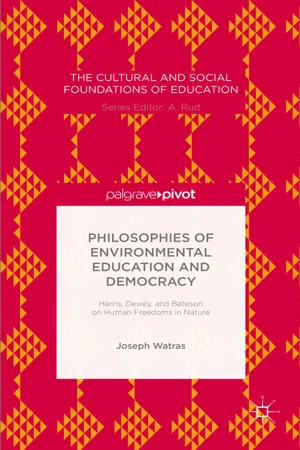
Philosophies of Environmental Education and Democracy: Harris, Dewey, and Bateson on Human Freedoms in Nature
Harris, Dewey, and Bateson on Human Freedoms in Nature
- English
- ePUB (mobile friendly)
- Available on iOS & Android
eBook - ePub
Philosophies of Environmental Education and Democracy: Harris, Dewey, and Bateson on Human Freedoms in Nature
Harris, Dewey, and Bateson on Human Freedoms in Nature
About this book
The project examines how three prominent philosophers of education - William Torrey Harris, John Dewey, and Gregory Bateson - each developed a world view that provides a philosophical basis for environmental education.
Information
Topic
EducationSubtopic
Comparative Education1
Defining the Task
Abstract: Settlers brought from Britain to the eastern shores of the United States several ideas of property and democracy that caused important problems. In the 1830s, Alexis de Tocqueville noted three tendencies among the settlers that threatened to destroy the benefits of democracy and the environment. They were individualism, materialism, and conformity. By the 1970s, the concept of ecology changed from a scientific term into a moral critique that urged people to restrain those tendencies. The process was difficult. Some critics argued that democratic governments were less effective in enacting conservation policies than authoritarian ones.
Keywords: Alexis de Tocqueville; John Locke; national parks
Watras, Joseph. Philosophies of Environmental Education and Democracy: Harris, Dewey, and Bateson on Human Freedoms in Nature. New York: Palgrave Macmillan, 2015. DOI: 10.1057/9781137484215.0003.
In recent years, colleges and universities around the world have introduced programs in environmental education. According to David John Frank, Karen Jeong Robinson, and Jared Olesen, such offerings appeared in the curriculums of universities around the world in the 1970s, and they spread dramatically in the 1990s. Such programs became the fastest growing academic area in the United States. At the same time, employers significantly increased the opportunities for graduates of such programs. According to Frank, Robinson, and Olesen, the growth of these university programs was not related to local needs but to a set of views that diffused rapidly and widely.1
Views of environmental sensitivity, sustainability, or ecological awareness may be a new perspective that spread to university campuses, as Frank, Robinson, and Olesen claim; however, the foundation for such a set of concerns began earlier. According to Anna Bramwell, the development of ecological awareness as an ethical position was a new political consciousness that derived from two strands. One strand began in the last quarter of the nineteenth century, and it built on the work of German zoologist Ernst Haekel, who coined the word “ecology” in 1866 to indicate the study of the relations among organisms and their environments. The second strand was an economics of energy that focused on the problem of non-renewable resources. She argued these ideas fused in the 1970s to produce an intensely conservative, moral critique that became popular when the twentieth century ended. Bramwell defined the ethical view of ecology as the recognition that energy flows within a closed system and that any drastic change within the system would be wrong or harmful.2
Although Bramwell focused her history on changes in the United Kingdom and Europe, a survey of articles in academic journals illustrated that the same strands appeared among scientists and literary authors in the United States. At the turn of the century, scientists used the term “ecology” to turn scientific research from constructing abstract theories to the discovery of connections among living things that could improve human agriculture and industry. By the 1970s, humanists borrowed the term as a call to unite people in a movement to restore democracy and cooperation under a traditional pastoral ideal. The following section may make clear this pattern of development.
Development of the field of ecology in America
In America, scientists began using the term “ecology” to define research that uncovered methods to improve human society. For example, when V. M. Spalding delivered his presidential address to the 1902 meeting of the Society for Plant Morphology and Physiology, he explained to his listeners that the term had entered the vocabularies of scientists only a few years earlier to define an academic area that he hoped would show how to rejuvenate forests and enhance agricultural production. In his address, Spalding noted that colleges in the United States had changed the instruction of biology and botany within a period of about 25 years. He pointed to a dramatic increase in the number of courses, books, and journals covering the biological sciences that were especially devoted to ecology to the extent that the word “ecology” had become rooted in university studies. According to Spalding, the person who advanced the work of ecologists before the field had a name was Charles Darwin, because he sought the origins of living forms by studying them in the conditions within which they lived. Noting that subsequent researchers applied the tools previously unconnected to botany, such as statistics, to determine the ways nature changed, Spalding urged the scientists in his audience to move quickly to undertake disciplined research that could apply findings about ecology to fields such as forestry and agriculture.3
The president of the Ecological Society of America made a similar plea in 1921 to include human activities in the study of ecology. Acknowledging that including human activities would make the field of ecology into an applied area of study, Stephen A. Forbes noted that the state of Illinois employed an ecologist and an entomologist to determine the ways weather conditions influenced the codling moth’s life cycle. This moth destroyed fruit tree crops, and insecticides worked best when they caught the larvae at particular stages of development. Since weather conditions affected the maturation of the moths, this information was valuable to farmers. Forbes termed such an application of science to farming as “the humanization of ecology.”4
As late as 1957, ecologists called on their colleagues to make careful, objective experiments that could clarify the aims of the field. Writing in Ecology, the journal of the Ecological Society of America, Richard S. Miller complained that the standard definition of “ecology” as the study of the relations between an organism and its environment did not distinguish this field from other biological sciences. He suggested that ecologists should recognize that they seek to discover the biological properties of populations and communities. He added that locating the properties of populations would separate the work of ecologists from those of biologists because the latter focused on individual organisms. More important, Miller thought that ecologists should conduct experiments producing measurements that defined those characteristics. It was not enough, he argued, to make observations of organisms in their environments.5
By 1970, the popular use of the term “ecology” included the notion that the spread of environmental destruction threatened the continued existence of human beings. For example, Leo Marx published an essay in the journal Science noting that competing groups expressed concerns about the preservation of nature. He suggested that since federal and state governments had rarely tried to preserve natural areas, voluntary organizations had sought to preserve the outdoor life they wanted to enjoy. Affluent and interested Americans joined organizations such as the Sierra Club or the National Wildlife Federation to work outside city limits; however, Marx noted they seldom tied their efforts to the welfare of people living in poverty. The advent of the Cold War encouraged younger people who disliked American middle-class life to argue that atomic destruction and chemical pollution threatened everyone’s lives. Marx argued that these dissenters fused a contemporary argument with a long-standing American image of the benefits of a pastoral life to forge an ecological movement.6
Although Marx claimed the inspiration for the ecological movement came from utopian nature writers, he thought that scientists from the American Association for the Advancement of Science could help resolve the problems. Marx recommended a three point strategy. The scientists could form a panel that met regularly to investigate critical environmental problems, evaluate the efficacy of government efforts up to that point, and suggest remedies. He wanted environmentalists to join forces to change people’s conceptions of the types of lives they should live, and pushed for a campaign to influence public and private institutions to limit the pursuit of profits to allow for practices that would preserve the environment.7
In the 1970s, educators began to consider ways schools could influence people to reduce the destruction of the environment. For example, James Wheeler and Nobuo Shimahara considered what they called the ethical aspects of the ecological crisis. They listed ten illusions about the economic and social conditions that led people to contribute to environmental problems. These included the belief that people had to own the latest automobile, a fine house, and the best clothes. The belief that full employment meant the economy had to grow continually required increasing amounts of natural resources. They suggested that schools could counter these misapprehensions with a growing recognition that the integrity of nature had to be protected and that people’s desires had to reflect this obligation.8
Despite the humanists’ and educators’ pleas for public campaigns and educational programs, political scientists argued that environmental problems could not be solved easily. According to Susan M. Leeson, the traditional model of property in America came from John Locke. His view was that people created private property by working on a piece of land to bring some provisions for themselves or for others. She added that the availability of land in the American frontier seemed to make this view the basis of American political thought even though critics noted that there was not enough land for everyone. As the open or available land disappeared, the National Environmental Policy Act of 1970 required federal proposals to state what would be the project’s impact on the environment. Despite this legislation, Leeson noted that federal agencies submitted proposals after 1970 for projects such as urban highway construction without revealing concern for natural resources. According to Leeson, several political scientists believed the only solution to environmental problems was for the government to become severely authoritarian. Leeson concluded that the ecological crisis offered an opportunity for people to choose the society they wanted. If people wanted to live in a democratic society, they would have to forgo their desires for cars, houses, and clothes. If they continued to circumvent reasonable regulations, some forceful agency would have to control their animal drives for human life to continue. Leeson hoped that people could reaffirm their capacities for reason and create an intelligible and sustainable order for themselves.9
Traditional American views of relation of society to the environment
When Leeson claimed John Locke provided the basis of American’s views of the relationship of nature and personal property, she repeated the ideas of many political scientists that Locke’s treatises of government principles underlay the creation of modern democracies. Locke divided the treatises into two parts. In the first, he refuted the view that monarchs had a right to rule. In the second, he argued that people justified their ownership of property by laboring upon the land to bring forth goods that people could use.10 This was the idea that Harris used.
Writing in 1689, Locke argued that God had given the world and all its creatures to humankind for them to use for their comfort and convenience. Although this implied that nature’s bounty was for all people, Locke used America as an example to contend that the fruit or venison that an Indian consumed belonged to that Indian because it had become part of his or her body. Since the labor of any person belonged t...
Table of contents
- Cover
- Title
- Introduction
- 1 Defining the Task
- 2 Developing Freedom within Social Institutions: William Torrey Harris and the St. Louis Hegelians
- 3 Pragmatism and Ecological Conservation: The Ideas of John Dewey
- 4 Science, Imagination, and the Environmental Movement: Gregory Batesons Views
- Where Do We Go from Here?
- Index
Trusted by 375,005 students
Access to over 1.5 million titles for a fair monthly price.
Study more efficiently using our study tools.
Frequently asked questions
Yes, you can cancel anytime from the Subscription tab in your account settings on the Perlego website. Your subscription will stay active until the end of your current billing period. Learn how to cancel your subscription
No, books cannot be downloaded as external files, such as PDFs, for use outside of Perlego. However, you can download books within the Perlego app for offline reading on mobile or tablet. Learn how to download books offline
Perlego offers two plans: Essential and Complete
- Essential is ideal for learners and professionals who enjoy exploring a wide range of subjects. Access the Essential Library with 800,000+ trusted titles and best-sellers across business, personal growth, and the humanities. Includes unlimited reading time and Standard Read Aloud voice.
- Complete: Perfect for advanced learners and researchers needing full, unrestricted access. Unlock 1.5M+ books across hundreds of subjects, including academic and specialized titles. The Complete Plan also includes advanced features like Premium Read Aloud and Research Assistant.
We are an online textbook subscription service, where you can get access to an entire online library for less than the price of a single book per month. With over 1.5 million books across 990+ topics, we’ve got you covered! Learn about our mission
Look out for the read-aloud symbol on your next book to see if you can listen to it. The read-aloud tool reads text aloud for you, highlighting the text as it is being read. You can pause it, speed it up and slow it down. Learn more about Read Aloud
Yes! You can use the Perlego app on both iOS and Android devices to read anytime, anywhere — even offline. Perfect for commutes or when you’re on the go.
Please note we cannot support devices running on iOS 13 and Android 7 or earlier. Learn more about using the app
Please note we cannot support devices running on iOS 13 and Android 7 or earlier. Learn more about using the app
Yes, you can access Philosophies of Environmental Education and Democracy: Harris, Dewey, and Bateson on Human Freedoms in Nature by Joseph Watras in PDF and/or ePUB format, as well as other popular books in Education & Comparative Education. We have over 1.5 million books available in our catalogue for you to explore.