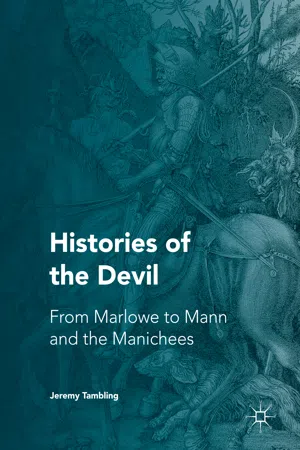
This book is about representations of the devil in English and European literature. Tracing the fascination in literature, philosophy, and theology with the irreducible presence of what may be called evil, or comedy, or the carnivalesque, this book surveys the parts played by the devil in the texts derived from the Faustus legend, looks at Marlowe and Shakespeare, Rabelais, Milton, Blake, Hoffmann, Baudelaire, Goethe, Dostoevsky, Bulgakov, and Mann, historically, speculatively, and from the standpoint of critical theory. It asks: Is there a single meaning to be assigned to the idea of the diabolical? What value lies in thinking diabolically? Is it still the definition of a good poet to be of the devil's party, as Blake argued?
- English
- ePUB (mobile friendly)
- Available on iOS & Android
eBook - ePub
About this book
Information
© The Author(s) 2016
Jeremy TamblingHistories of the Devil10.1057/978-1-137-51832-3_2Chapter 1: ‘The Tempter or the Tempted, Who Sins Most?’
Jeremy Tambling1
(1)
London, United Kingdom
How art thou fallen from heaven, O Lucifer [‘day star’, margin], son of the morning! How art thou cut down to the ground, which didst weaken the nations.
For thou hast said in thine heart, I will ascend into heaven, I will exalt my throne above the stars of God, I will sit also upon the mount of the congregation in the sides of the north;
I will ascend above the heights of the clouds; I will be like the most High.
Yet thou shalt be brought down to hell, to the sides of the pit.
(Isaiah 14: 12–15)
Marlowe’s Doctor Faustus is the subject then, and building on that, in moving to Shakespeare, the soliloquy, as the privileged medium for the devil’s appearance.
Georg Helmstetter (or Georgius of Helmstadt – his family name unknown) was an apparently ‘white’ magician who was born c.1466, heard of in Heidelberg in 1483, known through some eight extant documents, and recorded as dead in Staufen-im-Breisgau around 1539. Helmstetter seems to have been ‘Magister Georgius Sabellicus, Faustus junior, fons necromanticorum, astrologus, magus secundus, agromanticus, pyromanticus…’ and again, ‘Georgius Faustus…a mere braggart and a fool’ (quoted, Bevington and Rasmussen 1993: 4). So he called himself ‘Faustus’. ‘Sabellicus’ is Latin: meaning north of Rome, land of the Sabines, associated with the occult. ‘Magus’ relates to Simon Magus. Luther seems to have been fascinated by the name, and implicitly aligned Helmstetter with the Faustus the Manichee who had oppressed Augustine, while Melanchthon (1497–1560), Luther’s co-Reformer, linked Helmstetter with Simon Magus and Cornelius Agrippa (Laan and Weeks 2013: 129, 50–52, 67–91, 154–162).
Influenced by Melanchthon and Luther, who believed that every magician made a pact with the devil (Baron 1978: 78), the anonymous German Faustbuch appeared in 1587, and in an English version, by the possibly Calvinist ‘P.F.’, as The Historie of the Damnable Life and Deserved Death of Doctor John Faustus. Here appears Faustus’ ‘miserable and lamentable end’ (chapter 62, title), Faustus confessing to his students, who find his written history after his death:
I die both a good and bad Christian; a good Christian, for that I am heartily sorry, and in my heart always pray for mercy that my soul may be delivered: a bad Christian, for that I know the devil will have my body, and that would I willingly give him so that he would leave my soul in quiet…(Jones 1994: 178).
The translation appeared in 1592; perhaps earlier, according to John Henry Jones’ edition of The English Faust Book. Jones prefers late 1588, followed by Marlowe’s play in 1589. The year 1590 witnessed the production of Robert Greene’s comic-historical play Friar Bacon and Friar Bungay, which borrows from the Faust Book, from an anonymous mid-sixteenth-century prose romance, The Famous Historie of Friar Bacon, and from Marlowe. It has dealings with the devil as its subject (Jones 1994: 66–72, 256–258). Marlowe’s play, then, seems to be from one, or two, or many Faust versions, some predating Helmstetter, and which may even have their own English independent counterpart in the rhyme of Dr Forster who went to Gloucester; perhaps indicating too the pronunciation of the English Faustus, to suit with ‘we must perform/The form of Faustus’ fortunes…’ (Doctor Faustus, Prologue A, 6–7). Similarly, the eponymous hero of the anonymous comedy The Merry Devil of Edmonton (1608) was the fifteenth-century Peter Fabell, who had ‘beguiled the Devell by pollicie’ (ODNB): he is the ‘merry devil’ himself, as Launcelot Gobbo is (The Merchant of Venice 2.3.2).
Jones’ dating agrees with William Empson, for whom Doctor Faustus predates P.F.’s 1592 Faustbuch, saying it was acted before Henslowe’s company gave its first recorded performance, i.e. 1594. The ambivalence within Doctor Faustus shows in the play’s tensions between its forward daring and its debt to late medieval morality plays (see Chapter 2) (Brockbank 1962: 16–23). That is also apparent in Friar Bacon and Friar Bungay. Empson notes its double plot: one the wooing by the courtiers, including the future Edward the First, of Margaret, a Perdita-like country girl; the other comprises incidents from the thirteenth-century figure of the magus Roger Bacon (‘wise Bacon’, Doctor Faustus A.1.1.156), who seems a parallel to the later Peter Fabell. Bacon commands devils, having the power of a glass which can see things at a distance, and into the future; he desires to make a brazen head whose prophecies will give him status, and as a patriot, wants to wall England round with brass (compare Faustus A 1.1.90). The play’s nationalism makes him beat the German magus, Vandermast, returning him to Germany, transported by the Hercules whom he has raised up. Faustus’ pupil is Friar Bungay, his comic servant Miles, who lets him down over the appearance of the brazen head, for which he goes to hell, on the devil’s back (but Miles wears the spurs, so the devil is put to it). However, Friar Bacon breaks the glass, renouncing his magic.
Friar Bungay tells Vandermast, who is surely a reply to Doctor Faustus, that ‘magic haunts the grounds’ (Friar Bacon and Friar Bungay 9.46). For Empson, that is a claim for ‘the value of matter’, which he takes to be:
the essential novelty of the Renaissance. (Matter is not evil and made from nothing but part of God from which God willingly removed his will: one can therefore put [more] trust in the flesh, the sciences, the natural man…) (Empson 1965: 33–34).
Empson supports this via his own anti-Augustinianism, and anti-Manicheism. He almost equates the double plot, which he says English drama up to 1642 did not outlive, with the devil. Doctor Faustus shows the double plot with Robin the Ostler (a Miles figure) and Rafe, not co-incidentally the fool’s name in Friar Bacon and Friar Bungay; and their attempts to conjure the Devil.
1 Doctor Faustus: The Good Angel and the Spirit
Empson accounts for the differences between Doctor Faustus A and B by arguing for a censorship affecting all published editions of the play, turning it towards an orthodoxy which Marlowe lacked. He notes the reference to ‘infernal, middle and supreme powers’ (Jones 1994: 99) who witness the bargain that Faustus seals with Mephistopheles (Mephostophiles in the Faust Book: the name’s meaning is given as ‘no friend to light’, or ‘the light is not a friend’: Empson 1965: 203). Jones annotates powers as ‘nature spirits, e.g. nymphs, goblins, salamanders, etc.’ (Jones 1994: 193, compare; Empson 1987: 98–106). As Oberon distinguishes himself from damned spirits of the night, saying ‘But we are spirits of a different sort; / I with the morning’s love have oft made sport’ (A Midsummer Night’s Dream 3.2.388–389), so here. The powers fit Valdes’ simile, when, alluding to Mexico, and Peru, he says: as ‘Indian Moors obey their Spanish lords,/So shall the subjects of every element / Be always serviceable to us three’ (Doctor Faustus 1.1.123–125). Although Faustus has said that ‘necromantic books are heavenly’ (1.1.52), so claiming black magic, the Evil Angel tempts him less to ‘evil’ than to Tamburlaine-like exploration and dominion:
Go forward, Faustus, in that famous art
Wherein all nature’s treasury is contained.
Be thou on earth as Jove is in the sky,
Lord and commander of these elements.
(Doctor Faustus 1.1.76–79)
For Empson, Faustus compacts not with the devil, but middle spirits, another example of whom might be Ariel, in The Tempest, servant of Prospero, whose name translates as Faustus (fortunate). These ‘middle spirits’ are fairies; in Empson’s plotting, ‘Marlowe supposes a Middle Spirit who is a quisling or rather a double agent, professing to work for the devils, and actually inducing them to grant their powers to Faust, but on condition that Faust gives his immortal soul beforehand to the quisling’ (Empson 1987: 121). This is lost in censorship. Reading Empson’s view allegorically, rather than literally, might allow thinking that Marlowe revised the moralistic Faust Book to admit white magic, and affirm the presence of something other than the opposites present in Augustine; the play makes magic wonderful, and non-Christian, as well as diabolical.
In A, apart from the Iago-like ‘aside’, ‘O what will I not do to obtain his soul?’ (Doctor Faustus 2.1.73), the strategy revealed of the Tempter, the devil (Matthew 4:3), Mephistopheles is less active than melancholic, aware of his own loss, repeating endlessly ‘Lucifer’ (Doctor Faustus 1.3.41–100), who, as a son ‘most dearly loved of God’ lost heaven ‘by aspiring pride and insolence’, and who is eroticised in the lines: ‘as beautiful / As was bright Lucifer before his fall’ (2.1.160–161). Lucifer is ‘Lightborne’ in Edward the Second: he sodomises the king with a red-hot spit. The B text turns Beelzebub, an Old Testament god (2 Kings 1:2) into Lucifer’s ‘dam’ (Doctor Faustus, B.2.3.95), and makes Mephistopheles, the ‘familiar spirit’ (A. 4.1.4) more malicious:
’Twas I, that, when thou wert i’ the way to heaven
Damned up thy passage. When thou took’st the book
To view the Scriptures, then I turned the leaves
And led thine eye.
(B.5.2.95–101)
Mephistopheles says Faustus ‘begets a world of idle fantasies/To overreach the devil’ (B.5.2.14, 15). Hyperbole is the figure for overreaching (OED 1579 citation); Feste calls the Malvolio’s demon ‘hyperbolical fiend’ (Twelfth Night 4.2.22), though ‘to overreach’ may also mean to defraud, by language (OED vb.5b), so that diabolism works by hyperbole and by guile. Faustus as ‘overreacher’, like the base-born Tamburlaine (see Levin 1954), would also exceed God:
Excelling all whose sweet delight disputes
In heavenly matters of theology;
Till, swoll’n with cunning of a self-conceit.
His waxen [cp. ‘waxing’] wings did mount above his reach
And melting heavens conspired his overthrow[.]
(A Prologue 18–23)
Theology’s danger is disputing over texts which circle around what cannot be known, the mastery of which, creating pride (hence ‘swollen’), becomes apparent when it seems the heavens have ‘conspired’ (but with whom? Hell?) to destroy him; the Icarus imagery makes him Luciferian.
The Chorus’ narrative of his fall (is all up with Faustus before his soliloquy?) is difficult to correlate with what opens with ‘the man that in his study sits’. Is his ‘study’, his location, or his occupation? Faustus says ‘settle thy studies, Faustus’, as if they were unsettled. And to make a comparison, Macbeth says ‘I am settled’ (1.7.80) when resolved to murder Duncan. Which is diabolical, an unsettled state (the devil among the books), or a settled one? Following Benjamin, ‘the Renaissance explores the universe; the baroque explores libraries. Its meditations are devoted to books’ (Benjamin 1977: 140), Faustus is melancholic, baroque; like Prospero, who thought his library was dukedom enough (The Tempest 1.2.109–110). Faustus has exceeded and rejected the university faculties: philosophy (logic), medicine, law, and theology, to pursue magic, since ‘a sound magician is a mighty god’ (A1.1.64), but he is self-divided, introspective, of the baroque, as Benjamin (1977: 152, 179), claims Agrippa of Nettesheim to be saturnine, melancholic.
Faustus starts with a ‘self-discourse’ (Williams 1983: 48), addressing the self as an other, a second person, as if looking at himself (as every speaker of a soliloquy must know s/he is being looked at: the question is by whom). There may be three people present in Faustus’ speech to Mephistopheles:
I charge thee wait upon me whilst I live,
To do whatever Faustus shall command.…
(1.3.37–38)
In The Jew of Malta (c.1590), Barabas, who speaks half the lines in the play, many in soliloquy form, starts with a sentence in mid-flow. Richard the Third also starts with a soliloquy (uniquely in Shakespeare – as though the Machevill speaking the Prologue in The Jew of Malta becomes, in Shakespeare’s tragedy, Richard the Machiavel speaking his own prologue). Richard passes from ‘our’, to ‘I’ and then, addressing as ‘Thoughts’ the other which, as inside him, makes him speak, he says: ‘Dive, thoughts, down to my soul, here Clarence comes’ (Richard the Third 1.1.41). This address to a named part of the self, such as the faculty of Thought, C.S. Lewis associates with late Latin literature, specifically Prudentius, in Psychomachia (c. ce 400), where different qualities fight for possession of the soul. So Lewis writes:
to fight against ‘Temptation’ is also to explore the inner world; and it is scarcely less plain that to do so is to be already on the verge of allegory. We cannot speak, perhaps we can hardly think, of an ‘inner conflict’ with...
Table of contents
- Cover
- Frontmatter
- Introduction: Literature and Manicheism
- Chapter 1: ‘The Tempter or the Tempted, Who Sins Most?’
- Chapter 2: Medieval and Early Modern Devils: Names and Images
- Chapter 3: From Carnival to King Lear: Ships, Dogs, Fools, and the Picaro
- Chapter 4: Fallen Fire: Job, Milton, and Blake
- Chapter 5: Masks, Doubles, Nihilism
- Chapter 6: Goethe: Faust and Modernity
- Chapter 7: Dostoevsky: Murder and Suicide
- Chapter 8: Bulgakov, Mann, Adorno, and Rushdie
- Backmatter
Trusted by 375,005 students
Access to over 1.5 million titles for a fair monthly price.
Study more efficiently using our study tools.
Frequently asked questions
Yes, you can cancel anytime from the Subscription tab in your account settings on the Perlego website. Your subscription will stay active until the end of your current billing period. Learn how to cancel your subscription
No, books cannot be downloaded as external files, such as PDFs, for use outside of Perlego. However, you can download books within the Perlego app for offline reading on mobile or tablet. Learn how to download books offline
Perlego offers two plans: Essential and Complete
- Essential is ideal for learners and professionals who enjoy exploring a wide range of subjects. Access the Essential Library with 800,000+ trusted titles and best-sellers across business, personal growth, and the humanities. Includes unlimited reading time and Standard Read Aloud voice.
- Complete: Perfect for advanced learners and researchers needing full, unrestricted access. Unlock 1.5M+ books across hundreds of subjects, including academic and specialized titles. The Complete Plan also includes advanced features like Premium Read Aloud and Research Assistant.
We are an online textbook subscription service, where you can get access to an entire online library for less than the price of a single book per month. With over 1.5 million books across 990+ topics, we’ve got you covered! Learn about our mission
Look out for the read-aloud symbol on your next book to see if you can listen to it. The read-aloud tool reads text aloud for you, highlighting the text as it is being read. You can pause it, speed it up and slow it down. Learn more about Read Aloud
Yes! You can use the Perlego app on both iOS and Android devices to read anytime, anywhere — even offline. Perfect for commutes or when you’re on the go.
Please note we cannot support devices running on iOS 13 and Android 7 or earlier. Learn more about using the app
Please note we cannot support devices running on iOS 13 and Android 7 or earlier. Learn more about using the app
Yes, you can access Histories of the Devil by Jeremy Tambling in PDF and/or ePUB format, as well as other popular books in Literature & Literary Criticism. We have over 1.5 million books available in our catalogue for you to explore.