
eBook - ePub
Social Franchising
About this book
Social franchising represents a third generation form of franchising development, after trade-name and business-format franchising. At the intersection of social enterprise and micro finance literatures, this book reviews a variety of social franchising formats across a number of developing countries.
Information
1
Social Franchising as Organizational Format – An Overview
Anita du Toit
Abstract: In Chapter 1, Anita du Toit of Franchising Plus, South Africa, provides an overview of social franchising as an organizational format. Her chapter is an exploratory study of literature on social franchising as an organizational format. Chapter 1 consists of a review of available literature on social franchising, with notes on a social franchising project in South Africa in which the author is a consultant. The findings show that although social franchising predominantly exists in the health sector, there is a wide scope of services that may be franchised provided that certain criteria contributing to the success of a social franchise model is met. It also shows that there is scope for government social franchises, where government departments participate as franchisor.
Alon, Ilan, ed. Social Franchising. Basingstoke: Palgrave Macmillan, 2014. DOI: 10.1057/9781137455840.0005.
Introduction
Franchising, with its origins in the United States, has become one of the most popular expansion methods and distribution strategies in the world today. It seems that there is no limit to the concepts that can be franchised; from pet care to restaurants, from domestic cleaning services to waste removal, there are multitudes of franchise systems operating in the world today. As an expansion mechanism, franchising has the benefit of reduced capital investment for the franchisors. Franchisees gain access to business systems and formats that have been tried and tested.
A relatively new concept in franchising is social franchising. Social franchising, also referred to as not-for-profit franchising, entails the franchising of goods and services for social rather than commercial goals. ‘First-generation’ social franchises were funded by the United States Agency for International Development in Mexico in the early 1990s (Montagu, 2002). The interest in social franchising is gaining momentum around the world, as non-governmental organizations (NGOs) and social-aid programmes are considering franchising as a mechanism to deliver services and products that have social goals. The benefits of franchising, including expansion with reduced capital and the replication of a proven business system, are attractive to practitioners in the not-for-profit sector.
This chapter provides an overview of social franchising, the issues surrounding its implementation and its potential applications. The chapter is exploratory in nature and is based on an overview of literature available on the subject, as well as one in-depth interview with a practitioner. The goal of the chapter is to provide an introduction to social franchising, its potential applications and some theories on social franchising programme implementation. It also refers to a current project that the author is involved with in social franchising in South Africa.
Franchising as organizational format
Franchising is an agreement between two legal entities, the franchisor and the franchisee: ‘The franchisor is a parent company that has developed some product or service for sale; the franchisee is a firm that is set up to market this product or service in a particular location’ (Castrogiovanni and Justis, 1998). However, franchising is more than an agreement. It is the replication of a proven business formula and system. It is a business relationship with mutual benefits to franchisor and franchisees. This is known as business-format franchising.
The business-format franchise is also described as the ‘carbon-copy’ format, so called because of the replication of a formula and the controls applied to ensure adherence (Castrogiovanni and Justis, 1998). It exceeds the franchising of a mere brand name, since the franchise includes a self-contained business operation. Business-format franchising is held in high regard in franchising circles, since it usually provides franchisees with business know-how and continued management support from the franchisor.
Across the globe, franchising is at various stages of development. As the concept originated in the United States, it can be expected that the franchising industry in that particular country has reached maturity. In less developed countries, such as Singapore and South Africa, it is still seen as a vehicle for stimulating economic growth, especially because of the entrepreneurial component of franchising.
A franchised organization as a business system experiences many of the same management issues found in other non-franchised organizations. However, managerial problems and constraints occur due to franchising’s unique attributes. These differentiating features include the following: a geographic dispersal of organization units, replication across units and joint ownership (Castrogiovanni and Justis, 1998). The unique problems facing franchisors in managing their franchised brands usually revolve around these differences.
In transitional economies, franchising could potentially contribute to increased management knowledge and skills, improved productivity, the creation of effective distribution channels, the enhancement of product development and consequently the increase of overall income (Sanghavi, 1998). However, some negative factors may inhibit growth of franchising in countries that are not classified as developed. Lack of managerial and entrepreneurial talent, lack of capital for international franchising expansion, political instability/risk and underdeveloped infrastructure are all challenges (Alon, 2004).
Definitions of social franchising
The definitions of social franchising mostly refer to it as franchising with social, rather than profit-making goals. Montagu (2002) defines a social franchise as ‘... a franchise system, usually run by a non-governmental organization, which uses the structure of a commercial franchise to achieve social goals’. Smith (2002) also mentions ‘social rather than commercial goals’ when defining social franchising. She sees social franchising as analogous to social marketing, specifically when social franchising is applied in the arena of reproductive health services.
It is important to note the difference between social franchising and social enterprise. While a social enterprise also has social goals, it is not necessarily distributed through the mechanism of franchising. A social enterprise is a business with social objectives and has as its goal reinvestment in the community, as opposed to profit maximization for shareholders (Du Toit, 2003). Traditionally, these businesses are NGOs or charities that exist to promote social services to the communities that they are based in. Figure 1.1 provides a comparison between social enterprise and social franchising.
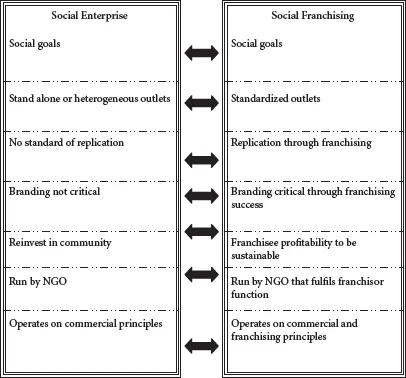
FIGURE 1.1 Social enterprise vs social franchising
The British government is actively promoting social enterprise as a means to ‘bring excluded groups into the labor market’, promote urban regeneration, contribute to socially inclusive wealth creation, to develop ‘active citizenship’ and to encourage new ways of delivering social services (Du Toit, 2003). According to the International Centre for Social Franchising, there are currently about 100 registered social franchises in the United Kingdom alone (International Centre for Social Franchising, n.d.).
The interest in social franchising and social enterprise should be seen in the context of the emergence of what is known as the social economy. While communism has failed as an economic model, capitalism has also started to show its flaws. The collapse of corporate giant Enron and other scandals in the corporate world have fuelled public distrust in what was once the pride of the capitalist economy. Corporate greed is increasingly frowned upon, and a new breed of activists, commonly referred to as the anti-globalization movement, seems to oppose anything to do with ‘big business’.
In the social economy, corporate responsibility takes on a new meaning of what is good and desirable for the ‘human good’. Academics and practitioners alike are beginning to realize that business inherently consists of a combination of social and economic functions. Economic activity and transactions are socially organized and take place through social networks and relations. As much as each individual is part of a social subset, each business entity is part of a social structure through the individuals that make up the organization and its relations with the outside world. Business does not exist in a vacuum but as a part of society. As such, it has responsibilities towards society. Therefore, the view of the economy is changing from self-interest and ‘self-possessive individualism’ towards an approach that encompasses the social environment in which markets operate (Sauer, 1997).
Social franchising and social enterprise should not be confused with philanthropy. It is not practical benevolence or charity but the management of businesses with social goals in a manner that is business-like and efficient. Practitioners in this market refer to social enterprises as ‘profit-making, not profit-taking’ (Du Toit, 2003). This implies that these enterprises make enough profit to be sustainable and to achieve and promote their social goals, but they do not take profit out of the community or distribute it to any other shareholders.
All the definitions of social franchising and social enterprise refer to the achievement of social goals. However, the pursuit of social goals does not negate the importance of running these businesses on commercial principles to ensure their continuity and longevity. With grants and donor funds seemingly decreasing, these businesses need to make enough profit to achieve sustainability. Thus, social enterprises and social franchises need to operate on commercial principles, but not for the attainment of commercial goals.
To summarize, social franchis...
Table of contents
- Cover
- Title
- Introduction
- 1 Social Franchising as Organizational Format An Overview
- 2 Overcoming Institutional Challenges in Microfranchising
- 3 The Scope for Scaling Up Social Enterprises in China
- 4 Access Afya: Micro-Clinic Health Franchise Designed for Scale
- 5 World Vision: Catalysing the growth of Microfranchising in Tanzania
- Index
Trusted by 375,005 students
Access to over 1.5 million titles for a fair monthly price.
Study more efficiently using our study tools.
Frequently asked questions
Yes, you can cancel anytime from the Subscription tab in your account settings on the Perlego website. Your subscription will stay active until the end of your current billing period. Learn how to cancel your subscription
No, books cannot be downloaded as external files, such as PDFs, for use outside of Perlego. However, you can download books within the Perlego app for offline reading on mobile or tablet. Learn how to download books offline
Perlego offers two plans: Essential and Complete
- Essential is ideal for learners and professionals who enjoy exploring a wide range of subjects. Access the Essential Library with 800,000+ trusted titles and best-sellers across business, personal growth, and the humanities. Includes unlimited reading time and Standard Read Aloud voice.
- Complete: Perfect for advanced learners and researchers needing full, unrestricted access. Unlock 1.5M+ books across hundreds of subjects, including academic and specialized titles. The Complete Plan also includes advanced features like Premium Read Aloud and Research Assistant.
We are an online textbook subscription service, where you can get access to an entire online library for less than the price of a single book per month. With over 1.5 million books across 990+ topics, we’ve got you covered! Learn about our mission
Look out for the read-aloud symbol on your next book to see if you can listen to it. The read-aloud tool reads text aloud for you, highlighting the text as it is being read. You can pause it, speed it up and slow it down. Learn more about Read Aloud
Yes! You can use the Perlego app on both iOS and Android devices to read anytime, anywhere — even offline. Perfect for commutes or when you’re on the go.
Please note we cannot support devices running on iOS 13 and Android 7 or earlier. Learn more about using the app
Please note we cannot support devices running on iOS 13 and Android 7 or earlier. Learn more about using the app
Yes, you can access Social Franchising by I. Alon in PDF and/or ePUB format, as well as other popular books in Business & Business Strategy. We have over 1.5 million books available in our catalogue for you to explore.