- English
- ePUB (mobile friendly)
- Available on iOS & Android
eBook - ePub
About this book
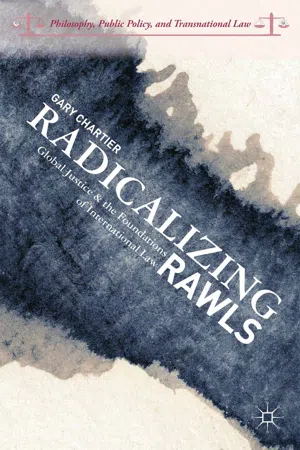
This book is a critical examination of John Rawls's account of the normative grounds of international law, arguing that Rawls unjustifiably treats groups - rather than particular persons - as foundational to his model of international justice.
Information
Chapter 1
Rawls’s Starting Point
I. Rawls’s Understanding of Global Justice Is People Based
Rawls offers an account of global justice and the grounds of global law expressed in what he calls “the Law of Peoples.”1 Peoples are like states, but they lack some of the more obviously dubious features of states (Part II). It is representatives of peoples whose deliberation in a (two-part) global version of Rawls’s familiar “original position” yields the content of the Law of Peoples; thus, Rawls’s approach treats peoples as basic to a just global order (Part III). Such a Law would contain what Rawls takes to be the most crucial elements of a refined version of current international law (Part IV). The broad category of “well-ordered” peoples includes both liberal peoples and those Rawls calls “decent nonliberal” peoples (Part V). Rawls’s adoption of a people-based approach leads to conclusions that are less appealing from the standpoint of individuals around the globe than a cosmopolitan alternative (Part VI). His entire project, organized around the needs and concerns of peoples, reflects the features of his starting point (Part VII).
II. Peoples Exhibit Many, but Not All, of the Features of States
Rawls treats peoples as the foundational elements of the global order elaborated in the Law of Peoples.
He attends to two kinds of peoples: liberal peoples and decent nonliberal peoples—these two groups together constituting a group he terms well-ordered peoples. His theory also address three other kinds of political units: outlaw states, societies burdened by unfavorable conditions, and benevolent absolutisms.2
United by its members’ “common sympathies,”3 a people is not a state. A state, for Rawls, is an entity that claims to be sovereign; peoples, by contrast, are organized societies that lack the kind of absolute sovereignty characteristically predicated of Westphalian states.4 Thus, peoples do not suppose themselves free to use military force—except to defend themselves or others against aggression—or to abuse the globally recognized human rights of persons within their borders.5 In addition, according to Rawls, peoples differ from states because states are primarily or exclusively self-interested.6 The interests, and therefore the actions, of states are unlimited by justice.7 By contrast, we can, Rawls supposes, attribute moral motives to peoples.8
The rights and duties of peoples are rooted in the Law of Peoples, which can be understood as a product of their own reasonable agreement.9 Peoples, Rawls imagines, treat other peoples as their equals10 and accept reasonable limits on their behavior,11 acknowledging and acting on principle rather than focusing exclusively on the satisfaction of their own interests by whatever means prove necessary.12
Peoples might be expected to be structured on the basis of cultural affinity. But Rawls does not imply that peoples will or should be constructed from scratch. Rather, we may assume that peoples will typically be transformed versions of existing states—ones whose domestic political institutions and attitudes toward other societies take on appropriate characteristics.13
III. Peoples Play Foundational Roles in Rawls’s Second Original Position
The Law of Peoples is understood as the product of (two-part) deliberation in a global original position.
A Theory of Justice introduced Rawls’s readers to an imaginative device that embodies some of our culture’s most deeply rooted convictions about justice. We should think of a society’s legal-cum-political rules and institutions as fair, he suggests, if they conform to principles that representatives of the society’s members would adopt behind a “veil of ignorance” in the “original position.”14 This device is best seen as a way of dramatizing what it would mean for people to choose reasonably—the focus is not on, say, how people with particular psychic characteristics likely would choose but on how reasonable people should choose.15
People deliberating behind a domestic veil of ignorance do not know the circumstances, abilities, life chances, or moral or religious convictions of those they represent in the real world of their society.16 Thus, the deliberators in the original position, all of whom are equal in status and influence, would settle on the requirement that everyone enjoy “the same indefeasible claim to a fully adequate scheme of equal basic liberties, which scheme is compatible with the same scheme of liberties for all.”17 For Rawls, the basic liberties enjoy “lexical priority”: they cannot be infringed in the interests of material well-being (though Rawls sometimes seems to have doubts about this). Deliberators in the original position would judge social and economic inequalities appropriate only if “attached to offices and positions open to all under conditions of fair equality of opportunity.”18 And they would likely decide that institutions shaping the distribution of wealth in their society should be shaped in accordance with what Rawls terms the “Difference Principle,” according to which basic legal and political rules and institutions should be structured in such a way that they work to the advantage—indeed, that they maximize the welfare—of the class made up of those who are least well off—the working poor.19
Rawls envisions another sort of original position, this time global, in The Law of Peoples. While the occupants of the original position at the domestic level represent individuals or families,20 the “second original position” at the global level is occupied by representatives of peoples, viewed as unitary entities.21 Deliberation in the original position at the global level takes place in two phases. In the first, only liberal societies are represented. The principles of global justice endorsed in this original position are then shown to be acceptable to decent nonliberal peoples represented in a second original position in which liberal societies do not participate. There is no global original position within which both liberal and nonliberal societies participate simultaneously. It will be simpler, however, to refer subsequently to Rawls’s account of global justice as involving “a global original position.”22
IV. Rawls’s Law of Peoples Features a Version of Contemporary International Law Norms
Rawls’s Law of Peoples comprises a set of norms designed to guide the “foreign policy of a reasonably just liberal people,”23 though these norms are also ultimately intended to structure the “realistic utopia” Rawls calls “the Society of Peoples”—a cooperative, peaceful, global community.24 The Law of Peoples is intended to be followed by individual societies—whether or not those societies or others are committed to its principles. Thus, even in a world in which many peoples did not conform to this Law, individual peoples would still be bound by it and could rightly demand that others conform to it.25
A just Law of Peoples, for Rawls, is one that would be endorsed behind a veil of ignorance among representatives of (the dominant actors in) both liberal and decent nonliberal societies. The Law of Peoples is a refinement of current norms of international law.26 Rawlsian deliberators do not reflect (like their counterparts at the domestic level) on a potentially unlimited range of possible conceptions of justice. Instead, they are depicted as beginning with, and evaluating, existing international law norms and as going on to embrace principles safeguarding their independence and equality of status, requiring them to keep their agreements, limiting their forcible intervention in one another’s affairs, protecting their rights to self-defense, limiting their rights to go to war to defensive cases, requiring justice in war and respect for human rights, holding them responsible for agreements made in their names or on their behalf, and requiring assistance for burdened societies.27 Rawls suggests that equal representatives of well-ordered peoples, deliberating behind a veil of ignorance, would endorse these traditional principles with some qualifications,28 with the addition of rules related to the operation of associations of particular peoples, to trade, and to other common activities.29
V. Decent Nonliberals Respect Some, but Not All, Human Rights
A nonliberal society qualifies as decent, in Rawls’s terms, if it meets several conditions.
• It must not be aggressive. Its legal order must serve the common good and protect human rights.
• Its legal norms must possess moral legitimacy from the standpoint of its people. It must view its people as responsible moral actors.
• Its officials must act on the assumption that its legal and political order does and must embody a genuine concern for the common good.30
While he observes that other models are possible, Rawls focuses on (imagined) decent hierarchical peoples he depicts as associationist as examples of decent nonliberal peoples.31 In these societies, people are related to the body politic as members of various societal groups with presumed commonalities of interest. An associationist model, Rawls suggests, might be preferred by those who find liberal society deracinated and who conceive of individuals’ identities as to a great degree conferred by the groups to which they belong.32 A decent hierarchical society seeks and preserves the common good by means of an array of bodies representing various organic social groups, all of which must be consulted before important public decisions are made,33 with the understanding that every member of a decent hierarchical society is a member of one or more represented groups.34 Because each group’s views must be taken into account by policy makers, membership in the various represented groups offers opportunities for people to express opinions regarding matters of public concern and to challenge government positions, and government officials are required to respond to challenges,35 justifying their policies with reference to the common good,36 making clear how their policies sustain a fair cooperative social scheme.37
Rawls evidently opts for this consultative structure because there is, he suggests, some historical precedent for it in Muslim political theory.38 He proposes an imagined Muslim people, Kazanistan, as a model decent nonliberal society, perhaps because he is concerned with the viability for Muslims in particular of the consultative hierarchical model he has proposed.39
A decent nonliberal society may have an official religion—or an official comprehensive doctrine of some other kind. That it does, however, need not call into question its status as a decent society, because it declines to propagate its comprehensive doctrine by force and it allows...
Table of contents
- Title Page
- Copyright Page
- Dedication
- Contents
- Acknowledgments
- Introduction
- 1. Rawls’s Starting Point
- 2. Rawls’s Explicit Defense of the Equality of Peoples
- 3. Challenging the Global Primacy of Peoples
- 4. Defining and Implementing a Law of Persons
- 5. Market Democracy, Market Anarchy, and Global Justice
- Conclusion
- Notes
- About the Author
Trusted by 375,005 students
Access to over 1.5 million titles for a fair monthly price.
Study more efficiently using our study tools.
Frequently asked questions
Yes, you can cancel anytime from the Subscription tab in your account settings on the Perlego website. Your subscription will stay active until the end of your current billing period. Learn how to cancel your subscription
No, books cannot be downloaded as external files, such as PDFs, for use outside of Perlego. However, you can download books within the Perlego app for offline reading on mobile or tablet. Learn how to download books offline
Perlego offers two plans: Essential and Complete
- Essential is ideal for learners and professionals who enjoy exploring a wide range of subjects. Access the Essential Library with 800,000+ trusted titles and best-sellers across business, personal growth, and the humanities. Includes unlimited reading time and Standard Read Aloud voice.
- Complete: Perfect for advanced learners and researchers needing full, unrestricted access. Unlock 1.5M+ books across hundreds of subjects, including academic and specialized titles. The Complete Plan also includes advanced features like Premium Read Aloud and Research Assistant.
We are an online textbook subscription service, where you can get access to an entire online library for less than the price of a single book per month. With over 1.5 million books across 990+ topics, we’ve got you covered! Learn about our mission
Look out for the read-aloud symbol on your next book to see if you can listen to it. The read-aloud tool reads text aloud for you, highlighting the text as it is being read. You can pause it, speed it up and slow it down. Learn more about Read Aloud
Yes! You can use the Perlego app on both iOS and Android devices to read anytime, anywhere — even offline. Perfect for commutes or when you’re on the go.
Please note we cannot support devices running on iOS 13 and Android 7 or earlier. Learn more about using the app
Please note we cannot support devices running on iOS 13 and Android 7 or earlier. Learn more about using the app
Yes, you can access Radicalizing Rawls by G. Chartier in PDF and/or ePUB format, as well as other popular books in Politics & International Relations & Comparative Law. We have over 1.5 million books available in our catalogue for you to explore.