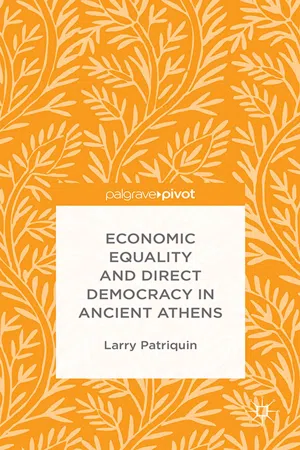
This book argues that ancient democracy did not stop at the door of economic democracy, and that ancient Athens has much to tell us about the relationship between political equality and economic equality. Athenian democracy rested on a foundation of general economic equality, which enabled citizens to challenge their exclusion from politics.
- English
- ePUB (mobile friendly)
- Available on iOS & Android
eBook - ePub
Economic Equality and Direct Democracy in Ancient Athens
About this book
Information
1
Introduction: The Importance of Athens
Abstract: The Introduction notes that Athens’ evident flaws are deemed fatally problematic by numerous observers, hence for them, Athens hardly qualifies as a “democracy.” Perhaps the major factor that leads numerous modern analysts to condemn the Greeks is the presence of slavery in their societies. Key to the argument of this book is opposition to the idea that slaves freed most citizens from the need to labor. It also argues against the notion that the democracy rested on a paradox, rooted in political equality and economic inequality, maintaining instead that Athenian democracy was the product of a historically unique combination of both political and economic equality.
Patriquin, Larry. Economic Equality and Direct Democracy in Ancient Athens. New York: Palgrave Macmillan, 2015. DOI: 10.1057/9781137503480.0003.
The Greek word demokratia, first coined by the 460s–450s B.C. and in common usage by the 440s B.C., combined the terms demos, understood by most Athenians to mean “the common people” or “the masses,” and kratos, a reference to sovereign power, the ability to make decisions for oneself. Kratos relates etymologically to words like “grasp” and “grip”; the image it portrays is one of individuals getting their hands on power (Cartledge 2007, 156–7). In its various uses, the word kratos placed a spotlight on specific people. For instance, aristokratia referred not only to members of an identifiable social group, the few wealthy aristocrats, but also to the power they held. Demokratia, in turn, underlined the power possessed by another faction of the population, the lower classes (Eder 1998, 113).
While demokratia implied “the common people,” Greeks disagreed on who precisely among “the people” constituted the demos. Pro-democrats believed that the demos included all citizens, and not just the poor.1 In contrast, anti-democrats employed “demos” in a derogatory manner to refer to one segment of the citizenry—the “crowd” or the non-aristocrats. The rich disparagingly dubbed these poorer men with terms such as “the rabble,” “the mob,” and the hoi polloi (the “many”).
Despite these differences of perspective, however, almost everyone in ancient Greek society understood democracy as more than just “rule by a majority”; the term was synonymous with rule by the poor (a class that just happened to constitute most of the population). It was not sheer numbers that defined democracy. Rather, it was the class position of the large proportion of men permitted to participate directly in political life that made a democracy.2 This is what led Aristotle to argue—though he noted the absurdity of huge numbers of wealthy people in any society—that a city-state would remain an oligarchy if it were ruled by the rich, even if they made up a majority of the citizenry. Oligarchy, then, did not mean “rule by the few.”
To begin, I should point out that not all scholars see ancient Athens’ mode of governance as relevant for modern nation-states. Well-known democratic theorist Giovanni Sartori, for one, is adamant that “ancient democracies cannot teach us anything about building a democratic state and about conducting a democratic system that covers not merely a small city but a larger expanse of territory inhabited by a vast collectivity” (quoted in Saward 2003, 75). Moreover, numerous observers, from the city-state’s famous philosophers to latter-day critics, have pointed to Athens’ evident flaws, including its occasional military defeats, its imperialism and empire-building, the trial and execution of Socrates, and the subordination of women. Given such a history, it is easy to understand how someone today might look at Athens for guidance, but then turn away disappointed.
Now universally viewed as repugnant, slavery stands as perhaps the greatest factor in contemporary condemnations of ancient Greek societies. At its peak, there were tens of thousands of slaves in Athens. The presence of these slaves, needless to say, is the subject of great debate amongst scholars. Despite this, one fairly common assertion is that slaves “helped to free the slaves’ masters from the onus of perpetual labour, and thus, ironically, created the precious leisure required for democratic political life” (Watson and Barber 2000, 25, emphasis added).3 Charles Tilly (2007, 26), a prominent theorist of democracy, also suggests that the labor of slaves “freed slave-owning citizens to participate in public politics.” Tilly goes on to claim that “between 300 BCE and the 19th century CE, a number of European regimes adopted variants on the Greek model: privileged minorities of relatively equal citizens dominated their states at the expense of excluded majorities.” In these states, including Athens, elites “all lived on the labor of excluded, subordinate classes” (Tilly 2007, 27). Tilly does not distinguish between the stunningly original Athenian experiment in creating the world’s first democracy, and the many other examples of governance over the next two millennia, none of which came close to copying the Greek model, a model that was never adopted by “privileged minorities,” but rather, for thousands of years, was condemned by ruling classes everywhere, without exception.
This ungenerous assessment of the ancients becomes almost apoplectic at times. In a recent book in the Oxford University Press’ prestigious “Very Short Introductions” series, Richard Bellamy (2008, 31) takes the “myth of the idle mob” to extremes, asserting that “to be a citizen” in Greece one had to be, among other things, “a master of the labour of others, notably slaves.” He further posits that “citizenship itself, if one adds military service and participation in local affairs, was a fairly full occupation” (33). He maintains that the capacity of men “to perform their not inconsiderable citizenly duties rested on their everyday needs being looked after by the majority of the population, particularly women and slaves” (32). He concludes, most absurdly, that ancient Greece “was oppressive of citizens in demanding they sacrifice their private interests to the service of the state,” something that is “the mark of totalitarian regimes” (35). Such interpretations of slavery make it difficult for us to understand Athenian democracy and to learn the lessons it can offer on how to democratize our own institutions of governance.4
It is the task of this small book to argue that Greek democracy—in particular its Athenian variant—has been the most radical form of democracy in the history of humanity, and that its radical nature was rooted in an equally radical version of economic parity. My argument stands in contrast to much of the literature on ancient democracy, wherein scholars tend to find an inexplicable “paradox” between Athens’ extraordinary politics, on the one hand, and its apparently typical economic arrangements, on the other hand. For instance, Anthony Arblaster (2002, 25) speaks of “the uneasy coexistence of political equality with social and economic inequality” at Athens. Meanwhile, Maureen Cavanaugh (2003, 452) asks: “If Athenian democracy was characterized by both political equality and economic inequality, what developments led to this extraordinary commitment to political equality?” Furthermore, Peter Liddel (2009, 136) observes that Athenians “did not think that economic redistribution was a prerequisite for political equality (or, for that matter, liberty),” adding that it “is clear, therefore, that ancient democratic thought was concerned with political equality but not socioeconomic equality.” Walter Eder (1998, 108), likewise, claims that: “Modern democracy began by realizing the idea of political equality, then strove for social equality, and finally, at least in theory, claimed economic equality for all citizens. In sharp contrast, the evolution of ancient democracy stopped with the concept of political equality.” Finally, even G.E.M. de Ste. Croix (1981, 285), perhaps the twentieth century’s most important commentator on the ancient Greek world, could posit, after noting the legal equality and free speech characteristic of Athenian democracy: “There was no pretence, however, of economic equality.”
While it is true that Athenians in their everyday political discourse never hotly debated the question of redistributing wealth, perhaps this silence is telling. I argue that there were no rallying cries for redistribution because Athenians began their democracy from a position of relative economic parity. The starting point of the ancient world’s most celebrated political experiment was a rough similarity in the ownership of material resources. In sum, Athens has much to tell us about the relationship between political equality and economic equality (not inequality).
This study begins with an examination of how Greek city-states, in particular Athens, came into existence. It then surveys the “nuts and bolts” of Athenian democracy, accounting for how this novel form of governance worked in practice, with particular emphasis on the Council, the Assembly, and the courts. Next, I highlight the economic egalitarianism that underpinned the democracy and consider two groups of people—slaves and women—who were never granted any form of equality.5 I then show how Athens’ major philosophers deployed elitist, anti-democratic perspectives, before moving on to the story of democracy’s decline and disappearance. The conclusion underscores the necessity to have economic equality as the essential foundation for political democracy. My findings have ramifications for how we might approach alterations to contemporary democracy, alterations which many analysts maintain are necessary to resuscitate confidence in the efficacy of our governing institutions.
Notes
1However, as we will see, even pro-democrats placed severe limitations on who could be citizens, excluding a majority of adults within the city-state, in particular all women, slaves, and foreign residents (metics).
2For a discussion of “class” and a defence of its use in the context of ancient Athens, see Wood and Wood (1978, 41–64).
3When analyzing ancient democracy, or any other historical phenomenon, it is best to proceed on the assumption that there are no “ironies,” just events and practices that require explanation.
4See Swift (2010) for an informative account of why such democratization is necessary.
5For the various meanings of “equality” in ancient Greek, see Cartledge (1996), who also notes that for the Greeks, “in hard political praxis the operative criterion governing equality’s implementation is not sameness or identity but rather similitude or likeness” (178).
2
Origins of the Polis
Abstract: This chapter begins with a brief history of the period prior to c.750 B.C., after which the polis began to appear as the typical form of governance throughout much of Greece. It then documents the various power struggles that occurred down to c.594 B.C., when Solon was appointed as mediator to resolve a major conflict, one that had developed within the aristocracy but also concerned relations between the rich and poor. The remainder of the chapter highlights Solon’s economic reforms, including the cancellation of debts and debt-bondage, which were critical to maintaining the independence of small farmers; and his political reforms, which established most of the major institutions of Athenian democracy.
Patriquin, Larry. Economic Equality and Direct Democracy in Ancient Athens. New York: Palgrave Macmillan, 2015. DOI: 10.1057/9781137503480.0004.
The first permanent settlements in Greece began around 7000 B.C. The earliest civilization in the area was based around the palace at Knossos, on the island of Crete in the Aegean Sea, south of the Greek mainland. These people, the Minoans,1 whose civilization prospered between 2200 and 2000 B.C., engaged in little independent economic activity. The palace was in charge of all wealth. Authorities collected goods from producers, returning a portion to each household for subsistence (Martin 2000, 25). The Minoans, via trade, had much contact with and influence on the mainland, including the Kingdom of Mycenae, located in the Peloponnese in southern Greece. Mycenaeans were among the first people to speak Greek. Their palaces date from c.1400 B.C., with the culture peaking over the next 200 years. Internal conflicts, especially power struggles among “princes,” as well as out-migration and external invasions by raiders and bands of mercenaries, gradually destroyed the kingdoms between 1200 and 1000 B.C. The palaces turned to ruins in the face of economic and political retrogression.
Amidst much violence and poverty, cities throughout Greece went into decline, some leaving behind little more than a few physical fragments as testimony to their existence. By perhaps 1200 and certainly no later than 1000 B.C., Greece entered a so-called Dark Age. States collapsed, population fell by somewhere between 75 and 90 percent (Rose 2012, 59n6), and the elaborate architecture that had characterized Knossos and Mycenae disappeared. The economy languished for more than a century before reviving slowly after c.900 B.C. In the Archaic Age (c.750–500 B.C.), more advanced civilizations emerged and, with rare exceptions, the Greek language dominated in settlements surrounding the Aegean Sea. While they certainly included elites of both wealth and birth, these new societies exhibited much less hierarchy in comparison with their palace-based predecessors. Around 700 B.C., scribes finally wrote down the two most famous poems of the era, the...
Table of contents
- Cover
- Title
- 1 Introduction: The Importance of Athens
- 2 Origins of the Polis
- 3 How Athenian Democracy Worked
- 4 Equality and Inequality
- 5 Elite Critics of Popular Rule
- 6 The End of Direct Democracy
- 7 Conclusion: The Key Lesson for Contemporary Democracy
- References
- Index
Trusted by 375,005 students
Access to over 1.5 million titles for a fair monthly price.
Study more efficiently using our study tools.
Frequently asked questions
Yes, you can cancel anytime from the Subscription tab in your account settings on the Perlego website. Your subscription will stay active until the end of your current billing period. Learn how to cancel your subscription
No, books cannot be downloaded as external files, such as PDFs, for use outside of Perlego. However, you can download books within the Perlego app for offline reading on mobile or tablet. Learn how to download books offline
We are an online textbook subscription service, where you can get access to an entire online library for less than the price of a single book per month. With over 1.5 million books across 990+ topics, we’ve got you covered! Learn about our mission
Look out for the read-aloud symbol on your next book to see if you can listen to it. The read-aloud tool reads text aloud for you, highlighting the text as it is being read. You can pause it, speed it up and slow it down. Learn more about Read Aloud
Yes! You can use the Perlego app on both iOS and Android devices to read anytime, anywhere — even offline. Perfect for commutes or when you’re on the go.
Please note we cannot support devices running on iOS 13 and Android 7 or earlier. Learn more about using the app
Please note we cannot support devices running on iOS 13 and Android 7 or earlier. Learn more about using the app
Yes, you can access Economic Equality and Direct Democracy in Ancient Athens by Larry Patriquin in PDF and/or ePUB format, as well as other popular books in Politics & International Relations & Economic History. We have over 1.5 million books available in our catalogue for you to explore.