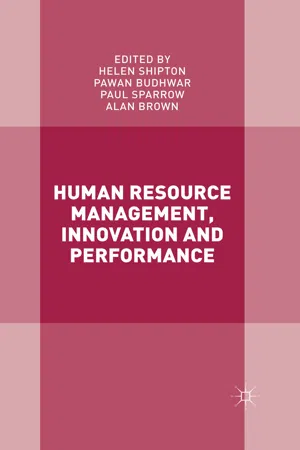
Human Resource Management, Innovation and Performance investigates the relationship between HRM, innovation and performance. Taking a multi-level perspective the book reflects critically on contentious themes such as high performance work systems, organizational design options, cross-boundary working, leadership styles and learning at work.
eBook - ePub
Human Resource Management, Innovation and Performance
- English
- ePUB (mobile friendly)
- Available on iOS & Android
eBook - ePub
Human Resource Management, Innovation and Performance
About this book
Information
1
Human Resource Management, Innovation and Performance: Looking across Levels
Helen Shipton, Pawan Budhwar, Paul Sparrow and Alan Brown
There are no old roads to new directions.
The Boston Consulting Group
The importance of innovation can hardly be exaggerated, given that landmark change has defined human progress in our technological age. The business pages of popular journals are replete with a dazzling array of inventions that have overturned existing ways of working and fundamentally changed human experience – from agricultural drones that offer farmers new ways to increase crop yield to genome editing that provides powerful insights into genetically baffling brain disorders. Innovation has become a topical theme within organisations, too, with no shortage of advice and suggestions often targeted at business leaders about how to craft an innovation strategy or increase the number and quality of ideas with a view to enriching organisational life. The quote at the start of this chapter bears testament to the sheer effort of moving away from familiar, habitual practices in the direction of less-certain, risky future terrain. Setting aside what has gone before to move in new directions requires determination, resilience and courage at a personal level. Often overlooked, though, are the multi-level dynamics that this entails.
Rather than occurring in a vacuum, innovation is prompted, shaped and enacted through an individual or a collective group engaging with the context, whether that of the wider team, the organisation, the institutional framework or even society itself (Gupta et al., 2007). In its simplest form, innovation might arise through an actor’s reaction to stimuli presented within a work setting. More complex, but conceptually similar, determinants might govern whether or not influences from the external environment, derived through inter-organisational networks, cause an organisation to embrace a new technology or a novel technique (e.g., cross-functional work systems). Added to this, influences may occur from the bottom up (initiated by individuals) or top down (triggered by contextual factors). Some impacts might be set in motion by management (a reward structure that recognises risk and experimentation) whilst others are likely to occur by accident (an informal discussion at a conference about a new product or idea).
Reflecting these considerations, our central goal in this book is simple. It is to bring people, or rather the complexities of managing of human resources in organisations, centre stage. While scholars have been inspired by the idea that HRM has the potential to build a committed and engaged workforce, thereby maximising firm performance (Jiang, Lepak, Hu & Baer, 2012), until recently rather less attention has been devoted to HRM’s role in fostering creativity and innovation (Shipton, Budhwar, Sparrow & Bimrose, 2012). Innovation scholars, by contrast, have devoted attention to the external context and the institutional framework (Chesbrough, 2004). HRM has been tangential, rather than central, in this literature. In bringing together the two strands, HRM and innovation, we believe that our text makes a novel contribution. Added to this, we draw into one conversation disciplinary perspectives such as leadership (Carmeli & Azeroual, 2009), workplace learning (Brown & Bimrose, 2014) and ambidexterity (Kang, Snell & Swart, 2012) that have evolved largely separately from one another. We do so in order to shed new light on the antecedents and enablers of innovation, with specific reference to people and the way in which they are managed.
Inherent in most conceptualisations of innovation, and our starting point for the book, is the notion of value (Gupta et al., 2007). The innovation or change must add something that is beneficial for the organisation, either complementing existing practice or adding something that supersedes and perhaps overrides what has happened before. Novelty is centre stage, in that innovation brings out previously unconsidered alternatives for change. Rather than absolute novelty, however, innovation is original within a context; its newness is relative and bounded. Level-of-analysis issues permeate reflections on definitions. Innovation is often conceptualised, at the individual level, in terms of an employee’s creativity (Amabile et al., 1996) or of the ability to devise new and potentially valuable ideas in a work context. Others examine an individual’s innovative behaviour (Scott & Bruce, 1994). The latter is suggestive of a propensity not only to devise original ideas, but also to work simultaneously with others so as to facilitate the implementation of those ideas. The micro-perspective of innovation also entails consideration of the attributes and antecedents of effective leadership for innovation.
Taking an organisational-level perspective, innovation is often conceptualised depending upon its incremental or radical nature. The former entails fairly minor adjustment to strategic functioning while, through the latter, significant and major amendments are proposed or have occurred (Zhou & Li, 2012). Linked with this is the notion of exploration and exploitation. March’s (1991) seminal work proposed that organisations face inherent tensions, on the one hand seeking to extend the boundaries of knowledge to pursue new and risky alternatives and, on the other, to refine and improve existing ways of working in order to deepen and enhance strategic functioning. The balance achieved varies across organisations, depending on many factors, including the volatility of the external environment, managerial orientation and employee skills and attitudes, including motivation and the nature of trust (Kang et al., 2007).
Chapter scheme
The first two parts of the book take an organizational-level perspective, presenting inspiring and research-informed insights into the outstanding HRM considerations relating to key themes of this book. We then, in Part III examine leadership considerations with innovation in mind, concluding in Part IV with a series of contributions that adopt a micro-level perspective, while simultaneously taking account of the context within which individuals are embedded.
Part I: People, innovation and performance: an overview
Chapter 1, written by Paul Sparrow, proposes that, for innovation, the notion of ‘best practice’ HRM may be less helpful as a conceptual lens than what is described as ‘conditioning contingencies’ – in other words, designing organisational structures to allow opportunities for knowledge flow across and within organisational boundaries. Sparrow alludes to the challenge of radical innovation, whereby psychological foundations inhibit members’ willingness to contemplate proposed change that may be seen to threaten the established order. Acknowledging the emotional fallout from innovation and from building appropriate support structures may be an important part of the HR remit in dealing with innovation of this kind. Sanders and Lin, in Chapter 2, focus upon ‘high commitment’ HRM practices, in particular those that foster tolerance for risk, job autonomy and employee proactivity. At the heart of their chapter lies the notion of interactive, informal learning, which allows employees to make connections across time, networks and institutional frameworks. Their chapter emphasises that HRM practices influence employee perceptions and actions to the extent that they are accurately detected by employees. Drawing on Bowen and Ostroff (2004), they argue that in order for HRM to influence performance outcomes – including innovation – effective communication and interpretation are key. To this end, they reference various stakeholders, including senior and line managers and HR specialists.
The next three chapters of Part I consider human resource development (HRD), that sub-section of HRM concerned with employee learning insofar as it flows from strategic goals. In Chapter 3, Pauline Loewenberger highlights HRD considerations where creativity and innovation are to be fostered. The chapter focuses upon creativity training and makes reference to a number of reliable models to guide the process. There is discussion of diagnosis at the organisational level, with recommendations for using a valid and reliable instrument to assess climate properties that can provide a valuable starting point for crafting a climate apposite for the purpose of innovation. They reference studies showing that the payback in terms of innovation is much greater where internal systems allow for learning, under the auspices of a strong innovation climate, rather than promote an implicit view that external training is sufficient for this purpose.
The HRD theme continues in Chapter 4 with a discussion of work-based apprenticeship schemes and the role that structured training can play in fostering an organisation’s propensity to innovate. The apprenticeship model of learning proposes a graduated approach to the formation of expertise. Fuller and Unwin argue that, through building an expansive rather than a restrictive work environment, apprentices and other learners have the potential to achieve functional expertise and to give back to the organisation in terms of guiding and supporting the learning of others. They argue that all employees can benefit from the supportive structuring of their development, as proposed in the apprenticeship model. They illustrate their framework through reference to case-study examples that demonstrate contrasting perspectives on the development of occupational identity and functional expertise. In Chapter 5, the final chapter of Part I, Gambin and Hogarth show that renewed interest from government and organisations means that apprenticeships are once again featuring as a tool in Human Resource Management policy, after a period of decline. Like Fuller and Unwin, Gambin and Hogarth point out that to add value to organisations as well as to individual learners, apprenticeships should be provided within a wider package of HR processes and approaches. In order for employers to retain apprentices and thereby recoup their investment, other HR policies are required which improve retention and provide development and progression opportunities as well as other incentives for former apprentices.
Part II: People, innovation and performance: in context
The second part of the book uncovers some of the contextual contingencies that influence whether and how innovation plays out. Chapter 7, by Nair, Pillai, Hirekhan and Budhwar, gives a novel and exciting insight into innovation within a developing economy – that of India. They outline HRM’s role in fostering what they label ‘frugal innovations’, referred to as jugaad. These innovations, while affordable, are based on simple ideas that entail leveraging scarce resources adapted for the local environment as appropriate. The chapter describes a cross-sectional survey of 174 Indian firms in order to shed light on the main factors promoting or hindering innovation. The authors note that, as proposed in the opening chapters of the book, HR practices need to be designed, developed and implemented to cater to an organisational environment that motivates employees, encourages collaboration and learning, improves employee commitment and promotes teamwork.
Frances Jorgenssen, in Chapter 8, provides an insightful discussion of HRM within small, high-growth firms. Jorgenssen shows that formal HRM systems may not necessarily be conducive to innovation and growth for this sector, especially where they are adopted uncritically, without taking account of underlying attitudes such as staff engagement and commitment. The chapter reports that high-growth firms tend to encounter numerous and sporadic ‘tipping points’ (Phelps, et al., 2007), defined as significant strategic challenges, decisions that appear on target at one point in time but which may rather rapidly become outdated as circumstances change. These tipping points influence the extent to which formal, rather than informal, HRM practices are apposite in a given context, and also influence the role of ambidexterity, jointly balancing exploration and exploitation. The chapter illustrates these points through reference to a high-growth technology firm based in Denmark which, being sensitive to changing employee perceptions, made rapid adjustments to HRM systems in order to facilitate ongoing growth.
In Chapter 9, Tansley and Kirk, in a study of a local authority in the UK which has a sophisticated e-HRM system, argue that in order to support organisational innovation, HR practitioners must first understand the challenges of innovating within their own functional areas. They further develop the theme of ambidexterity, which entails HR specialists exploiting existing HR knowledge while enabling the integration of new knowledge from inside and outside the organization. An effective e-HRM system relies on the skills and expertise of exploratory learners – labelled ‘communication stars’ – who reach outside the organisation to bring in new ideas and share them with others, benchmarking e-HRM practice elsewhere, especially (given the local authority setting) within related organisations such as Social Services and Highways. Balancing exploration and exploitation is, in the eyes of these scholars, an overriding challenge for HR specialists seeking to foster innovation within their own functional areas.
In Chapter 10, Swart and Kinnie highlight the impact of human and client capital on innovation within professional service firms (exemplified through reference to accountancy and legal service companies). They further develop the notion of external liaison expounded above, proposing that professional service firms work within a complex set of external stakeholder relationships to develop products and services. Their empirical work in this area suggests that HRM systems vary according to the degree of power exhibited by the client, as well as to the extent of work integration between the focal organisation and the client. Four configurations are proposed reflecting these factors: regeneration, refreshment, re-use and re-invention. Each configuration requires a specific set of HRM practices. For example, for the re-invention orientation, HR has a role to play in protecting employees from burnout that may ensue from dealing with the most demanding clients. Added to this, HR has the task of developing client relationship skills in order to address the strains of this type of client base. Rewarding high performers by showcasing exceptional achievement may be a key consideration for employees performing a re-invention role.
Part III: Leadership and innovation
The third part of the book deals with the challenges faced by leaders who have responsibility for implementing innovation within their organisations. The part starts with Chapter 11, a study by Černe, Hernaus, Dysvik and Škerlavaj, who have an interest in the antecedents of innovation implementation. Drawing on the Self-Determination Theory (Deci & Ryan, 1985), they present a conceptual case for supervisor support in conjunction with employee autonomy in decisions fostering innovation-related outcomes. Contextual factors, in particular team leadership and management support, have been shown to be more important for implementation than for the suggestion of ideas. This is attributed to the leadership role in resource allocation, as well in dealing with resistance to ideas. As they point out, creative employee ideas very often cannot be realised without having a strong following wind and a supervisor’s ‘I am with you’ orientation.
In Chapter 12, Maura Sheehan further develops insights into the leader’s role in fostering innovation highlighting the importance of knowledge-sharing, defined, as proposed in Chapt...
Table of contents
- Cover
- Title
- 1 Human Resource Management, Innovation and Performance: Looking across Levels
- Part I People, Innovation and Performance: An Overview
- Part II People, Innovation and Performance: In Context
- Part III Leadership and Innovation
- Part IV The Bedrock for Innovation: Building Capability at the Individual Level
- Index
Trusted by 375,005 students
Access to over 1.5 million titles for a fair monthly price.
Study more efficiently using our study tools.
Frequently asked questions
Yes, you can cancel anytime from the Subscription tab in your account settings on the Perlego website. Your subscription will stay active until the end of your current billing period. Learn how to cancel your subscription
No, books cannot be downloaded as external files, such as PDFs, for use outside of Perlego. However, you can download books within the Perlego app for offline reading on mobile or tablet. Learn how to download books offline
Perlego offers two plans: Essential and Complete
- Essential is ideal for learners and professionals who enjoy exploring a wide range of subjects. Access the Essential Library with 800,000+ trusted titles and best-sellers across business, personal growth, and the humanities. Includes unlimited reading time and Standard Read Aloud voice.
- Complete: Perfect for advanced learners and researchers needing full, unrestricted access. Unlock 1.5M+ books across hundreds of subjects, including academic and specialized titles. The Complete Plan also includes advanced features like Premium Read Aloud and Research Assistant.
We are an online textbook subscription service, where you can get access to an entire online library for less than the price of a single book per month. With over 1.5 million books across 990+ topics, we’ve got you covered! Learn about our mission
Look out for the read-aloud symbol on your next book to see if you can listen to it. The read-aloud tool reads text aloud for you, highlighting the text as it is being read. You can pause it, speed it up and slow it down. Learn more about Read Aloud
Yes! You can use the Perlego app on both iOS and Android devices to read anytime, anywhere — even offline. Perfect for commutes or when you’re on the go.
Please note we cannot support devices running on iOS 13 and Android 7 or earlier. Learn more about using the app
Please note we cannot support devices running on iOS 13 and Android 7 or earlier. Learn more about using the app
Yes, you can access Human Resource Management, Innovation and Performance by Paul Sparrow, Helen Shipton, Pawan Budhwar, Alan Brown, Paul Sparrow,Helen Shipton,Pawan Budhwar,Alan Brown in PDF and/or ePUB format, as well as other popular books in Business & Business Strategy. We have over 1.5 million books available in our catalogue for you to explore.