- English
- ePUB (mobile friendly)
- Available on iOS & Android
eBook - ePub
About this book
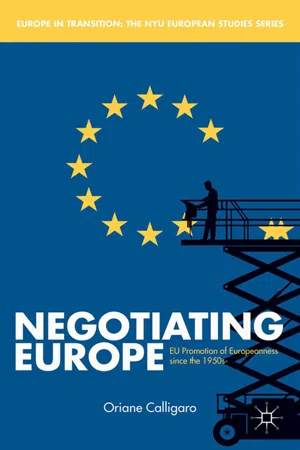
The book explores the promotion of Europeanness, which aims to arouse feelings of belonging to the European Union. It demonstrates that the promotion of Europeanness at the EU level does not constitute an overarching identity policy that imposes a homogenous interpretation of European identity. Rather, it is a process of negotiation in which various entrepreneurs of Europeanness within and outside the EU institutions invent and communicate representations of Europe. Both the negotiation and the multilayered representations of Europe that it produces are investigated through three case studies: the academia and the historians, European heritage, and the iconography of the euro.
Information
CHAPTER 1
The European Commission’s Action in the Academic and Historical Fields
In 1955, Jean Monnet, then president of the High Authority of the European Coal and Steel Community (ECSC) wrote: “Our Community will only truly be realized if the actions it takes are made public and explained publicly . . . to the people of our Community.”1 According to Jacques-René Rabier, first director of the Joint Press and Information Service of the ECSC,2 most actors who were active in the High Authority were not interested in information and it was essentially the personal commitment of Monnet that led to the early development of an informational action. The information policy started “spontaneously”3—without being mentioned in the treaties—as early as 1953, although the official Service de Presse et d’Information was created in October 1955. From the very outset, information policy was given a political objective: the creation of European citizens.4 In numerous testimonies, Jacques-René Rabier described himself and his collaborators as “fonctionnaires-militants” or “missionaries,” who openly admitted their desire to nurture a European consciousness.5 Considering the lack or at least the very limited character of this European spirit after 50 years of European integration, the efficiency of this “militant” information policy should be questioned. In an article discussing the first decade of the Information Service, Piers N. Ludlow underlines the discrepancy between its “lofty ambitions” and the concrete implementation and results of its policies.6 In light of the openly proclaimed identity-building objectives of the information policy in this period, Ludlow’s reference to “frustrated ambitions” appears to be justified. However, analysis of the longer-term nature of the Commission’s actions in the specific field of universities offers a different picture. As I will show, as a result of their potential social and cultural influence, the university milieu and its actors—professors, researchers, and students—have been targeted by EU information from the start. Only very recently, in 2000, was this area of action transferred from the Directorate-General Information (DG X) to the DG Education and Culture (DG EAC).
The aim of this chapter is to show that, despite the slow development and the often modest character of the university information policy, it constitutes a successful dimension of the Commission’s informational action. To be sure, certain projects of the university information policy failed or had a very limited impact. However, I demonstrate that the emergence of European integration as an object of research and teaching in European universities is a very significant achievement in terms of the EU’s attempt to reach out European citizens. Indeed, the integration of a specifically European dimension in the academic disciplines concerned (law, political sciences, economics, history) is not merely the consequence of an interest in the European phenomenon on the part of the academic world. It is also the result of a long-drawn-out work carried out by different actors of the European Commission, and to some extent of the EP. This chapter therefore insists on the proactive role played by the Commission. Considering the significance of universities in the definition of national identities, the importance given to their independence and the often conservative character of this milieu, it is all the more necessary to understand the process through which, over four decades, the phenomenon of European unification has been integrated into academic activity throughout Europe. Since the DG X designed specific actions to communicate with historians and to promote the history of European integration, in particular in the framework of the Liaison Committee of Historians, I focus in depth on the particular case of history as a discipline. The awkward position of this Committee and the complexity of its relation with Brussels indicates the limits of the involvement of the Commission in the activities of academics. However, the enduring willingness of historians to adopt objectives and concepts officially proclaimed by the EU institutions in their scientific research highlights the efficiency of the incentives and structures invented by the Commission.
The EU’s actions directed toward the university milieu are also interesting because of the constancy of its objectives. In the very first years of the European integration process, Jean Monnet underlined the need to spread teaching on European integration and to integrate European studies into the universities.7 This initial objective remained central to the EU information policy. Furthermore, without falling into teleological reasoning, we might underline the striking similarity between the objectives set out by Monnet in the 1950s and those of the Jean Monnet Action, which created the Jean Monnet Chairs for European Studies in the late 1980s. I argue that this constancy is also the result of the commitment over several decades of key actors like Émile Noël, secretary-general of the Commission and then president of the European University Institute (EUI) and Jacqueline Lastenouse, an official employed by the University Information Unit of the DG X. The goal is not to tell the success story of EU action in the academic world. Rather I analyze how an administrative entity of a completely new type—European Commission—incrementally adapted its strategies and actions to implement a policy for which it originally received no competence. The role of other institutions in this process, and especially the EP, is also taken into consideration.
This last point, concerning the sui generis creation of new areas of action is essential. Indeed, I show that EU action in the university milieu has provided a means of circumnavigating the resistance opposed by certain member states to a “militant” information policy that they considered an improper extension of the originally defined prerogatives of the Commission. The establishment of direct relations with the academic world allowed the Commission to create a link with an influent section of European public opinion without having to obtain—at least initially—the approval of the intergovernmental level. Moreover, providing university actors with the incentive to work on European matters was advantageous in that it did not invite accusations of spreading a gross form of propaganda. Indeed, the appropriation of the European subject by the academic world functioned as a way of legitimizing the phenomenon of European integration, and of making it exist in the eyes of significant groups of European public opinion: professors and, above all, students. This chapter does not aim to assess the social and political impact of the appropriation of European matters by the academic world, nor does it seek to determine whether this actually increased the popularity and legitimacy of the EU. The focus is instead on how a supranational institution such as the European Commission established a productive relationship with specific groups within European societies: the university milieu, and historians in particular.
The sources on which this study is based are largely derived from the European Commission Historical Archives in Brussels (ECHAB)—more specifically from the archives of the Information Service and of the University Information Unit of the DG X—and from the papers of Noël held in the Historical Archives of the European Union in Florence (HAEU). However, a significant part of the sources for the last 30 years are not yet accessible and for this reason, the personal archives of key actors have been crucial. I consulted the important personal archive of Jacqueline Lastenouse, member and then head of the University Information Unit. I also drew on the archives of the Liaison Committee of Historians conserved by Michel Dumoulin, one of its historic members. Interviews with Commission officials, historians, and promoters of EU-funded project provided a further supplement to this material.
The first part of this chapter is dedicated to the Jean Monnet Action. It first addresses the prehistory of the initiative, describing the birth and methods of the university information promoted by the Joint Press and Information Service of the Communities from the early 1950s to the mid-1960s. It was only in 1987 that the DG X, successor of the Press and Information Service, launched the Jean Monnet Chairs, first large-scale project for the development of European studies in the universities. I analyze the different steps through which the officials of the DG X University Information Unit succeeded in imposing a Community action in the field of higher education, for which the EU institutions were originally not competent. The analysis of the administrative and political process necessary to launch such a policy offers an interesting insight into the function of EU institutions. In order to illustrate more specifically the type of relations developed between the European Commission and academic actors, the second part focuses on the role of European historians. Indeed, by the mid-1970s, whereas the European problematic was already well established in the legal and economic disciplines, contemporary and international historians paid little attention to European integration. In this context, the Commission attempted to arouse the interest of historical researchers through various initiatives, the most significant being the creation of a Liaison Committee of Historians. Moreover, in the same period, the European Commission was submitted private initiatives of history of Europe. I will concentrate on the ambiguous fate of the Delouche/Duroselle project, which benefited from the support of the Commission.
I. The Jean Monnet Action: “Europe in the University Programs”
The concept of university chairs specialized in European matters already featured in the objectives set out in 1958 by Jean Monnet’s Institut de la Communauté Européenne pour les Études Universitaires, a private institution that deeply influenced the agenda of the Commission’s action in the university domain.8 In order to understand the process that led to the creation of the Jean Monnet Action in 1987, it is first necessary to trace the history of the EU university information policy. Over a decade, from the mid-1950s to the mid-1960s, a small administrative division devoted to the university sector progressively gained legitimacy and power of action—especially via the support of the European Parliament of the European Union (EP)—and discretely laid the foundations of the Commission’s future large-scale actions in favor of European studies. In the early 1960s, the commitment of personalities like Émile Noël allowed for the creation of informal relations between the Commission and the academic world, which eventually made possible the promotion of EU studies in European universities, despite institutional difficulties. I will first show that the creation of the Jean Monnet Chairs more than 20 years later is among the lasting results of these discrete but enduring actions.
I will then show that after a period of stagnation in the 1970s, the Commission’s university information action was given a new impetus in the early 1980s due to a favorable political context. The Jean Monnet Chairs were launched in narrow cooperation with the university actors and thanks to the support of the EP, which allowed the program to quickly obtain the necessary budget and institutional status despite the Council’s unwillingness to see the Commission’s action in the educational field expand. I will finally observe that after a decade of constant development through the Jean Monnet Action, the university information policy eventually disappeared as such in 1999 with the deep reform of the Commission. Although the Jean Program was maintained, its nature deeply changed, with a shift from a militant approach to information to a communication action increasingly focused on the image of the EU abroad.
1. Background: The Commission’s University Information Policy
1.1 The Universities: A Specific Target of European Information
Already at an early stage the need to inform the public on issues related to the European Communities and to interest citizens in the idea of Europe was a central concern for the promoters of European unification. The Service de Presse et d’Information was created in 1952 as part of the ECSC. In January 1953, Jacques-René Rabier who was among Jean Monnet’s closest collaborators, was given the responsibility to develop the informational action of the High Authority. In 1958, when the European Economic Community (EEC) and the Euratom were created, Rabier became director of a Joint Information Service for the three European executives.9 According to Rabier, the founders of this service have always tried to remain faithful to what Monnet had described as the mission of European information: “information and formation of European citizens.”10 The goal was to reach out the people and foster a European consciousness, with the ultimate objective of gaining the support of public opinion for European integration and securing its further development.11 I...
Table of contents
- Cover
- Title
- Introduction
- 1 The European Commission’s Action in the Academic and Historical Fields
- 2 Using and Negotiating European Cultural Heritage
- 3 Designing Europeanness: Euro Banknotes and Coins
- Conclusion
- Notes
- Sources
- Bibliography
- Index
Trusted by 375,005 students
Access to over 1.5 million titles for a fair monthly price.
Study more efficiently using our study tools.
Frequently asked questions
Yes, you can cancel anytime from the Subscription tab in your account settings on the Perlego website. Your subscription will stay active until the end of your current billing period. Learn how to cancel your subscription
No, books cannot be downloaded as external files, such as PDFs, for use outside of Perlego. However, you can download books within the Perlego app for offline reading on mobile or tablet. Learn how to download books offline
Perlego offers two plans: Essential and Complete
- Essential is ideal for learners and professionals who enjoy exploring a wide range of subjects. Access the Essential Library with 800,000+ trusted titles and best-sellers across business, personal growth, and the humanities. Includes unlimited reading time and Standard Read Aloud voice.
- Complete: Perfect for advanced learners and researchers needing full, unrestricted access. Unlock 1.5M+ books across hundreds of subjects, including academic and specialized titles. The Complete Plan also includes advanced features like Premium Read Aloud and Research Assistant.
We are an online textbook subscription service, where you can get access to an entire online library for less than the price of a single book per month. With over 1.5 million books across 990+ topics, we’ve got you covered! Learn about our mission
Look out for the read-aloud symbol on your next book to see if you can listen to it. The read-aloud tool reads text aloud for you, highlighting the text as it is being read. You can pause it, speed it up and slow it down. Learn more about Read Aloud
Yes! You can use the Perlego app on both iOS and Android devices to read anytime, anywhere — even offline. Perfect for commutes or when you’re on the go.
Please note we cannot support devices running on iOS 13 and Android 7 or earlier. Learn more about using the app
Please note we cannot support devices running on iOS 13 and Android 7 or earlier. Learn more about using the app
Yes, you can access Negotiating Europe by O. Calligaro in PDF and/or ePUB format, as well as other popular books in Politics & International Relations & European Politics. We have over 1.5 million books available in our catalogue for you to explore.