eBook - ePub
Performing Cities
About this book
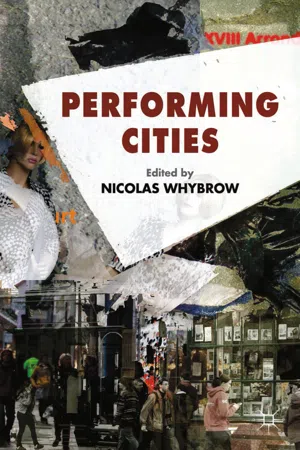
Performing Cities is an edited volume of contributions by a range of internationally renowned academics and performance makers from across the globe, each one covering a particular city and examining it from the dynamic perspectives of performances occurring in cities and the city itself as performance.
Information
Subtopic
Art GeneralUrban Rhythms
1
Performing Palermo: Protests Against Forgetting
David Williams
E SÉ QUALCUNO FA QUALCHE COSA?
(And what if someone were to do something?)
Padre Pino Puglisi: Palermo graffito
How to write (about) a city one loves and, at the same time, despairs of, for being so much less than what it is and could be? How to brush up against it in language, registering some of its intensities, rhythms and flows, its catastrophes and dreams? Partially and in pieces, perhaps, knowing that inevitably so much more will be overlooked and concealed than can ever be revealed. The following texts – part of an ongoing, unfinished series – emerge from numerous journeys to Sicily and Palermo over the past decade, and in particular two periods of immersive research in and around the old city in the spring and autumn of 2012.
Firstly, they attempt to sketch an affective mapping of Palermo, through an associational tracking of some of the layers and patterns of its vertiginous jostle-spin through history, in order to intuit something of how the city feels and moves today: the imaginal shadow lands and momentum of a psychic topography. In part my approach here draws on Jane Rendell’s articulation of ‘site-writing’ as a spatial practice in which the writer both interprets and performs, endeavouring to fashion an architecture for a critical writing that is speculative and intersubjective, affectively entangled and rational (Rendell 2010: 1–20). In addition, it attempts to engage with Deleuze and Guattari’s experimental and performative conception of mapping as ‘entirely oriented towards an experimentation in contact with the real [...]. The map is open and connectable in all of its dimensions; it is detachable, reversible, susceptible to constant modification [...]. The map has to do with performance’ (1988: 12).
Secondly, in recent years the terrible frictions of Palermo’s troubled history have given rise to many performative practices of resistance, signs of possible realignment and renewed agency grained by an attentive critical memory – and a handful of these practices are central to what follows. For Palermo remains a city of grassroots activists who refuse to accept any normalizing of the intolerable and, in the name of an ethical civility, compassionate responsibility, social justice and cultural life, decide to ‘do something’. Re-membering the thwarted futures of the past – the trash(ing) of history – in their engagements with the present, their utopian works-in-progress endeavour to ‘reverse destiny’ and perhaps contribute to a pedagogy of hope.1
The texts that follow propose a montage of three modalities of writing, each signalled by a different typeface: descriptions of a particular dance-theatre performance; historical accounts of the city, and narratives of focused pilgrimage; and a splintered register of dis/orientation, encounters and events of losing and finding (a way, ‘the plot’) during a series of drift-like walks. In their relational dynamics, these three registers of writing endeavour to perform something analogous to the layered, fractured attributes of the city’s haunted relationship to its pasts and the material fabric of its topography. In this way, these texts attempt a partial staging of the city’s polyrhythmic multiplicity and contradictions, as well as drawing into relief some of the patterns and ‘lines of flight’ that seem to an informed ‘outsider’ to underpin the fragmentation and arc out of the overlooked and forgotten. So ‘performance’ is conceived and practised here in plural ways and locations: through acts of art-making, urban planning, walking, mapping, conversing, narrating, resisting, re-membering, writing and reading.
The first of these modalities, framing the architecture of the chapter as a whole (its beginning, middle and end), comprises three short descriptions of sequences from Pina Bausch’s Palermo Palermo (1989), a performance researched and produced in the city, and greatly admired there to the present time. Bausch felt a strong affection for Palermo, recognizing in the particularities of the city’s broken beauty something of its structures of feeling and difficulties; it was, she said, one of the only cities in the world where people could still climb out of the auditorium to wipe away the tears of a performer. When she visited ZEN (Zona Espansione Nord), a notoriously deprived and disaffected area in the north of the city, she was followed by a crowd of people who took her for a holy person; there was, it seems, some disappointment to discover that she was ‘just’ a choreographer.2 The performance that resulted from her company’s detailed, compassionate engagement with a city that was not their own both animated an anatomy of urban trauma and affirmed the desires, fragilities and resilience of Palermitans. Its dramaturgical weave of poetry and politics, eros and thanatos, love song and cri de coeur of delirious defiance, offers me encouragement here, as do the paradoxical words of the late anti-mafia magistrate Paolo Borsellino: ‘I didn’t like Palermo, and so I learnt to love it. Because real love consists in loving what we don’t like in order to be able to change it’.3
___________________
Debris field
It begins with a dead-end. A vast wall of grey concrete bricks fills the proscenium arch, both consuming and obstructing our field of vision. This impenetrable barrier seems to erase, at the outset, the possibility of movement and exchange, the traffic of theatre. A long period of stillness and silence ensues in the face of its monolithic, uncanny inertia. Eventually, suddenly, a tiny ripple tugs at the wall’s top-right corner, and the entire structure buckles, curves and folds backwards, like a wave suspended then breaking, smashing noisily into the shadowy stage space beyond. In this tectonic rending, a vertiginous fall into the world, solid becomes fluid and singularity collapses into multiplicity. Gradually, as clouds of ashen dust rise and settle over the debris field, silence returns. Finally, far in the distance, a woman makes her way through the rubble towards us, carefully navigating the chaos of it all in her floral-print dress and high heels. At the front of the stage she chalks a white ‘X’ on the floor and stands on it. Then with a pen she marks a black ‘X’ across her face and begins to dance to a 1930s blues song, ‘Why don’t you do right’...
‘Most beautiful and defeated’
Throughout its complex history Palermo has been the site of a dizzyingly repetitive cycle of invasions and occupations – by Phoenicians, Greeks, Carthaginians, Romans, the Byzantine Empire, Arabs, Normans, French Angevins, Spanish Aragonese and Bourbons, Garibaldi’s red-capped rebels during the Risorgimento, the German army and then the Allies in the Second World War. It has endured plagues, fires, mass public uprisings and suppressions, the horrors of the Inquisition, bombardments, exploitation and extreme poverty, waves of emigration, institutional corruption, and over the last hundred years or so the aggressive cancer of the mafia ‘state within the state’. In 1943 American Superfortress bombing of the port area reduced much of the old city to rubble, and pockets of it remain in the same state of devastation to this day. The infamous ‘Sack of Palermo’, from the late 1950s until the 1970s, saw an explosion of unregulated and illegal building speculation in which the mafia conspired with senior officials in the city’s administration. Their regime of urbicidal vandalism entailed the partial abandonment and further dereliction of much of the centro storico, the destruction of historic buildings, communities, public spaces and orchards, and the centrifugal displacement of many working-class Palermitans from the old city to tower blocks on the city’s fringes: brutalist and shoddily constructed new suburbs largely devoid of public amenities and infrastructure, a concretization of a mafia mindset. Meanwhile the city has witnessed mafia wars (in particular the mattanza4 of 1978–92), the assassination of many high-profile public figures in Cosa Nostra’s psychotic choreography of terror against the state, and the cynical complicity in clientelism and vote-rigging of Italy’s major post-war political party (the so-called ‘Christian Democrats’).5 Perhaps inevitably these painful histories have produced in many people a pervasive mistrust of the state and its representatives, and a deep-seated fatalism and exhausted pessimism. ‘In Sicily it doesn’t matter about doing things well or badly; the sin which we Sicilians never forgive is simply that of “doing” at all. We are old [...]’ (Lampedusa 2005: 143–4).
Materially and metaphorically, contemporary Palermo seems to hover at some indeterminate mid-point between demolition and renovation. It seems traumatized, dismembered, weighed down by unresolved grieving, its baroque shadow life fuelled by the conspiratorial suspicion and paranoia of dietrologia, a melancholic obsession with ‘what lies behind’ (dietro): behind surface appearances, received ‘truths’, language, silence, history; behind cover-ups and ‘walls’ of all kinds. Today this city of around 800,000 inhabitants, bustling and brooding in its ‘Conca d’Oro [golden shell] covered with a shroud of cement, the garden of bloodstained oranges’, as the great Sicilian writer Vincenzo Consolo puts it (2006: 89), remains a haunted city of densely sedimented temporalities, of disappearances, silencings and uncanny returns, of proliferative memorializing and selective amnesia. Consolo again: ‘We live in a place of enchantment, memories, remorse, nostalgia, we who have remained, in the solitary crumbling villa, at the foot of the Mountain, threatened by the Giants’ (2006: 90).
Viewed from another perspective, Palermo – the city the Phoenicians named Ziz, ‘flower’, and the Greeks Panormos, ‘all harbour’ – has been the crucible of periods of extraordinary creativity, cultural pluralism and tolerance, of syncretic coexistence, dynamic exchange and resistance to barbarism. Vincenzo Consolo has often returned, strategically, to Palermo’s heterogeneous flowering under the Muslim Emirs from the tenth to the twelfth century, when it was known as Balharm, ‘the first great cosmopolitan city of the High Middle Ages’ (2006: 238). In this period of renewal, Consolo suggests, ‘everything received a new impulse: agriculture, artisanry, commerce, science and art. And Palermo became one of the most beautiful cities of the Mediterranean [...] the city of the three hundred mosques, of the great many public baths, of crowded suqs [... a] Palermo of colour and light, activism and refinement, of fragrances and flavours’ (239). Consolo’s construction of a quasi-mythical cultural golden age for an Arab Palermo curtailed by repressive Catholicism, its few remaining traces in the twentieth century all but suffocated by Fascism, war and the mafia’s ruinous urbanization, proposes a critical narrative whose targets are contemporary intolerance, violence, injustice, insularity and amnesia. To borrow Eric Hobsbawm’s description of the function of history, perhaps above all Consolo’s text offers a ‘protest against forgetting’.6 In its recognition of loss, his historiographic fable of a ‘Palermo, Most Beautiful and Defeated’ (the title of a 1999 essay) decries present absence and anomie, and articulates the desire for difference, the possibility of ‘otherwise’. Implicitly, Consolo also references a more recent micro renaissance in Palermo and its subsequent erosion: the so-called ‘Palermo Springs’ of 1985–90 and 1993–2000, two periods of intense if short-lived political optimism, engaged civic resistance and cultural energy during the administrations of mayor Leoluca Orlando.
As I write, in the autumn of 2012, Orlando has recently been reinstated for a third term as mayor in a city severely compromised by bankruptcy, a credit rating recently downgraded to virtual junk status, endemic corruption and rising unemployment (roughly twice the national average). Tax increases and austerity cuts in the face of deep recession have fuelled further poverty, homelessness and low-level criminality, and there are signs of heightening animosity towards the city’s growing migrant populations, largely from Africa. Meanwhile the astonishing results of Sicilian regional government elections in October 2012 suggest a period of significant political instability may lie ahead in Sicily and Italy, with a national general election scheduled for 2013. In the wake of Silvio Berlusconi’s conviction for tax fraud and the apparent implosion of his Popolo della Libertà (‘People of Freedom’) party, Sicilian voters have elected as their new, centre-left president Rosario Crocetta, the vigorously anti-mafia and openly gay former mayor of Gela, where he was the target of repeated death threats. In addition, protest votes have produced a significant tranche of regional assembly seats for comedian Beppe Grillo’s MoVimento 5 Stelle (M5S, 5 Star Movement), and a Sicilian hung parliament looks inevitable.7 So Palermo, a city at the contested southern border of ‘fortress Europe’, continues to perform its contradictions (and some of the Euro zone’s) with crystalline concentration. Perhaps, as Leonardo Sciascia suggested over thirty years ago, it also operates more broadly as a metaphor for shared predicaments and possibilities in these uncertain times.8
Locus solus (1): X marks the spot
L’ESSENZIALE È INVISIBILE AGLI OCCHI
(What’s essential is invisible to the eyes)
Palermo graffito
It begins with a crossroads. The old city is divided by the intersection of two major roads, Via Maqueda and Corso Vittorio Emanuelle. It inscribes a perfect cruciform at the literal and symbolic centre of the centro storico, defining the four quarters of the old city...
Table of contents
- Cover
- Title
- Copyright
- Contents
- List of Illustrations
- Acknowledgements
- Notes on Contributors
- Writing Performing Cities: An Introduction Nicolas Whybrow
- Part I Urban Rhythms
- Part II Urban Lands
- Index
Trusted by 375,005 students
Access to over 1.5 million titles for a fair monthly price.
Study more efficiently using our study tools.
Frequently asked questions
Yes, you can cancel anytime from the Subscription tab in your account settings on the Perlego website. Your subscription will stay active until the end of your current billing period. Learn how to cancel your subscription
No, books cannot be downloaded as external files, such as PDFs, for use outside of Perlego. However, you can download books within the Perlego app for offline reading on mobile or tablet. Learn how to download books offline
Perlego offers two plans: Essential and Complete
- Essential is ideal for learners and professionals who enjoy exploring a wide range of subjects. Access the Essential Library with 800,000+ trusted titles and best-sellers across business, personal growth, and the humanities. Includes unlimited reading time and Standard Read Aloud voice.
- Complete: Perfect for advanced learners and researchers needing full, unrestricted access. Unlock 1.5M+ books across hundreds of subjects, including academic and specialized titles. The Complete Plan also includes advanced features like Premium Read Aloud and Research Assistant.
We are an online textbook subscription service, where you can get access to an entire online library for less than the price of a single book per month. With over 1.5 million books across 990+ topics, we’ve got you covered! Learn about our mission
Look out for the read-aloud symbol on your next book to see if you can listen to it. The read-aloud tool reads text aloud for you, highlighting the text as it is being read. You can pause it, speed it up and slow it down. Learn more about Read Aloud
Yes! You can use the Perlego app on both iOS and Android devices to read anytime, anywhere — even offline. Perfect for commutes or when you’re on the go.
Please note we cannot support devices running on iOS 13 and Android 7 or earlier. Learn more about using the app
Please note we cannot support devices running on iOS 13 and Android 7 or earlier. Learn more about using the app
Yes, you can access Performing Cities by N. Whybrow in PDF and/or ePUB format, as well as other popular books in Media & Performing Arts & Art General. We have over 1.5 million books available in our catalogue for you to explore.