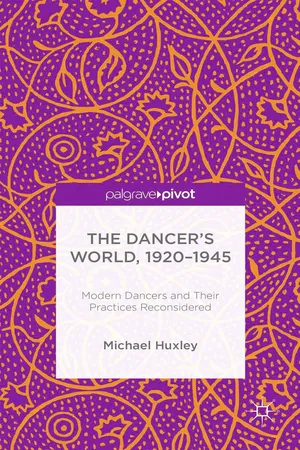
eBook - ePub
The Dancer's World, 1920 - 1945
Modern Dancers and their Practices Reconsidered
- English
- ePUB (mobile friendly)
- Available on iOS & Android
eBook - ePub
About this book
The Dancer's World 1920-1945 focuses on modern dancers as they saw themselves. Five chapters describe a narrative arc that encompasses Europe and the USA with a focus between 1920 and 1945. A final chapter considers contemporary relevance for dancers, dance artists, choreographers, dance students and scholars alike.
Information
Subtopic
Art General1
Introduction: Early Modern Dancers and Their Practices Reconsidered
Abstract: This chapter sets out the case for examining the dancer’s world as expressed in dancers’ writings. The historiography of modern dance between 1920 and 1945 in Europe and the United States of America tends to stress the role of the choreographer in the sense that we use the term today. I argue that this is a revisionist interpretation and that during the period modern dancers wrote of themselves as dancers even when talking of choreography. A case is made to reconsider early modern dancers and their practices by a re-reading of their writings. Dancers’ writings referred to include those from both continents and those involved in both performance and education including that of Leslie Burrowes, Isadora Duncan, Martha Graham, Doris Humphrey, Rudolf Laban and Elizabeth Selden.
Keywords: dancers’ writings; historiography; modern dance
Huxley, Michael. The Dancer’s World, 1920–1945: Modern Dancers and Their Practices Reconsidered. Basingstoke: Palgrave Macmillan, 2015. DOI: 10.1057/9781137439215.0004.
My aim in this account is to recover the writings of both European and American modern dancers in order to reconsider their practices internationally and to reposition ideas of the dancer and the choreographer in the period 1920–1945. I should stress that this is not a new history of modern dance; rather it is a historical account of dancers’ practices as made evident in their writings. It was the dancers themselves whose experience became the substance of the dances that encapsulated the period. It was also dancers who attempted to define the new modern dance form that they were creating, on their own terms. It is in this sense that I use the phrase ‘dancer’s world’. In this period, as we shall see, it was a dancer’s world where the focus was on the dancer. The change of emphasis from dancer to choreographer is one that comes much later and this development, and how it has been obscured by later writings, is one that I will discuss later in this chapter.
A new generation of dancers first began to talk of dance in a new way in the early years of the twentieth century. Isadora Duncan is perhaps the most celebrated of these but what she had to say about the dancer’s world is worthy of re-examination as an example of how a dancer made sense of the world through her writing about dance.
In 1903, Duncan’s speech1 on the dance of the future was published. It has become part of the canon of writings about modern dance. Today there is nothing particularly remarkable about a dancer speaking about what matters to them. In 1903, Duncan was one of the few to give voice to ideas outside the established classical ballet. Duncan’s speech is often referred to and analysed from a late twentieth- and twenty-first-century perspective, but it is worth reconsidering both as a statement in its time and as an introduction to the topic of this book – the dancer’s world.
Duncan spoke as a dancer and spoke for herself and for other dancers. She did not talk of the choreographer of the future. For her the dancer of the future will be a woman who, through her dancing, will embody a freedom that will be an inspiration for all women. She said of the ‘dancer of the future’ that ‘the dancer will not belong to a nation but to all humanity ... . From all parts of her body shall shine radiant intelligence, bringing to the world the message of the thoughts and aspirations of thousands of women. She shall dance the freedom of women’.2 She was, of course, speaking for herself and what she wished to achieve. Nonetheless, it remains a powerful statement. Over a century ago, a woman dancer aspired to a global outlook where freedom was the goal. She spoke out at a time when in both Europe and the United States of America there was a rising chorus of women’s voices to redefine their place in the world, not least in the political campaigns for universal suffrage.3 What marks Duncan out is that she was a dancer and her words had considerable impact. It was unusual at the time for a woman dancer to make such aspirations so public and for her to be taken seriously. Readers can decide for themselves how much has changed in the intervening years.
Duncan’s concerns are very similar to those of the many modern dancers who chose to put their thoughts into words in the early decades of the twentieth century. They talk of the dancer’s world, as dancers, from dancers’ perspectives. We are fortunate that many of the dancers of the period wrote about their work.4 When these dancers wrote, they did so to propose alternative dance practices to existing forms, notably classical ballet. These new practices eventually became so established as to present a technical orthodoxy that would itself be challenged in the 1960s. However, the virtuosity and formalism of the modern dance as presented in, say, Martha Graham’s 1957 film of A Dancer’s World, is different from the dancer’s world of the years before World War II.5
By returning to the written ideas of modern dancers from both Europe and the United States of America, I suggest that the very formation of modern dance as dance practices can be looked at afresh. The dancers’ world of the 1920s and 1930s was one where modern dancers individually and together began to mark out a new territory. Many of them were able to articulate what was new about their own dancing and that of their peers in a way that captured the primacy of the dancing itself.
During the early part of the twentieth century, modern dance was discussed in terms of modern dancers, with the emphasis on the dancer. Not only did the practitioners talk of themselves as dancers, but also so did the critics and the first historians of the modern dance. John Martin, in his seminal work The Modern Dance of 1933,6 defines the new form in terms of its dancers and this was the predominant way of talking about the modern dance in this period. This can be found in British, German and American publications from John Ernest (J.E.) Crawford Flitch’s Modern Dancing and Dancers7 through Rudolf Laban’s8 Die Welt des Tänzers9 to Elizabeth Selden’s The Dancer’s Quest.10 Indeed, as late as 1965, Olga Maynard was still writing of American Modern Dancers: The Pioneers.11 The revisionism that created histories that included early modern dance based on a late-twentieth-century idea of the choreographer led to histories and surveys of choreographers rather than dancers. For instance, there is a huge leap from the genealogy set out by Maynard in 1965 which includes both American and European dancers to that of Don McDonagh in 1976 with his exclusively American ‘extended choreographic families’ and his survey of choreographers.12
In the twenty-first century we are far more likely to write about what is now known as contemporary dance in terms of significant choreographers, even when they dance themselves. This is a perfectly valid description for much of the work of late-twentieth-century/twenty-first-century artists. However, the blanket attribution of the term ‘choreographer’ to dancers of a past period, which does not acknowledge fully how they saw themselves, poses a significant historiographical problem. For instance, Martha Bremser’s widely used textbook refers to Fifty Contemporary Choreographers.13 Deborah Jowitt gives Martha Bremser’s collection of ‘choreographers’ a fine, broad, well-informed historical introduction and starts with the period before 1940, which is her chronological starting point for the idea of ‘contemporary’. She begins by talking about a number of dancers of the early twentieth century including Martha Graham, Doris Humphrey and Charles Weidman, whom she refers to as ‘American dancers’. Yet, within a page these same people are referred to, without further elaboration, as ‘choreographers’ [my emphasis].14 They thus became part of the same narrative as the ‘choreographers’ of the book’s title, such as Richard Alston and Matthew Bourne whose main contribution has indeed been as choreographers rather than dancers. Sally Banes does something very similar in her book Dancing Women: Female Bodies on Stage. The book’s title draws attention to the activity that these women were engaged in – dancing. In her chapter on ‘early modern dance’ she introduces the ‘first generation of American modern dancers, including Loie Fuller, Isadora Duncan, and Ruth St Denis’. When considering ‘modern dance’ in a later chapter she refers back to this early period and talks of ‘these women, and many other, less famous choreographers [my emphasis] of their generation – like the Canadian Maud Allan and the Austrian Wiesenthal sisters’. She then introduces the dancing women whom she will consider as ‘the four choreographers [my emphasis] whose works I will analyze in this chapter – Mary Wigman, Doris Humphrey, Katherine Dunham, and Martha Graham’.15 Interestingly, the elision between dancer and choreographer refers to a similar period to Jowitt’s (the 1920s/1930s) and some of the same dancing women. These are...
Table of contents
- Cover
- Title
- 1 Introduction: Early Modern Dancers and Their Practices Reconsidered
- 2 The World of the Dancer
- 3 We (Dancers) Are Standing at the Beginning
- 4 German and American Modern Dance: Constitutional Differences
- 5 A New World for the Dancer
- 6 Conclusion: A Dancers World
- Epilogue: A Historical Sense of a Dancers World
- Select Bibliography
- Index
Trusted by 375,005 students
Access to over 1.5 million titles for a fair monthly price.
Study more efficiently using our study tools.
Frequently asked questions
Yes, you can cancel anytime from the Subscription tab in your account settings on the Perlego website. Your subscription will stay active until the end of your current billing period. Learn how to cancel your subscription
No, books cannot be downloaded as external files, such as PDFs, for use outside of Perlego. However, you can download books within the Perlego app for offline reading on mobile or tablet. Learn how to download books offline
Perlego offers two plans: Essential and Complete
- Essential is ideal for learners and professionals who enjoy exploring a wide range of subjects. Access the Essential Library with 800,000+ trusted titles and best-sellers across business, personal growth, and the humanities. Includes unlimited reading time and Standard Read Aloud voice.
- Complete: Perfect for advanced learners and researchers needing full, unrestricted access. Unlock 1.5M+ books across hundreds of subjects, including academic and specialized titles. The Complete Plan also includes advanced features like Premium Read Aloud and Research Assistant.
We are an online textbook subscription service, where you can get access to an entire online library for less than the price of a single book per month. With over 1.5 million books across 990+ topics, we’ve got you covered! Learn about our mission
Look out for the read-aloud symbol on your next book to see if you can listen to it. The read-aloud tool reads text aloud for you, highlighting the text as it is being read. You can pause it, speed it up and slow it down. Learn more about Read Aloud
Yes! You can use the Perlego app on both iOS and Android devices to read anytime, anywhere — even offline. Perfect for commutes or when you’re on the go.
Please note we cannot support devices running on iOS 13 and Android 7 or earlier. Learn more about using the app
Please note we cannot support devices running on iOS 13 and Android 7 or earlier. Learn more about using the app
Yes, you can access The Dancer's World, 1920 - 1945 by M. Huxley in PDF and/or ePUB format, as well as other popular books in Media & Performing Arts & Art General. We have over 1.5 million books available in our catalogue for you to explore.