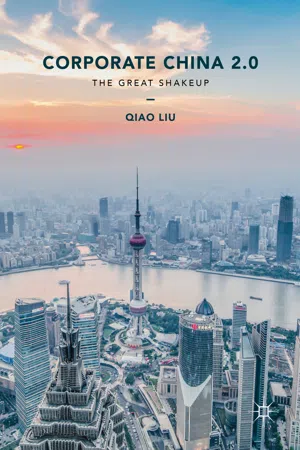
This book argues that that the rise of great firms - those with sustainable high return on invested capital (ROIC) - will lay the foundation for China's successful economic transformation. Drawn from the author's research on corporate finance and the Chinese economy, the author maintains that being big could be easy but means little for corporate China, especially in the context of China's transition from an investment-led economy to an efficiency-driven one. The work discusses both internal and external impediments that lead to lack of great companies in China and suggests institutional conditions which foster the rise of great companies in China, including, reversing the government's obsession with GDP, reforming the financial system, and promoting entrepreneurship. Policy makers, investors, corporate executives, and MBA students and scholars will appreciate case studies of Huawei, Alibaba, Xiaomi, and Lenovo, among others, that illustrate the endeavors made by Chinese entrepreneurs at the grassroots level and highlight what makes successful companies in China.
Qiao LiuCorporate China 2.010.1057/978-1-137-55089-7_1
Begin Abstract
1. The Improbable Surge of Corporate China
Qiao Liu1
(1)
Guanghua School of Management, Peking University, Beijing, China
End Abstract
In 1984, Liu Chuanzhi, a research scientist from the Institute of Computing Technology at the Chinese Academy of Science (CAS), decided to venture into the business world. With the help of ten other colleagues, he set up a technology company in Zhongguancun, a district where most national research institutes are located.1 They managed to put together RMB 200,000 as the initial investment. Liu’s goal was humble—he wanted to develop a system to speed up typing Chinese characters on computers and, if possible, make some money. It was probably beyond Liu’s wildest dreams that his small company would one day develop into one of China’s most successful technology companies. The company, later known as Lenovo, was ranked as the world’s 231st largest company (by sales) by Fortune magazine in 2015. It not only boasts of the world’s largest PC market share, but has also developed a solid footing in areas such as smartphones, tablets, Big Data, cloud computing, private equity, venture investment, and agriculture. Lenovo was a fully homegrown company prior to its acquisition of IBM’s PC unit in 2005. As of 2015, both overseas assets and sales had exceeded 50 percent and non-Chinese executives account for more than half of Lenovo’s senior executives. Lenovo has been widely viewed as the most market-oriented and most international company in China.2
In 1980s, Ren Zhengfei, a former army officer in his 40s, relocated to Shenzhen to explore his luck. After a few failed attempts, he founded Huawai Technologies in 1988. In less than 30 years, Huawai has become the world’s leading information and telecommunication equipment provider, exporting products and services to more than 150 countries. In 2014, Huawei’s total sales exceeded RMB 288 billion and its net profit stood at RMB 27.9 billion. Huawei now has sales significantly larger than traditional champions in this field such as Ericsson, Alcatel-Lucent, and Siemens. Huawei is also the world’s third largest smartphone producer, with more than 9 percent of the global market share as of the third quarter of 2015.
On January 20, 2012, Sany Group, a company headquartered in Changsha, the capital city of Hunan Province, announced its €360 million acquisition of Putzmeister—a German engineering machinery manufacturer and a giant in the industry. When Liang Wengen founded Sany in 1994, owning the “elephant” (Putzmeister’s nickname) was just a dream for Mr. Liang. In less than 20 years, Sany owned the elephant, and has also obtained access to Putzmeister’s cutting-edge technologies and distribution channels across the world.
In May 2013, China’s largest meat processor, Shuanghui International Holdings Ltd., struck a $4.7 billion deal to acquire Smithfield Foods Inc. in the USA. The deal marked the largest takeover of an American firm by a Chinese company. Set up in 1936, Smithfield Foods Inc., together with four other companies, controls 73 percent of the US pork-processing industry. While the revenue of Shuanghui was RMB 39.7 billion in 2012, Smithfield had reported revenue twice the size of Shuanghui (approximately RMB 80.3 billion in 2012). The acquisition greatly boosted Shuanghui’s operation scale, laying a solid foundation for its later initial public offering (IPO) in Hong Kong. As the demand for pork keeps rising in China, Shuanghui is emerging as a porcine empire.
In April 2010, in a small rented office in Beijing, Lei Jun, together with his six partners, announced the founding of Xiaomi.com. Lei Jun had been a successful businessman before he founded Xiaomi. He took Kingsoft, a software developer, to IPO status. He also founded Joyo, an e-commerce platform that was acquired by Amazon. Founding Xiaomi, Lei Jun aimed to get into the high-end smartphone market. One year later, Xiaomi.com launched its first-generation millet phone with a retail price set at RMB 1999. Relying on internet sales and word-of-mouth buzz, Xiaomi’s sales rose quickly. It sold more than 60 million handsets in 2014, making it the world’s sixth largest mobile phone producer. To Lei Jun, millet phone is not just a simple device. It is a gadget encompassing software, internet services, and hardware. From the outset, Xiaomi.com has successfully managed to develop an ecosystem that not only houses apps but also sells a wide range of items from content, to software, to services. With its newest round of fund-raising in late 2014, Xiaomi.com was valued at $45 billion, easily making it one of the world’s most valuable startups, and one of the ten largest internet companies (by estimated market value) in the world.
Over the past three and half decades, stories like Lenovo, Huawei, Sany, Shuanghui, and Xiaomi have abounded in China. Corporate China is surging. Along with the improbable surge of corporate China is the fast growth of the Chinese economy. Since the Chinese government kick-started the economic reform in 1978, China has managed to maintain an average GDP growth rate of over 9 percent. In 2010, China overtook Japan to become the world’s second largest economy; in 2012, China surpassed the USA to become the world’s largest manufacturer. In 1990, China produced less than 3 percent of the world’s total manufacturing output (by value). This share has now increased to nearly a quarter. Take the aluminum industry as one example. In 1990, Chinese aluminum producers made up only 4 percent of global production; by 2014, their share had increased to 52 percent.3 Along the way, China has also become the world’s largest luxury goods consumer. Walking on the streets of Beijing, Shanghai, Shenzhen, and many coastal cities, one can easily feel the excitement of Chinese citizens. Many of them seem to be in an optimistic hurry, talking on iPhones, carrying their Rimowa suitcases, wearing their Prada shoes and Piaget watches. Although GDP growth has slowed down in recent years and many have lost faith in the narrative of China continuing to be the world’s manufacturing and export center, China still remains one of the world’s most powerful growth engines.
From Zero to 106
Every year, Fortune magazine publishes a list of the world’s 500 largest companies, the Fortune Global 500. This vintage product of the magazine is greatly valued by the Chinese media as well as Chinese companies. To many, appearing on this list is tantamount to becoming a well-respected world-class company. For corporate China, the real breakthrough came along in 1996 when two Chinese companies entered the list for the first time. Since then, the number of China’s Fortune Global 500 companies has been increasing. On the 2015 list, there are in total 106 Chinese companies, compared to 128 in the USA.4 Since 2011, China has claimed more Fortune Global 500 companies than Germany and Japan, second only to the USA. Over the past 35 years, Chinese firms have successfully transformed themselves from following the practice and standards of companies like GE, Toyota, and Shell to setting their own practice and standards.
Fortune ranks the global companies according to their total sales. The threshold for the 2015 list is close to US$24 billion, approximately RMB 154 billion (US$1 = RMB 6.4). More than one hundred companies report sales over RMB 150 billion in 2015—the surge of corporate China could not be more obvious. To a greater extent, this surge symbolizes China’s economic success in the past 35 years. In 2015, ranking among the ten largest companies in the world by revenue are three Chinese state-owned manufacturing firms: Sinopec, PetroChina, and State Grid Corporation of China.
Figure 1.1 presents the dynamic distribution of Fortune Global 500 companies in the USA and mainland China from 1996 to 2015. Here, to be consistent across time, I only report the mainland Chinese firms by excluding companies in Taiwan and Hong Kong. Given the trend demonstrated in this Figure, China will very likely catch up with the USA, in terms of the number of Fortune Global 500 companies, by 2020.
Fig. 1.1
Fortune Global 500 companies: USA versus mainland ChinaSource: Collected and calculated by the author
Back in 1978, when China was forced to start its economic reform, China did not even have a company in the modern sense. All the so-called companies were the Soviet Union type of work units designed to fulfill the tasks assigned to them by the planning agencies at different levels. By then, China’s central bank, the People’s Bank of China (PBOC), under the supervision of the Finance Ministry, also functioned as a commercial bank. PBOC spun off its commercial functions and formed the Industrial and Commercial Bank of China (ICBC hereafter) in the early 1980s. ICBC has since then grown into one of the largest finical intermediaries in the world. In 2015, ICBC is the world’s 18th largest company by revenue, the largest bank, and overall, the most profitable company, beating Apple and Exxon.
Transforming from simple production units under the planned economy to profit-driven and market-minded firms, corporate China successfully completed its first metamorphosis. Studying the quick and improbable rise of corporate China is engrossing as it poses many fascinating, and often troubling, questions: How do millions of Chinese firms, often on a large scale, conduct business in the absence of well-developed institutional infrastructure such as effective law enforcement and the protection of property rights? What is behind corporate China’s improbable surge? What does the surge of corporate China imply for China and the rest of the world? How are those corporate giants going to evolve? How many of these corporate giants that emerged during the past three and a half decades are truly great companies, and what made these companies great?
Behind the Improbable Surge
To understand the quick and improbable rise of the Chinese firms, we need to place the corporate stories in the context of China’s fast economic growth in the past three and a half decades. China has been a stable contributor to the global economic growth. China’s economic boom has led to an unprecedented surge of productivity and prosperity that has lifted hundreds of millions from poverty, pushed the country to the forefront of global manufacturing and trade, and unleashed sweeping transformations of employment, education, urbanization, consumption, healthcare, inequality, ownership, and many other dimensions of economic and social life in the world’s most populous nation. While China’s strong economic growth momentum plays an important role in catalyzing the birth of corporate giants, the approach China has taken to grow its economy also helps explain the quick surge of corporate China.
The Investment Feast
Hangzhou Bay Bridge, spanning the Hangzhou Bay on the East China Sea and crossing the Qiantang River, is one of the longest ocean-crossing bridges in the world. Opened to the public in May 2008, the 36-kilometer-long bridge cuts the trip between Ningbo and Shanghai from 400 kilometers to 180 kilometers and the ground time from more than 4 hours to about 2 hours. The total project cost of the six-lane, two-direction bridge with cable-stayed design was RMB 11.8 billion. Part of this amount was funded by loans from China’s state-owned banks and regional banks (close to 60 percent). The rest was provided by private companies in Ningbo. The bridge, although expensive by any standard, greatly boosts economic integration and development in the Yangtze River Delta, the most economically developed area in China.
Investments like Hangzhou Bay Bridge were by no means rare in China over the past 35 years. The cranes looming over vast construction sites have been most foreigners’ first impression of China. China today, for example, with less than 6 percent of the world’s water resources and just 9 percent of the world’s arable land, can produce in one year 50 billion T-shirts, 10 billion pairs of shoes, 800 million metric tons of crude steel (50 percent of global supply), 2.4 gigatons of cement (nearly 60 percent of world production), close to 4 trillion metric tons of coal (burning almost as much coal as the rest of the world combined), more than 23 million vehicles (more than a quarter of global supply), and 62,000 industrial patent applications (1.5 times that in the USA). China is also the world’s largest producer of ships, speed trains, robots, tunnels, bridges, highways, electricity, chemical fiber, machine tools, cell phones, computers, bicycles, motorcycles, air-conditioners, refrigerators, washing machines, furniture, textiles, clothing, footwear, toys, fertilizers, agricultural crops, pork, fish, eggs, cotton, copper, aluminum, books, magazines, television shows, and college students. China produces one-third of world agricultural products and supplies nearly 50 percent of global industrial goods. Currently, China builds the square-foot equivalent of Rome every two weeks.
A large academic literature has been devoted to the understanding of China’s economic ascendance. Fixed-asset investment has been singled out as one of the most important and reliable pillars of China’s growth. Fixed-asset investment accounts for more than 40 percent of China’s GDP in the past 40 years, and the ratio of fixed-asset investment to GDP even reached 50 percent in recent years. In a comparison, between 1970 and 2009, fixed-asset investment accounted for only 23 percent of GDP in India, and less than 30 percent in most of the East Asian economies including South Korea, Singapore, Taiwan, and Hong Kong.5 The Chinese growth model can be characterized as an investment-led growth model.
In hindsight, an investment-led growth model was a natural choice for China. Traditionally, saving ratio in China has stayed at a h...
Table of contents
Cover
Frontmatter
1. The Improbable Surge of Corporate China
2. What’s In A Great Company?
3. Does ROIC Apply to Corporate China?
4. The “Great” Hope Struggles
5. It Is Also About Corporate Governance
6. The Perils of Diversification
7. Shake Up the Foundations
8. The Beginning of a Breakthrough
9. Conclusion: How Can Chinese Companies Be Truly Great?
Backmatter
Trusted by 375,005 students
Access to over 1.5 million titles for a fair monthly price.
Study more efficiently using our study tools.
Frequently asked questions
Yes, you can cancel anytime from the Subscription tab in your account settings on the Perlego website. Your subscription will stay active until the end of your current billing period. Learn how to cancel your subscription
No, books cannot be downloaded as external files, such as PDFs, for use outside of Perlego. However, you can download books within the Perlego app for offline reading on mobile or tablet. Learn how to download books offline
Perlego offers two plans: Essential and Complete
Essential is ideal for learners and professionals who enjoy exploring a wide range of subjects. Access the Essential Library with 800,000+ trusted titles and best-sellers across business, personal growth, and the humanities. Includes unlimited reading time and Standard Read Aloud voice.
Complete: Perfect for advanced learners and researchers needing full, unrestricted access. Unlock 1.5M+ books across hundreds of subjects, including academic and specialized titles. The Complete Plan also includes advanced features like Premium Read Aloud and Research Assistant.
Both plans are available with monthly, semester, or annual billing cycles.
We are an online textbook subscription service, where you can get access to an entire online library for less than the price of a single book per month. With over 1.5 million books across 990+ topics, we’ve got you covered! Learn about our mission
Look out for the read-aloud symbol on your next book to see if you can listen to it. The read-aloud tool reads text aloud for you, highlighting the text as it is being read. You can pause it, speed it up and slow it down. Learn more about Read Aloud
Yes! You can use the Perlego app on both iOS and Android devices to read anytime, anywhere — even offline. Perfect for commutes or when you’re on the go. Please note we cannot support devices running on iOS 13 and Android 7 or earlier. Learn more about using the app
Yes, you can access Corporate China 2.0 by Qiao Liu in PDF and/or ePUB format, as well as other popular books in Business & International Business. We have over 1.5 million books available in our catalogue for you to explore.