eBook - ePub
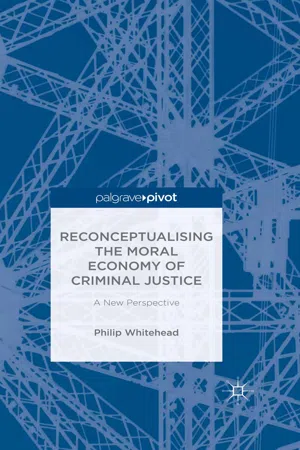
Reconceptualising the Moral Economy of Criminal Justice
A New Perspective
- English
- ePUB (mobile friendly)
- Available on iOS & Android
eBook - ePub
About this book
This book reconceptualises the concept of moral economy in its relevance for, and application to, the criminal justice system in England and Wales. It advances the argument that criminal justice cannot be reduced to an instrumentally driven operation to achieve fiscal efficiencies or provide investment opportunities to the commercial sector.
Information
Topic
PhilosophySubtopic
Ethics & Moral Philosophy1
Theorising Morality: Assembling the Intellectual Resources
Abstract: This chapter assembles some of the intellectual resources to introduce, explore critically and theorise the moral. To pursue this task it is necessary to allude to a rich compendium of philosophical ethics; theological and Christological insights; the doctrine of personalism; psychoanalysis and symbolic ethics. Furthermore, after considering politico-economic and moral conditions before and after the great transformation of the late-18th century, specific references to moral economy are introduced before turning briefly to social theory.
Whitehead, Philip. Reconceptualising the Moral Economy of Criminal Justice: A New Perspective. Basingstoke: Palgrave Macmillan, 2015. DOI: 10.1057/9781137468468.0005.
Philosophical ethics
Although Albert Schweitzer (from 14 January 1875 to 4 September 1965) demonstrated little academic precocity during his formative years, he cultivated a respect for life that shaped his ethical thought. By the age of 30 he had obtained doctorates in philosophy, theology and music, prior to studying medicine to work as a missionary at Lambaréné, Gabon, in French Equatorial Africa. Seaver commented that after Schweitzer had distinguished himself in the philosophy of Kant, the interpretation of Bach and Biblical scholarship, ‘behold him now, in a shed by a riverside in Equatorial Africa, holding, with a comrade’s grip, the hand of a primitive negro whom his surgical skill had just rescued from an agonizing death’ (1947: 60). His primary intellectual outputs in the aforementioned fields that can be added to his first doctorate on The Religious Philosophy of Kant are cited below.1 The text requiring close attention is Civilisation and Ethics Part II (1929), because it purviews Hellenistic ethics, the Judaeo-Christian inheritance, continuing through Renaissance and Enlightenment moral perspectives and beyond into the nineteenth century.2 His primary concern was the tragedy of the Western world-view that collapsed with the First World War when barbarism on an industrial scale destroyed the promise of the European Enlightenment for progress towards human civilisation through reason (Outram, 2013). Furthermore, the encroaching gloom of technical rationality and bureaucratic state-craft (Weber, 1922/1968), quantifiable state-istics (Cullen, 1975), positivistic obsessions and cost–benefit analysis combined to erode the ethico-cultural and emotional dynamics of existence (Meštrović, 1997). By the spring of 1923 the first two volumes of Philosophy of Civilisation were complete, but Part II constitutes the coping stone and supreme achievement of his work (Seaver, 1947: 85) as it explores the quest for the foundational principle of the moral. The question of ethics is different to figuring out the world-process that speculates on the ontological structure of reality with, for example, Plato and Hegel. Schweitzer followed Kant rather than Hegel by questioning whether it is possible to discover a world-process explicated, for example, as Spirit’s growing self-consciousness. Accordingly, metaphysical certitudes are beyond the power of abstract thought to comprehend so that ‘the more systematized any philosophical system is (for example, the immensely imposing systems of an Aristotle or a Hegel) so much the more fallacious it can be shown to be’ (Seaver, 1947: 280). Schweitzer’s agnosticism towards metaphysical system-building and theoretical abstraction is replaced with an enthusiasm for life. Not the Cartesian ‘I think, therefore I am’, but rather ‘I am life that wills to live’ as the starting point for reverence for life. It is elucidated that ‘Reverence for Life pretends to no knowledge of the world or of what the world may mean; it formulates no world-view’ (Seaver, 1947: 293) but advances a life-view. Reverence for life is not constitutive of speculative reason but practical reason that affirms the sacredness of existence which is universal in its demand and scope. Consequently, Schweitzer issued a practical invitation to ‘Find yourselves some secondary work, an inconspicuous one, perhaps a secret one. Open your eyes and look for a human being or some work devoted to human welfare which needs from someone a little time or friendliness, a little sympathy, or sociability, or work’ (1929: 260). Schweitzer does not advance a critique of 19th century liberal capitalism throughout his ethical enquiries. Nevertheless, he tangentially analyses its effects when issuing the summons for the restoration of ethical responsibility that affirms life per se which has implications for politico-economic structures. In fact, he questions how it is possible to attain the standard of economic justice unless it is premised upon the morality of reverence for life (1929: 277). Even after the calamitous capitalist crisis of 2007/08, we still need to arrive at an accommodation of how to organise ourselves morally. It is as urgent now as when Schweitzer was writing.
Schweitzer’s exposition of Kantian morality confirms human beings as ends rather than means, an interest in motives rather than consequences, so that the ‘utilitarian ethic must abdicate before that of immediate and sovereign duty’ (1929: 107). Kant’s deontological ethic opposes utilitarianism in asseverating that human beings are intrinsically worthy of respect, so the basic principle of ethics transcends contingent conditions and political manipulation. What is more, the moral impulse as the imperative of duty intimates a transcendent realm that cannot be known, only postulated. Because of the limits placed on knowledge, religious experience is reduced to the moral impulse. God belongs to the numinous not phenomenal realm which is beyond the scope of human knowledge, yet in whom human beings believe to act morally out of practical reason. Kant asserted that just because something facilitates pleasure or Aristotelian happiness does not make it right: ‘A good will is not good because of what it effects or accomplishes. Even if ... this will is entirely lacking in power to carry out its intentions, if by its utmost effort it still accomplishes nothing ... even then it would still shine like a jewel for its own sake as something which has its full value in itself’ (1785/2005: 65). Schweitzer’s criticism of Kant is that even though there is merit in universally binding duty, it lacks human content: ‘How far Kant is from understanding the problem of finding a basic moral principle which has a definite content can be seen from the fact that he never gets beyond an utterly narrow conception of the ethical’ (1929: 108). In doing so Kant does not establish a basic principle of the moral that encapsulates the whole of life-existence in not allowing for sympathy as a springboard of ethics. Therefore, the Kantian position elevates rigid duty above Aristotelian happiness, Enlightenment reason before human sympathy and emotion. During Schweitzer’s historical exposition and critique, ethical systems are allocated to one of three positions (1929: 72).
First, egoism can be transposed into altruism by meditation or psychological reflection to benefit others. Second, altruism is imposed onto individuals because, according to Hobbes, they predominantly act out of self-interest – man as wolf to man. Although the Aristotle–Augustine–Aquinas philosophical and theological tradition asserted the natural sociability of human beings who are suited for life in the polis (Pagden, 2013: 44), Hobbes rejected this for a pessimistic anthropology that must be restrained by a central political authority to ensure social co-existence. Third, egoism and altruism are constitutive components of the human condition and, where the latter is concerned, it is out of sympathy for others that benevolence arises. At this point it is of interest to note that Hutcheson, influenced by Shaftesbury, postulated a moral sense that is able to differentiate between ethical and unethical behaviour in others. Moreover, Hume, influenced by, yet proceeding beyond Hutcheson, asserted that reason was insufficient to provide instruction on matters of blame or approbation. Sentiment is required which ‘can be no other than a feeling for the happiness of mankind, and a resentment of their misery ...’ (Hume, 1777/1983: 83 italics added). Accordingly, Schweitzer summarised that ethical systems have been deemed a matter of reason or rational deduction; the intimation of a transcendental realm (Kant); imposed by a central authority to establish sociality (Hobbes); a biologically endowed moral sense that can be added to the five physical senses (Hutcheson). Ethics overlaps with politics, anthropology, psychology, sociology and education. There is also the conundrum of whether it is a biological-given or something we repeatedly have to learn (nature or nurture)? More recently Michael Sandel (2009) advanced a philosophico-political perspective on morality and justice according to three positions: utilitarianism, liberal economics and Aristotelian virtue ethics. Eagleton (2009) covers some of the ground contained in Schweitzer (1929), Sandel (2009) and MacIntyre (1967), but assigns ethical systems to one of three psychic orders that we shall come to later. Schneewind (2003) is indispensable on the subject of moral philosophy.
Pagden contributes to this discussion when arguing that the aim of the European Enlightenment was civilisation, defined as a ‘process of aggregation and cooperation – the working out in time of the “sympathy” which bound all human beings inexorably to one another’ (2013: 210). This interpretation envisaged that reason would improve the world through scientific advances, the declaration of universal justice and human rights, establishing minimal ethical standards and the moral duty to alleviate suffering. Whatever the prospects for civilisation in the 18th century Age of Reason, they were buffeted by industrial capitalism in the 19th century with its laissez faire economics, utilitarian philosophy, Hobbesian atomistic individualism that pitted self-interest over public interest, profit before social well-being and capitalist exchange relations before Aristotelian virtue. Pagden, like Schweitzer, does not adequately address the problematic of liberal capitalism in his exposition of the Enlightenment vision of a benign, unified and cosmopolitan humanity in what increasingly became a modern and post-theological European world. He explains that ‘Hobbes had not merely demolished the Aristotelian–Thomist theological order, he had also banished any possibility of any mode of human interaction which was not based upon a crude calculation of interests’ (2013: 55). But where was Humean feeling in this bleak dystopian view of humanity? Are we nothing more than biological and psychological beings ineluctably stuck with the tyranny of our selfish egos, pursuing our own interests and in constant conflict with the social? Pufendorf, with Shaftesbury, Hutcheson, even Adam Smith, appealed to sentiment, human beings as moral creatures, with inclinations and feelings of benevolence, the self’s recognition of someone other than themselves that transcended Hobbes and Grotius (Schneewind, 2003). This is not the language of Kant’s rigid duty and the categorical imperative, but it does provide content for Schweitzer’s ethic of reverence for life. Throughout all these discussions on the moral and content of ethical systems, Pagden asserts optimistically that there was a demand for a theory of human mind that incorporated a richer account of the human person than one governed by instrumental and calculating self-interest, or even rigid duty, that was central to Schweitzer’s ethic of reverence for life.
One of the unquestionable guarantors of morality for centuries was a God-orientated world-view, a philosophico-theological perspective. Charles Taylor (2007) argued that from the Fathers of the early Church, through to Augustine and Aquinas who supported a God-centred universe, it was axiomatic to believe in God. However, Renaissance science, post-Enlightenment secular philosophy and Nietzsche’s proclamation of the ‘death of god’ disturbed this view. Nevertheless, this did not culminate in a final obituary notice posted on the history of God or study of moral philosophy. David Hume and Bertrand Russell, for example, may well have decoupled metaphysics from morality which rearranged the intellectual, religious and moral furniture, but the furniture remained, if less secure than formerly. Former certainties were intellectually challenged, but we still do not live in a ‘Fatherless World’ (Pagden’s reference to Adam Smith, 1759/2009: 277; also Eagleton, 2014). This is a propitious moment to turn from philosophy to the former ‘queen of sciences’, namely theology. Raines suggests, ‘In the twenty-first century, religion promises to be a major historical force for the first time in four hundred years’ (2002: 12). Although Raines does not consign religion to a Freudian illusion, he fails to tell us whether it is a force for good or evil.
Theological and Christological ethics
On Being A Christian (Küng, 1977) is an academic though accessible text on theology and Christology with implications for theorising the moral. Küng’s God (Θεός Theos) is not an object alongside objects in the world that can be known, empirically verified or accessible to pure reason. Kant and Schweitzer would approve. Instead, God is a proposition of faith, presupposed if human beings want to live a meaningfully moral life. To construct a language that makes it possible to talk about God (the primary task of theology), in conjunction with morality, is ontologically and epistemologically problematic. Moreover, theoretical reason and abstract speculative metaphysics of the Platonic and Hegelian sort are not all that useful as a guide for formulating a life-view. We are therefore shunted, as an existential necessity, onto more solid ground with Küng’s exposition of Jesus of Nazareth as the definitive expression of God’s cause in the world (God’s logos – λόγος word), the anthropological exemplar who stands at the head of a restructured humanity. Schweitzer believed that the gift bestowed by Christianity is an ethic of self-renunciation to benefit others. By stripping back the accretions of church councils and their impenetrable dogmatic formulations (Kelly, 1968), centuries of religious conflict, byzantine ecclesiastical operations and priestly castes engaged in debilitating discussions on homosexuality, women priests and bishops, Jesus of Nazareth is the criterion of what it means to be human and to live humanely. This historical figure represents a ‘Wholly new approach to life, at an awareness transformed from the roots upward, a new basic attitude, a different scale of values, a radical rethinking and returning of the whole man’ (Küng, 1977: 546). From the prophetic literature on social justice (Jones, 1968), the ethical injunction to individual and community responsibility, and the resolution of disputes contained in the Old Testament literature; to the new covenant of neighbourliness and love extended to enemies (see the Ethical Lists in Metzger and Coogan, 1993: 201); the Judaeo-Christian inheritance provides a resource for exploring the concept of the moral. The Pauline inheritance is particularly important.
We must always keep in mind that Paul was a man of his own classical era, who’s framing (or re-framing) of Christianity reflected his Greek, Roman and Jewish cultural inheritance. Pauline theology articulates the contours of a new humanity that, in turn, constitutes a new ethical community that requires explanation. When doing so it is necessary to allude to a considerable work of scholarship (Blumenfeld, 2001) that grounds Pauline theology and Christology within the intellectual parameters of Platonic and Aristotelian politics, and the literature known as the Pythagorean pseudepigrapha. The importance of Blumenfeld’s scholarship is that it draws attention to the neglected political dynamic of the Pauline literature. It is not easy to produce a summation of this comprehensive and sometimes complex text but it demonstrates how Paul, in the style of Aristotelian Ethics (2000), moves from the individual to the polis (πόλις), ethics to politics. Like Aristotle ‘Paul connects one’s proper end with the collective end, the good of one with that of the many, ethics with politics’ (Blumenfeld, 2001: 382), of which the epistolary motif is the one Body (so̲ma σῶμα) with its interconnected limbs. What is good or moral is rooted in the concept of dikaiosunē (δικαιοσύνη justice), the opposite of adikia (ἀδικία injustice); it eschews evil, considers others and is universal in scope. It supports the Aristotelian virtues of wisdom, prudence and justice, but agapē (ἀγάπη love) is the essence of the new order within the polis (πόλις) that defines citizenship and civic order. The conception of the new political and ethical order eradicates the binaries between Jew and Greek, Greek and barbarian, free and slave, wealthy and poor and ruler and ruled within the transformed polis which is good news (τo euangelion, τό εὐαγγέλιον). It does not invite monastic withdrawal into deserted landscapes but full engagement with the world to renew and transform it which is subversive, radical, scandalous, even revolutionary (see Milbank, 2010). The symbolic representation of the new existence is a disturbing cross (stauros σταυρός). In other words, at the beginning of Christianity is a sacrificial death that challenges anthropological self-interest. The sacrificial cross is the ultimate ethical expression of costly self-renunciation on behalf of the other, more convincing than doctrines of the atonement obsessed with haematology (Dillistone, 1982). Consequently, Pauline ethics echo Hippodamos and Aristotle who warn ‘against social inequity and even economic surfeit, and the changes to sociality and social stability they present’ (Blumenfeld, 2001: 388).3 N.T. Wright, a former Bishop of Durham, explains that the scandalon of the New Testament presented in Pauline epistolary writing is that the new being in Christ ‘overturns all the social pride and convention of the surrounding culture’ (2009: 26). Human existence is transformed by faith by a new narrative and signification system. The wisdom of the world is not God’s wisdom and ‘the whole point of the gospel is to put the world – not upside down, because that is where it already is, but the right way up’ (Wright, 2009: 131). Everything is judged by different political and ethical criteria that demand a new perspective on all dimensions of life that reconcile politics, ethics and anthropology into a transcendent unity.
Earlier I called for the reanimation of academic interest in the life and work of Albert Schweitzer. I now make a similar case for Dietrich Bonhoeffer on whom there is also a considerable primary and secondary literature.4 Born in Breslau on the 4 February 1906 into a cultured, patriotic but not nationalistic family (Kelly and Nelson, 2003), the Bonhoeffer family moved to Berlin in 1912 when their father accepted the chair in psychiatry and nervous diseases at Berlin University. In 1919, following the death of an older brother in the First World War, Dietrich Bonhoeffer attended the Grunewald Gymnasium to continue his formative ed...
Table of contents
- Cover
- Title
- 1 Theorising Morality: Assembling the Intellectual Resources
- 2 Moral Economy: Exploring a Contested Concept
- 3 Moral Economy, Criminal Justice and Probation: From 1979 to 2010
- 4 Moral Economy, Markets and Privatisation: From 2010 to 2015
- 5 Morality and Justice: Challenging the Established Order
- References
- Index
Trusted by 375,005 students
Access to over 1.5 million titles for a fair monthly price.
Study more efficiently using our study tools.
Frequently asked questions
Yes, you can cancel anytime from the Subscription tab in your account settings on the Perlego website. Your subscription will stay active until the end of your current billing period. Learn how to cancel your subscription
No, books cannot be downloaded as external files, such as PDFs, for use outside of Perlego. However, you can download books within the Perlego app for offline reading on mobile or tablet. Learn how to download books offline
Perlego offers two plans: Essential and Complete
- Essential is ideal for learners and professionals who enjoy exploring a wide range of subjects. Access the Essential Library with 800,000+ trusted titles and best-sellers across business, personal growth, and the humanities. Includes unlimited reading time and Standard Read Aloud voice.
- Complete: Perfect for advanced learners and researchers needing full, unrestricted access. Unlock 1.5M+ books across hundreds of subjects, including academic and specialized titles. The Complete Plan also includes advanced features like Premium Read Aloud and Research Assistant.
We are an online textbook subscription service, where you can get access to an entire online library for less than the price of a single book per month. With over 1.5 million books across 990+ topics, we’ve got you covered! Learn about our mission
Look out for the read-aloud symbol on your next book to see if you can listen to it. The read-aloud tool reads text aloud for you, highlighting the text as it is being read. You can pause it, speed it up and slow it down. Learn more about Read Aloud
Yes! You can use the Perlego app on both iOS and Android devices to read anytime, anywhere — even offline. Perfect for commutes or when you’re on the go.
Please note we cannot support devices running on iOS 13 and Android 7 or earlier. Learn more about using the app
Please note we cannot support devices running on iOS 13 and Android 7 or earlier. Learn more about using the app
Yes, you can access Reconceptualising the Moral Economy of Criminal Justice by Philip Whitehead in PDF and/or ePUB format, as well as other popular books in Philosophy & Ethics & Moral Philosophy. We have over 1.5 million books available in our catalogue for you to explore.