- English
- ePUB (mobile friendly)
- Available on iOS & Android
eBook - ePub
About this book
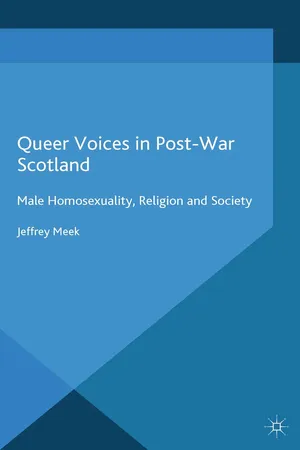
This book examines the experiences of gay and bisexual men who lived in Scotland during an era when all homosexual acts were illegal, tracing the historical relationship between Scottish society, the state and its male homosexual population using a combination of oral history and extensive archival research.
Trusted by 375,005 students
Access to over 1.5 million titles for a fair monthly price.
Study more efficiently using our study tools.
Information
1
Introduction
In 1967 gay men in England and Wales celebrated the limited decriminalisation of sex between males, brought about through the Sexual Offences Act. The path to law reform had begun in 1957 with the publication of the Report of the Committee on Homosexual Offences and Prostitution (hereafter, the Wolfenden Report),1 which had followed investigations into whether the laws governing sex between men were appropriate. It may have taken a decade for the recommendations to find their way into law, but after centuries of persecution gay men had achieved a measure of freedom from state interference in their lives. Yet, gay men in Scotland were excluded from this legal change, and faced a further 13 years of criminalisation until in 1980 the Criminal Justice (Scotland) Act brought about legal equity. Prior to this, crossing the border between England and Scotland was a legally retrograde step which reduced the lives and experiences of non-heterosexual men to a collection of sexual acts judged by a prurient and hostile legal justiciary.
A number of publications have offered insights into how homosexuality was viewed historically in Britain, and into the processes of homosexual law reform in this country. Jeffrey Weeks has published a variety of works that have attempted to explain how British legislators, politicians and medical professionals have viewed homosexuality, and how the processes of law reform have developed over the nineteenth and twentieth centuries.2 Additionally, Matt Cook et al. have offered their interpretations of British society’s relationship with homosexuality since the Middle Ages, and in particular, the shifts in discourses about same-sex desire.3 Stephen Jeffery-Poulter has documented the struggle for homosexual law reform in Britain from the 1950s onwards, with particular emphasis on the gay rights movement and the political processes involved in the quest for change.4
However, with the exception of Jeffery-Poulter, the majority of works concerning homosexuality and Britain fail to offer convincing accounts of how homosexuality was viewed in Scotland, and the law reform process in that country. Many of the works focusing on Britain are in fact neglecting the Scottish dimension. Weeks devotes fewer than 10 pages of Coming Out to Scottish issues, and stops short of offering an explanation as to why the 1967 legislation bypassed Scotland. Matt Cook et al. offer a similarly brief discussion, and most books of this nature focusing on a British perspective are in fact focusing on England.5
Much of this work has engaged with the argument that the change in law reflected reformist principles within government, and the emergence of more liberal moral attitudes in post-war Britain.6 This leads to the assumption that such sentiments were absent north of the border. Scotland appeared to be sticking rigidly to the position that homosexual acts committed consensually by adults in private were morally and legally unacceptable. Discussions on the nature of the Scottish homosexual law reform movement and on how homosexuality has been viewed by Scottish social, medical and political institutions have been left to a small number of Scottish-based writers. Brian Dempsey has briefly examined the development of the homosexual law reform movement in Scotland with particular emphasis on the structure and development of the Scottish Minorities Group (SMG) and its later incarnation the Scottish Homosexual Rights Group (SHRG).7 Roger Davidson and Gayle Davis, who have focused on the post-Wolfenden push for homosexual law reform in Scotland, argue that the delay in implementing legal reform regarding homosexual acts in Scotland was due to a combination of factors. Firstly, there appeared to be a lack of appetite for reform amongst Scottish politicians. Secondly, the body of opinion amongst institutions such as Scottish churches and Scottish media was apparently against decriminalisation. Thirdly, evidential requirements under Scottish criminal law meant that the prosecution of consensual homosexual acts in private was difficult to enforce,8 and thus reform was deemed unnecessary.
As much of the focus on Scotland and male homosexuality has been related to the post-Wolfenden era, little is understood about the wider history of homosexuality from a Scottish perspective. To the casual observer of twentieth-century Scotland, homosexuality appeared something alien to the Scottish nation, but beneath that facade exists evidence of same-sex desire within the fabric of Scottish society. As this book will detail, inter- and post-war Glasgow and Edinburgh were home to thriving queer subcultures, and profitable homosexual prostitution rings. Whilst politicians and media organisations of the period were loath to comment on the existence of homosexual subcultures, the country’s legal authorities handed out punitive sanctions to the men who publicly challenged the nation’s supposed conservative values.
Until 1967 Scottish non-heterosexual men faced many of the threats their English and Welsh counterparts faced. Yet, the bulk of material written to date on Scotland has focused on institutional responses to homosexual law reform, and the voices and experiences of non-heterosexual men have been absent. Questions remain as to how much they knew about the Wolfenden Report, and Scots Law, which rarely interfered in the private lives of the nation’s non-heterosexual population. Most would have been aware of the legal inequity that existed within the United Kingdom, and that the threat of criminality was never far away. What this book offers is a telling account of the experiences of non-heterosexual men who grew up within Scotland during a period when homosexuality was perceived as a threat to the nation’s robust heterosexuality.
This was most exemplified in the opinions of James Adair, the former procurator fiscal, and the most prominent Scot on the Wolfenden Committee. Adair viewed homosexual law reform as the first step in Scotland’s fall into moral turpitude.9 Scotland’s churches have been viewed as playing an instrumental role in the decision not to apply the Sexual Offences Act 1967 to Scotland.10 Scotland’s largest church, the Church of Scotland, aligned itself with Adair’s objections in the immediate post-Wolfenden period, but this book will demonstrate that there was considerable ambivalence within the church on the thorny issue of law reform. Within a decade the church was mired in conflict and by the late 1960s was proactively engaging with the Scottish homosexual law reform movement. Scotland’s second largest religious institution, the Roman Catholic Church, was also intimately involved with Scotland’s foremost homosexual rights organisation, the Scottish Minorities Group (SMG). Interviews I conducted with non-heterosexual Scottish religious professionals offer insights into both institutional and personal attitudes to homosexuality and religious adherence.
There appeared to be little outrage at Scotland’s omission from the 1967 legislation, and the continued legal proscriptions against the sexual lives of non-heterosexual adult males. Whereas in England several organisations had emerged in the post-Wolfenden era to challenge the laws on homosexuality, there was little political activity north of the border until a decade after the change in law in England and Wales. This peculiarity hints at a cultural gulf between Scotland, England and Wales during this period. The lack of political activity obscures the fact that Scotland did have a non-heterosexual population during this period whose lack of representation left them in a sexual wilderness.
This book will demonstrate how Scottish politicians’ failure to be proactively involved in discussions of homosexual law reform during the 1960s immediately hamstrung the push for decriminalisation north of the border. Instead they participated in the drive for the continuation of the status quo in Scotland,11 and in discussions which bolstered the position of Scots Law and its treatment of homosexual offences in debates in the Houses of Parliament. The law of this land was deemed to be eminently superior to the law of England and Wales when it came to homosexual offences. In Scotland, private and consensual homosexual acts had never featured prominently in legal actions against non-heterosexual men, and this resulted in a tacit acceptance that Scotland would not feature in any homosexual law reform. The Wolfenden Report may have featured in the consciousness of English homosexuals during the 1950s and 1960s, but as this book will demonstrate it was almost tangential to the experiences of their Scots counterparts. Homosexuality had never featured prominently in Scottish social discourse; Scotland lacked an Oscar Wilde, and the infamous trials in England during the 1950s were not sufficiently relevant to prompt self-referral. Interviews conducted with 24 gay and bisexual men (GBM) from Scotland will demonstrate that an absence of queer cultural references north of the border led to intense isolation for many non-heterosexual men brought up during the wartime and post-war periods. But what also emerges is the forging of community and the struggle for accrediting identities.
Any homosexual law reform organisation operating in Scotland faced considerable ambivalence to the question of decriminalisation. This was the problem faced by Scotland’s law reform champions, the SMG. Formed in 1969 by a small group of middle-class men, the SMG approached their task with assimilation at the forefront of their campaign. Being confrontational and politically radical would not, in the minds of SMG members, be a productive tactic. Instead the SMG sought to work with Scottish organisations and institutions which historically had decried gay sex and illicit unions. Of particular focus in this book are the relationships between the SMG and various institutions in Scotland, which offer considerable insight into the many contradictions at work when it came to homosexuality and sexual morality. Interviews undertaken with former members of the organisation offer a telling insight into the complexities of law reform in Scotland.
A shift in the way that homosexuality was conceptualised occurred in Britain during the twentieth century; the Wolfenden Committee, in effect, was navigating morality, the law and medicine in its efforts to find an answer to the homosexual problem. Medicine did not offer an answer, its efficacy in treating homosexuality as a pathological concern being disputed by the committee,12 yet this did not prevent medicine being proffered as a potential solution to the anxiety and isolation felt by many gay men in Scotland. The interactions between Scottish gay men interviewed for this research and medical professionals suggest that in mid-twentieth-century Scotland there were men and medical professionals willing to pursue a clinical answer.
What this book offers is an examination of the intersections of sexuality, the law, religion, medicine and Scottish society during the twentieth century. This is achieved by combining archival research which examines the construction of same-sex desire in Scotland, and analysis of the experiences of non-heterosexual men who lived, and loved, during a period when homosexuality attracted considerable disapproval within Scottish society. What emerges is a story of isolation, resistance, community and considerable endeavour.
Outline of chapters
Chapter 2 ‘From Sodomy to Same-Sex Desire’ examines the historical construction of same-sex desire in Scotland through the use of archival materials relating to incidences of homosexuality from the sixteenth century to the mid twentieth century. Firstly, I discuss how pre-nineteenth-century cases involving homosexual acts were viewed by pre-eminent legal commentators of the period and how those accused were treated by the Scottish legal system. Secondly, I examine the emergence of distinct homosexual subcultures in major Scottish cities and how legal authorities conceptualised, and punished, their members. Lastly, through the use of select criminal trials I discuss what became of those men who found themselves at the mercy of the legal system.
Chapter 3 ‘Wolfenden and Scotland’ examines how the deliberations and findings of the Wolfenden Report were received in Scotland by politicians, the press, religious institutions, and by Scottish GBM. Firstly I detail how much young GBM in Scotland knew about the Wolfenden Report and what impressions they had at the time of its scope, content and findings. Secondly, this chapter examines press and political reactions to the findings of the report, and how these might have influenced future legislative changes. Finally, I consider why precisely Scotland was omitted from the homosexual law reform in 1967.
Chapter 4 ‘Moments in Time: Growing up Queer in Post-War Scotland’ assesses the scope of sexual knowledge accrued by young GBM in Scotland during the post-war period. Firstly, this chapter examines how sex education was delivered in Scottish schools, and young GBMs’ experiences of this at educational institutions and at home. Secondly, it analyses young GBMs’ responses to popular representations of homosexuality available in Scotland during the post-war period, with an emphasis on representations in literature, the press, and film, radio and television. Thirdly, it examines representations of homosexuality from within peer and family groups, and offers discussion on sexual activity among young GBM in Scotland during their formative years. Finally, the chapter examines the life of Harry Whyte, who was possibly the first gay Scot to challenge homophobic representations, albeit in Stalinist Russia. Whyte should have become a well-known figure in the queer history of Scotland during the twentieth century for his courageous stand for gay rights, albeit in the Soviet Union. For the first time Whyte’s story is put into print.
Chapter 5 ‘The Scottish Minorities Group’ details the formation and development of the Scottish Minorities Group (SMG), Scotland’s first and foremost homosexual law reform organisation through detailed analysis of SMG archives and interviews with former SMG committee members. The chapter examines the group’s interaction with Scottish churches, the legal establishment, the Scottish police and Scottish medical professionals in an effort to understand the group’s motivations and measure its successes.
Chapter 6 ‘In Sickness and in Health’ examines medical reactions to same-sex desire in Scotland during the post-war period. Firstly, this chapter examines how the Wolfenden Report led to a shift in the way that homosexuality was viewed and regulated by the state, with a growth in medical enquiries into same-sex desire. Secondly, it details how medicine interacted with homosexuality in Scotland...
Table of contents
- Cover
- Title Page
- Copyright
- Contents
- List of Illustrations
- Acknowledgements
- List of Abbreviations
- 1. Introduction
- 2. From Sodomy to Same-Sex Desire
- 3. Wolfenden and Scotland
- 4. Moments in Time: Growing up Queer in Post-War Scotland
- 5. The Scottish Minorities Group
- 6. In Sickness and in Health
- 7. God, Sin and Sodomy: Reconciling Religious Identities and Sexual Identities
- 8. From Crime to Community?
- 9. Non-Heterosexual Men, Scotland and Homosexual Law Reform
- Notes
- Select Bibliography
- Index
Frequently asked questions
Yes, you can cancel anytime from the Subscription tab in your account settings on the Perlego website. Your subscription will stay active until the end of your current billing period. Learn how to cancel your subscription
No, books cannot be downloaded as external files, such as PDFs, for use outside of Perlego. However, you can download books within the Perlego app for offline reading on mobile or tablet. Learn how to download books offline
Perlego offers two plans: Essential and Complete
- Essential is ideal for learners and professionals who enjoy exploring a wide range of subjects. Access the Essential Library with 800,000+ trusted titles and best-sellers across business, personal growth, and the humanities. Includes unlimited reading time and Standard Read Aloud voice.
- Complete: Perfect for advanced learners and researchers needing full, unrestricted access. Unlock 1.5M+ books across hundreds of subjects, including academic and specialized titles. The Complete Plan also includes advanced features like Premium Read Aloud and Research Assistant.
We are an online textbook subscription service, where you can get access to an entire online library for less than the price of a single book per month. With over 1.5 million books across 990+ topics, we’ve got you covered! Learn about our mission
Look out for the read-aloud symbol on your next book to see if you can listen to it. The read-aloud tool reads text aloud for you, highlighting the text as it is being read. You can pause it, speed it up and slow it down. Learn more about Read Aloud
Yes! You can use the Perlego app on both iOS and Android devices to read anytime, anywhere — even offline. Perfect for commutes or when you’re on the go.
Please note we cannot support devices running on iOS 13 and Android 7 or earlier. Learn more about using the app
Please note we cannot support devices running on iOS 13 and Android 7 or earlier. Learn more about using the app
Yes, you can access Queer Voices in Post-War Scotland by J. Meek in PDF and/or ePUB format, as well as other popular books in History & British History. We have over 1.5 million books available in our catalogue for you to explore.