- English
- ePUB (mobile friendly)
- Available on iOS & Android
eBook - ePub
About this book
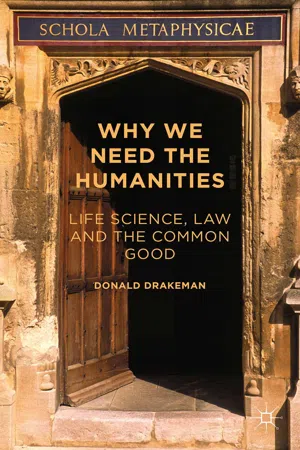
An entrepreneur and educator highlights the surprising influence of humanities scholarship on biomedical research and civil liberties. This spirited defence urges society to support the humanities to obtain continued guidance for public policy decisions, and challenges scholars to consider how best to fulfil their role in serving the common good.
Information
1
The Ups and Downs of the Humanities
The cartoon cover of a 1935 issue of The Princeton Tiger humor magazine showed Depression-era students lined up at their graduation ceremony to be handed a loaf of bread with every liberal-arts diploma.1 A few months later, the university’s alumni magazine reported on students’ shifting academic interests in a table titled ‘Trend Away from the Humanities’.2 Students concentrating their studies in those disciplines were down by nearly a third from the go-go years of the ‘roaring twenties’.
The humanities eventually regained their popularity, and national reports show that enrollments peaked around 1971, following a period of economic growth in the 1960s. Then came ‘stagflation’ and the prolonged bear market on Wall Street that accompanied it. Down went humanities degrees as well, until a bull market started its run in the early 1980s.3 After a bit of a lag, the humanities became popular yet again until recent times, when, just as we seem to be getting over the crash of 2008, we have discovered (as if for the first time) a ‘trend away from the humanities’, with even Harvard fretting about declining humanities enrollments.4
Maybe there is a correlation here. As Americans’ stock portfolios go up, so does their interest in the humanities. Then, when the bears dominate Wall Street, there is an accompanying bear market for the humanities. Perhaps, one might hypothesize, there is even a cause-and-effect relationship. We ought not to leap to conclusions, of course. But it is worth considering: is it possible that the humanities cause economic decline? Perhaps all those humanities students spent too much time with Aquinas instead of accounting, and, before you know it, we are in the midst of the Great Depression.
Or, perhaps, it is more likely that causation runs the other way. In difficult financial times, students (and their parents) might tend to seek out courses of study that increase their chances of gainful employment. In the economically depressed 1930s, Princeton’s engineers tripled from the 1920s, while enrollments in English, art and classics dropped sharply. That we have seen similar shifts in more recent economic downturns may not so much signal what has been described as a ‘crisis of the humanities’ as simply reflect a reasonably predictable reaction to tough times, especially in the United States, where the pursuit of higher education can involve spending—and sometimes borrowing—hundreds of thousands of dollars.5
The good news, for those of us who believe in the importance of the humanities, is that once the bread lines disappear, people realize that they cannot live by bread alone. The important questions addressed in religion, literature, the arts and elsewhere in the humanities will always captivate us, and we will continue to return to them when we can. There is, however, an ever present need to think about how to earn one’s keep, and the economic factors can appear to weigh heavily in favor of some disciplines over others, especially when unemployment rates are rising.
The decisions by students and their parents about subjects it makes sense to study at the undergraduate level take place in an environment in which abundant information about employment prospects and starting salaries is readily available, if not always completely accurate. In economically difficult eras, the potential joys of spending several years studying literature, history or philosophy will encounter stiff competition from fields promising better job prospects and well-paying careers. ‘Just look at salary.com’, an engineer friend advised a mathematically talented son, who was beginning to hear the siren call of a less pragmatic but more intriguing course of study. Sure enough, on one popular website, engineering holds 9 of the 12 top-earning positions, joined by actuarial mathematics, computer science and physics. The first humanities discipline, philosophy, appears in 45th position, with religious studies (my undergraduate focus) holding down 101st place, just edging out classics.6 The situation is similar in the UK, where one report shows the salaries of humanities graduates to be substantially below the average of ‘all graduates’, although still ahead of non-graduates.7
President Barack Obama is not even sure that humanities degree holders will fare better in the job market than non-graduates in the skilled trades, saying in 2014, ‘[A] lot of young people no longer see the trades and skilled manufacturing as a viable career. But I promise you, folks can make a lot more, potentially, with skilled manufacturing or trades than they might with an art history degree.’8 President Obama anticipated the predictable outcry from art historians, saying, ‘Nothing wrong with art history degree. I love art history. I don’t want to get a bunch of emails from everybody.’ Protest emails arrived anyway, and the president responded to one University of Texas professor, who had ‘emphasize[d] that as art historians we challenge our students to think, read and write critically’.9 His (partial) apology—‘I was making a point about the jobs market, not the value of art history. … [A]rt history was one of my favorite subjects in high school’10 —was too much for political opponent Senator Marco Rubio, who called the apology ‘pathetic’, and tweeted, ‘We do need more degrees that lead to … jobs.’11 Both President Obama and Senator Rubio have undergraduate degrees in political science, #48 on the Payscale.com rankings, just below philosophy but well ahead of #94 art history.12
The reports of a technology-based promised land are not necessarily predictive, as undergraduates seeking to ‘follow the money’ may rush to the areas that are currently the most economically attractive, only to find that so many have done so that they have overwhelmed the job opportunities, even in science and engineering.13 There can also be more to a job than simply collecting a paycheck, and the benefits of higher education may well extend beyond simply earning a high income living. According to a 2014 Gallup poll, ‘liberal arts majors [in the United States] were slightly more satisfied with their jobs than were business and science majors’.14 The University of Oxford, meanwhile, studied 11,000 of its humanities graduates, and issued a widely publicized report of their ‘Hidden Impact’, noting ‘the breadth and variety of roles in society that they adopt, and the striking consistency with which they have had successful careers in sectors driving economic growth’.15
Oxford’s reference to ‘sectors driving economic growth’ is an important reminder that governments, too, make decisions about where to invest their resources in higher education (if at all). National economies are considerably more complex than our family finances—among other things, you and I are not in a position to print money—but governments must also think about how to pay for their many expenses, from health, education and welfare to defense, foreign aid, and on and on. In light of glowing reports of the job growth and economic benefits that flow from the technology-based entrepreneurial sectors, it is easy to see why legislators would find it attractive to pour billions into, for example, medical research, which promises to deliver better health and greater wealth at the same time, making it the government’s way of ‘doing well by doing good’. And where better to support that research than at the universities where so many of the fundamental discoveries have occurred?
Although science departments may worry that they also are underfunded (especially outside the life sciences), advocates for science and technology research funding have recently received a more attentive audience in congresses and parliaments than proposals to promote the study of the humanities. These politicians are taking a cue from public opinion. For example, when a 2010 poll asked Britons ‘which university subjects … offer the best value for taxpayers’ money’, the responses ranked ‘medicine, education, mathematics, dentistry, chemistry and biology’ at the top, ‘with humanities subjects clustered at the bottom of the list’.16 Advocates for the humanities have not been willing to concede defeat to the force of public opinion, however. The University of Cambridge and the UK Arts and Humanities Research Council commissioned an independent analysis ‘of the reported impacts of arts and humanities activities conducted at … Cambridge “that will be suitable for dissemination to stakeholders locally and nationally, including at senior levels of government, in particular to the Treasury” ’.17 The report’s primary conclusion was that ‘Arts and humanities research by University of Cambridge academics has many impacts’, although ‘attribution of research impact is often difficult’, and ‘impact is difficult to predict or assess in advance’.18 To a considerable extent, the goal of this book is to specify especially important areas where there has been, and can be reasonably predicted to be, significant impact of the kind described in the report.
The debates about whether university programs in the humanities are worth the cost to individuals or to nations—however we may choose to measure ‘worth’ and ‘cost’—are unlikely to be resolved to everyone’s satisfaction anytime soon. What may be fairly predictable, however, is that when the stock market shows signs of sustained economic growth, there is likely to be a resurgence of interest in the humanities from individuals, and perhaps from governments as well. This link between economic health and support for the humanities is not just a recent phenomenon. In tracing the ‘forgotten origins of the modern humanities’ through the work of philology scholars over many centuries, James Turner notes, for example, that Scottish economic growth after 1707 furthered the work of Scottish philologists like Thomas Blackwell. Turner argues, ‘Prosperity energized Scotland’s ancient universities.’19 In general, we should probably not make too much of this ebb and flow of interest in the humanities other than to note that it has roughly correlated with economic conditions at least since the 1920s, is likely to have done so in previous centuries and may well continue indefinitely into the future. The point is simply that the humanities may find themselves squeezed somewhat harder during financially exigent times than academic disciplines that claim closer links to prosperity.
Speaking up for the Humanities
One regular aspect of this periodic appearance of a crisis, or at least of a decline in student interest that may be accompanied by an actual or threatened reduction in governmental funding, is the need for the humanities to stand up for themselves during the difficult times—to articulate a rationale for students to study, for scholars to explore and for societies to support those academic fields for which a close relationship with high-paying jobs and economic growth is considerably less clear than for whatever is considered to be a more practical field of study. This ‘humanities defense’ literature often speaks of the need for careful reading and critical thinking, the power of a well-crafted written argument, the societal value of public displays of art and historical artifacts, the importance of civic education, the need to inculcate moral values (or, in some quarters, the need to question the inculcation of moral values) and so on—even the importance of doing something just for its own sake or for the personal joy in doing so.20 These arguments describe, and actually even display, an impressive array of eloquent and excellent reasons for humanities scholars to do what they have devoted their professional lives to doing, and for others to follow in their intellectual footsteps.
These traditional arguments are valuable and important, and I am fully in sympathy with most of them. For those disinclined to believe in the importance of the humanities, however, they are unlikely to carry the day. Even an academic figure as distinguished as Alan Ryan, Princeton professor and former Warden of Oxford’s New College, concludes that none of the most common defenses is ‘completely plausible’.21 Harvard’s Louis Menand has reached much the same conclusion: ‘About twenty years ago, the humanities acquired a rationale problem. … The problem was not that humanists were unable to provide rationales for their work. … The problem was that even humanists felt that those rationales were not completely persuasive to outsiders.’22 Among other things, it is too easy to point to engineers, scientists and mathematicians, and many others with no university education at all, who exhibit the qualities of critical thinking, good citizenship, effective communication and other positive attributes that advocates claim as the special province of the humanities. These standard claims about the usefulness of the humanities simply have not been compelling enough to convince parents or treasuries to favor the humanities in economically bleak times.
My goal is to demonstrate our need for the humanities from a considerably different perspective. Rather than setting out to defend the humanities, I will point to two especially important areas of modern life where society genuinely needs the help of the humanities. That is, I am writing primarily for the people who remain unconvinced by the arguments that have been advanced by humanities scholars in defense of their academic disciplines. Those who have not been persuaded need to see that we really do need the humanities. Thus, the ‘we’ in the title—Why We Need the Humanities—refers to all of us, in particular the many of us who are not academics working in a humanities discipline. We require the insights of the humanities to help our society sort out some particularly knotty problems of public policy that affect each one of us. It turns out that the humanities and the ‘real world’23 actually intersect in more important places than either side might expect.
These policy issues arise in the realms of healthcare and civil liberties, where they influence a significant portion of our economies and affect our lives. In these areas, national policies are being made by unelected political elites who often rely on scholarship in the humanities. So that the policy-makers will receive guidance that will best contribute to the common good, we need to continue to support the scholarly research that contributes to the deep well of learning of which the humanities is justly proud.
This book will, then, be an argument for the central importance of the humanities in our economic and political lives. We need the humanities. At the same time, we would be better served by them if they were more focused on what we need them to do than they often are at the moment, a topic I will address in Chapter 4. My suggestions are more focused on shifting perspectives than overhauling a system, however. They are simply rooted in the kinds of questions that the much more expansively funded biomedical researchers have often had to address to obtain research grants over the last few decades: how does my research relate—if only indirectly, tangentially and hypothetically—to human health? Or in the case of the humanities, we might say, to the good of humanity? In the end, my hope is to convince both scholars and the rest of us to think differently about the humanities.
In summary, this book will try to show why society should pay for something as apparently irrelevant to a modern high technology economy as the humanities. The simple answer is that some of our most exciting and economically important technological advances, as well as the recognition of many of our fundamental rights and liberties, require the ongoing contributions of philosophy, politics, history and other disciplines where the key questions have traditionally been addressed. Abandoning the humanities for the sake of the anticipated ability of the STEM fields—that is, science, technology, engineering and math—to give us better lives may, paradoxically, lead to the opposite result.
What this book is about
The second chapter describes the increasingly common view of universities as en...
Table of contents
- Cover
- Title Page
- Copyright
- Contents
- Preface
- Acknowledgments
- 1. The Ups and Downs of the Humanities
- 2. The Humanities and the Future of the Life Sciences
- 3. The Humanities and the Law
- 4. Toolboxes, Preferences and the Humanities
- 5. The Humanities and the Common Good
- Notes
- Bibliography
- Index
Trusted by 375,005 students
Access to over 1.5 million titles for a fair monthly price.
Study more efficiently using our study tools.
Frequently asked questions
Yes, you can cancel anytime from the Subscription tab in your account settings on the Perlego website. Your subscription will stay active until the end of your current billing period. Learn how to cancel your subscription
No, books cannot be downloaded as external files, such as PDFs, for use outside of Perlego. However, you can download books within the Perlego app for offline reading on mobile or tablet. Learn how to download books offline
Perlego offers two plans: Essential and Complete
- Essential is ideal for learners and professionals who enjoy exploring a wide range of subjects. Access the Essential Library with 800,000+ trusted titles and best-sellers across business, personal growth, and the humanities. Includes unlimited reading time and Standard Read Aloud voice.
- Complete: Perfect for advanced learners and researchers needing full, unrestricted access. Unlock 1.5M+ books across hundreds of subjects, including academic and specialized titles. The Complete Plan also includes advanced features like Premium Read Aloud and Research Assistant.
We are an online textbook subscription service, where you can get access to an entire online library for less than the price of a single book per month. With over 1.5 million books across 990+ topics, we’ve got you covered! Learn about our mission
Look out for the read-aloud symbol on your next book to see if you can listen to it. The read-aloud tool reads text aloud for you, highlighting the text as it is being read. You can pause it, speed it up and slow it down. Learn more about Read Aloud
Yes! You can use the Perlego app on both iOS and Android devices to read anytime, anywhere — even offline. Perfect for commutes or when you’re on the go.
Please note we cannot support devices running on iOS 13 and Android 7 or earlier. Learn more about using the app
Please note we cannot support devices running on iOS 13 and Android 7 or earlier. Learn more about using the app
Yes, you can access Why We Need the Humanities by Donald Drakeman in PDF and/or ePUB format, as well as other popular books in Literature & Higher Education. We have over 1.5 million books available in our catalogue for you to explore.