eBook - ePub
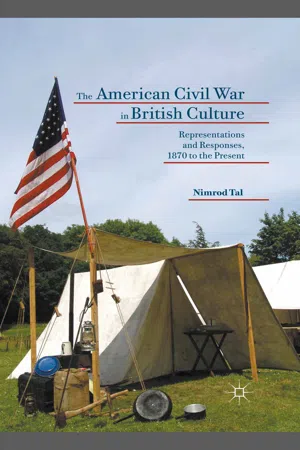
The American Civil War in British Culture
Representations and Responses, 1870 to the Present
- English
- ePUB (mobile friendly)
- Available on iOS & Android
eBook - ePub
The American Civil War in British Culture
Representations and Responses, 1870 to the Present
About this book
This book explores the continuous British fascination with the American Civil War from the 1870s to the present. Analysing the War's place in British political discourse, military writing, intellectual life and popular culture, it traces the sources of Britons' appeal to the American conflict and their use of its representations at home and abroad.
Information
1
The War and the Political Debate about Ireland
From the very outbreak of hostilities Britons were exposed to the contesting notions of political unity and political autonomy that were embedded in the rhetoric explaining the Civil War. British correspondents and envoys reported from America and, throughout the war, Northern and Southern agitators worked indefatigably in Britain to convey their respective – naturally conflicting – ideas about the issues.1 Accordingly, as historians have already pointed out, Britons could and did draw parallels between the war in the United States and the questions that it raised about nationalism and British affairs.2
However, in the Irish context, for Britons of the mid-1860s the debate about national autonomy and unity was almost irrelevant outside Irish nationalist circles. True, since the Acts of Union in 1800, Anglo-Irish relations had been ever turbulent.3 Compared with Scotland and Wales, Ireland seemed a less-natural addition to the Union, and both the Irish and British constantly debated the nature of their relations.4 However, the turmoil of Ireland’s position in the United Kingdom of Great Britain and Ireland, especially in the Civil War era, should not be overstated. The 1850s, for example, was a relatively calm decade. Additionally, Fenians and members of the Irish Republican Brotherhood (IRB) had remained unorganized and divided until at least late 1863.5 As Richard Blackett has argued, many at that time recognized that ‘no British government had ever conceded the legitimacy of calls for independence in either [India or Ireland]’.6 For a time there was no reason to think that this would change. With danger to their political order far from sight, Britons saw few political lessons to draw from the war in America regarding Ireland’s status within the British Union.
For Irish nationalists, the case was different. In Ireland, mass-movements promoting ideas of national autonomy had begun to appear as early as the 1790s.7 By 1861, notions of self-rule were not new and hardly irrelevant to Irish nationalists, who thus saw the conflict in America as a timely opportunity to advance their goals. As Joseph Hernon has noted, Irish nationalists were aware of the analogy between the secession of the South in the United States and their aspirations for national autonomy at home.8 However, in the context of the Irish Question, Irish nationalists, both at home and in America, viewed the war chiefly in a pragmatic way that was based on two main assumptions. First, they thought that they could find an ally or allies in America. Supporters of the Union reasoned that a unified United States would be a natural and invaluable ally in their fight against Britain.9 Much along the same lines of reasoning, Irish support of the Confederacy stemmed partially from the belief that two American nations – a Northern one and a Southern one – would pose greater opposition to Britain than one.10 A second pragmatic calculation was that the war in America was an opportunity to gain military training to be utilized later against the British.11
British politicians were conscious of Irish nationalists’ aspirations and supposed gains from the war, and they linked the conflict and its possible repercussions on Anglo-Irish and Anglo-American affairs much as the Irish did, especially in the years immediately following the American conflict. In 1866, John George, former solicitor-general for Ireland, expressed his anxiety in the House of Commons about the war’s implications on the military abilities of Irish nationalists. Fenianism, he feared, ‘had attained a greater power and strength in consequence of the hundreds and thousands of men who had been disbanded at the termination of the American Civil War’.12 A week earlier, Prime Minister Earl Russell, expressed his own distress about the potential danger of the Fenians’ military skills:
With regard to Fenianism, I believe my noble Friend the Under Secretary of State said what was perfectly correct when he contended that it was another of those movements coming from foreign countries; that as the movement of 1798 had been connected with the French Republic, and as the movement of 1848 was connected with the revolutionary ideas which were rife at that time on the Continent, so this Fenian movement of our own day has been connected with the American Civil War.13
The Fenian stir brought together in the British mind lessons from the Civil War, British politics and the question of Ireland. As W. E. Gladstone put it at the time: ‘It is only since the termination of the American war and the appearance of Fenianism that the mind of this country has been again turned to Irish affairs’.14
However, Irish nationalists interpreted events erroneously. For one thing, military lessons from the Civil War, such as guerrilla warfare and the use of explosives, achieved limited success and endorsement when they crossed the Atlantic. The methods employed during the Dynamite War in the 1880s, for example, roused mainly bitter feelings, even among the Irish.15 It was clear, too, that trained as they might have been – and an Irish-American military elite did emerge out of the war – the Irish did not have the discipline, organization or military power to stand against the British.16 Additionally, Irish nationalists had misread the political map. Seeking an ally in America, they had failed to realize that, despite evident tensions, Anglo-American relations were in fact on the road of rapprochement. As Phillip Myers has argued, rather than undermining Anglo-American rapprochement, the Civil War, during which Britons and Americans resolved their conflicts diplomatically, in many senses contributed to this motion.17 The failed raids in Canada between 1866 and 1871, by which Fenians sought to incite a transatlantic conflict, but instead met with Anglo-American cooperation and the concluding of the Treaty of Washington (1871), were good indications that by this stage a war between Britain and the United States was but a daydream.18
The Fenians in America, as the IRB at home, were illegitimate extra-parliamentary movements. They did not generate a genuine debate about the political status of Ireland in the British Union. Since British politicians did not see a concrete challenge from Ireland to the integrity of the Union, the Civil War continued to bear only limited relevance to Anglo-Irish politics. For the British, as Russell’s words (cited above) made clear, Irish radicalism and the Civil War – and the idea of a fight over national unity and national freedom that both represented, were American and thus foreign. As such, Russell calmly predicted: ‘That spirit, I trust, will not be one of long duration, and it certainly is not one which ought to be connected with the general condition of Ireland’.19 He was largely correct. Britons felt no reason to worry about the Civil War’s impact as either a source of potential conflict with the United States or of Irish military power. Additionally, they saw no reason as of yet to look to the United States for relevant lessons on this matter.
The 1870s saw a profound shift in the British attitude to the Civil War. Starting from this period, three parallel developments moved Britons to see the conflict’s political aspects as relevant. The first was a change in the Irish question. In the early 1870s, as Irish revolutionary activism declined, an Irish parliamentary movement, under the leadership of Isaac Butt, became the leading voice of Irish nationalism.20 This movement first made Irish Home Rule a conceivable, if at this stage unlikely, political model for the United Kingdom.21 Butt’s idea of home rule ran along federal lines. ‘I believe’, he stressed in 1870, ‘that Ireland would be happier and better under a Federal Union with England than she would be either as a member of the American Confederation, or as an independent nation under the protection of any European power’.22 Nonetheless, whether within the empire or not, the Irish question began to undermine the nature of the British Union from within the British political system.
A second development was a change in the British perception of the United States. The Civil War cast doubts on the viability of the American political system.23 Many in Britain saw the conflict as a test that would reveal whether American democracy – a novel political ideology and form of government – could endure.24 Deterred by the scale of violence and skeptical that reunification could ever be achieved, some saw the war as evidence that the American experiment had already failed.25 However, after the war and as the century wore on, the United States proved to be anything but an abortive endeavor. Increasingly industrialized and populated, rapidly growing financially and more willing to exert its power in the western hemisphere, the durability of the ‘Gilded Age’ United States was unquestionable.26 Accordingly, in the latter part of the nineteenth century, British political thinkers frequently used the United States as a practical model through which to assess their own governmental system.27 As Hugh Tulloch has observed, even conservatives, previously critical of the United States, had by the 1880s come to commend it.28 As time passed, the success and resilience of the American model became more evident, less doubtful and thus more applicable.
The third development was the continuous consolidation of the representation of the war that depicted it as a glorious constitutive moment for the United States. This was especially true with the rise of the conciliatory narrative of the war in the latter part of the nineteenth century. This narrative emphasized that both Northerners and Southerners showed their Americanism and patriotism in the fighting.29 Accordingly, rather than a symbol of national decline, the war was rooted in contemporary American memory, culture and national identity as a moment of rebirth into greatness. It came to symbolize patriotism, citizens’ love for their nation and national unity. Notions of a noble fight for secession were perpetuated in the Southern legacy of the war, known as the ‘Lost Cause’. Although (according to this narrative) secession was legitimate, it was also stressed – again, especially with the rise of sentiments of reconciliation – that the South had not wanted to take that path and had been forced to do so only when its way of life had been endangered. The narrative of reconciliation accommodated these sentiments alongside the celebration of reunion. Subsequently, the view of the war as a patriotic and romantic event that had united America and forged its current political system became the dominant post-conflict narrative.30
The change in the nature of the Irish question, the growing prominence of the United States and the rise of the conflict’s reconciling representation made the Civil War appealing to British politicians. Examining Ireland’s political status in the Union, they now began to internalize the war and to draw lessons from the American experience that the war’s narratives reflected. In June 1871, Spencer Cavendish, the Marquess of Hartington, challenged Irish nationalists to attempt breaking the Union, promising them that ‘they will find that our determination is just as strong as was that of the people of that country to which we are told their eyes are always turned – the United States of America – that their Union should not be dissevered’.31 Similarly, when Butt presented his political scheme in the House of Commons on 2 May 1872, Gladstone reminded him:
You cannot have two supreme authorities in a country; and as in the great American Civil War it was the Federal Government and the Federal Legislature which found it necessary to take into its own hands the circumscription of the liberties of the States, and the solution of the controversy which had formerly been raised on that subject.32
The prime minister did not neglect to remind Butt that the war also gave the Fenian ‘conspiracy’ an ‘additional scope’, but the focus of the speech was clearly elsewhere. Increasingly, the military and diplomatic aspects of the war’s possible impact on Anglo-Irish affairs gave way in British political discourse to its political aspects.
Rather than looking at the Civil War as a purely foreign affair, external to British politics, British politicians started to appropriate the conflict, apply it to the British Union and draw lessons from it. Gladstone, for example, presented a contemporary and legitimate British reading of the Irish question and, consequently, of the Civil War. For one thing, Butt did not call for secession as did the Confederate states, but rather for Irish autonomy fully subordinated to British rule. In fact, Butt – an imperialist who saw Ireland as an integral part of the British Empire – repeatedly stressed that he ‘was anxious to maintain the Union’.33 Gladstone also denied the Irish claim based on a construction of the British Union as an American federation. He further omitted from his analogy the liberties that the American states enjoyed under their federal Union and which were denied to Ireland, such as having state legislatures. Appealing to America’s heritage, Gladstone, Cavendish and others nonetheless filled it with British substance.
As the century progressed, and at a time when American growth became increasingly evident, so too the Irish question became more pressing. Succeeding Butt in 1882, Charles S. Parnell had established the Irish Parliamentary Party (IPP) and cemented the idea of Irish Home Rule in British political discourse. By 1885, the IPP had won the Irish vote in Ireland from Liberal hands, becoming the latter’s indispensable, if inconvenient, political partner.34 Consequently, British Liberals had to alter their use of the Civil War. Instead of accentuating the war’s unifying force, Liberals began to emphasize the political liberty that the war and its aftermath had secured for the individual states. On 13 April 1886, Gladstone, whose Liberal Party was by...
Table of contents
- Cover
- Title
- Introduction
- 1 The War and the Political Debate about Ireland
- 2 The Civil War in British Military Thought
- 3 British Intellectuals and Abraham Lincoln
- 4 The American Civil War in British Cinemas
- 5 Civil War Roundtable and Re-enactment Societies
- Conclusion
- Notes
- Bibliography
- Index
Trusted by 375,005 students
Access to over 1.5 million titles for a fair monthly price.
Study more efficiently using our study tools.
Frequently asked questions
Yes, you can cancel anytime from the Subscription tab in your account settings on the Perlego website. Your subscription will stay active until the end of your current billing period. Learn how to cancel your subscription
No, books cannot be downloaded as external files, such as PDFs, for use outside of Perlego. However, you can download books within the Perlego app for offline reading on mobile or tablet. Learn how to download books offline
Perlego offers two plans: Essential and Complete
- Essential is ideal for learners and professionals who enjoy exploring a wide range of subjects. Access the Essential Library with 800,000+ trusted titles and best-sellers across business, personal growth, and the humanities. Includes unlimited reading time and Standard Read Aloud voice.
- Complete: Perfect for advanced learners and researchers needing full, unrestricted access. Unlock 1.5M+ books across hundreds of subjects, including academic and specialized titles. The Complete Plan also includes advanced features like Premium Read Aloud and Research Assistant.
We are an online textbook subscription service, where you can get access to an entire online library for less than the price of a single book per month. With over 1.5 million books across 990+ topics, we’ve got you covered! Learn about our mission
Look out for the read-aloud symbol on your next book to see if you can listen to it. The read-aloud tool reads text aloud for you, highlighting the text as it is being read. You can pause it, speed it up and slow it down. Learn more about Read Aloud
Yes! You can use the Perlego app on both iOS and Android devices to read anytime, anywhere — even offline. Perfect for commutes or when you’re on the go.
Please note we cannot support devices running on iOS 13 and Android 7 or earlier. Learn more about using the app
Please note we cannot support devices running on iOS 13 and Android 7 or earlier. Learn more about using the app
Yes, you can access The American Civil War in British Culture by Nimrod Tal in PDF and/or ePUB format, as well as other popular books in History & British History. We have over 1.5 million books available in our catalogue for you to explore.