eBook - ePub
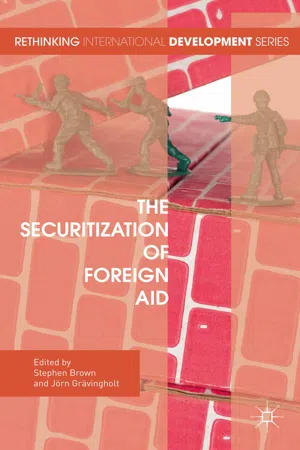
The Securitization of Foreign Aid
- English
- ePUB (mobile friendly)
- Available on iOS & Android
eBook - ePub
The Securitization of Foreign Aid
About this book
Security concerns increasingly influence foreign aid: how Western countries give aid, to whom and why. With contributions from experts in the field, this book examines the impact of security issues on six of the world's largest aid donors, as well as on key crosscutting issues such as gender equality and climate change.
Information
1
Security, Development and the Securitization of Foreign Aid
In recent years, the foreign aid industry has undergone an important shift. Whereas development workers until the late 1980s were mainly perceived – and often perceived themselves – as a rare species of internationalist idealists, the emergence of ‘failed and fragile states’, such as Afghanistan and Somalia, and ‘new wars’ in the Balkans and elsewhere contributed to the blurring of lines between the ‘neat’ world of development and the ‘murky’ field of national and international security. Although governments used development assistance throughout the Cold War to further their own interests in the context of superpower rivalry, aid workers generally agreed that these were regrettable circumstances. The end of the Cold War nurtured hopes that foreign aid would finally be free to focus solely on fighting poverty and inequality.
Such hopes, however, quickly faded with the advent of new forms of conflict, along with failing states that were unable to preserve minimal authority, and as a result hosted new forms of internationalized violence, thus becoming security risks both in their neighbourhoods and far beyond their borders. Beginning with Western engagement in the Balkans, and accelerated by an ever-increasing number of UN-mandated military interventions in Africa, the Middle East and Asia, aid instruments became increasingly intertwined with complex international operations that addressed development and security simultaneously.
Recent donor discussions of fragile countries in the developing world have raised the spectre of negative ‘security spill-overs’ and ‘safe havens for terrorists’ and often cite the adage ‘There is no security without development and no development without security’ – a claim ‘repeated to the point of monotony’, notes Duffield (2007: 1). Consequently, governments and international aid agencies have revised their aid strategies to reflect new security concerns and increased aid to strategic conflict-affected countries, especially ones where they have intervened militarily, such as Iraq and Afghanistan, or key allies in the fight against terrorism – for instance, Pakistan and Ethiopia. In this context, donor governments often adopt ‘whole-of-government approaches’ to integrate policy across departments. As a result, aid workers frequently work closely with military personnel and insurgents increasingly consider them legitimate targets for attack, rather than neutral humanitarian workers.
A significant debate has consequently emerged about the ‘securitization’ of Western countries’ foreign aid policies. So far, this debate has mainly relied on the analysis of official speeches and policy documents. Beyond discourse, far less is known about actual consequences on foreign aid itself. This book seeks to fill that void. It looks into the consequences of a ‘security lens’ on the development assistance provided by the rich countries of the ‘Global North’ to poorer countries in the ‘Global South’.
The term ‘securitization’ has been popularized in the study of international relations by the writings of the Copenhagen School. It is meant as a critical term for how fields hitherto unrelated to security concerns become ‘securitized’ by actors who attach a (typically national) security value to them. This allows them to be prioritized as urgent matters and therefore dealt with through exceptional means, bypassing regular procedures.1 For most scholars writing in or building on this tradition, the securitization of foreign aid is analysed as inherently problematic (for an exception, see Floyd 2011). According to this perspective, most prominently represented by Mark Duffield (2001, 2007), the new security discourse in development policy has made military interventions, often conducted in the name of the welfare of citizens of the ‘target’ countries, seem more legitimate and feasible. Although this is a powerful argument, empirical evidence of a real change in donor behaviour has so far remained elusive, with very few studies getting to the empirics of foreign aid practice.2 The fact that politicians and public commentators often evoke this securitized rationale for foreign aid does not ipso facto mean that aid cannot still be motivated by normative concerns about inequality and well-being and that the degree of securitization cannot vary over time or across donor and recipient countries.
As scholars who work more on foreign and development policy than security per se, we are motivated by our own curiosity and the evident gap in knowledge about the extent to which foreign aid has indeed been transformed and how. What Duffield describes as the state of development assistance, we see as a growing but not totally hegemonic trend. In other words, whereas Duffield seems to believe that aid is completely securitized, we believe that it is being securitized – unevenly across time and space and with varying effects. The goal of this book is to help understand the nature, extent and impact of this trend, including the possibility that the trend has begun to reverse itself. More specifically, we are interested in the effects that security concerns and interests of major donor countries have had on the rationales, priorities, policies and practices of their foreign aid since the end of the Cold War.3
We thus use the term securitization in a way that differs from the Copenhagen School and its dominant focus on ‘speech acts’ that invoke a state of exception. In our view, the securitization of aid takes different forms and can be observed through changes in discourse, aid flows and institutional structures. Securitization can be said to occur, for instance, when donors increasingly justify aid in terms of national or international security, when they provide the highest levels of assistance to specific countries and sectors based on security imperatives, when security actors (such as military forces) deliver significant amounts of aid, and when donor governments create new institutional units within their aid agencies or new interdepartmental coordination mechanisms based on security-related motives.
We do not start from the normative position, common in development circles, that all forms of securitization are to be condemned as a matter of principle. We believe that the promotion of some forms of security, such as human security, can be a legitimate endeavour, as can activities such as security sector reform. We nonetheless take seriously the increasing concern among many foreign aid scholars, aid workers and others interested in the field that development goals are being sacrificed at the altar of security. This volume examines the extent to which this is taking place among different donors and in various contexts.
The background: Rising foreign aid and the increasing relevance of security
The rationale, modalities and organization of the foreign aid that industrialized countries – mostly of the Northern Hemisphere – provide to developing countries in the Global South have undergone fundamental changes, as have other areas of international politics, since the end of the Cold War over 25 years ago. In its ideal version, as exemplified by the Millennium Development Goals adopted by the UN in 2000 and the 2005 Paris Declaration on Aid Effectiveness, foreign aid is an undertaking in which developed and developing countries join forces to reduce poverty and inequality by working continuously to improve the impact of their collective efforts in a broad range of sectors. From 1997 to 2013, as can be seen in Figure 1.1, total aid flows from the main donor countries from the Global North – those that belong to the OECD/DAC – almost doubled from a low of US$71 billion to a high of $134 billion (OECD 2015a).4

Figure 1.1 ODA from DAC countries (1990–2013)
Source: OECD (2015a).
Official development assistance has become a major arena in the emerging global governance architecture, beyond a mere focus on the reduction of poverty per se. It is generally considered an integral part of a modern, broader foreign policy that is not limited to promoting individual national interests but rather aimed at shaping the global environment.5 At the same time, the emergence of ‘new wars’ (Kaldor 1999), an apparently increasing number of fragile states and ‘international terrorism’ have replaced the Cold War as major sources of perceived global threats, raising new, urgent security concerns in a less orderly, less structured world. Western countries have identified inadequate socio-economic development and poor governance as important factors driving civil war and state fragility in many countries. They have placed development assistance, which aims to address both of these causes, alongside military instruments in order to reduce the risk of violent conflict and state failure. Figure 1.2 illustrates the evolution in DAC aid commitments to the ‘conflict, peace and security’ sector. These commitments rose from less than $1 billion in 2004 (the first year for which data are available) to a peak of $3.3 billion in 2009, after which they began to fall.

Figure 1.2 DAC ODA commitments to conflict, peace and security (2004–13)
Source: OECD (2015a).
Initially, and particularly before 9/11, the debate on development and security focused on human security in violence-affected countries. Consequently, all major donor countries in Europe and North America as well as Japan reorganized their aid systems to reflect greater conflict sensitivity, with a new emphasis on security-related impact and better coherence between development assistance and more traditional foreign and security policies.6 However, military engagement in the Balkans, Iraq, Afghanistan and other places, as well as the threat perception of international terrorism, turned the lens back to industrialized countries’ ‘homeland’ security, including the security of armed forces deployed to ‘crisis states’ – thus creating a possible tension between ‘their security’ and ‘our security’ (see Duffield 2006: 28; Picard and Buss 2009). Table 1.1 illustrates the rise after 2001 of countries associated with the War on Terror as top aid recipients, notably Afghanistan and Iraq, as well as other conflict-affected states such as the Democratic Republic of the Congo.
Table 1.1 Top 15 recipients of DAC aid (with percentage of total DAC aid)

Source: OECD (2015b: Table 32).
Nevertheless, although all donor governments routinely refer to twin rationales – reducing conflict for the sake of the people immediately affected and helping prevent the spillover of negative consequences, such as terrorism, to donor territories – actual policies, processes and priorities in the reorientation of aid differ considerably. For example, at one point Canada strongly advocated a human security perspective, while the United States made the prevention of terrorism a major objective of its aid agenda. In the United Kingdom, organizational innovations such as the Conflict Prevention Pools stood alongside an explicit aid allocation focus on poverty reduction, while Germany invested in establishing an organizational infrastructure to support civilian conflict prevention. At the European Union (EU) level, the European Commission had to reconcile its traditional development objectives with a new focus on security as laid down in the 2003 European Security Strategy.
Scholarship on security and development
We do not intend to conduct here a comprehensive review of the concepts of security and development and the complex relationship between the two – for that, we recommend that readers consult the valuable overview provided by Spear and Williams (2012a), the first of whom wrote the US case study in this volume. However, we do revisit some of the literature to assess the extent to which it considers the effects of this emerging relationship on foreign aid.
There is no shortage of books published in recent years that adjoin the terms ‘security’ and ‘development’ in their titles, often paired with ‘nexus’ or ‘conflict’. For instance, McNeish and Lie’s (2010) edited volume Security and Development adopts an anthropological/ethnographic approach to the nexus and presents several case studies of its impact on local-level power structures in developing countries. Tschirgi et al.’s (2010) volume of the same name focuses on conflict prevention in specific developing countries. The chapters in Mavrotas’ (2011) volume, which also shares the same title as the previous two, analyse aid donors’ important security challenges and recommend ways of reducing insecurity. Carment et al.’s (2010) book, Security, Development, and the Fragile State, focuses on state fragility and how to engage more effectively with fragile states. Spear and Williams’ (2012b) book, Security and Development in Global Politics, contains two chapters devoted to aid: The first traces and denounces how, at the macro level, post-9/11 aid increasingly reflects donors’ security objectives, rather than recipients’ development needs (Harborne 2012), while the other chapter concentrates on aid’s ability to create economic development, including in fragile and conflict-affected countries (Morrow 2012). Beswick and Jackson’s (2011) Conflict, Security and Development explores the complex relationship between security and development, including the role of foreign aid. The World Bank’s 2011 World Development Report, also titled Conflict, Security and Development, summarizes its central message in the following terms: ‘[S]trengthening legitimate institutions and governance to provide citizen security, justice, and jobs is crucial to break cycles of violence’ (World Bank 2011: 2). Buur et al.’s (2007) edited volume, The Security-Development Nexus, focuses mainly on crime and violence and the challenges of reintegrating ex-combatants from various civil wars and liberation struggles in southern Africa, while Amer et al.’s (2012) book of the same name concentrates on security in specific developing countries.
These books are primarily interested in the actual and potential impact of aid/development on security or, to a certain extent, how insecurity impedes development. With the exception of one chapter in one book (Harborne 2012), they pay very little or no attention to how the ‘security turn’ has affected foreign aid. In positivistic social science terminology, they treat aid as an independent variable (cause), whereas we want to look at it as a dependent one (effect). A few publications do, however, look at aid donors. For example, most chapters in Howell and Lind’s (2010) book, Civil Society Under Strain: Counter-Terrorism Policy, Civil Society and Aid Post-9/11, focus on developing countries, but a few examine donor countries (Australia, Spain, the UK and US) as well. However, as the book title indicates, it examines the effects of new security concerns on civil society actors, not donor government aid programmes. Picard and Buss (2009) analyse the new, post-September 11 realities of security and aid, but only in relation to the United States. Development, Security, and Aid, by Essex (2013), also focuses solely on the US, taking a more historical approach. Patrick and Brown’s (2007) volume is the only book to actually examine multiple donor countries’ policies. It assesses the extent to which seven Western countries’ various government departments achieved policy coherence in their dealings with conflict-prone developing countries. It adopts, however, the lens of security and does not examine the policies’ actual impact on foreign aid.
Beyond monographs and edited volumes, the impact of increased Western security concerns on the post-Cold War foreign aid system has received attention in various academic journal articles. This literature falls ...
Table of contents
- Cover
- Title Page
- Copyright
- Contents
- List of Figures and Tables
- Acknowledgements
- Notes on Contributors
- List of Abbreviations
- 1. Security, Development and the Securitization of Foreign Aid
- 2. The Militarization of United States Foreign Aid
- 3. The UK’s Approach to Linking Development and Security: Assessing Policy and Practice
- 4. The Securitization of Aid: The Case of France
- 5. Peacebuilding and the ‘Human Securitization’ of Japan’s Foreign Aid
- 6. From Ottawa to Kandahar and Back: The Securitization of Canadian Foreign Aid
- 7. The European Union’s Development Policy: A Balancing Act between ‘A More Comprehensive Approach’ and Creeping Securitization
- 8. Provincial Reconstruction Teams in Afghanistan: Securitizing Aid through Developmentalizing the Military
- 9. Space for Gender Equality in the Security and Development Agenda? Insights from Three Donors
- 10. The Securitization of Climate Change: A Developmental Perspective
- 11. The Securitization of Foreign Aid: Trends, Explanations and Prospects
- Index
Trusted by 375,005 students
Access to over 1.5 million titles for a fair monthly price.
Study more efficiently using our study tools.
Frequently asked questions
Yes, you can cancel anytime from the Subscription tab in your account settings on the Perlego website. Your subscription will stay active until the end of your current billing period. Learn how to cancel your subscription
No, books cannot be downloaded as external files, such as PDFs, for use outside of Perlego. However, you can download books within the Perlego app for offline reading on mobile or tablet. Learn how to download books offline
Perlego offers two plans: Essential and Complete
- Essential is ideal for learners and professionals who enjoy exploring a wide range of subjects. Access the Essential Library with 800,000+ trusted titles and best-sellers across business, personal growth, and the humanities. Includes unlimited reading time and Standard Read Aloud voice.
- Complete: Perfect for advanced learners and researchers needing full, unrestricted access. Unlock 1.5M+ books across hundreds of subjects, including academic and specialized titles. The Complete Plan also includes advanced features like Premium Read Aloud and Research Assistant.
We are an online textbook subscription service, where you can get access to an entire online library for less than the price of a single book per month. With over 1.5 million books across 990+ topics, we’ve got you covered! Learn about our mission
Look out for the read-aloud symbol on your next book to see if you can listen to it. The read-aloud tool reads text aloud for you, highlighting the text as it is being read. You can pause it, speed it up and slow it down. Learn more about Read Aloud
Yes! You can use the Perlego app on both iOS and Android devices to read anytime, anywhere — even offline. Perfect for commutes or when you’re on the go.
Please note we cannot support devices running on iOS 13 and Android 7 or earlier. Learn more about using the app
Please note we cannot support devices running on iOS 13 and Android 7 or earlier. Learn more about using the app
Yes, you can access The Securitization of Foreign Aid by Stephen Brown, Jörn Grävingholt, Stephen Brown,Jörn Grävingholt in PDF and/or ePUB format, as well as other popular books in Social Sciences & Development Economics. We have over 1.5 million books available in our catalogue for you to explore.