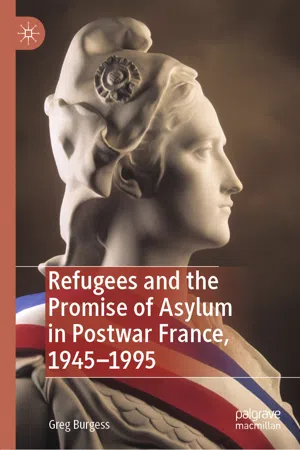
This book recounts France's responses to refugees from the liberation of Paris in 1944 to the end of the civil wars in the former Yugoslavia in 1995. It questions whether France fulfilled the promise of asylum for those persecuted for the 'cause of liberty' made in its Constitution of 1946. Post-war development and the demand for immigrant workers were favourable to refugees from the Communist east, from Franco's Spain, from Hungary after insurrection of 1956, and later from Latin America and Indochina. Asylum developed nationally in conjunction with international developments, the interventions of the United Nations High Commissioner for Refugees, and the adoption of the 1951 Refugee Convention. Economic ruptures in the 1970s, however, and the appearance of refugees from Asia and Africa, led to the assertion of national priorities and brought about a sense of crisis, and questions about whether France could continue to fulfil its promise.
- English
- ePUB (mobile friendly)
- Available on iOS & Android
eBook - ePub
Refugees and the Promise of Asylum in Postwar France, 1945–1995
About this book
Information
© The Author(s) 2019
G. BurgessRefugees and the Promise of Asylum in Postwar France, 1945–1995https://doi.org/10.1057/978-1-137-44027-3_11. Introduction: The Promise of Asylum
This promise was made in the fourth paragraph of the preamble to the 1946 Constitution, which set down fundamental rights that shaped France’s post-war Republican political culture: ‘all who have been persecuted for their actions for the cause of liberty have a right of asylum on the territory of the Republic’. 1 It rephrased for the post-war era Article 120 of the Republican Constitution of 1793, by which the French people promised to ‘give asylum to [those] banished from their homelands for the cause of liberty’. 2 With such a clear echo of this in the 1946 text, the French reclaimed asylum as an historical tradition and as one of the principles upon which the new republic would be founded. This promise was affirmed in the preamble to the 1958 Constitution of the Fifth Republic and was reaffirmed in a 1993 amendment. 3
This book develops further the claims I have previously made about the historical significance of this paragraph on asylum in the Preamble. 4 It examines how this promise was realised in practical form as France encountered and responded to its refugees between the Liberation of Paris on 26 August 1944 and the end of the wars in the Yugoslav successor states with the signing of the Dayton Accords of 14 December 1995, the final act of the collapse of Communism in Eastern Europe and the world order initiated at the Paris Peace Conference of 1919.
Although the Preamble did not itself have constitutional force, nor the force of law, as there was yet no legislation on a right of refugees to asylum in France, it nevertheless expressed intent. Its sixteen paragraphs were the principles that would inform the political culture of the Republic while the Constitution itself set out its political structures. For this reason, the paragraph on asylum can be called a ‘promise’ since it declared that France was a country in which those persecuted for defending and promoting liberty—either individual or collective—had a right to protection.
It would be too cynical to dismiss a statement such as this as so much political rhetoric at a time when France and its republican ideals were still being reconceived and reconstructed, and when its political culture and political structures were yet uncertain. This would ignore the fundamental rights the Preamble expressed. The paragraph on asylum came between such basic principles as the equal rights of women and the right to employment and the obligation to work, and alongside other fundamental rights such as the freedom of association, national solidarity, the right to social welfare, health care, material security and leisure.
The men of the Constituent Assembly who wrote the constitution were very conscious of their place in history and imagined the Liberation as another expression of the French people’s long desire for liberty first expressed in July 1789. They saw themselves as completing the work begun in 1789 by rewriting the Declaration of the Rights of Man and the Citizen as a new Declaration of Rights so that it was more applicable to the mid-twentieth century. The Preamble, in fact, was a compromise reached in the wake of the failure of the constitution of the Constituent Assembly to win the assent of the people in the referendum of 5 May 1946. A Second Constituent Assembly consequently condensed the unwieldy 39 articles of the 1946 Declaration of Rights, which had tried to set down specific social and economic rights, into the sixteen paragraphs of fundamental principles. 5
Among the many problems that France faced at the moment of Liberation in 1944, the status of refugees was not of major importance, but the status of foreigners in France certainly was. As war continued to the east and many displaced persons and prisoners of war of the Wehrmacht were liberated by the allied advance and the German withdrawal, there followed many the question on their status and their rights until they could be repatriated. Other questions faced the Provisional Government, such as the status at law of formerly naturalised foreigners who were denationalised under the Vichy regime, and pre-war refugees whose status had been compromised by Vichy’s abnegation of the refugee arrangements of the League of Nations. And, almost immediately, new refugees appeared: the displaced persons from Germany and Central Europe; from Spain, as Socialists, Communists and Republicans continued to seek sanctuary from the regime of General Franco, and from the east, as refugees fled the creep of Communism into their homelands.
These were just the start of the many refugee problems that France, Europe and the world would experience in the years from the end of the Second World War to the end of the Cold War in the 1990s. These crises have escalated over the years; new conflicts have reshaped Western opinion and revealed the powerlessness of nations individually, and collectively through the United Nations, to take truly meaningful and effective actions to assist the millions in need of protection.
These crises have led historians to reflect upon the persistent problem of refugees over the twentieth century. The immediate post-war years have received particular attention because of the magnitude of the problem of displaced persons after the Second World War and the international humanitarian efforts that they gave rise to. 6 A common feature is their attention to post-war innovations, especially the work of agencies of the United Nations for the assistance of Displaced Persons, but they are also attentive to the continuities of refugee crises across the twentieth century and their international reach. Each of a different kind, these crises are yet symptomatic of flaws in international politics, national relief efforts and the doctrine of asylum for those in need of protection. 7
While these histories have placed refugees outside international norms, requiring special measures for their welfare and protection, French histories have integrated refugees into its histories of immigration and immigrants. The literature has grown markedly since France awoke to the presence of its immigrants in the 1970s and 1980s, with refugees a part of the many immigrant communities so visible in France’s cities. 8 A notable exception is Gérard Noiriel’s refugee history first published in 1991 and reissued in a new edition under a new title in 1999. 9 His is a history of the right of asylum and not of refugees. Asylum traverses national sovereignty and the ‘rights of man’ ideals of France’s revolutionary legacy. Asylum therefore evolved institutional forms over two centuries of rapport between individual refugees and the state. Yet this rapport was characterised by conflicting demands of the state: the reception of persecuted peoples and the defence of national citizens; between the ‘fantastical’ (fantasmatique) 10 notion of asylum in the 1793 Constitution and the political realities of keeping a check on foreign revolutionaries and political ‘criminals’ within the national public space while limiting the public burden of hosting them. The position in which this placed the state therefore justified policing and surveillance, while the laws on nationality developed over the course of the nineteenth century marginalised foreigners from nationals and instilled in them the imperative of assimilation. In Noiriel’s view, then, the framework for post-war asylum is found in the nineteenth and early twentieth centuries. The institutional structures developed from 1950 were to control refugees and assert state authority and national sovereignty against the background of international humanitarian innovations. Against the modalities of the national and popular moods of nationality and xenophobia, objective criteria defined and categorised the refugees. The creation of the French national refugee office, the OFPRA, interceded between refugees, the state and the international refugee regime, leading to a tyranny of documents and the word: evidence, testimony, forms, permits marked this intercession, and were a tyranny that fell between the ideals of the ‘rights of man’ and its corollary the ‘right of asylum’, jurisprudence and the ‘walls’ of administrative practices. 11
The field of study has expanded greatly since Noiriel first published his work. Historians, sociologists, political scientists and anthropologists, leaving aside for the time being the work of jurists, have penetrated much more deeply into the refugees of post-war France and the promise of asylum that France made in its constitutions. They have given a more nuanced understanding of the rapport between the state and its refugees and have presented refugee experiences and the development of institutional practices in greater detail. They also illustrate how the refugee history of post-war France is more than a history of asylum. There are its manifest institutional forms, certainly, but more importantly these histories highlight also the responsiveness of the state to the protection needs of refugees. As a consequence, we should not see this as an adversarial distinction between ‘rights’ and the ‘state’, or ‘refugees’ and the ‘national’. Rather, it needs to be approached as a question of how the state fulfilled its constitutional promise of asylum.
The subject discussed in the book falls neatly into two parts: from the end of the war to the adoption of the law on asylum in France in 1952—that is, up to the point where France introduced its first law relating specifically to the legal status of refugees—and from 1952 to 1995, when asylum was institutionalised under this law. The sources for this research also fall neatly into these two parts. From 1944 to the 1950s, there is a great deal of archival material from the Ministries of Foreign Affairs and the Interior in, respectively, the Archives Diplomatiques and the Archives Nationales in Paris. In addition, much is learned about responses to refugees up to 1950 from the records of the Intergovernmental Committee for Refugees (IGCR) and the International Refugee Organisation (IRO) which are also held in the Archives Nationales, Paris. These are documents and reports about refugees; refugee voices are themselves largely absent. We see that, in the early stages after Liberation, timid reactionaries briefly reappeared in public debates in their efforts to try to shape a nationalist, xenophobic and indeed racial approach to the place of foreigners and refugees in post-war France. Afterwards, we witness the emergence of republican idealists, with the important ministries of state—the Interior, Foreign Affairs, Justice and Labour—placed in the hands of resistance figures in order to reassert France’s republican political culture. We therefore witness the efforts of the ministries to provide effective protection to refugees and to establish efficient services for refugee admission, settlement and welfare. These all show how ministers, state officials and their committees respected in practice the promise of asylum written into the 1946 Constitution. Due to legal restrictions on access to French government material, archival sources after 1960 are much more limited. The research for the second half of the period under review consequently relies on published documents of the United Nations, and studies of historians, sociologists, demographers and others who have turned their attention to the questions of immigration, refugees and exile.
While there are two distinct parts to this research, the history itself shows three phases, although there is considerable overlap between them. These can be summarised as the initial post-war years, dominated by displacement and repatriations, the start of the Cold War migrations and the resumption of the retirada from Spain; the period following the establishment of the French Office for the Protection of Refugees and Stateless Persons (Office Français pour la Protection des Réfugiés et Apratrides—OFPRA) in 1952; and the emergence of a sense of crisis in asylum against the background of economic troubles of the 1970s. France honoured its promise of asylum for refugees initially in the first years after the war through the intervention of agencies such as the IGCR and IRO. In 1952, it passed its first law on refugees and asylum and created a national refugee office. The OFPRA applied in state practice legal protections under 1951 United Nations Convention on the Status of Refugees. It fulfilled France’s promise of asylum, so much so that there are no statistics on rejections of asylum claims until 1970. 12
More than the fulfilment of domestic undertakings, this promise was also a part of France’s obligations under international conventions. In analysing how this played out over time, certain patterns are apparent that are of historical significance. One is the clear relationship between immigration and refugees. When immigration was favoured in policy and the presence of immigrants was accepted among the French people, the admission of refugees and their protection claims were uncontroversial. Indeed, the lines between immigrants and refugees were blurred, and refugees merged into the many immigrant communities that had deep historical roots in France. On the other hand, when immigration became problematic, the admission of refugees was itself problematised; public policy and public opinion both shifted sharply. This was the case with the economic ruptures of the 1970s. In a bid to assert greater controls over immigrants and to placate public opinion that was turning against the scale of immigration and the ethnicities of the immigrants, the government suspended all new labour migration. Claims for asylum became a means by which new immigrants, shut out by these new restrictions, could nevertheless gain access to the country and the benefits it offered. The asylum process was therefore tainted as a means of backdoor entry, by manipulation to gain welfare benefits or illegal employment, or worse by outright fraud. As applications rates increased, rejections rates also increased. A sense of crisis engulfed the admission of refugees, and France’s promise of asylum seemed illusory. A surge in refugee numbers and a higher rejection rate coincided, from 1974, with new policies to curb immigrant numbers.
A second observation follows from the concept of ‘interest convergence’ in international law. 13 R...
Table of contents
- Cover
- Front Matter
- 1. Introduction: The Promise of Asylum
- 2. Convergence: Population, Immigration, Refugees
- 3. Refugees, Deportees and Repatriates After 1944
- 4. The ‘Neo Refugees’ of Spain and the East
- 5. The Refugee Convention and a Law of Asylum, 1951–1952
- 6. The OFPRA and Its Refugees, 1952–1960
- 7. The Crossroads of the 1960s: A Retreat for Humanitarian Asylum
- 8. Exiles, Repatriates and Refugees Without the Name
- 9. Asylum in Crisis, 1975–1995
- 10. Conclusion
- Back Matter
Trusted by 375,005 students
Access to over 1.5 million titles for a fair monthly price.
Study more efficiently using our study tools.
Frequently asked questions
Yes, you can cancel anytime from the Subscription tab in your account settings on the Perlego website. Your subscription will stay active until the end of your current billing period. Learn how to cancel your subscription
No, books cannot be downloaded as external files, such as PDFs, for use outside of Perlego. However, you can download books within the Perlego app for offline reading on mobile or tablet. Learn how to download books offline
Perlego offers two plans: Essential and Complete
- Essential is ideal for learners and professionals who enjoy exploring a wide range of subjects. Access the Essential Library with 800,000+ trusted titles and best-sellers across business, personal growth, and the humanities. Includes unlimited reading time and Standard Read Aloud voice.
- Complete: Perfect for advanced learners and researchers needing full, unrestricted access. Unlock 1.5M+ books across hundreds of subjects, including academic and specialized titles. The Complete Plan also includes advanced features like Premium Read Aloud and Research Assistant.
We are an online textbook subscription service, where you can get access to an entire online library for less than the price of a single book per month. With over 1.5 million books across 990+ topics, we’ve got you covered! Learn about our mission
Look out for the read-aloud symbol on your next book to see if you can listen to it. The read-aloud tool reads text aloud for you, highlighting the text as it is being read. You can pause it, speed it up and slow it down. Learn more about Read Aloud
Yes! You can use the Perlego app on both iOS and Android devices to read anytime, anywhere — even offline. Perfect for commutes or when you’re on the go.
Please note we cannot support devices running on iOS 13 and Android 7 or earlier. Learn more about using the app
Please note we cannot support devices running on iOS 13 and Android 7 or earlier. Learn more about using the app
Yes, you can access Refugees and the Promise of Asylum in Postwar France, 1945–1995 by Greg Burgess in PDF and/or ePUB format, as well as other popular books in History & European History. We have over 1.5 million books available in our catalogue for you to explore.