eBook - ePub
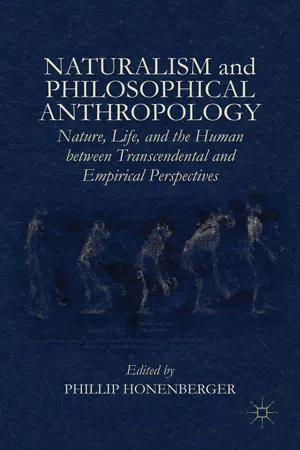
Naturalism and Philosophical Anthropology
Nature, Life, and the Human between Transcendental and Empirical Perspectives
- English
- ePUB (mobile friendly)
- Available on iOS & Android
eBook - ePub
Naturalism and Philosophical Anthropology
Nature, Life, and the Human between Transcendental and Empirical Perspectives
About this book
What is a human being? Philosophical anthropology has approached this question with unusual sophistication, experimentalism, and subtlety. This volume explores the philosophical anthropologies of Scheler, Gehlen, Plessner, and Blumenberg in terms of their relevance to contemporary theories of nature, naturalism, organic life, and human affairs.
Information
Topic
PhilosophySubtopic
Political Philosophy1
In Pursuit of Something ‘Essential’ about Man: Heidegger and Philosophical Anthropology
Beth Cykowski
Introduction
The question of the degree to which Heidegger can be counted as an anthropological thinker is a controversial one. Throughout his corpus, Heidegger expresses concern with the fundamental character and destiny of human existence, but does the possession of such a concern situate Heidegger within the history of the German philosophical- anthropological tradition? Heidegger’s interest in the human appears to circumnavigate many of the issues and questions that occupy this tradition. For instance, Heidegger frequently appears to be more concerned with what the articulation of the question of what it means to be human itself says about human existence, than with seeking a positive definition of the human as a particular living species. Nevertheless, through his interrogation of the human as a being that possesses the capacity to articulate this question, Heidegger does develop an understanding of human existence that could be said to approximate a philosophical anthropology.
Despite this apparent kinship, Heidegger envisages his own task very differently. He is in pursuit of something ‘essential’ about man: the ultimate foundation of human existence, that ground from which all other disciplines that claim to know about the human derive their content. Heidegger insists that, as one such discipline, anthropology, ‘philosophical’ or otherwise, is a form of ‘Darstellung’, a representation of the human that is based on ‘regional’ rather than fundamental suppositions (1995, p. 76). As such, anthropology does not and cannot provide a ‘complete ontology’ of Dasein, that is, a description of the foundation and total structure of human existence (1962, p. 38).
According to Heidegger, a consistent and fatal characteristic of all versions of the anthropological perspective, including philosophical anthropology, is its treatment of the human as a living species. Prior to all of its information-gathering, anthropology has already presupposed that the human is a biological being amongst others that can be observed, tracked, and measured. Such a method examines the animality in the human, and does not reveal anything about the human as such. Heidegger claims that when it comes to securing ‘essential’ knowledge concerning the human, anthropology is no more than a ‘confusion’, a distraction (1995, p. 280). The task of uncovering something ‘essential’ about the human is not an anthropological one, because, as Beistegui says, for Heidegger the essence of the human ‘is itself nothing human’, that is, nothing hominid-like (2003, p. 13). When we question what human beings are, we are already questioning something in excess of the idea of the human as a type of primate (Beistegui, 2013). This is because, in the very activity of posing this question, we have already broken away from the domain of the purely ‘natural’ by opening ourselves up to concerns that go beyond the simple matter of our survival. We have opened ourselves up to the question of existence as such. It is the propensity for this type of openness that interests Heidegger, because it is a requisite for all methods of determining the kind of being that the human is.
In this essay I will elaborate Heidegger’s critique of philosophical anthropology and question its legitimacy. I will focus in particular on Heidegger’s 1929–1930 lecture course, The Fundamental Concepts of Metaphysics: World, Finitude, Solitude,1 which contains an emphatic rejection of the discipline. The lectures are particularly pertinent, since they are delivered during the most fertile period in the history of the philosophical-anthropological tradition, following some of its most significant publications.2 The essay will examine various passages of Heidegger’s lecture course in order to contextualize his critique of anthropology as Darstellung, and will then provide a brief exposition of the philosophical-anthropological tradition in light of this critique. I will ultimately argue that, though there is a methodological and conceptual chasm between their respective approaches, the outcome of Heidegger’s analyses and those of the philosophical anthropologists converge in a profound way.
The ancient conception of the human’s place in physis: Heidegger’s 1929–1930 lecture course
Do we know what is ‘essential’ about man? Have we ever known? According to Heidegger, essential knowledge concerning human existence was articulated in Greek philosophy prior to the establishment of Plato’s Academy and the organization of different philosophical schools. In the opening passages of FCM, Heidegger outlines this essential articulation. At the dawn of philosophy, Heidegger says, Heraclitus reveals a deep insight into the dynamic relationship between the human, nature (understood as physis), and philosophy, implied in his claim that the ‘prevailing of things [physis] has in itself a striving to conceal itself’ (cited in Heidegger, 1995, p. 27). Beings, according to Heraclitus, are not transparent and available for us; they tend towards obscurity. Through the logos they are given expression – ‘revealed’ and ‘torn from concealment’ (p. 27). As the being that accesses the logos, the human is the agent of this ‘unconcealment’. It is the means by which physis is spoken out (pp. 26–27).
Heidegger insists that physis, in this ancient context, is not to be understood as ‘nature’ in the modern scientific sense; it does not simply name the domain of animals and plants, but also ‘irrupts in the primal experience of man’ (p. 25). The human, like other living beings, belongs to physis. However, though the human is part of physis, ‘entwined’ within it just as primordially as all other living beings, it has a deviant relationship to physis in the sense that, as the being who partakes in logos, it has always already ‘spoken out’ about physis from within it:
In Greek, speaking is called λέγειν; the prevailing that has been spoken out is the λόγος. Therefore – it is important here to note this from the outset, as we shall see more precisely from the evidence – it belongs to the essence of prevailing beings, insofar as man exists among them, that they are spoken out in some way. If we conceive of this state of affairs in an elementary and originary way, we see that what is spoken out is already necessarily within φύσις, otherwise it could not be spoken from out of it. To φύσις, to the prevailing of beings as a whole, there belongs this λόγος. (p. 26)
The human is described here as tied into the realm of physis in a dual sense. Its own form of life is such that it ‘exists among’ natural beings, and it is also the being that, via its participation in the logos, is the medium through which physis is given expression. This dual relationship to physis, which appears, prima facie, to amount to a detachment and freedom from the natural terrain that encapsulates all other beings, subjects the human to a dissonant existence: though it is the being that is able to somehow ‘go beyond’ physis, it is also one of the beings about which it speaks out. Consequently, the human will never be able to complete the exercise that defines its being, for it is part of the very totality that it attempts to disclose, and it will thus never be able to detach from physis in order to attain an elevated, non-situated perspective that can capture the entirety of physis.
The outcome of Heidegger’s analysis of this Greek conception of the human and its relationship to physis is the idea that the human is constituted by a kind of ‘metaphysical’ disposition in the following, original sense of the term ‘metaphysical’. Heidegger claims that the ‘meta’ component of the word denotes a movement ‘away from one matter and over to another’, a ‘turning around’ from one position to another (p. 39). The ‘physika’ component, which comes from physis, originally means beings ‘as such and as a whole’; it names all beings that ‘prevail’ as well as ‘prevailing’ as such (p. 30). The term ‘metaphysics’ thus designates a ‘turning around’ towards physis, a ‘going after’ beings (p. 39). It denotes the fundamental tendency of the human being to strike out beyond beings, to take in and articulate the ‘whole’. It is this capacity for metaphysical thought that singularizes the human; the human is the meta-physical being.
In developing this conception of the human as a ‘meta-physical’ being on account of its relationship to physis, Heidegger also problematizes it. Given that the human is necessarily tied to the nature about which it speaks, how is metaphysical thinking even possible? In other words, how can human beings inquire into the totality of beings if they necessarily remain within that totality? Heidegger addresses this problem by claiming that, from within its position of detachment from the domain of beings as a whole, the human can only do metaphysics if it first gains a ‘grip’ on what it is trying to understand (p. 7). Following the meaning of the German begreifen, this ‘becoming gripped’ amounts to a conceptualization or understanding of beings rather than a passive reception of them. Gaining a grip on entities is only necessary if such a grip is initially lacking. If the human were seamlessly homologous with other entities, if it were not disconnected from physis, it would not be compelled to grip onto entities. There is a sense of intemperate urgency contained in this idea that the human needs to gain a grip in this manner, an urgency that stems, Heidegger claims, from an originary ‘homesickness’ (p. 5). This homesickness is responsible for all of the human’s efforts to claim a world of meaning for itself from within the abysses of its tenuous relation to physis, for all instances in which human beings ‘go beyond’ physis and engage in metaphysics. In making this claim, Heidegger follows Novalis’s description of homesickness as a requisite of all philosophizing, and cites the following fragment: ‘Philosophy is really homesickness, an urge to be at home everywhere’(Novalis, cited in Heidegger, 1995, p. 5).
Though the ‘speaking out’ through which the human detaches from physis appears to grant it a superior position in nature, Heidegger insists that it also consigns it to an endless struggle, a struggle that is expressed in the relationship between logos and physis. Heidegger claims that the Greek sense of logos as that exercise of uncovering through which beings are revealed implies that, as Heraclitus observes, beings are initially hidden (p. 27). Physis is primarily self-concealing, and this concealment, Heidegger says, is implied in the negative a- prefix in the Greek aletheia (p. 27). Like the German ‘un-’, this prefix signifies the absence of something:
It expresses the fact that something is lacking in the word it prefixes. In truth beings are torn from concealment. Truth is understood by the Greeks as something stolen, something that must be torn from concealment in a confrontation in which precisely φύσις strives to conceal itself (p. 29).
Once again, an intemperance, this time bordering on violence, is evident in Heidegger’s conception of the human’s relationship to physis. On account of their self-concealing tendency, beings must be ‘torn’ from concealment, wrested into appearance via the logos (p. 27). Truth, in this aletheic sense, is ‘something stolen’ (p. 29).
This exercise through which the human appropriates beings and develops a world of meaning for itself comes prior to all distinct fields of enquiry. As the most radical expression of this exercise, the activity of metaphysics is something ‘ultimate’, something that ‘stands on its own’, and the human stands on its own as the being that undergoes this activity as a result of its detachment from physis (p. 2). The upshot of this idea, according to Heidegger, is the Novalisian conception of metaphysics as the outcome of a kind of brokenness in the human, a negativity that expresses itself as homesickness. For Heidegger, this negativity has two dimensions. Firstly, as a finite being, the human is always exposed to the constant possibility of the imminent negation of its existence (p. 294). Secondly, as we have already seen, this negativity is expressed in the inevitable struggle pertaining to the fact that, ‘insofar as he exists’, man ‘has always already spoken out about φύσις, about the prevailing whole to which he himself belongs’ (p. 26). The human’s dubious status as both the object and instrument of metaphysics means that there something inherently unstable about its capacity to ‘speak out’ about beings. However, if we wish to understand the kind of being that the human is we need to explore this instability, rather than trying to remove the problem by constructing definitions of the human that are sought, outside of philosophy, in the sciences or in the ‘proclamations of worldview’ (p. 1). Though the Greeks and particularly the Presocratics achieved this profound level of exploration, in the time that has elapsed since, Heidegger says, their enlightened awareness of the structure of human existence has been lost and replaced by a far more superficial methods of defining human beings (pp. 35–37).
‘Scholastic splitting’ and the birth of the anthropo-biological ‘worldview’
On reading Heidegger’s endorsement in FCM of this antiquated depiction of the human, are we convinced of its essentiality and primordiality? Saddled with our modern conceptions of the human and its position in nature, are we persuaded by the idea that human existence is founded on a pervasive homesickness that is the expression of its fundamental insecurity and desire for inclusion in the whole of physis? As the lecture course proceeds, Heidegger poses this question himself by examining how contemporary metaphysics depicts human existence.
Heidegger argues that the history of metaphysics has been a process of covering over ancient knowledge of the ‘co-belonging’ between the human and metaphysics, with the result that metaphysics is no longer understood in terms of the original meaning of its component terms: meta and physika. Since antiquity, the concept has been subjected to a corrosive disciplinary ‘splitting’, wherein the field of physis is broken down and regionalized (Heidegger, 1995, p. 35). Heidegger claims that this splitting occurs because, in the work of Plato and Aristotle, ‘the formation of schools becomes unavoidable’ (p. 35). This formation of philosophical schools begins with the establishment of a fundamental conceptual division between those beings which are understood as ‘natural’, that is, beings that ‘subsist’, ‘grow’ and ‘prevail’ independently, and those beings that exist as a result of human action (p. 35). The former assemblage of entities is designated by the title ‘physis’, and the second by the title ‘ēthos’ (p. 35). The term ‘ēthos’, Heidegger says, ‘comprises everything referring to human deed and action, including man and his activity’ (p. 35). Ēthos marks all the various ways in which the human ‘conducts’ itself as a being. Whereas, according to Heidegger, pre-Platonic man existed in subservience to physis, and did not project his own form onto beings, after Plato and the construction of academic schools, the terrain of the human is seen as distinct from physis. Meanwhile, physis is reinterpreted more narrowly as the domain of the ‘natural’ (Heidegger, 1995, p. 30).
Heidegger claims that the distinction between physis and ēthos results in a movement towards the classification and systematization of thought and the ‘decline’ of genuine questioning (p. 35). The subsequent history of philosophy is a process of further separations, which continue to mobilize the idea of a division between ‘man’ and ‘nature’ in increasingly unthinking ways. This disarticulation within philosophy of ancient knowledge, beginning with the delimitation of the fields of logic, ethics, and the philosophy of nature, means that all questions are localized, confined to problems that are treated from within their own category of the schema, and according to their own specified principles and methodologies. These questions are ‘dealt with’ according to the individual discipline’s ‘methodological schema of question and proof’ and, though they produce communicable results, they encompass none of the ‘enrootedness’ of the questions originally posed prior to Plato (p. 37; p. 35).
The separation of the dimension of the human’s way of being from the being of physis triggers a reduction, generalization, and simplification of philosophical questioning:
[B]ecause the enrootedness of ... philosophizing has been lost, the school and those who come after are left with the task of somehow stitching together the divergent elements which are now splitting apart ... Everything that had once grown out of the most diverse questions – extrinsically unconnected, but all the more intrinsically rooted – now becomes rootless, heaped together in subjects according to viewpoints that can be taught and learned....
Table of contents
- Cover
- Title
- Introduction
- 1 In Pursuit of Something Essential about Man: Heidegger and Philosophical Anthropology
- 2 Gehlen, Nietzsche, and the Project of a Philosophical Anthropology
- 3 Hans Blumenberg: Philosophical Anthropology and the Ethics of Consolation
- 4 Naturalism, Pluralism, and the Human Place in the Worlds
- 5 Plessners Conceptual Investigations of Life: Structural Narratology
- 6 Gehlens Philosophical Anthropology: Contemporary Applications in Addiction Research
- 7 The Hybrid Hominin: A Renewed Point of Departure for Philosophical Anthropology
- 8 Intentionality and Mentality as Explanans and as Explanandum: Michael Tomasellos Research Program from the Perspective of Philosophical Anthropology
- 9 Biology and Culture
- 10 The Mortal Self: Toward a Transcendental-Pragmatic Anthropology
- Index
Trusted by 375,005 students
Access to over 1.5 million titles for a fair monthly price.
Study more efficiently using our study tools.
Frequently asked questions
Yes, you can cancel anytime from the Subscription tab in your account settings on the Perlego website. Your subscription will stay active until the end of your current billing period. Learn how to cancel your subscription
No, books cannot be downloaded as external files, such as PDFs, for use outside of Perlego. However, you can download books within the Perlego app for offline reading on mobile or tablet. Learn how to download books offline
Perlego offers two plans: Essential and Complete
- Essential is ideal for learners and professionals who enjoy exploring a wide range of subjects. Access the Essential Library with 800,000+ trusted titles and best-sellers across business, personal growth, and the humanities. Includes unlimited reading time and Standard Read Aloud voice.
- Complete: Perfect for advanced learners and researchers needing full, unrestricted access. Unlock 1.5M+ books across hundreds of subjects, including academic and specialized titles. The Complete Plan also includes advanced features like Premium Read Aloud and Research Assistant.
We are an online textbook subscription service, where you can get access to an entire online library for less than the price of a single book per month. With over 1.5 million books across 990+ topics, we’ve got you covered! Learn about our mission
Look out for the read-aloud symbol on your next book to see if you can listen to it. The read-aloud tool reads text aloud for you, highlighting the text as it is being read. You can pause it, speed it up and slow it down. Learn more about Read Aloud
Yes! You can use the Perlego app on both iOS and Android devices to read anytime, anywhere — even offline. Perfect for commutes or when you’re on the go.
Please note we cannot support devices running on iOS 13 and Android 7 or earlier. Learn more about using the app
Please note we cannot support devices running on iOS 13 and Android 7 or earlier. Learn more about using the app
Yes, you can access Naturalism and Philosophical Anthropology by Phillip Honenberger in PDF and/or ePUB format, as well as other popular books in Philosophy & Political Philosophy. We have over 1.5 million books available in our catalogue for you to explore.