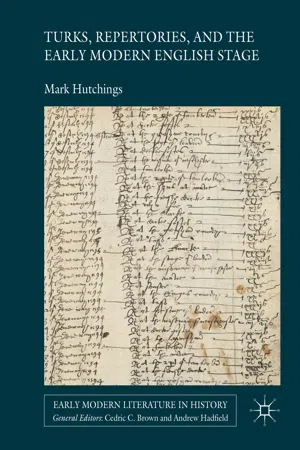
- Suggests that the presence of the Ottoman Empire on the early modern English stage was due to the London repertory system, rather than cultural engagement between a Christian nation and Islamic 'other'
- Examines a variety of sources ranging from Henslowe's Diary to Shakespeare's plays
- Approaches the question of the 'Turk' as a playhouse construct, using playhouse records, playbills, and playscripts
- English
- ePUB (mobile friendly)
- Available on iOS & Android
eBook - ePub
Turks, Repertories, and the Early Modern English Stage
About this book
Information
© The Author(s) 2017
Mark HutchingsTurks, Repertories, and the Early Modern English StageEarly Modern Literature in Historyhttps://doi.org/10.1057/978-1-137-46263-3_11. Introduction
When that hapless English traveller Sir Politic Would-Be recklessly declares that he could ‘sell this state now to the Turk’ (4.1.130) his bravado comes back to haunt him, Peregrine claiming mischievously that the Venetian authorities have been alerted: ‘warrants are signed by this time / To apprehend you and to search your study / For papers’ (5.4.39–41).1 The episode culminates in the comical knight’s inevitable humiliation, but he offers a telling explanation for the remark. Though subsequently admitting to the possession of ‘some essays’ (5.4.43), he protests: ‘Alas, sir, I have none but notes / Drawn out of playbooks’ (5.4.41–42). This of course is one of Ben Jonson’s familiar jibes at the theatre and its playgoers, only here given an extra twist, for the spectators at the Globe playhouse are thus trapped in their laughter at the foolish traveller, who has added drama to his intelligence-gathering activities.2 Yet it cannot be wholly accounted for in these terms. In redirecting the audience’s attention to the playmaking that has brought it to life Volpone (1606) self-reflexively re-orientates its brief reference to Venice’s proximity to Constantinople to the world of playing. In part perhaps a metatheatrical joke about how the English acquired their knowledge of the wider world,3 the episode identifies ‘the Turk’ as not only a geopolitical entity but a construct of playhouse culture.
Such allusions were a staple of the early modern stage. Jonson knew that playgoers would immediately grasp the meaning of this reference to ‘the Turk’, not (or not only) because the Ottoman Empire was the greatest of the age—‘the present terrour of the world’, as Richard Knolles famously put it in his monumental Generall Historie of the Turkes (1603)—but because for twenty-odd years the playhouse had exploited that awareness in numerous plays.4 Sir Pol’s confession reverses the line of association: in this moment the play’s conjuring of Venice gives way (in the vernacular of theatre practice) to the discovery of the playhouse as the fount of Sir Pol’s knowledge.5 This legerdemain points to a deeper truth, namely that London playmaking did not simply ‘reflect’ an external reality but created a self-referential environment as much in dialogue with itself as with the world outside its framing timbers.
Jonson’s joke calls attention to a remarkable narrative in English theatre history, one which would continue to flourish up to the closure of the theatres in 1642 and beyond.6 Although records of playgoing are frustratingly slight,7 judging by the number of extant textual allusions few visitors to playhouses could have been unaware of it. Quite how the scale of this corpus of plays might be identified and evaluated as a theatrical phenomenon is far from straightforward, however. An earlier generation of scholars sought to define the stage’s interest by employing a variety of descriptors: Joseph Quincey Adams opted for ‘Turks’, Louis Wann preferred ‘Oriental’, and Warner G. Rice and Samuel Chew decided on ‘Islamic’, Chew’s magisterial study providing the foundations for the work of their modern successors.8 Each of these choices testifies to the problem of classification this material raises, not only with respect to scholarly working practices but also in terms of how the plays were—or may have been—originally conceived and experienced. It is well to remember that these playwrights were working with complex material. Some but not all Moors were Ottoman subjects; not all Turks were Muslims born but had converted, willingly or otherwise, from Christianity or Judaism; remarkably, converts, not natural-born Muslims, filled the higher and highest echelons of the Ottoman polity, and membership of the famed and feared Janissary corps was restricted to Christians who had been forcibly converted under the dev s irme law; all Turks and Persians were Muslim but belonged to different branches of the Islamic faith.9 Perhaps a useful way to express this is to think of how these plays might be plotted on a Venn Diagram, with ‘Turk’, ‘Moor’, ‘Jew’, ‘Persian’, ‘Islamic’, ‘Islamic convert’, and ‘non-Christian’ (as well as ‘Christian’, subdivided perhaps into ‘Roman Catholic’ and ‘Protestant’) indicated as both discrete categories and, as was often the case in actuality, as overlapping with one or more others. Such a schema would acknowledge the complexity of ethnic/religious identity (from an anthropological perspective) on the one hand and its representation and reception in theatrical performance on the other; but it would need to be further modified to accommodate precise theatre categories, which might discriminate between entities such as character, setting, passing allusion, and so on. Immediately it becomes apparent that there are different ways of identifying—and hence counting in/out—plays according to the individual scholar’s preferred criteria. For every ‘lumper’ there is a ‘splitter’.10
A rough figure may provide a useful starting point. Of the approximately three thousand plays scholars estimate were written during the period 1567–1642 around six hundred survive,11 but perhaps a fifth of these (to which may be added a number of lost plays whose titles are suggestive) may be categorised as referring to Turks, to the Ottoman Empire, or to ‘Turkish’ elements. Scholars may disagree about the inclusion/exclusion of some of these. For example, Linda McJannet concentrates her attention on ‘specifically Ottoman (as opposed to Moorish or generically Muslim) characters’, in other words hers is a ‘splitter’ approach; conversely, Jonathan Burton’s designation ‘Turkish plays’ includes non-Ottoman Islamic subjects, on the grounds that ‘Islam and “Turkishness” were often considered synonymous in early modern English parlance’—a ‘lumping’ which technically implies the inclusion of ‘Persian’ plays as analogously ‘Turkish’.12 The first of these privileges a scholarly bent for categorisation and neatness, the second prefers to consider early modern reception conditions. But regardless of differences in methodological approach there can be no dispute that London playmakers—playhouse owners, dramatists, and actors—made a sustained investment in staging, in myriad ways, the Ottoman Empire. This book is specifically concerned with what it designates (as a convenient shorthand) ‘the Turk’, a term which in the period could signify the sultan himself or, in abstract terms, the Ottoman threat; except where there is overlap in Venn Diagram terms this study is not concerned directly with Persians or Moors—that is, with plays that allude to the non-Ottoman Islamic world or non-Ottoman north Africa.13 This is not to suggest, however, that playgoers engaged with plays in terms demarcated by and through the categories scholars set down; it recognises that the representation of identity on stage was fluid, a fluidity that reflected complex external realities but also registered how the theatre itself operated.14 This study argues, too, for a broad definition of ‘Turk’ that privileges a ‘theatrical’ over a ‘cultural’ or ‘historical’ perspective. Understandably scholars have tended to focus their attention on the ‘major’ plays, which has produced important readings of canonical texts such as the Tamburlaine diptych (1587–1588) and Othello (1604) and brought hitherto obscure plays such as A Christian Turned Turk (c. 1611) and The Renegado (1624) into esteemed company. A key question, however, is how such examples are to be brought into dialogue with ‘minor’ plays (which some scholars might hesitate to qualify as ‘Turk’ at all), where the allusion is apparently incidental and inconsequential: another lumper/splitter conundrum. But any attempt to account for how the theatre deployed this material must avoid the lumper/splitter problem and collapse major/minor categories. If, as this study proposes, dramatists and actors adapted this material to suit playmaking, rather than the other way around, then we might challenge scholarly orthodoxy and thereby arrive at a fruitful evaluation of how ‘Turk’ may have meant, then.
Correspondingly Turks, Repertories, and the Early Modern English Stage approaches this material primarily in terms of the theatre practices that produced these plays. When dramatists and actors represented or alluded to the Turk, for all that this called up a certain knowledge underwritten by a shared cultural memory it also performed a theatre-specific function. This book is interested principally in how such a substantial presence in the corpus may be evaluated, and on what terms. Similar approaches might be taken with plays alluding to matters associated with Persians, Moors, or Jews (with corresponding Venn Diagram overlap, undoubtedly), though not on the scale of the Turk play, which offers a particularly rich case study for sustained analysis. The textual evidence may originally have been no more substantial than what happens to have survived, but given that up to eighty percent of the plays written for the London stage has been lost this is surely unlikely. It is fairly safe to assume that the Turk (and its associated, overlapping, categories) was even more extensive than the one hundred or so extant texts identified in this study indicates. Beyond that it would be inadvisable to speculate. But the sheer scale of this theatre narrative invites a quantitative as well as qualitative approach to the data. One way of presenting this data, in rather crude form, is illustrated in Appendix A. Yet however crude, a chronological listing of plays and their provenance is more than simply a tabular supplement to the analysis that follows this introduction. It also represents, as pure data, a quantitative account of the narrative—not ‘neutral’, for sure, but in its raw form it offers a starting point for the questions this study identifies as useful to address. As will become clear, in this respect this book departs from the modes of enquiry taken by scholars currently working in this field.
Historicising the Phenomenon
Thanks to the work of Nabil Matar and those who have followed his lead, such as Daniel Vitkus, Richmond Barbour, Matthew Dimmock, Jonathan Burton, Linda McJannet, and Jane Hwang Degenhardt, among others, the cultural and histor...
Table of contents
- Cover
- Front Matter
- 1. Introduction
- 2. 1453 and All That
- 3. Henslowe’s Turks
- 4. The Turk Play and Repertory Modelling
- 5. Shakespeare’s Turks
- 6. Conclusion: Repertory Geographies and Theatregoing
- Back Matter
Trusted by 375,005 students
Access to over 1.5 million titles for a fair monthly price.
Study more efficiently using our study tools.
Frequently asked questions
Yes, you can cancel anytime from the Subscription tab in your account settings on the Perlego website. Your subscription will stay active until the end of your current billing period. Learn how to cancel your subscription
No, books cannot be downloaded as external files, such as PDFs, for use outside of Perlego. However, you can download books within the Perlego app for offline reading on mobile or tablet. Learn how to download books offline
Perlego offers two plans: Essential and Complete
- Essential is ideal for learners and professionals who enjoy exploring a wide range of subjects. Access the Essential Library with 800,000+ trusted titles and best-sellers across business, personal growth, and the humanities. Includes unlimited reading time and Standard Read Aloud voice.
- Complete: Perfect for advanced learners and researchers needing full, unrestricted access. Unlock 1.5M+ books across hundreds of subjects, including academic and specialized titles. The Complete Plan also includes advanced features like Premium Read Aloud and Research Assistant.
We are an online textbook subscription service, where you can get access to an entire online library for less than the price of a single book per month. With over 1.5 million books across 990+ topics, we’ve got you covered! Learn about our mission
Look out for the read-aloud symbol on your next book to see if you can listen to it. The read-aloud tool reads text aloud for you, highlighting the text as it is being read. You can pause it, speed it up and slow it down. Learn more about Read Aloud
Yes! You can use the Perlego app on both iOS and Android devices to read anytime, anywhere — even offline. Perfect for commutes or when you’re on the go.
Please note we cannot support devices running on iOS 13 and Android 7 or earlier. Learn more about using the app
Please note we cannot support devices running on iOS 13 and Android 7 or earlier. Learn more about using the app
Yes, you can access Turks, Repertories, and the Early Modern English Stage by Mark Hutchings in PDF and/or ePUB format, as well as other popular books in Literature & European Literary Criticism. We have over 1.5 million books available in our catalogue for you to explore.