- English
- ePUB (mobile friendly)
- Available on iOS & Android
eBook - ePub
About this book
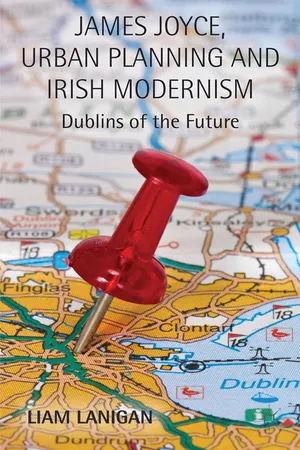
Irish writing in the modernist era is often regarded as a largely rural affair, engaging with the city in fleeting, often disparaging ways, with Joyce cast as a defiant exception. This book shows how an urban modernist tradition, responsive to the particular political, social, and cultural conditions of Dublin, emerged in Ireland at this time.
Information
1
Urbanizing the Revival: Urban Planning, Irish Modernism, and Dublin
Joyce’s works seem stubbornly to refuse inclusion in any cohesive developmental narrative which we might try to create. In part, this is simply a function of the works themselves, since they do seem to frustrate any effort to categorize them, generically, aesthetically, or thematically, alongside his peers. However one must also suspect that the machinery of Joyce scholarship, with so many journals and essay collections and professional gatherings devoted solely to the examination of his work, serves not only to elevate but to isolate it. There is an expectation intrinsic to this scholarly apparatus, that it should reinforce the necessity for that isolation. Eliot and Pound and Woolf can be regarded as elitist high modernists, but Joyce is different. Yeats and Synge and O’Casey can be regarded as cultural revivalists, but Joyce is different. It is not that such readings are not correct, but rather that Joyce’s exceptionalism becomes, in effect, the point. To say that Joyce is different is one thing, but the assertion easily shades off into the implied assumption that Joyce’s writing emerges from a set of cultural coordinates that are also utterly different. In such circumstances, Joyce’s works can quickly seem to float free of any set of historical, cultural, or literary circumstances through which the nature of his achievement might be more fully understood.
Critical discussion of Joyce’s depiction of Dublin frequently takes its cue from his comment to Grant Richards that ‘I chose Dublin for the scene [of Dubliners] because that city seemed to me the center of paralysis’ (Letters II 134). Similarly, he described Dublin to Nora Barnacle on 22 August 1909 as follows: ‘It is the city of failure, of rancour and of unhappiness. I long to be out of it’ (Letters II 239). At the beginning of Chapter 8 of Richard Ellmann’s biography of Joyce, in which he recounts Joyce’s arrival in Paris, we are told that ‘Paris was Dublin’s antithesis’ (JJII 111). He gives no indication that this is anyone’s opinion but his own, and while one might point to a number of examples of Joyce’s ambivalence towards Paris, the line is suggestive of the underlying assumptions about Dublin in Joyce criticism. Whereas it is assumed that Paris is a glamorous European capital and a center of global culture, Dublin is regarded as a backwater in which the force of Joyce’s intellect could not be contained, and could never be fully developed.
This approach to Joyce’s Dublin is typified by Hana Wirth-Nesher’s comment that ‘Joyce’s Dubliners is a succession of proofs that Dublin is a city in name only, paralysed by provincialism’ (20). She expands:
Joyce’s Dubliners seem to be outsiders in their native city because of the absence of sufficient urbanism, because Dublin is only pretending to be a city, and they are in some form of exile from a metropolitan life that they know only by its absence. (159)
Wirth-Nesher contends that Joyce’s characters look beyond the confines of Dublin, whether to Buenos Aires, London, or the West of Ireland, for ‘“real” life’ because of a suspicion that ‘their native city … isn’t really a city at all’ (159). Robert Alter, too, stresses that Dublin is ‘not one of the great European cities’ (122–3). Morton Levitt similarly characterizes Joyce’s depiction of Dublin as ‘more real and vital and convincing than the historical Dublin’ (263–4). He goes on: ‘The city which Joyce has preserved for us … is essentially a lower-middle-class city, inbred, decaying, unaware’ and concludes that ‘we read Joyce because he left Dublin behind him’ (264–6).1
Wirth-Nesher’s assertion that Joyce’s characters are ‘in exile from a metropolitan life’ deserves closer analysis. The use of the term ‘metropolitan’ does not, here, appear to have the same overtones of colonial domination that it does in much recent postcolonial theory. However, it does carry with it enough associations with modernization and technological advance to imply its displacement of ‘pre-modern’ social forms and cultural values. Similarly, her contention that the characters’ sense of being ‘outsiders’ in their ‘native city’ can be traced to ‘the absence of sufficient urbanism’ carries within itself the assumption that the paralysis of the social world Joyce depicts can be attributed to the persistence of cultural and historical forces incommensurate with modern urban technologization. The problems the characters face are attributable not to the city, but specifically to the fact that Dublin ‘isn’t really a city at all.’2 However, what her analysis elides is the extent to which the alienation and ‘paralysis’ of the characters in Joyce’s early work is, in fact, produced by, rather than in spite of, the technological and cultural urbanization of the Dublin they occupy. Wirth-Nesher’s approach highlights the necessity for a more thorough historicization of the relationship between Joyce’s texts and Dublin’s development as a city, and a more variegated understanding of modern urbanization, and its ideological and cultural effects.3
Recent works of scholarship in Irish studies have sought to broaden our view of ‘culture’ and to examine how non-literary cultures might have informed the development of Irish writing.4 Approaches that embrace the role of the particular material and cultural environment informing Irish literary production enable us more effectively to historicize the representational strategies of Irish writers. Betsy Taylor-Fitzsimon and James H. Murphy, in their collection of essays on the Irish Revival, for instance, highlight the role of a broad spectrum of cultural forms (such as the fashion industry and architecture) in that movement, ‘widening the lens’ of individuals, movements and viewpoints ‘within the panorama of what constitutes the Revival’ (13). The emphasis is on the intersection of often conflicting attitudes to the notion of revivalism as generative of different modes of cultural production. Similarly Michael Rubenstein’s recent analysis of the relationship between Irish modernism and public utilities demonstrates that ‘works of art and public works – here limited to water, gas, and electricity – are imaginatively linked in Irish literature of the period for reasons having to do with the birth of the postcolonial Irish state’ (2). This approach foregrounds the role of processes of modernization and technological change, and how those processes are mediated in local cultural conditions, in the formation of Irish modernist literature.
Similarly, I wish to argue that urban planning, both as a cultural movement in Ireland and as an aesthetic response to the experience of the modern city, can inform our understanding of how Dublin catalyzed Irish literary modernism. The idea of the city as a totalistic, integrated and rationalized system, operating beyond the control of any individual, became central to intellectual debate about urban life as a reaction to the apparent chaos of the modern city, but also in recognition of its increasing administrative complexity. The advent of rational urban planning as a discourse and as a design practice in the 1880s and ’90s reflected this recognition. Theories of urban planning also help us in understanding the aesthetic strategies adopted by European modernists in representing the city beyond the confines of individual subjectivity, because in responding to the idea of the city as an impersonal system, they reflect the sense of individual alienation which many writers portrayed as characteristic of modern urban life.
1.1 Planning, literature, and the panoramic perspective
This mode of representing the city manifests itself most clearly at the level of perspective. For Robert Alter, the defining achievement of the novel in the late nineteenth and early twentieth centuries was that it ‘managed to be progressively more subtle and more persuasive in registering … the shifting pulse of experience felt by the individual’ (Alter xi). With their increasing emphasis on the individual consciousness, many novels in the late nineteenth century tended to emphasize subjective experience of the cityscape, with all the limitations of that perspective. Thus, Alter comments that in Flaubert, ‘the urban world is never represented in and of itself but always through the sensibility, the preoccupations, and the limited visual or auditory vantage point of the protagonist’ (41). While the city is ‘solidly there’ as a social reality, it is represented, Alter contends, only insofar as it impinges on the consciousness of the subject (42).
On the other hand, we can also detect a growing tendency towards the depiction of the city in its objective reality. Alter argues, for example, that through the accretion of concrete data Émile Zola’s novels create a ‘judgmental perspective’ that is ‘lacking in that keen sense of the subjective feel of quotidian experience’ (44). Alter is critical of Zola’s approach; however, he also recognizes alternate modes of depiction of the cityscape that were emerging in the late nineteenth century that sought to represent it as an objective world whose workings were not explicable in terms of the motivations of individual subjects. This literary development paralleled the emergence of planning, which was similarly predicated on a conception of the city as a system operating autonomously from the desires of its citizens.
The emergence over the course of the nineteenth century of urban planning as a mode of thinking about cities and as an architectural practice marks an important departure from earlier ideas about urban design. It emerged as a reaction against the problems of urban sprawl and massive poverty that characterized the industrial city. By imposing principles of rationalism and order in the design of the streetscape it sought to recapitulate the power of an urban elite to define the city as a site of meaning. That power was declining in the face of an increasingly complex and multi-vocal city in which ownership of public space was increasingly disputed. However planning also reflected a growing recognition that large cities were increasingly functioning at a level of complexity that lay beyond the perceptual capacity of their inhabitants. By adopting a panoramic perspective on the city, then, planning reflected the increasing distance between the systemic complexity of the modern city and the individual, subjective experience of it, and also sought to provide a utopian understanding of the city that could exclude those elements of urban life it found incompatible with that vision.
This latter point provided the ideological motivation for much urban development in post-Enlightenment Europe. Those motivations are most thoroughly exemplified by Georges-Eugène Haussmann’s extensive redesign of Paris during the nineteenth century. Cardinal Morlot, the Archbishop of Paris, once wrote to Baron Haussmann, then Prefect of the Seine:5
You are combating moral squalor indirectly but with certain effect…. In wide and straight streets flooded with light, people do not behave with the same slovenliness as in dark, narrow, winding streets. (Quoted in Carmona 150)
The city Haussmann inherited was ‘cramped, often stinking, undrained, unhealthy, short of water, labyrinthine and difficult to cross’ (Tombs 21). However, Cardinal Morlot’s letter is a reminder of the moral significance accorded by many to straight streets, which was to become such a central feature of urban planning theory for the following hundred years.
Haussmann set out to replace the labyrinth of winding, unsanitary and impoverished streets of central Paris with a rationalized street grid based around a few very wide streets expanding in a radial system from the center outward, and defined by classical architectural principles of symmetry and balance. Haussmann’s plan was not an ‘innocent enterprise’ of urban renovation. As Jeanne Gaillard points out, its intention was ‘to make an un-governable city governable’ (21). As well as the moral alteration Morlot professes to have seen, Robert Tombs notes that Haussmann’s alterations were intended to render insurgency more difficult, and easier to quell, making the streets ‘penetrable, controllable, healthier and more prosperous’ (21). Walter Benjamin argued that the widening of the streets was intended to make the erection of barricades impossible (Arcades 23). In this regard Haussmann’s works reflected a commitment to the idea of physical determinism: the belief that the physical environment could be used to alter the behavioral patterns of people, or even their beliefs and desires.
The wide streets leading onto wide open squares which were to become the signature of Haussmann’s Paris often cut through large areas of slum housing and extreme poverty. The inhabitants of these places were simply dispersed rather than provided with social housing, and the city center became ‘an administrative enclave’ (Tombs 22). Carmona argues that the visible segregation of people into rich and poor areas ‘for which Haussmann is often blamed’ had in fact been an ongoing process since the early nineteenth century (138). However the construction of long and grandiose streets was frequently remarked to make it possible to cross huge swathes of the city without encountering poverty. They could therefore be regarded as exercises in urban desensitization, dislocating the experience of the urban elite from the impact on urban space of social deprivation and difference, placing the individual bourgeois subject at a remove from the visible presence of the undifferentiated urban crowd.
It is frequently remarked upon that what most benefitted Haussmann in bringing in his sweeping changes to the cityscape were the authoritarian powers that availed him. Sigfried Giedion writes that he ‘so wielded his almost dictatorial powers that in the space of seventeen years he changed the whole aspect of Paris and recast its technical organization from top to bottom’ (209). Working unilaterally and therefore at a remove from the express concerns of the city’s residents, Haussmann was, as Giedion notes, ‘the first to perceive the city primarily as a problem in engineering and organization’ (209). Perhaps it is unsurprising, then, that much of the increasingly violent opposition to Haussmann’s work in the late 1860s insisted that democratic control of municipal city government was necessary:
There was resentment of the authoritarian nature of the Empire’s treatment of Paris, and a feeling of dispossession, when people were forced out of a city that was no longer theirs. (Tombs 24)
Tombs argues, indeed, that among the reasons for the establishment of the Paris Commune was precisely this authoritarian approach to the redesign of central Paris, and the alienation many inhabitants felt as a result of it. Walter Benjamin draws the same conclusion, declaring that ‘[t]he burning of Paris is the worthy conclusion to Haussmann’s work of destruction’ (Arcades 13).
Unsurprisingly, Haussmann, like many later urban planners, was plagued with anxiety about the potential for such resistance from marginalized sectors of the city’s population, and this anxiety motivated him in his restructuring of the city center. Tombs writes:
The swarming bazaar-like city center, so prone to turbulence and whose narrow streets facilitated barricade building, was physically pushed back from the government buildings which had proved so vulnerable [in 1848]. (21–2)
As a result Haussmann’s Paris was, to a greater extent than any preceding city, a space that was architecturally, socially, and ideologically controlled. What is more, Haussmann’s works prefigured and often directly influenced leading figures in the later urban planning movement. Haussmann’s (or, rather, Cardinal Morlot’s) equation of aesthetic and moral order; the belief that geometrical symmetry denoted rationalistic spatial organization; a commitment to the principle of physical determinism as a justification for urban development; the apparently systematic process of marginalization by which a city’s social integrity is supposedly stabilized; an avowedly authoritarian conception of city administration; and a tendency to regard such administration as a process of physical engineering rather than an attempt to respond to the needs of the city-dwelling public; in all of these respects Haussmann foreshadowed the rise of the planning movement in Europe and America.
Twentieth-century city planning, Peter Hall writes, ‘essentially represents a reaction to the evils of the nineteenth-century city’ (7). The plight of the poor, the rapid spread of slums during the industrial revolution, and the general sense of chaotic and uncontrollable urban expansion this seemed to portend, generated an intellectual movement whose desire was to bring the city under control and to order its future development for the betterment of those living there.6 The urban planning ‘movement’ was not a coherent or unified response to these problems, but rather a host of solutions linked primarily by the conviction that the welfare, happiness, beliefs, and behaviors of people could be altered through the radical reorganization of urban space.
The notion of the suburb was the first response to slums: relocating those living in cramped conditions at the center of the city to the spacious, clean, and idyllic outskirts was seen as a straightforward solution to the worst problems of urban life. This response informed virtually all early planning ideas, not least in its diagnosis of the problem with cities: the city itself (Hall 46). Early planning, by and large, regarded urban life itself as a malady of the industrial era, one that could be solved by simply undoing the process of urbanization. This is what Thomas Angotti identifies as the anti-urban bias of early planning (147). While recognizing the benefits, even the necessity, of the city as a site of social and economic interaction, most urban planners saw some form of suburb as a way to tap into those benefits while avoiding the (seemingly inevitable) problems of urban life itself.
Early urban plans that advocated the use, in one form or another, of suburbs to alleviate congestion included those of Raymond Unwin and Ebenezer Howard. Howard’s work, Garden Cities of Tomorrow, first appeared in 1898 to broad acclaim. In it, Howard advocated the creation of large sub-cities surrounding the central city, albeit at a considerable distance, with all of these sub-cities linked by a municipal railway. Many politicians saw such ideas as a means to prevent the spread of socialism. David Lloyd George, on the advice of Raymond Unwin, supported the creation of large-scale suburbs outside of England’s major cities to alleviate slum congestion, largely on the promise that it would halt the rise of communist sympathizers among the working class (Hall 70–2). However, the idea that the suburb could prevent the rise of an ideology ceded the principle that physical space could alter how people behave and what they believe. Thus, like Haussmann, early leaders of the planning ‘movement’ became advocates for an authoritarian form of physical determinism that paid scant attention to the needs and desires of the city’s inhabitants. Increasingly, the emphasis was placed on the city as a physical object, and a visual spectacle. Howard’s book is full of elaborate and highly geometrical diagrams of his plan for a Garden City. The plan is underpinned by the utopian commitment to a ‘town-country’ that is ‘free from the disadvantages’ of either the urban or the rural (7).
Formalism and authoritarian determinism were bolstered by the tendency for planning to...
Table of contents
- Cover
- Title
- Copyright
- Contents
- Acknowledgments
- List of Abbreviations
- 1 Urbanizing the Revival: Urban Planning, Irish Modernism, and Dublin
- 2 A Drama in Muslin and the Formation of an Irish Urban Modernism
- 3 ‘A Space-embracing Somewhere, Beyond Surmise, Beyond Geography’: Visions of the City in the Irish Revival
- 4 ‘A More Spacious Age’: Reimagining the City in Dubliners
- 5 A Portrait of the City
- 6 ‘If My Memory Serves Me’: the Subject, Memory, and Democratic Planning in ‘Wandering Rocks’
- 7 ‘A Necessary Evil’: Planning and the Marginal Space of Nighttown in ‘Circe’
- 8 Epilogue: Writing Dublin after Joyce
- Notes
- Works Cited
- Index
Trusted by 375,005 students
Access to over 1.5 million titles for a fair monthly price.
Study more efficiently using our study tools.
Frequently asked questions
Yes, you can cancel anytime from the Subscription tab in your account settings on the Perlego website. Your subscription will stay active until the end of your current billing period. Learn how to cancel your subscription
No, books cannot be downloaded as external files, such as PDFs, for use outside of Perlego. However, you can download books within the Perlego app for offline reading on mobile or tablet. Learn how to download books offline
Perlego offers two plans: Essential and Complete
- Essential is ideal for learners and professionals who enjoy exploring a wide range of subjects. Access the Essential Library with 800,000+ trusted titles and best-sellers across business, personal growth, and the humanities. Includes unlimited reading time and Standard Read Aloud voice.
- Complete: Perfect for advanced learners and researchers needing full, unrestricted access. Unlock 1.5M+ books across hundreds of subjects, including academic and specialized titles. The Complete Plan also includes advanced features like Premium Read Aloud and Research Assistant.
We are an online textbook subscription service, where you can get access to an entire online library for less than the price of a single book per month. With over 1.5 million books across 990+ topics, we’ve got you covered! Learn about our mission
Look out for the read-aloud symbol on your next book to see if you can listen to it. The read-aloud tool reads text aloud for you, highlighting the text as it is being read. You can pause it, speed it up and slow it down. Learn more about Read Aloud
Yes! You can use the Perlego app on both iOS and Android devices to read anytime, anywhere — even offline. Perfect for commutes or when you’re on the go.
Please note we cannot support devices running on iOS 13 and Android 7 or earlier. Learn more about using the app
Please note we cannot support devices running on iOS 13 and Android 7 or earlier. Learn more about using the app
Yes, you can access James Joyce, Urban Planning and Irish Modernism by L. Lanigan in PDF and/or ePUB format, as well as other popular books in Literature & Literature General. We have over 1.5 million books available in our catalogue for you to explore.