- English
- ePUB (mobile friendly)
- Available on iOS & Android
eBook - ePub
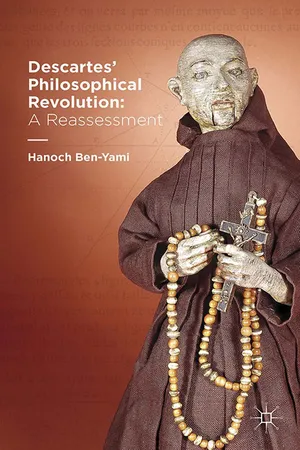
Descartes' Philosophical Revolution: A Reassessment
About this book
Ben-Yami shows how the technology of Descartes' time shapes his conception of life, soul and mind–body dualism; how Descartes' analytic geometry helps him develop his revolutionary conception of representation without resemblance; and how these ideas combine to shape his new and influential theory of perception.
Information
Topic
PhilosophySubtopic
Mind & Body in Philosophy1
Introduction
Descartes revolutionised philosophy. With which of his ideas? And how did he arrive at them?
When we read the works of the great philosophers from Descartes onward, we feel much closer to them than we do while reading those of their predecessors from antiquity, the Middle Ages or the Renaissance. The works of those older masters is of course still of philosophical relevance, and much is to be gained from the writings of Plato, Aristotle, and later philosophers who preceded Descartes. Moreover, in some areas earlier philosophy has more to offer than does Early Modern philosophy – logic and the philosophy of language being perhaps the most obvious examples. Yet all the same, the philosophy of Descartes clearly marks a new turn, and it starts a tradition of which we justly consider ourselves a part.
Descartes restarted everything from the very beginning, said Hegel, and constituted afresh the foundations of philosophy (1986, p. 123). This is undeniably wrong: although Descartes writes as if it were so, he is indebted to earlier philosophers, from Plato to his seventeenth century contemporaries (as many scholars have shown and as we shall see in detail in this book). But some of the ideas of his philosophy must be, first, new, and second, later adopted by most other philosophers; in addition, they should also have that vague quality of being revolutionary. Otherwise there would not be this feeling of both a break with earlier traditions and an initiation of the Cartesian one, to which we belong. Which ideas are these?
When one thinks of the philosophy of Descartes, the Cartesian ideas that first come to mind are those central to the Meditations. The most prominent of these are probably scepticism and its refutation, the dream argument, the deceiving God or demon, the cogito, the proof of the real distinction between mind and body, the proofs of God’s existence, and the reasons for error. But, apart from the cogito, none of these meets all the criteria mentioned in the previous paragraph.
Extreme forms of scepticism appeared time and again in philosophy, from Pyrrho in the fourth century BC to Descartes’ own day. In the sixteenth century Sextus’s scepticism gained an unprecedented influence, as is shown, among other things, by the translation into Latin of his works (Outlines of Pyrrhonism: 1562, Geneva; Against the Dogmatists: 1569, Paris). Cicero’s Academica was printed even earlier, in 1553, also in Paris. Works developing extreme forms of scepticism were written in the generations preceding Descartes’, the most influential being Michel de Montaigne’s (1533–1592) Essays (Essais, 1580) and Pierre Charron’s (1541–1603) Of Wisdom (De la sagesse, 1601). In Descartes’ own day, François de La Mothe Le Vayer (1585–1672) published in 1630–1631 radical sceptical views in his Dialogues.1 Descartes wrote that he had seen many ancient writings on scepticism and that he was therefore reluctant to reheat and serve this stale cabbage (Second Replies, AT VII 130; cf. his Comments on a Certain Broadsheet, AT VIIIB 367). And he also commented that
we should not suppose that sceptical philosophy is extinct. It is vigorously alive today, and almost all those who regard themselves as more intellectually gifted than others, and find nothing to satisfy them in philosophy as it is ordinarily practised, take refuge in scepticism because they cannot see any other alternative with greater claims to truth. (Seventh Objections with Replies, AT VII 548–549, CSM II 374)
The revival of the interest in scepticism is not due to Descartes. As Floridi has recently written, ‘by the time the Meditations were published, we should no longer speak of the influence of sceptical arguments on modern philosophy, but rather take them to be an integral part of it’ (2010, p. 284).
Similarly, the refutation of scepticism became a preoccupation of Descartes’ contemporaries. His close friend Marin Mersenne (1588–1648) published in 1625 his book, The Truth of the Sciences: Against the Sceptics and Pyrrhonists. Jean de Silhon (c. 1600–1667), another person with whom Descartes associated during the mid-twenties, published in 1626 his anti-sceptical book, The Two Verities: The one of God and his Providence, the other of the Immortality of the Soul. In this respect too Descartes belonged to his times and did not depart from them.2
This is not to say that Descartes did not make original contributions to the sceptical tradition or to the attempts to refute scepticism; he definitely did. No idea that passed through his hands came out of them looking the way it previously had. I discuss these contributions later in the book. But in his focus on scepticism and its refutation we do not find the turning point we are after.
The dream argument first appeared in Plato’s Theaetetus (158b–e), and has been one of the cornerstones of scepticism ever since. It was used by other ancient authors who were widely read in Descartes’ time – Cicero, Sextus and Augustine – and frequently reused in Renaissance philosophy, its best-known occurrence being in Montaigne’s Apology for Raymond Sebond.3 And of course, Descartes’ contemporaries recognised it as a commonplace. Here is what Hobbes had to say of the argument’s occurrence in the Meditations:
From what is said in this [first] Meditation it is clear enough that there is no criterion enabling us to distinguish our dreams from the waking state and from true sensation. ... I acknowledge the correction of this Meditation. But since Plato and other ancient philosophers discussed this uncertainty in the objects of the senses, and since the difficulty of distinguishing the waking state from dreams is commonly pointed out, I am sorry that the author, who is so outstanding in the field of original speculations, should be publishing this ancient material. (AT VII 171; CSM II 121)4
Descartes responded that he ‘was not trying to sell [these arguments] as novelties’ (ibid.). Indeed, his presentation of the dream argument is typically concise and elegant, and it has therefore justly become a classic. More importantly, the conclusions Descartes drew from the argument are not the same as those drawn by earlier philosophers, but much more like those that have typically been drawn by later ones. Yet these conclusions, as we shall see below, follow from other aspects of his philosophy, and not just from the dream scenario and the claim that there is no criterion distinguishing the waking state from dreaming. In his employment of the dream argument we do not find an original or revolutionary Cartesian contribution to philosophy.
The deceiving God or demon, apart from not being original with Descartes,5 has not gained in post-Cartesian philosophy a prominence that resembles those of the dream argument, the cogito, or any other influential Cartesian idea. It seems that none of the great post-Cartesian philosophers allotted this thought-experiment or alleged possibility any important role in their writings. This idea is also not a contribution to the Cartesian revolution in philosophy.
Of course, Descartes’ discussion of the deceiving God or demon continues to occupy Cartesian scholarship, which has flourished since around the mid-nineteenth century. Nor do I maintain that it is not an interesting idea – all the ideas of the Meditations mentioned above are of philosophical interest. But we are looking for a different, wider kind of influence: one that permeates philosophy, even when it does not have Descartes’ thought as its subject. The deceiving God or demon did not achieve this status.
But the cogito did. The argument itself, as well as its use to refute scepticism, are indeed due to Augustine and not to Descartes, as Descartes’ contemporaries were quick to note (more on this below); and some of them had used it for this purpose in their writings before Descartes published his version of it.6 But beginning philosophy from the point of view of the thinking subject as the primary source of certainty and constructing the philosophical system in this way, while attempting to eliminate any prior theoretical assumptions, are Descartes’ innovations. Moreover, they recurrently appear in later philosophy, in such otherwise dissimilar philosophers as, for instance, Berkeley, Hume, Kant, Husserl and Russell. Here is what Russell wrote about this move in the second chapter of his The Problems of Philosophy, 275 years after the first appearance in print of Descartes’ cogito:
Descartes (1596–1650), the founder of modern philosophy, invented a method which may still be used with profit – the method of systematic doubt. He determined that he would believe nothing which he did not see quite clearly and distinctly to be true. Whatever he could bring himself to doubt, he would doubt, until he saw reason for not doubting it. By applying this method he gradually became convinced that the only existence of which he could be quite certain was his own. ... ‘I think, therefore I am’, he said (Cogito, ergo sum); and on the basis of this certainty he set to work to build up again the world of knowledge which his doubt had laid in ruins. By inventing the method of doubt, and by showing that subjective things are the most certain, Descartes performed a great service to philosophy, and one which makes him still useful to all students of the subject. (1912, Chapter 2)
In much of post-Cartesian philosophy we time and again meet with attempts to restart the philosophical project from Descartes’ point of departure, namely the thinking subject, only to conduct it better than he did and thus establish safer results. Husserl was explicit about this dual-aspect of his philosophy: in his Cartesian Meditations of 1929 he characterises ‘Descartes’ Meditations as the prototype of philosophical reflection’ (heading of Section 1); and when describing Descartes’ influence on his own transcendental phenomenology he writes:
One might almost call transcendental phenomenology a neo- Cartesianism, even though it is obliged – and precisely by its radical development of Cartesian motifs – to reject nearly all the well-known doctrinal content of the Cartesian philosophy. (1950, p. 1)7
And if we abstract from the subjectivist aspect of Descartes’ cogito approach, we shall find an even wider influence. As Hegel said, Descartes tried to restart philosophy from the very beginning and to construct it afresh on indubitable foundations. Descartes’ starting point was the existence of the thinking subject and what can be learned from his ideas (the idea of God, clarity and distinctness in ideas, and so on). Some other philosophers accepted the general methodological approach, but had different starting points: Spinoza, for instance, starts his Ethics with allegedly evident axioms, and builds his system afresh on them as foundations. Another very different example is Wittgenstein’s Tractatus.
This philosophical methodology was not used by earlier philosophers. It did appear as an ideal, in Plato’s divided line (Republic VI, 511b–c), where we find both the dialectical cancelling of hypotheses in order to arrive at the first principle, and then the new beginning from it in order to build knowledge in successive steps. But this ideal was not applied, either by Plato himself, who considered its application ‘a task which is really tremendous’ (ibid.), or by any other pre-Cartesian philosopher. This is not to say that none had a philosophical system, in the sense of interconnected doctrines supporting each other and together offering a Weltanschauung; Aristotle’s philosophy can serve as a paradigm of a system in this sense. But none tried to present or justify his system in the Cartesian manner, namely starting afresh from a minimal number of fundamental claims, supposedly secure from any doubt, and building the whole edifice on them.8
By contrast, after Descartes this method almost became the rule, with philosophers either starting from roughly the same subjective point as did Descartes, or substituting other foundations for his.9
Indeed, by now this Cartesian method has largely been rejected in philosophy. We are all familiar with Neurath’s simile (1932, p. 209), made famous as the motto of Quine’s Word and Object (1960):
We are like sailors who must reconstruct their ship on the open sea, without ever being able to take it apart on a dock and build it afresh from the best constituents.
We cannot advance our knowledge by first dismissing everything which is not immune to doubt; rather, we should start with the system of beliefs we already have, and improve on them piecemeal.10 Very few today would adopt the point of view of the thinking subject as their point of departure and try construct from it, with minimal assumptions about the world, a significant philosophical system.
We thus find in various aspects of Descartes’ cogito dialectic a deep methodological influence on future philosophy, influence that has nevertheless been waning in recent decades.
If the Cartesian method is misconceived, as Neurath and others have powerfully claimed, it must have failed in Descartes’ own case as well. It is, of course, generally acknowledged that the Meditations as a whole is not a success: the system of nature with which the book ends, which includes a benevolent omnipotent God, an immaterial mind united with a body, clarity and distinctness as a criterion of truth, and so on, has not been established. However, the first two Meditations might seem more successful: starting philosophy afresh, largely free of any theory-laden presuppositions, and achieving certainty in some significant claims. Bernard Williams’s description of the thoughts of the Meditations probably represents the way many conceive of at least the first two:
Indeed, the ‘I’ who is having these thoughts may be yourself. Although we are conscious, in reading the Meditations, that they were written by a particular person, René Descartes, and at a particular time, about 1640, the ‘I’ that appears throughout them from the first sentence on does not specifically represent that person: it represents anyone who will step into the position it marks, the position of the thinker who is prepared to reconsider and recast his or her beliefs, as Descartes supposed we might,...
Table of contents
- Cover
- Title
- 1 Introduction
- 2 Descartes Theory of Perception
- 3 The Development of Descartes Theory of Perception
- 4 Soul and Physiology
- 5 Mind, Machine, Sensation
- 6 Descartes and the Metaphysical Project
- 7 The Meditations: Borrowed Themes with Original Variations
- Epilogue
- Notes
- Bibliography
- Index
Trusted by 375,005 students
Access to over 1.5 million titles for a fair monthly price.
Study more efficiently using our study tools.
Frequently asked questions
Yes, you can cancel anytime from the Subscription tab in your account settings on the Perlego website. Your subscription will stay active until the end of your current billing period. Learn how to cancel your subscription
No, books cannot be downloaded as external files, such as PDFs, for use outside of Perlego. However, you can download books within the Perlego app for offline reading on mobile or tablet. Learn how to download books offline
Perlego offers two plans: Essential and Complete
- Essential is ideal for learners and professionals who enjoy exploring a wide range of subjects. Access the Essential Library with 800,000+ trusted titles and best-sellers across business, personal growth, and the humanities. Includes unlimited reading time and Standard Read Aloud voice.
- Complete: Perfect for advanced learners and researchers needing full, unrestricted access. Unlock 1.5M+ books across hundreds of subjects, including academic and specialized titles. The Complete Plan also includes advanced features like Premium Read Aloud and Research Assistant.
We are an online textbook subscription service, where you can get access to an entire online library for less than the price of a single book per month. With over 1.5 million books across 990+ topics, we’ve got you covered! Learn about our mission
Look out for the read-aloud symbol on your next book to see if you can listen to it. The read-aloud tool reads text aloud for you, highlighting the text as it is being read. You can pause it, speed it up and slow it down. Learn more about Read Aloud
Yes! You can use the Perlego app on both iOS and Android devices to read anytime, anywhere — even offline. Perfect for commutes or when you’re on the go.
Please note we cannot support devices running on iOS 13 and Android 7 or earlier. Learn more about using the app
Please note we cannot support devices running on iOS 13 and Android 7 or earlier. Learn more about using the app
Yes, you can access Descartes' Philosophical Revolution: A Reassessment by H. Ben-Yami in PDF and/or ePUB format, as well as other popular books in Philosophy & Mind & Body in Philosophy. We have over 1.5 million books available in our catalogue for you to explore.