- English
- ePUB (mobile friendly)
- Available on iOS & Android
eBook - ePub
About this book
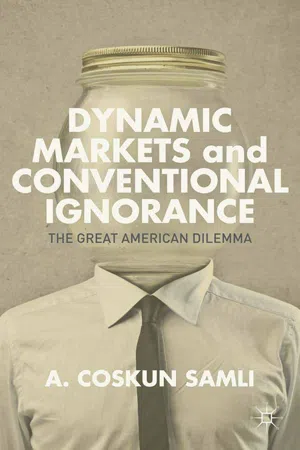
In this follow up to From a Market Economy to a Finance Economy, Samli reflects on his more than half a century of economic experience and research, maintaining that financiers, the government and many decision makers in both politics and the economy, do not really the 'free market.
Information
Chapter 1
What Is a Market Economy?
In a society, all people are consumers. They have to have goods, clothing, shelter, and medicines, among other things. But consumers do not produce for their own consumption. Products and services are produced by some people and distributed by others that form what is called the market system in general. The market system distributes the goods and services produced to all consumers.
Although the market systems and their performance are not the same in every society, there are products and services produced, sold, distributed, and consumed in every society. This is how human and social needs are `satisfied. To satisfy these needs, the products and services are delivered where they will be utilized. This activity creates consumer value and producer profit (Kotler and Keller 2012). In totality, the production and consumption of goods and services utilize the society’s natural and human resources. In the twenty-first century, these natural and human resources are exchanged among different countries as well, which is called international trade. The degree to which the market system can satisfy consumer needs and utilize the scarce natural resources most efficiently indicates how well the market system is working. If the market system is functioning well, then everyone in the society will have access to all of the opportunities to improve their quality of life and share the benefits of economic growth. This is how the middle class in the society will grow and create more stability for the whole society. Perhaps this is the theoretical point in economics depicting Pareto’s optimalities. These optimalities stood for making available the greatest volume of goods for the most number of people in the society. This also meant that no one could be better off without making someone else worse off. The concept further meant that allocation of economic resources is managed in such a way that these resources are utilized in the most efficient way (Pieters 2005–2012). Particularly during the post–World War II era until around the early 1980s, the American economy bloomed. Perhaps it would not ever achieve the Pareto optimalities but the economy functioned in that direction. During that period, GDP increased for all. Its distribution was somewhat equitable, and quality of life appeared to be improving for all. In other words, the economy was moving in the direction of Pareto’s optimalities. But this whole process slowly reversed itself.
The Forgotten Pareto Optimalities
From around the early 1980s, the American market economy started moving in the opposite direction of Pareto’s optimalities. According to Samli (2013), four key developments created this counter Pareto movement. These four developments are merger mania, deregulation, tax cuts, and privatization.
Modifying or ignoring the antitrust laws that in general advocated that any attempt to hurt competition or to gain monopoly power is illegal, merger mania created a situation where industrial giants grabbed the upcoming innovational activities and entrepreneurial entities that they considered to be a threat. They either put them out of existence or absorbed them and totally reduced their competitive potential.
Deregulation is also part of the general propaganda maintaining that if there are no laws or regulations, the market will function better. Of course the savings and loan fiasco, the real estate bubble, the banking industry’s problems, all have been based on this lawlessness that was supposed to help the economy. These problems, created by the lack of regulations, caused billions of dollars of loss to the economy and American tax payers, particularly to the middle class.
Tax cuts based on the propaganda articulate that if the taxes are lower, the economy will do better. The foundation of this propaganda was and is based on two premises. First, government does not contribute to the economic well-being of the society the way the private sector does. Second, this propaganda implied that if there are such things as private and public economic multipliers creating economic growth, the private multiplier is the bigger of the two and contributes more to the economic growth than the public multiplier. Of course the general ignorance would not even acknowledge that these two types of multipliers exist. However both these do multipliers exist and it is proven in most advanced economic societies that the public economic multiplier is very important. The concept of economic multiplier, in our society, is not understood. Samli (2013) talks about government being a fair and a powerful partner rather than a foe. But this point has been eliminated by the propaganda put out by those whom Ratigan (2012) calls vulture capitalists. The second point here is that tax cut advocates maintain that jobs are created by multimillionaires or by billionaires, a fact that has not been proven at all. In fact, during the Clinton years the American economy did extremely well by creating 22 million jobs as the taxes were raised.
Flattening the tax code, which implies tax cuts and which create a basic discrepancy between the rich and the poor, is always proposed and favored by vulture capitalists. Tax cuts, by definition, benefit the rich much more than they benefit those with limited income. This is so because the rich save much more money through tax cuts. Tax cuts and a flattened tax system create a group of extremely rich people who are coined as 1 percenters (Samli 2013). This group received 93 percent of the total GDP in 2010. They still insist on more tax cuts. But there is no evidence that they create jobs.
Privatization is also based on a propaganda factor of the 1 percenters, who consider it to be more productive than the public sector. Therefore, in their mind, everything needs to be privatized. In fact, they feel the government has no role to play and should be kept to a minimum size. However, if analyzed more carefully, some greedy people want to privatize social security, for instance, which certainly will bring billions of dollars to Wall Street and not necessarily help the poor and the elderly (Samli 2013).
So What Is This Market System?
Even though we constantly talk about “free market system,” very little is commonly known about this system. It is not sacrosanct, it is not an all-knowing and all-doing system that works wisely if left alone. In fact, we do not even know whose freedom we are talking about when we say free markets. After half a century of research, teaching, consulting, and writing, I know that the market does not think, it does not have conscience, it does not plan ahead. It is like an automobile. If we have a driver who is accelerating, if there is enough gasoline in the tank and if there are good roads, it will go to the desired destination. Here, the driver is the government leading the business sector, the gasoline is the economic stimulants, and the road is the conditions under which the market system is functioning. The desired destination is the economic goal that needs, or is desired, to be achieved. But, all of these conditions cannot be met with the prevailing level of ignorance in the country’s decision making circles in both public and private sectors. As a result of existing ignorance and propaganda from powerful greedy sections, our economy has moved away from being a market economy and has become a finance economy (Samli 2013). As such, it is almost exclusively emphasizing the current financial gains for the rich. It is prioritizing short-run financial gains over long-run human and economic values. This is terribly counter-progressive.
Somehow our market system has not been well understood. The current conditions are such that the automobile or the market will not go anywhere without the conditions put forth above. As stated earlier, it is not understood that the market does not have a mind of its own. It will not move in a direction that is beneficial for the whole society by itself, but it functions very well if the proper conditions prevail.
At the writing of this book, the gap between the rich and the poor in the United States has never been worse (Saez 2012). Again, at the writing of this book almost half of the United States population is below the poverty line. The market system has almost totally become an instrument of the 1 percenters. Some 450 families are estimated to have more money and income than the rest of the 150 million Americans. Thus, the rest of the society appears to be working for that 1 percent group. This situation is not sustainable and could lead to a major civic unrest. But, with the financial powers of the 1 percenters and almost nonstop propaganda, the American society has become a finance economy (Samli 2013). This situation is continuing.
Shocking Conditions
At the writing of this book, the business sector has made record profits (Bloomberg BusinessWeek 2012). The stock market is at a record level but unemployment and underemployment proportions are alarmingly high. According to estimates, one-fourth of the Americans who are employed are getting salaries not more than the minimum wage, which is considered below the poverty line. Despite the fact that American consumers are taking on a big financial burden by saving the financial sector, this sector is not providing financial support for economic growth and is not hiring more people. It is not making credit available for economic growth. In essence, the financial sector is not sharing the benefits of the market system with the rest of the society.
Wrong Points of Emphasis
If a firm or a group of firms in the economic sector are doing well, certainly they are not likely to change. This is the story of 1 percenters. The rest of the society, at this point of writing, is working for about 7 percent of the total GDP. The finance economy is trying to make as much money as possible in the shortest run by cost cutting, by charging more in their oligopolistic situations, and by getting the benefit of unbelievably low tax rates (Samli 2013). One may ask the most critical set of questions that Robert B. Reich raised (2010). Just at what point does the economy put itself in a position that the majority in the society considers that it is rigged? In fact, just what and whom is the economy for? Currently, the answers for these two questions are: the American economy is functioning in favor of financiers and it appears that there are almost no solutions to reverse this dangerous trend. This book is written to remedy this situation.
Just How Can This Trend Be Reversed?
Once again, we must go back to a market economy (Samli 2013), which thrived to reach full employment. This means not only that every person in the society has a chance to get a job but also that the jobs pay reasonable living wages. The financial sector will not be allowed to receive outrageous proportions of the GDP that obviously is not generated by one or two people but by the society as a whole. The prevailing merger mania will stop and industries will become more competitive, not oligopolistic. Manufacturing in the United States will expand and counteract outsourcing of well-paying jobs. More progressive income taxes would give the government an opportunity to fix the deteriorating infrastructure, to support more research and development, to create more equal opportunity for education, and in general to level the economic playfield. But at the point of this writing, almost none of these conditions are being met or, at best, only some progress is being made in these directions (Samli 2013, Reich 2010).
How Did We Reach This Dismal Situation?
In practice, deregulation, merger mania, tax cuts, and privatization, as mentioned earlier, are the main culprits. But the problem is much deeper. Two colossal areas of ignorance have played and still are playing an almost deadly role in American economy.
First, the party in power, particularly between late 1990s and early 2000s, simply did not and still does not believe the government has a role in the economy. They believe that smaller and more inactive the government is, the better the society will be. This kind of total libertarian orientation existed in the seventeenth-century Austria as a reaction to strong and evil emperors. This is a totally outdated and dysfunctional orientation, which has no place in the twenty-first century. To make it worse, those who were in political power—and many are still there at this writing—have some dogmas that are perhaps thousands of years old. They are trying to propagate these old and dysfunctional values such as prayers being more important in schools than education, evolution and creationism must be taught side-by-side, stem cell research and similar progressive areas of explorations are unethical, women should not be given the freedom of dealing with their own contraception issues, and the like. These are totally regressive points of view. They have no place in the twenty-first century. But they have played a major role in keeping our society from making major economic progress. Some of the political leaders did not learn that a society cannot make major progress if it is run on the basis of thousands of years’ old dogmas.
The second ignorance issue was even more dramatic and all of us, perhaps except the 1 percent group, are paying for it. The ignorance is that the decision makers do not know how the market system works. During the particular periods cited, the United States was involved in two almost totally unnecessary wars. But at no time in the history of mankind has a country involved in two wars given a huge tax cut to the population. As a result, foreign indebtedness became very large. The wars and interest on the debt created a lopsided situation of lack of support for education, for innovation, for manufacturing, and for infrastructure, among others. As mentioned earlier, some of the politicians who have important administrative power, maintain that the budget deficit should be eliminated by cutting spending. This will create jobs. But that does not explain how the economy functions. Cutting down spending in economic hard times will do nothing but create unemployment and even a recession. This is what is being discussed at the writing of this book but those who are in powerful administrative places in the government do not realize that if the unemployment rate were to come down from the current 8 percent of the labor force to say 5 percent, the deficit will be paid off in an impressive manner. But the current administration is under pressure to cut cost, which would create more unemployment and cause perhaps more indebtedness subsequently. Cutting spending too much could send our vulnerable economy into a recession.
Greed Still Rules
In my earlier book (Samli 2013) I pointed out that our economy allows ambition as well as greed to function. While ambition is entrepreneurial and progressive in the sense that it stimulates the development of new businesses promotes new innovations and creates more employment, greed does totally the opposite. When in 2008 the representative Henry Waxman of California asked Alan Greenspan, the head of Fed for many years, “You have been a staunch advocate for letting markets regulate themselves . . . were you wrong?” The answer was “YES” (Ratigan 2012). When the economy deregulates willy-nilly, then ambition starts becoming greed. The greedy assume the economy is a zero-sum game—if they want to make money, they have to take from others. The greedy, therefore, are those who do not give to the economy—they simply take as much as they can (Ratigan 2012, Samli 2013). Nothing is enough for them, they take through lower taxes, they take by lowering the wages of workers, they take by using their oligopolistic powers in the economy, they take by eliminating retirement programs of workers, they take by eliminating unions, and they take by forcing the tax system to become more flat. In short, they simply take. Here, we have 93 percent of GDP going to them, meaning that 99 percent of the society is working for only 7 percent of the total GDP but still they are creating tremendous propaganda that they are the givers, they create jobs and generate income. But, with the exception of the Great Depression of 1920s and early 1930s, there has never been that big a gap between the haves and have-nots in our country. They are the ones who are STEALING THE AMERICAN DREAM (Smith 2012). As we moved away from a market economy, shockingly everything in our society seems to have been put up for sale. Shocking concepts such as: paying money for our children to get good grades, paying people to test new risky drugs or donate their organs, paying mercenaries to fight our wars, selling the rights to pollute, auctioning admissions to elite universities, selling citizenships to immigrants, auctioning out our elections—must we go on? These and al...
Table of contents
- Cover
- Title
- Introduction
- 1 What Is a Market Economy?
- 2 Financial Conservatism Does Not Work
- 3 Industrial Giants Are a Major Block
- 4 The Needed Change in the Orientation
- 5 A Totally Unknown Concept: Marketing Multiplier
- 6 Activating the Marketing Multiplier
- 7 Government: A Leader and a Partner
- 8 Managing the Outsourcing
- 9I nnovation Is the Answer
- 10 What about Infrastructure? Lessons from International Experiences
- 11 What Is at Risk?
- 12 Returning to the Market Economy
- 13 The Future of the American Market System
- 14 Needed: A Constructive Vision
- Postscript
- About the Author
- References
- Index
Trusted by 375,005 students
Access to over 1.5 million titles for a fair monthly price.
Study more efficiently using our study tools.
Frequently asked questions
Yes, you can cancel anytime from the Subscription tab in your account settings on the Perlego website. Your subscription will stay active until the end of your current billing period. Learn how to cancel your subscription
No, books cannot be downloaded as external files, such as PDFs, for use outside of Perlego. However, you can download books within the Perlego app for offline reading on mobile or tablet. Learn how to download books offline
Perlego offers two plans: Essential and Complete
- Essential is ideal for learners and professionals who enjoy exploring a wide range of subjects. Access the Essential Library with 800,000+ trusted titles and best-sellers across business, personal growth, and the humanities. Includes unlimited reading time and Standard Read Aloud voice.
- Complete: Perfect for advanced learners and researchers needing full, unrestricted access. Unlock 1.5M+ books across hundreds of subjects, including academic and specialized titles. The Complete Plan also includes advanced features like Premium Read Aloud and Research Assistant.
We are an online textbook subscription service, where you can get access to an entire online library for less than the price of a single book per month. With over 1.5 million books across 990+ topics, we’ve got you covered! Learn about our mission
Look out for the read-aloud symbol on your next book to see if you can listen to it. The read-aloud tool reads text aloud for you, highlighting the text as it is being read. You can pause it, speed it up and slow it down. Learn more about Read Aloud
Yes! You can use the Perlego app on both iOS and Android devices to read anytime, anywhere — even offline. Perfect for commutes or when you’re on the go.
Please note we cannot support devices running on iOS 13 and Android 7 or earlier. Learn more about using the app
Please note we cannot support devices running on iOS 13 and Android 7 or earlier. Learn more about using the app
Yes, you can access Dynamic Markets and Conventional Ignorance by A. Samli in PDF and/or ePUB format, as well as other popular books in Economics & Econometrics. We have over 1.5 million books available in our catalogue for you to explore.