- English
- ePUB (mobile friendly)
- Available on iOS & Android
eBook - ePub
About this book
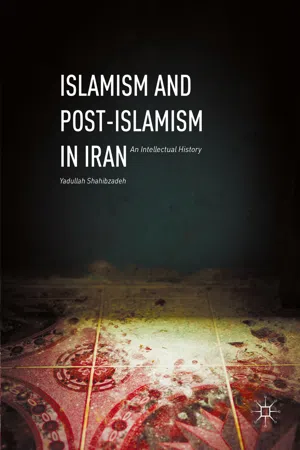
This book is a study of overlooked themes in Iran's contemporary political and intellectual history. It investigates the way Iranian Muslim intellectuals have discussed politics and democracy. As a history of Iranian Islamism and its transformation to post-Islamism, this work demonstrates that Muslim intellectuals have enriched the Iranian society epistemologically, aesthetically, ethically, and politically. This book examines the internal conflicts of the Islamist ideology as the intellectual underpinnings of the 1979 Revolution, its contribution to the formation of the post-revolutionary state, and the post-Islamist response to the democratic deficits of the post-revolutionary state. Seeking to overcome the shortcomings of historiographical approaches, this book demonstrates the intellectual and political agency of Muslim intellectuals from the 1960s to the present.
Information
© The Editor(s) (if applicable) and The Author(s) 2016
Yadullah ShahibzadehIslamism and Post-Islamism in Iran10.1057/978-1-137-57825-9_11. Introduction
Yadullah Shahibzadeh1
(1)
Department of Cultural Studies and Orien, University of Oslo, Oslo, Norway
In The Origins of Totalitarianism, Hannah Arendt argues that “Idealism, foolish or heroic, always springs from some individual decision and conviction and is subject to experience and argument. The fanaticism of totalitarian movements, contrary to all forms of idealism, breaks down the moment leaves its fantasized followers in the lurch, killing in them any remaining conviction that might have survived the collapse of the movement itself.”1 This book is a history of such heroic idealism, which has been subject to experience and argument in the Middle East, a history of a politico-intellectual transformation in Iran. It deals with the intellectual underpinnings of the 1979 Revolution and struggle for reform and democracy since the 1990s. Some scholarly works have conceptualized this politico-intellectual transformation through two key concepts, Islamism and post-Islamism. I employ the same concepts to explain the same transformation. However, my understanding of these concepts and the content of this politico-intellectual transformation is substantially different from previous studies. Islamism means, according to one analyst, “the political ideologization of Islam on the model of the great political ideologies of the 20th century.”2 Others define Islamism as a nativist ideology constructed by marginalized Muslim intelligentsia to overcome their marginalization. The marginalized Muslim intelligentsia presented Islam as a “divine system with a superior political model, cultural codes, legal structure, and economic arrangement,” capable of solving all problems of humankind. Thus, Islamism’s main objective was the establishment of an Islamic state.3 Islamism in Iran resulted in a successful popular revolution and establishment of an Islamic Republic. The belief in the comprehensiveness of Islam as ideology led the Islamists to marginalize all non-Islamist social forces.4 According to another analyst, Islamism was the expression of Iranian nativism. As the expression of Iranian nativism, Islamism was flawed epistemologically, ethically, and politically. It reduced “everything in the context of the binary opposition between the authentic and the alien.” It denied “the authenticity of the other” and suppressed other voices in the Iranian society.5
According to some analysts, after realizing their political and ideological failure in the post-Khomeini era, the Islamists took a critical approach toward the ideological foundations of Islamism. When the critical approach to Islamism developed into multilayered critiques expressing new social, religious, intellectual, and political trends in Iran, post-Islamism became a reality.6 Post-Islamism was both an awareness of “anomalies and inadequacies” of the Islamic political system7 and “a conscious attempt, to conceptualize and strategize rationale and modalities of transcending Islamism in social, political, and intellectual domains.”8 Thus post-Islamism was about appreciating “rights instead of duties, plurality in place of a singular authoritative voice, historicity rather than fixed scriptures, and the future instead of the past.”9 The question, which is worth discussing, is how this epistemologically, ethically, and politically flawed ideology and movement gave birth to post-Islamism. Was Post-Islamism an “unintended consequence[s] of the Khomeinist state?” In that case “the Khomeinist state” empowered the members of the Iranian political community to challenge “the intellectual, political and social foundations of the Islamic Republic.”10 The logical consequence of this line of argument is that the Islamist discourse should be considered as the discursive condition of possibility of post-Islamism. Islamism made visible and audible individuals and social groups, which had been invisible and inaudible in the public space, so that they could make their situation intelligible and their visions of their emancipation from the situation reliable. The Islamists rejected Western democracy, but they did not reject democracy as such. They categorized Western democracy as a formal democracy because it concealed the reality of the economic exploitation and class domination. The Islamists searched for true democracy as the realization of their emancipation because it was supposed to be a classless society free from social antagonism. On the contrary, Post-Islamism was an intellectual and political struggle to force the state to recognize the political and civil rights of Iranian citizens.
Post-Islamists criticized the Islamist authoritarianism and advocated democracy and human rights, but they have been aware of the significance of the sovereignty of the state and the integrity of the public sphere in the democratic struggle in Iran. Iranian post-Islamists are self-educated politically and intellectually. They are not the representatives of the so-called moderate Islam, constructed by Western scholars and NGOs. Iranian Islamists established the Islamic Republic and made Khomeini the supreme leader of the state, Vali-ye Faqih because they saw him as the expression of the general will. The Islamic Republic was also a constitutional political system based on popular vote, in which one could argue against the discrepancies between the rights of the people inscribed in the constitution and the practices of the state institutions. In the post-Khomeini era, the Islamists realized that the new Vali-ye Faqih was no longer the manifestation of the general will. Rather than reflecting the will of the people, he reflected the will of the state institutions that violated the Iranian constitution. In its pre-revolutionary phase, Iranian Islamism was not an ideological and political movement to establish an Islamic state based on Islamic Sharia/Islamic law. Few months after the 1979 Revolution, a popularly elected assembly discussed the draft of a secular constitution, modeled on the current constitution of France and endorsed by Ayatollah Khomeini.11 The present form of the Islamic Republic is a result of the constitutional debates, revolutionary situation and armed rebellion, the war with Iraq, the American effort for regime change, and the democratic struggles. The Islamists of the Arab countries establish their ideology on fundamental principles of Islamic Sharia, whereas Iranian Islamists constructed an ideology with borrowed concepts from the French Humanist Marxism. The Islamists of the Arab countries focused on Islamization of the state and legal system, whereas Iranian Islamists propagated political revolution to achieve a classless society. Post-Islamism can be described as an attempt to recognize “plurality in place of a singular authoritative voice, historicity rather than fixed scriptures.” However, it is more than emphasizing on people’s “rights instead of [their] duties” or appreciating “the future instead of the past.” In fact, both Iranian Islamists and post-Islamists emphasized people’s rights rather than their duties and looked forward to the future than the past. The peculiarity of the Islamists was that they subordinated the people’s rights to the decisions of revolutionary leaders in the transitory revolutionary period toward a real democracy in the future. On the contrary, the post-Islamists argued that democracy was the expression of the rights that people have at the present.
Democracy: A Neoconservative Project
This book intends to challenge the two central assumptions upon which the neoconservative projects for promoting democracy in the Middle East rely. The projects for promoting democracy in the region is encouraged and supported by a great number of Western scholars, NGOs, and governments.12 According to the first assumption, there is no room for nation-states in the age of globalization because a global civil society that consisted NGOs has gone beyond nation-states. This supposedly global civil society represents, “millions of ordinary citizens who are prepared to challenge political and economic decisions made by nation-states and intergovernmental organizations.”13 This global civil society is supposed to establish “a democratic global government” or “a cosmopolitan democracy.” The cosmopolitan democracy is supposed to be “based on Western cosmopolitan ideals, international legal arrangements, and a web of expanding linkages between various governmental and non-governmental organizations.”14 According to the second assumption, democracy in the Middle East is reconcilable with the interests of the USA and its European allies in the region because it will be based on Western democratic values.15 An advocate of the project for promoting democracy in the Middle East argues that it is not enough to support democratization in the region in its consolidating phase. The local people expect that the advocates of the democratic project stimulate democracy in its “initial steps.”16 Obviously, this democratic project does not need independent pubic spheres and autonomous political subjects because even opening steps for democracy in the region are delegated to the guardians of the democratic project. As the guardians of the democratic project in the Middle East, Western scholars, members of NGOs, and government officials explain liberation to the local people. They know that “democracy can be built from nothing: once stripped of all ideology, the “other” is putty that can be remain.”17 The history of democratic struggle in Iran demonstrates the logical contradiction between the universality of democracy and the particularity of Western governments’ interests. It attests that democratic achievements of every society can be protected in a public space, which is free from outside interventions. A few examples may illustrate the contradictions between the universality of democracy and particularity of Western interests in the Middle East. The British backed a coup against the Iranian constitutional government in 1921, which led to Reza Shah’s dictatorship. The US-British-organized coup in 1953 overthrew the democratically elected Mohammad Mosaddeq. Western governments supported the Iraqi dictatorship against Iran in the 1980s while Iran was the only constitutional democracy in a Muslim country. The USA labeled Iran as part of the axis of evil in 2002 while prodemocracy forces led the government and dominated the parliament and local councils.
The Culturalist V...
Table of contents
- Cover
- Frontmatter
- 1. Introduction
- 2. The Crisis of Political Leadership
- 3. Islamist Totalism
- 4. Islamism in Power
- 5. Post-Islamist Perspectivism
- 6. Post-Islamism and Democracy
- 7. Post-Islamism Versus Neoconservatism
- 8. Conclusion
- Backmatter
Trusted by 375,005 students
Access to over 1.5 million titles for a fair monthly price.
Study more efficiently using our study tools.
Frequently asked questions
Yes, you can cancel anytime from the Subscription tab in your account settings on the Perlego website. Your subscription will stay active until the end of your current billing period. Learn how to cancel your subscription
No, books cannot be downloaded as external files, such as PDFs, for use outside of Perlego. However, you can download books within the Perlego app for offline reading on mobile or tablet. Learn how to download books offline
We are an online textbook subscription service, where you can get access to an entire online library for less than the price of a single book per month. With over 1.5 million books across 990+ topics, we’ve got you covered! Learn about our mission
Look out for the read-aloud symbol on your next book to see if you can listen to it. The read-aloud tool reads text aloud for you, highlighting the text as it is being read. You can pause it, speed it up and slow it down. Learn more about Read Aloud
Yes! You can use the Perlego app on both iOS and Android devices to read anytime, anywhere — even offline. Perfect for commutes or when you’re on the go.
Please note we cannot support devices running on iOS 13 and Android 7 or earlier. Learn more about using the app
Please note we cannot support devices running on iOS 13 and Android 7 or earlier. Learn more about using the app
Yes, you can access Islamism and Post-Islamism in Iran by Yadullah Shahibzadeh in PDF and/or ePUB format, as well as other popular books in Politics & International Relations & World History. We have over 1.5 million books available in our catalogue for you to explore.