Sir Philip Gibbs was one of the most widely read English journalists of the first half of the twentieth century. This coverage of his writing offers a broad insight into British social and political developments, government and press relations, propaganda, and war reporting during the First World War.
- English
- ePUB (mobile friendly)
- Available on iOS & Android
eBook - ePub
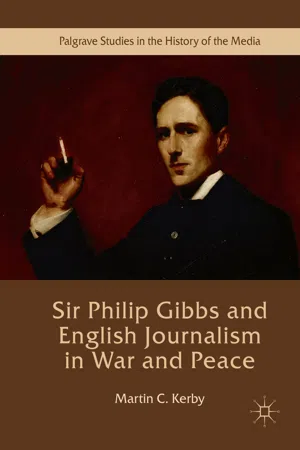
Sir Philip Gibbs and English Journalism in War and Peace
About this book
Information
© The Editor(s) if applicable and The Author(s) 2016
Martin C. KerbySir Philip Gibbs and English Journalism in War and PeacePalgrave Studies in the History of the Media10.1057/978-1-137-57301-8_11. Victorian Childhood: 1877–1895
Martin C. Kerby1
(1)
Humanities & International Studies, University of Southern Queensland, Toowooomba, Queensland, Australia
In the opening line of The Pageant of the Years, the longest of his four autobiographies, Philip Gibbs observed that his childhood was spent in ‘the England of Dickens’.1 In later life, as he felt increasingly alienated from social and political developments with which he had little sympathy, it may have offered Gibbs some comfort to boast that he ‘belonged to Victorian England’.2 Yet this identification with an era and its greatest author was more than just a prosaic description of time and place. It was an introduction to his personal manifesto, a statement of allegiance to a world view that valued above all else ‘personal responsibility, of duty, and of living for something other than the satisfaction of the immediate needs of the self’.3 These values, inculcated during his youth and which he saw as defining the Age, would later be stirred but not shaken by his experiences as a correspondent during the First World War and the chaos of the interwar years. Unlike his brother Arthur, whose wartime experiences led him to question the entire moral fabric of society, Gibbs saw in the slaughter on the Western Front the legitimacy of this world view. It is here, in the final decades of the Victorian Age, where the origins of his wartime journalistic output are to be found.
Philip Armand Thomas Hamilton Gibbs was born in West Brompton, London, on 1 May 1877 into the ‘shabby genteel middle class’ which was growing in number, wealth, and influence due to the expansion of manufacturing and trade associated with industrialization. It was also one which, in his view, produced in the Victorian era ‘so much quality and character’.4 He was the fifth of nine children born to Henry James Gibbs (1844–1906), a civil servant at the Board of Education in Whitehall, and Helen Hamilton (1847–1911). The family assumed both the outward signs of middle-class life, such as the idealization of family, the cultural pursuits, and the family entertainments, and the pervasive belief in the values of hard work, sexual morality, and individual responsibility. Gibbs described his father Henry as ‘imaginative, well read, passionately interested in humanity, witty and eloquent’.5 He enjoyed a relatively successful career in the Education Department, rising from a junior to a first-class clerk, and by 1875 he had written the first of a number of booklets about elementary education law in England and Scotland. Given his own uncertain yet successful years as a freelance writer, it is not surprising that Gibbs felt it was a tragedy that his father should have been ‘fettered to the soul destroying drudgery of a government office’.6 Henry’s second eldest son Cosmo supported this assessment of his father’s 40-year career when he noted that ‘his spirit of taking chances had been killed by heavy responsibility, the caution and timidity growing out of a painful knowledge of the risks and difficulties of life, and the undermining security of having sat all his working years in the safe cul-de-sac of a government office’.7 There is the obvious contrast with the actions of Henry’s sons who were part of the Diaspora of English men and women throughout the Empire and the Americas. Cosmo led a carefree but successful life in America, Frank emigrated to New Zealand after working as a plantation manager in West Africa, Arthur became an author and lived in America, and even Henry, who the younger brothers regarded as ‘square’, became a bank official in Argentina.8
In the few descriptions Gibbs provided of his father, he portrayed him as a man whose literary ambitions far outstripped his opportunities, yet one who had gathered a circle of ‘worshipful friends’ around him. This literary circle became one of the dominant memories of his father, for despite coming to know many of the great writers of his age—GK Chesterton, EW Hornung, Bernard Shaw, Sir JM Barrie, HG Wells, and Sir Arthur Conan Doyle among them—Gibbs remembered a youth spent in the ‘company of men and women of a literary turn of mind…a long portrait of authors, novelists, and journalists…utterly unknown to fame, and entirely without fortune’.9 He referred ironically to men such as George Alfred Henty, George Manville Fenn, and Ascot Hope Moncrieff as literary giants, though his father’s résumé of two novels and a number of articles published in the Globe would also be dwarfed by his son’s prodigious output. Interestingly, for a man of liberal politics, Gibbs does not mention that Henty was, among other things, a war correspondent who later enjoyed enormous popularity amongst boys for his historical fiction. His books were ‘cheerily bellicose tales of Empire’ in which the hero reaps ‘the bounty of a world earmarked for the profit of white men’.10 Such a view would have been the antithesis of Gibbs’ far more critical view of jingoism, particularly later in life.
There were other literary and theatrical diversions. As a result of his friendship with an Irish family, for a time Gibbs attended the Irish Literary Society and met WB Yeats, ‘who looked more like a poet than any poet ought to look’, and Algernon Percival Graves, father of Robert and Charles.11 His love of theatre was nurtured by a childhood toy in the form of a wooden theatre three feet by one, replete with back scenes, wings, and cardboard characters which were drawn on and off by fixing them into metal slides. He performed Miller and His Men with his brothers and sisters reading the parts while concealed behind curtains. In the middle of the last act, the ‘theatre’ caught fire and it was only the prompt action of his father that contained the blaze. In time, the family graduated to a live performance of Pygmalion and Galatea, presented in their home to an admiring audience of friends and family. Outside of the home, the family attended performances of Gilbert and Sullivan by the D’Oyly Carte Company at the Savoy, as well as the comic opera Les Cloches de Corneville in Surrey for the princely sum of twopence. It was a period of his life which would later form the basis of his novel Oil Lamps and Candlelight (1962), which documented the story of a middle-class Victorian family between 1887 and 1902.
A trait that Henry shared with his famous son was an enduring interest in the stories and anecdotes shared with him by a large and eclectic group of acquaintances. Over the course of 30 years, Henry kept a written record of ‘the strangest friendships’ and ‘surprising confidences’ in a journal which became the basis for his novel A Long Probation. Though Gibbs recognized that they were not of ‘riveting interest’ and were primarily examples of the ‘many sidedness of human nature’, it is not difficult to see the genesis of Gibbs’ own determination, often to the detriment of his political analysis, to cast himself as the mouthpiece of the ordinary man and woman. As a man who drew a clear line between the public and the private, he also noted that many of his father’s stories were of a ‘personal and intimate nature’.12 Though Gibbs was reticent to provide public insights into the dynamics of his family life, in at least one piece of personal correspondence, he revealed the depth of his connection to his father:
My taste for literature (such as it is) is by right of inheritance. I owe it all to my father. His influence pervades every line I write. The conversations we have had together a multitude of times, during long rambles in the country, or in his study, have moulded my character very much on his own pattern (as regards my literary predilections, at least) and many a time when I am writing I catch myself unconsciously using a phrase, or running in a quotation that I have heard time out of number upon his lips.13
Gibbs remembered his mother, with whom it appears he had even more in common, somewhat differently, although he wrote even more sparingly of her in his autobiographies. She was born in Liverpool, the daughter of a local merchant, but to Gibbs she was a saint and martyr, ‘always sewing and mending and darning to keep the boys’ clothes decent and to make frocks for the two girls’.14 His reverence for her would later find expression in his unashamedly romanticized treatment of women. Even when he found them sheltering in the rubble of their homes in Rheims in 1914, he pictured them ‘preserving their dignity, and in spite of dirty hands [eating] their meagre rations with a stately grace’.15 As Phillips and Phillips observed to the growing Victorian middle class, the mother was the ‘counterpoint to the vigorous and vulgar, material and masculine world’, one which offered a civilizing influence in a world that could be both cruel and hard. They also noted the home was a shrine to this Goddess of the hearth.16 Such was his emotional connection to this family life, Gibbs would later suffer from homesickness during the first years of his marriage.
Gibbs’ most revealing insight into his relationship with his parents appeared not in his autobiographies, but in one of his works of fiction. In The Street of Adventure, in which he appears as both himself and the main protagonist Frank Luttrell, he is remarkably candid about his parents and their impact on his own nature. Luttrell, like Gibbs, was the ‘heir to his father’s sensitive and shy nature, although underneath that shyness he had the gay imagination and the desire for companionship which belonged to his mother, who had faced a life of drudgery…with a sunny courage’. Between father and son, ‘there was a friendship of rare tenderness’, but it was one veiled by ‘the reserve w...
Table of contents
- Cover
- Frontmatter
- 1. Victorian Childhood: 1877–1895
- 2. The New Journalism: 1895–1912
- 3. Free Lance War Correspondent: 1912–1915
- 4. Official War Correspondent: 1915–1918
- 5. Adventures in Journalism: 1918–1939
- 6. The Pageant of the Years: 1939–1962
- 7. Conclusion
- Backmatter
Trusted by 375,005 students
Access to over 1.5 million titles for a fair monthly price.
Study more efficiently using our study tools.
Frequently asked questions
Yes, you can cancel anytime from the Subscription tab in your account settings on the Perlego website. Your subscription will stay active until the end of your current billing period. Learn how to cancel your subscription
No, books cannot be downloaded as external files, such as PDFs, for use outside of Perlego. However, you can download books within the Perlego app for offline reading on mobile or tablet. Learn how to download books offline
Perlego offers two plans: Essential and Complete
- Essential is ideal for learners and professionals who enjoy exploring a wide range of subjects. Access the Essential Library with 800,000+ trusted titles and best-sellers across business, personal growth, and the humanities. Includes unlimited reading time and Standard Read Aloud voice.
- Complete: Perfect for advanced learners and researchers needing full, unrestricted access. Unlock 1.5M+ books across hundreds of subjects, including academic and specialized titles. The Complete Plan also includes advanced features like Premium Read Aloud and Research Assistant.
We are an online textbook subscription service, where you can get access to an entire online library for less than the price of a single book per month. With over 1.5 million books across 990+ topics, we’ve got you covered! Learn about our mission
Look out for the read-aloud symbol on your next book to see if you can listen to it. The read-aloud tool reads text aloud for you, highlighting the text as it is being read. You can pause it, speed it up and slow it down. Learn more about Read Aloud
Yes! You can use the Perlego app on both iOS and Android devices to read anytime, anywhere — even offline. Perfect for commutes or when you’re on the go.
Please note we cannot support devices running on iOS 13 and Android 7 or earlier. Learn more about using the app
Please note we cannot support devices running on iOS 13 and Android 7 or earlier. Learn more about using the app
Yes, you can access Sir Philip Gibbs and English Journalism in War and Peace by Martin C. Kerby in PDF and/or ePUB format, as well as other popular books in History & British History. We have over 1.5 million books available in our catalogue for you to explore.