- English
- ePUB (mobile friendly)
- Available on iOS & Android
eBook - ePub
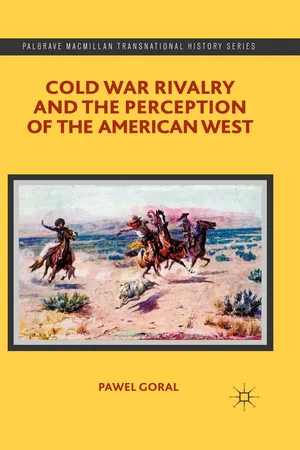
Cold War Rivalry and the Perception of the American West
About this book
This book demonstrates how the two adversaries of the Cold War, West Germany and East Germany, endeavored to create two distinct and unique German identities. In their endeavor to claim legitimacy, the German cinematic representation of the American West became an important cultural weapon of mass dissemination during the Cold War.
Information
1
Karl May Westerns and the Conquest of the American West
The first West German Western
Less than a century ago, the Far West was still a land which was unknown. It attracted all kinds of men; pioneers, seeking a new home; adventurers seeking excitement and gold. But the West also attracted the outcasts of society; criminals, chased by the forces of law and order; bandits; killers; tramps. And then, there were those who fought for the cause of justice. Such a man was Charles Vaillant, known as Old Shatterhand, a hunter and trapper. His friend and blood brother was Winnetou, chief of the Apaches. We shall follow them through the valleys and drags of the mountains. We shall live with them the adventure of a desperate struggle for the possession of fabulous wealth.1
So starts the first West German Western, The Treasure of Silver Lake, released in 1962. The two main characters, Old Shatterhand and Winnetou, discover the site of the ambush of a stagecoach. Following the trails, they enter a nearby town, where they promise a young man to help avenge the death of his father. It turns out that Engel, the murdered man, had half of the map that was to lead him, his son Fred, his business partner Patterson, and Patterson’s daughter Ellen, to the treasure buried in the Silver Lake area. Led by Winnetou and Old Shatterhand, Engel’s son Fred and two other frontiersmen know they need to leave immediately to find the bandits. They encounter an Indian village en route to the Silver Lake, a horrible site of a massacre of Indian women and children. The Colonel’s band committed another atrocity while Indian men were gone hunting for buffaloes. Upon the Indian men’s return, they see Old Shatterhand, Winnetou, and the others, and immediately assume they are facing the perpetrators. They continue to chase them until Old Shatterhand agrees to follow them to their camp to allow the tribal elders to decide whether Old Shatterhand told them the truth. Old Shatterhand must fight Big Wolf, a fierce warrior, to prove his innocence. He defeats his opponent, but refuses to kill him, as he wants them to believe he is a friend of the Indians. Old Shatterhand and his friends leave the Indian camp, but unbeknown to Big Wolf, some Indians decide to follow them, still unconvinced Old Shatterhand had nothing to do with the massacre of their families. At the last moment, just as a fight is about to start, Big Wolf arrives and tells the Indians that Old Shatterhand must be allowed to go, as he honorably defeated him and gained his freedom. Old Shatterhand and Winnetou tell the Indians that they are close to capturing the one responsible for the massacre. The Indians join the hunt for the Colonel. Once justice is done, they all go back to their homes, while Old Shatterhand and Winnetou ride away through the prairie in search of another adventure.
The production of the first German Western intensified the cultural contest between the two German states and further deepened the cultural divide between them, thus contributing to the formation of two distinct identities. Despite the ambivalence and, in some cases, outright hostility toward Americanization, West Germany’s Cold War liberal identity became intertwined with the consumption of American cultural products even before the production of the first West German Western, The Treasure of Silver Lake, in 1962, soon followed by the Winnetou trilogy. The Karl May Westerns, next to Edgar Wallace thrillers, proved to be the most popular films of the 1960s. East Germany responded to the increasing popularity of Westerns in 1966 by producing its first Indianerfilm, The Sons of the GreatBear, followed by another 11 movies. East German Westerns, however, used the American genre and the myth of the American West to denounce the hegemony of American culture as well as to distinguish itself from both the Nazi past and its West German neighbor. By appropriating the American genre and responding to West German Westerns, DEFA Westerns contested and negotiated the meanings of German national and cultural identity. Crucially, the Holocaust and the memory of the Nazi past influenced the way the collective identity was shaped on both sides of the Iron Curtain.
West Germany and denazification
When the Allies agreed to the creation of provisional postwar zones of occupation at the Yalta Conference in 1945, no one imagined that by the end of the decade there would still be two different German states, each representing the ideological contest between capitalism and communism. Immediately after the war, Germans living in a shattered country focused on survival and could hardly remain passive as the occupying authorities decided the future of their country. By 1948, it became more and more apparent to all the parties involved that the occupying authorities’ competing visions of Germany’s future would result in the division of Germany into two states. Regardless of the potency of German political parties, which started developing shortly after the war ended, the former World War II allies were going to make crucial decisions regarding the postwar shape of the German state. Thus, the permanent division of Germany into two states by 1949 precipitated a quest for German identity and contributed to the emergence of competing interpretations of Germanness across the Iron Curtain.
In West Germany, the issues that had the biggest impact on the shaping of national identity proved to be the legacy of the Nazi era and the immediate results of World War II. Many West Germans doubted whether a return to “normality” was possible. Others believed that normality was not even desirable. The debates over a West German identity revolved around the question of whether West Germany was indeed an “abnormal” state due to its legal status as the successor of the Third Reich. Indeed, many Germans agreed with West German President Gustav Heinemann’s assertion that Germany was a “difficult fatherland.”2
West Germans defined their two most important diplomatic objectives as the maintenance of bilateral relationships with the Western allies and prevention of a Soviet invasion. Another goal proved to be equally important, namely, West Germans would try to rebuild their image as trustworthy members of the international community. Discussions ranged from whether the goal could be achieved through honest confrontation regarding the Nazi past to whether the West Germans should keep a low profile and avoid discussing their responsibility for the Nazi crimes. Ruth Wittlinger has shown that the West Germans found an attractive way out of this dilemma by subscribing to notions of cosmopolitanism and a post-national identity as opposed to narrow-minded and backward-looking nationalism. Focusing on the present and the future seemed more appealing than discussing the years of Nazism that many West Germans never wanted to discuss again. Thus, a commitment to universal values allowed for the creation of a new collective identity, strengthened by the economic miracle of the 1950s and based on the rule of law that guaranteed political and economic stability. In the words of the first West German Chancellor, Konrad Adenauer, West Germany would become the antithesis of the Third Reich.3
West Germans, however, did not neglect the fact that they were not a fully sovereign nation. Thus, regardless of the influences and popularity of American culture, West Germans did not identify the United States only with popular products such as films, Coca-Cola, or jeans and rock and roll. They also believed that they were a nation under occupation, even though they enjoyed an incomparably higher level of autonomy than did East Germany under Soviet control. The number of American troops stationed in West Germany, which tripled between 1950 and 1953 to a quarter million and was maintained at this level for almost four decades, reminded Germans on a daily basis that West Germany was not a sovereign state.4 American GIs and the perceived “moral deterioration that followed the troops into the Heimat,” causing a “bleeding, dangerous wound to local communities,” intertwined with “an explosion of the entertainment industry.”5 Thus, not only did American troops cause distress, but they also caused open resentment, despite the economic benefits their presence brought, which accounted partially for the economic revival of the regions where they were stationed.
The ways that Germans dealt with their past changed over time, but inexorably affected the shaping of postwar German identity. Indeed, the Holocaust influenced every aspect of Germans’ lives, from politics to culture. The trauma caused the people involved to question their identity, and it caused many of the perpetrators to deny and repress the memory of their crimes.6 When the Karl May Western era began in West Germany in the 1960s, it coincided with the trial of Adolf Eichmann in Jerusalem and the Frankfurt Auschwitz trials. Thus, German Westerns and the racist stereotypes of the American West should be understood in the context of Germans’ relationship with the Holocaust. For many West Germans, the frontier seemed to offer absolution and forgiveness for the genocide of World War II and a definite break with the troubling past.7
Following World War II, the German state underwent significant administrative changes. Not only were two German states established under the protectorate of the United States and the Soviet Union, the two newly created Germanies carried out many significant administrative reforms as well. Internal administrative changes, both prior to the creation of the two German states as well as after 1949, implemented by the German governments in their respective zones, forced some Germans to identify with newly created states without any roots in history.8 One of the greatest powers and symbols of the might of Imperial Germany, Prussia, ceased to exist, thus postwar Germany experienced the destruction of traditional units of organization and, at the same time, it had to adjust to its new external borders. Significantly, not only did the two German states’ political orientations conflict with each other, but the two states disputed which one constituted Germany territorially. Whereas West Germany did not acknowledge the Oder-Neisse border and kept the issue of national territory open, East Germany strongly criticized its western neighbor’s territorial claims and used them to equate capitalist West Germany with National Socialism. The Oder-Neisse line had always been depicted as the East German-Polish border on East German maps from the inception of the GDR, though the German state was not always referred to as East Germany. Sometimes the mapmakers simply labeled it as Germany. Moreover, even a few years after the creation of the two German states, West Germany did not even appear on East German maps, since East German maps depicted the entire country as Germany. Contrary to the East German emphasis on precision, West Germany’s mapmakers allowed for a great degree of ambiguity. West Germany used three different Eastern boundary lines: the border between the two German states; the Oder-Neisse border; and the border of the German Empire as of December 31, 1937, which West Germany considered to be the legal basis of a future reunited Germany. The use of the German-Polish boundary of 1937 did not become controversial until two decades after the war. West Germany eventually ceased to use the border of 1937 to represent Germany’s eastern border; however, West Germany’s Supreme Court ruled in 1973 that not only was West Germany the only true representative of Germany, but that the German Empire continued to exist as a legal entity. The Oder-Neisse boundary was only recognized in November 1990, shortly after the reunification of Germany.9 Whereas on West German maps West Germany was divided into proper German Lands, East Germany was labeled as “The Soviet Zone of Occupation,” and Silesia and Eastern Prussia were labeled as “German Eastern Territories under Polish and Soviet Administration.”
One of the greatest postwar population movements occurred in Central Europe after World War II. More than 15 million non-Germans either occupied or resided in Germany, including millions liberated from concentration and labor camps, thousands of refugees who fled from the Red Army and territories occupied by the Soviet Union, as well as millions of soldiers of the occupying forces. Although historians still debate the numbers, over 10 million ethnic Germans either fled or were expelled from Czechoslovakia, Hungary, Yugoslavia, Romania, and Poland, including from the newly incorporated territories of the former Silesia and East Prussia, in order to do away with any new pretext for future German aggression. A great majority of the refugees fled to Western Germany, where they were often unwelcome and considered aliens, due to the political and cultural baggage they carried with them.10 Moreover, tens of thousands of East Germans fled the newly created East German state to West Germany until construction of the Berlin Wall in 1961. Essentially, German-speaking immigrants constituted about 20 percent of the West German population.11 In addition to the great population movement, the division of Germany, first into four occupational zones and later into two distinct states, followed by domestic administrative reforms, engendered further the quest for self-understanding of the German identity. Undoubtedly, the mass migrations of the immediate postwar era must have made people reconsider their national identity and made them ponder the meaning of their past and its consequences for their future.
East and West Germany competed with each other in another important sphere: the politics of memory. In their quest for legitimacy, nothing was as important as the legacy of the Nazi past. While West Germany saw East Germany as a continuation of the rule of totalitarianism, East Germany took pride in the alleged successful denazification within its borders. While the recent past had a great impact on ordinary citizens in both East and West Germans, they gradually ceased to become concerned with the Holocaust and Nazi crimes against humanity, but rather, as David F. Crew pointed out, with “the suffering to which ordinary Germans had been subjected during and immediately after the war: hunger, homelessness, mass rape, flight, deportation, and forced labor.” In addition, the “memories of hunger and deprivation during the First World War, the postwar inflation, and the world economic depression after 1929” only exacerbated the gravity of their plight.12 Moreover, “the combination of Hitler’s ‘economic miracle’ (the result of the rearmament boom in the mid/late 1930s) and the first deliriously successful years of the Second World War had tantalized many Aryan Germans with the dream of a brilliant national future,” which only contributed to the bitterness of the despair in the immediate aftermath of the war. Thus, the competition manifested itself in the economic dimension as well: the state whose economy would improve faster would be able to forget the hardships of the immediate postwar years and thus purge the wartime experiences, both good and bad, from its collective memory.13 In general, then, in West Germany the population wanted simply to forget the Nazi regime and the crimes it had committed and, significantly, the government did not counteract this desire. Older generations of West Germans especially, preferred to keep silent.14 Both German states claimed to be morally superior over the other, which, as Thomas Lindenberger demonstrated, “helped to install a logic in Cold War Germany according to which it was impossible to address publicly the legality of the Nazi dictatorship without making reference to the vilified ‘other,’ “ thus, “in particular during the 1950s and 1960s, the two Germanys behaved like inimical members of a family clan who each shared knowledge about skeletons in the closet of the other and were prepared to use this knowledge in public campaigns when necessary.”15
Both West Germany and East Germany acknowledged the suffering of Germans during the war. Chancellor Konrad Adenauer and other West German politicians considered Germany a nation of victims; however, West German victimization differed significantly from East Germany’s. While the issue of guilt tended to be neglected, West Germans shared stories of suffering and loss and the ethnic cleansing of German expellees from former German territories in the East, which had become part of Poland and the Soviet Union after the war. May 8, celebrated as Day of Liberation in the East, was still considered the Day of Surrender in the West. Furthermore, West Germans were incapable of accepting the Red Army as a liberating force and instead saw the advance of the Red Army into Germany and its continued presence on German soil as the precondition for replacing one totalitarian regime with another. According to this interpretation, East Germans were victims first of Nazism and then of Communism after 1945. In addition, the rape of German women by Soviet soldiers as they marched onto Germa...
Table of contents
- Cover
- Title Page
- Copyright
- Contents
- List of Illustrations
- Series Editors’ Preface
- Acknowledgements
- Introduction
- 1. Karl May Westerns and the Conquest of the American West
- 2. Indianerfilme and the Conquest of the American West
- 3. German Westerns: Popularity, Reception, Heroines, Miscegenation, Race, and Landscape
- 4. German Indian Heroes and Intercultural Transfer
- 5. The Quest for National Identity
- Conclusion
- Notes
- Bibliography
- Index
Trusted by 375,005 students
Access to over 1.5 million titles for a fair monthly price.
Study more efficiently using our study tools.
Frequently asked questions
Yes, you can cancel anytime from the Subscription tab in your account settings on the Perlego website. Your subscription will stay active until the end of your current billing period. Learn how to cancel your subscription
No, books cannot be downloaded as external files, such as PDFs, for use outside of Perlego. However, you can download books within the Perlego app for offline reading on mobile or tablet. Learn how to download books offline
Perlego offers two plans: Essential and Complete
- Essential is ideal for learners and professionals who enjoy exploring a wide range of subjects. Access the Essential Library with 800,000+ trusted titles and best-sellers across business, personal growth, and the humanities. Includes unlimited reading time and Standard Read Aloud voice.
- Complete: Perfect for advanced learners and researchers needing full, unrestricted access. Unlock 1.5M+ books across hundreds of subjects, including academic and specialized titles. The Complete Plan also includes advanced features like Premium Read Aloud and Research Assistant.
We are an online textbook subscription service, where you can get access to an entire online library for less than the price of a single book per month. With over 1.5 million books across 990+ topics, we’ve got you covered! Learn about our mission
Look out for the read-aloud symbol on your next book to see if you can listen to it. The read-aloud tool reads text aloud for you, highlighting the text as it is being read. You can pause it, speed it up and slow it down. Learn more about Read Aloud
Yes! You can use the Perlego app on both iOS and Android devices to read anytime, anywhere — even offline. Perfect for commutes or when you’re on the go.
Please note we cannot support devices running on iOS 13 and Android 7 or earlier. Learn more about using the app
Please note we cannot support devices running on iOS 13 and Android 7 or earlier. Learn more about using the app
Yes, you can access Cold War Rivalry and the Perception of the American West by P. Goral in PDF and/or ePUB format, as well as other popular books in History & European History. We have over 1.5 million books available in our catalogue for you to explore.