- English
- ePUB (mobile friendly)
- Available on iOS & Android
eBook - ePub
About this book
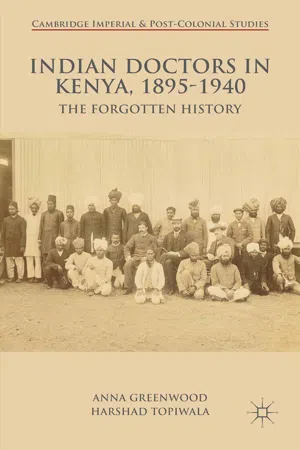
This ground-breaking book offers unique insights into the careers of Indian doctors in colonial Kenya during the height of British colonialism, between 1895 and 1940. The story of these important Indian professionals presents a rare social history of an important political minority.
Information
Topic
HistoriaSubtopic
Historia africana1
‘The Empire is not white’: Indian Doctors in Kenya
The Empire is not white or English-speaking or Anglo-Saxon or British or Christian. It embraces many complexions, many languages, many races, many continents, many religions.1
Indian doctors working in Kenya (formerly East Africa Protectorate) under British rule have been almost entirely written out of the history books. This research gap seems to have passed unremarked by historians of the region, despite various books focussing on the Colonial Medical Service, missionary doctors or the history of Africans entering western medical education.2 Yet to miss Indian doctors distorts our understanding of the medical history of colonial East Africa—not only in terms of describing the way it imported ideas, medicines, and personnel from the subcontinent—but also by failing to describe a large, diverse and vibrant cross section of the medical community.
Indians should be placed at the very heart of the history of medicine in colonial East Africa with increasing numbers of Indian doctors entering Kenyan ports from the 1890s. Indeed, it would be no exaggeration to claim that Indians were pivotal in the establishment of western medicine in Kenya. They played a large role in the medical care of indentured railway workers in the construction of the Uganda Railway (1896–1901), and cared for troops in the early East African military campaigns of British conquest. During their highpoint at the end of World War One, it is a little known fact that there were actually almost twice as many Indian doctors working for the Colonial Medical Service as Europeans. In fact, if the historian goes back to the colonial medical department files—although Indian names by no means dominated—their presence was nevertheless obvious and consistent until the 1920s, after which time Indian doctors are mostly to be found within the historical records as private practitioners. Collectively, whether working for the railways, the military, the Colonial Service, or as private doctors, Indians provided medical care for hundreds of thousands of Kenyan inhabitants and became the forefathers of medical dynasties— the descendants of which still sometimes work in East Africa today.
Why an entire ethnic group within the colonial medical history of a British colonial dependency has escaped academic scrutiny is open to debate. The explanation lies at least partially in the inherent limitations in researching the history of any cohort who has left few written sources. To be sure, the majority of Indian migrants to East Africa were poorly educated and were preoccupied with earning a livelihood, often in extremely strained conditions. But even Indian traders who regularly produced and maintained accurate business accounts, left few written records in their own vernaculars.3 Perhaps for the particular professional group of doctors, the persuasive explanation for the lack of published contemporary Indian perspectives is that more educated members of the community, which would have included doctors, consciously avoided publication, fearing political victimisation if they were seen to be too critical.4 Indians—especially educated and articulate Indians—tended to be silenced by the British authorities, particularly if they were thought to possess views dangerous to the political status quo. Although the recipients of British colonial violence were mainly Africans, Indians would have been well aware that they were not exempted from the punitive consequences of critically confronting their European masters.5
Whatever the reasons behind the silence of this literate professional group, the overarching aim of the book is to restore the voices of this forgotten cohort of practitioners to their rightful place within history. Indians were more than just useful cogs in the medical administration of empire. In fact, to all intents and purposes, Indian doctors seemed often well liked and appreciated by their European colleagues, at least before the watershed of the Devonshire Declaration of 1923. The publication of this White Paper occurred after extended and high profile debates and endorsed support for white settlers (under the guise of protecting African interests). It was to be the decisive nail in the coffin for Indians in Kenya for the rest of the colonial period, formally curtailing their ambitions for political power and representation.
This sea change in attitudes had the unintentional repercussion of marginalising Indians in historical retellings. After 1923 Indians were rarely mentioned in official medical departmental business and Indian names were omitted in many staff lists. As the book will show, this partly reflected the reality of the situation. After the Devonshire Declaration majority Indian doctors were retrenched from the Colonial Medical Service, but even those that remained employed in this capacity were rarely mentioned in official returns to the Colonial Office. Precisely because they became erased from official records Indian doctors were almost entirely forgotten. The history of Asian professionals in Kenya should be therefore recognised as having fallen between the two stools of the old white triumphalist accounts and the newer focus upon the history of black participation in empire.6 When the history of medicine in colonial Africa was revisited, it was the history of the Black African doctors that was assumed to be the only crucial missing part of the story.7 Yet, by reinserting Indian doctors into the social mix of early twentieth century Kenya, a more intriguing, literally more colourful, history of this colonial society emerges. Furthermore, once scrutinised, the relationships that existed between British colonial authorities, Indian doctors and the indigenous population of Kenya are seen to be a complicated array of social and political allegiances with few cohesive agenda, defying any neat generalisations or categorisations of beliefs or loyalties based on skin colour alone. While, for sure, most Europeans accepted racist ideologies prevalent at the time, some can readily be identified as having been remarkably sensitive to both Indian and African rights. Africans in turn can be shown to have both worked in harmony with Indians to their mutual benefit and also, on different occasions, to have been evidently enraged by the lack of solidarity that they felt Indians displayed towards them. To add to the complexity Indians were as likely as Europeans to display racist attitudes towards Africans and individuals within all groups can be shown to have held racial-ideological allegiances that were self-contradictory. Within the Indian communities especially (though Europeans and Africans were not exempt) issues of caste and religious loyalties additionally fractured them into different, often rival, sub-groups, meaning that—although useful as a vague blanket categorisation—it is also crude and inadequate to envisage Kenyan Indians as part of a single, unified, community. Indians were themselves divided as a group and were by no means as homogeneous in their stance towards the British government (or even towards members of their own community). Some Indians were fully collaborative with British government concerns, while others were actively involved in pursuing freedom from the shackles of colonialism. Race, when analysed in this context, then quickly reveals itself as simultaneously both a fragile and a durable concept. Durable because crude, colour based, categorisations of peoples and their dominant behaviours were assumed all the time; fragile because political allegiances, personal loyalties and attitudes, once scratched beyond their surface, cannot always be mapped along ethnic lines with any assurance.
Some of these conflicts and contradictions can be understood as a corollary of the position of Indians in Kenya as members of a group of equivocal status—the middle rank.8 While often of humble origins, only able to study medicine through the receipt of scholarships—and therefore not ‘middle class’ in the sense of their class origins—they nevertheless formed a middle tier within society: floating in an indistinct middle land between the white ruling elite and the black African ‘subalterns’.9 Although never credited with the so-called civilised status of Europeans, the Indian doctors of Kenya were nevertheless educated, literate, and relatively prosperous. They enjoyed a reasonably high status in their community and, in most cases, embraced Europeanised tastes and standards of living. Mostly, they worked for the colonial state rather than against it, although it is fair to say that even when publically esteemed most Europeans ultimately regarded them as being indecipherable. As John Lonsdale pithily summarised: Indians were the ‘unknowable, in-between’. They were at times respected while also at times they were regarded with suspicion. Kenya was a colonial world where all resident communities were struggling for a political and social identity and mutual distrust was a fundamental part of the game.10 In this context, the Indians who worked for the colonial medical department undertook a variety of official responsibilities that straddled the gap between the lower tiers of junior personnel and the Colonial Medical Officers. The experiences of these middle men (for they were nearly all men), become all the more historically vital, if one thinks of them, as Nancy Rose Hunt has emphasised in her own study of middle ranking hospital aides in Congo, as ‘central to processes of translation in a colonial and therapeutic economy’.11
The story of Indian doctors therefore offers pertinent insights into the processes that have sometimes swept important components of history under the carpet. It also deepens and broadens modern understandings of the complex constitution of the British Empire. This was an empire that, although ideologically racist, nevertheless relied upon staff of all nationalities and ethnicities. Policies, people and ideas of best practice were imported between regions of empire at least as much as they were dictated from the epicentre of Whitehall.12 By exploring imperial medical migration as more than just a white phenomenon the study aims to extend diaspora studies that have formerly concentrated upon convicts and labourers, rather than on the movements of professionals. In so doing, this research calls into question ideas of western medicine as a ‘tool’ of empire emanating principally from the metropolis to the colony.13 Instead it draws attention to the multiple ways western medicine and its personnel were imported ‘sideways’ between colonies and will show how the practice of medicine was enacted in ways both collaborative with, and antagonistic to, the colonial government. In this conception of a highly interlinked empire, governors, policy makers, and personnel recruiters were as likely to look towards Bombay as to London for their inspiration.14
But this is not to deny the importance of local conditions. While also advancing modern understandings of British Empire as a linked, multi-centred global phenomenon, this research also provides a case study that enriches our local understandings of the practice of medicine in a racially segregated context. Colonial Kenya, ‘Britain’s most troublesome African colony’, should be noted as different from its colonial neighbours.15 It was home to one of the most hard-line racist settler societies of the period—led by Lord Delamere and Ewart Grogan, the settlers of the so-called White Highlands were fierce in their articulation of white supremacy. This provided a local political climate fundamentally antithetical to any enthusiastic accommodation of Indian interests. The loud political voices of the settlers dominated many of the Kenya-related parliamentary debates of the time and have, in turn, influenced the way East African colonial histories have been framed. Barely consciously, subsequent historical descriptions have themselves fallen into the simplistic delineations of white versus non-white that formed the basis of much of the colonial discourse. Yet, as the book that follows will show, any ‘them and us’ categorisation was rhetorical only and did not begin to describe the intricate social dynamics of either the formal medical administration nor the quotidian community life of this colonial dependency.
Furthermore, by looking at the organisation of medical practice in Kenya, the historical evolution of professional Indian diaspora identity (despite being multiply fractured between kin, family, caste, religion, and political affiliation) is revealed. Even though Indians were not successful in achieving their aims for land rights and enfranchisement in Kenya, they ultimately became the forefathers of a relatively successful community. Over time the ethnic identity of Kenyan Indians began, against the odds, to gain common elements, despite the fact that there was little systemic coherency in the way that different interest groups variously and flexibly deployed their versions of an unpolished generalised identity.16
Perhaps most powerfully of all, the reinsertion of the history of Indian middle-men into the story of medicine in Kenya, reminds us of the asymmetries of power. Colonial dominance embodied many forms and was often contradictorily conceived and unequally applied. The British did not speak in one voice, and the way ideologies of racism were deployed were not uniform towards all non-white groups. Indians collaborated as well as resisted, racism was not just the preserve of the British, and local allegiances and colonial policies were all malleably deployed to suit the expediencies of any given situation. In short, this study of the practice of medicine shows not only the colour and diversity of a colonial society, but also reveals (much in the way that John Darwin has shown) that the operation of colonial power should be seen more in terms of the flexible and pragmatic negotiation of deep socio-political asymmetries and networks rather than as the straightforward deployment of dogmatic vertical directives.17 Local conditions as much as international networks coloured the practice of medicine in the colony—on one hand the Indian subcontinent loomed large as the administrative model for colonial medical administration, on the other hand conditions were formed responsively to home-grown circumstances, particularly under the influence of individuals, such as the Principal Medical Officer (PMO) for much of this period, John Langton Gilks (1880–1971, PMO, Kenya, 1920–33), or the white settler leader, Lord Delamere.
If one were to straightforwardly describe a chronology of the history of Indian doctors in Kenya one would start with the early pioneers who arrived either to attend to the health of the ‘coolie’ labourers on the Uganda Railway or to provide medical care to the sepoy soldiers who defended East African borders during the establishment of colonial rule. From the 1900s, however, the majority of immigrant doctors came to work for the colonial medical department, although a slow but steady trickle of private doctors also arrived from that time. Especially in their governmental positions, Indians were integral to the establishment of the British administration in the East African region and enjoyed a certain degree of assimilation within colonial departments. Distrust between Europeans and Indians simmered under the surface for almost two decades, but Indians decisively faced a formal barrier to their political ambitions in 1923. The Devonshire Declaration of the same year made a firm statement of policy that halted Indian hopes for equal social recognition and signalled the beginning of a new, much more exclusionist phase in attitudes towards Indians in Kenyan society.
After that point, although it was never officially declared, there was no more active recruitment of Indians to the Colonial Medical Service. In this new context, many of the Indian doctors returned to find jobs in India or initiated a sideways move into private practice. Although this was a turning point, the dramatic cutback to Indian medical recruitment did ...
Table of contents
- Cover
- Title
- Copyright
- Contents
- List of Figures and Tables
- Preface and Acknowledgements
- 1 ‘The Empire is not white’: Indian Doctors in Kenya
- 2 Indians, Migration, and Medicine
- 3 Indians, Western Medicine, and the Establishment of the Protectorate
- 4 Race and Medicine
- 5 Indians in the Colonial Medical Service
- 6 Squeezing Indians Out of Government Medicine
- 7 Indian Private Doctors in Kenya
- 8 Private Doctors: Practising Medicine in a Segregated World
- 9 Conclusion
- Appendix 1: Indians in the Railway Medical Department
- Appendix 2: Indians in the Colonial Medical Service
- Appendix 3: Indian Private Practitioners
- Appendix 4: Statistics Concerning Indian Workers, Uganda Railways
- Notes
- Bibliography
- Index
Trusted by 375,005 students
Access to over 1.5 million titles for a fair monthly price.
Study more efficiently using our study tools.
Frequently asked questions
Yes, you can cancel anytime from the Subscription tab in your account settings on the Perlego website. Your subscription will stay active until the end of your current billing period. Learn how to cancel your subscription
No, books cannot be downloaded as external files, such as PDFs, for use outside of Perlego. However, you can download books within the Perlego app for offline reading on mobile or tablet. Learn how to download books offline
Perlego offers two plans: Essential and Complete
- Essential is ideal for learners and professionals who enjoy exploring a wide range of subjects. Access the Essential Library with 800,000+ trusted titles and best-sellers across business, personal growth, and the humanities. Includes unlimited reading time and Standard Read Aloud voice.
- Complete: Perfect for advanced learners and researchers needing full, unrestricted access. Unlock 1.5M+ books across hundreds of subjects, including academic and specialized titles. The Complete Plan also includes advanced features like Premium Read Aloud and Research Assistant.
We are an online textbook subscription service, where you can get access to an entire online library for less than the price of a single book per month. With over 1.5 million books across 990+ topics, we’ve got you covered! Learn about our mission
Look out for the read-aloud symbol on your next book to see if you can listen to it. The read-aloud tool reads text aloud for you, highlighting the text as it is being read. You can pause it, speed it up and slow it down. Learn more about Read Aloud
Yes! You can use the Perlego app on both iOS and Android devices to read anytime, anywhere — even offline. Perfect for commutes or when you’re on the go.
Please note we cannot support devices running on iOS 13 and Android 7 or earlier. Learn more about using the app
Please note we cannot support devices running on iOS 13 and Android 7 or earlier. Learn more about using the app
Yes, you can access Indian Doctors in Kenya, 1895-1940 by A. Greenwood,H. Topiwala in PDF and/or ePUB format, as well as other popular books in Historia & Historia africana. We have over 1.5 million books available in our catalogue for you to explore.