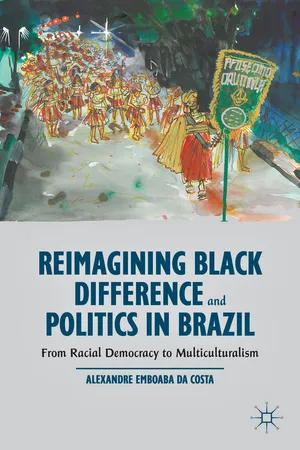
Reimagining Black Difference and Politics in Brazil examines Black Brazilian political struggle and the predicaments it faces in a time characterized by the increasing institutionalization of ethno-racial policies and black participation in policy orchestration. Greater public debate and policy attention to racial inequality suggests the attenuation of racial democracy and positive miscegenation as hegemonic ideologies of the Brazilian nation-state. However, the colorblind and post-racial logics of mixture and racial democracy, especially the denial and/or minimization of racism as a problem, maintain a strong grip on public thinking, social action, and institutional practices. Through a focus on the epistemic dimensions of black struggles and the anti-racist pluri-cultural efforts that have been put into action by activists, scholars, and organizations over the past decade, Alexandre Emboaba Da Costa analyzes the ways in which these politics negotiate as well as seek to go beyond thedelimited understandings of racial difference, belonging, and citizenship that shape the contemporary politics of inclusion.
eBook - ePub
Reimagining Black Difference and Politics in Brazil
From Racial Democracy to Multiculturalism
- English
- ePUB (mobile friendly)
- Available on iOS & Android
eBook - ePub
Reimagining Black Difference and Politics in Brazil
From Racial Democracy to Multiculturalism
About this book
Information
CHAPTER 1
Post-racial Ideology, Emergent Multiculturalisms, and the Contemporary Conjuncture of Racial Politics in Brazil
The current conjuncture of the politics of race in Brazil presents an uneven, contested shift from a paradigm of mixture and racial democracy to one involving the recognition of difference, multiculturalism, and ethno-racial policy. While the majority of Brazilians acknowledge that racism is a societal issue and agree that policies are necessary to address it, a post-racial ideology that negates the structural significance of race remains strong in corridors of power and policy implementation. The ongoing power of mixture and racial democracy as post-racial ideologies lie in their continued centrality to modes of thought and action that privilege the promise of getting beyond race to the detriment of addressing hierarchies, practices, and structural inequalities shaped through racial difference. Race and racism continue to be difficult topics in a society that long considered itself relatively free of such divisions and the privileges and disadvantages they bring to those who are lighter and darker skinned.
The recognition of difference, its incorporation into political and economic structures, and its use as a category of social policy shape the allure and potential of multiculturalism as a tool for the inclusion of hitherto marginalized populations. Black activists and scholars have long sought for the recognition of race as an issue and the construction of a positive black identity as a means to mobilize against the whitening and antiblackness inherent to the Brazilian social formation. However, as activists, scholars, and their critical perspectives become increasingly intertwined with state discourses and policies, racial and cultural difference turn into tools to address certain claims for rights while managing the more substantive intentions of black demands. This produces varying effects on structural racism and the socio-economic condition of Afro-descendants, illustrating the persistence of coloniality through the hierarchical treatment of Afro-descendants, the minimization of the issues of race and racism they face, and the delimited incorporation of their perspectives in rethinking practices of citizenship and belonging.1
Herein lies a central tension of the current conjuncture: attention to racial inequality and black participation in state institutions has significantly increased over the past decade and resulted in solid initiatives to improve the lives of Afro-descendants. Yet the implementation of a more significant epistemological and material transformation of state and society envisioned by activists and scholars remains largely restricted on key issues, from violence and gender inequality to cultural policy and land redistribution. This situation raises questions about the forms of inclusion made possible by the “multicultural turn” in Brazil. What perspectives underlie these forms of black inclusion? What types of political and policy action do they engender? What processes facilitate or hinder implementation? In what ways do initiatives approximate the critical anti-racist pluriculturalismo2 of decolonial orientation envisioned by the more transformative forms of thought and practice emerging from the black movement?
To answer these questions, I first historicize post-racial ideology in Brazil, arguing that it persists as a strategy of power in moments necessitating direct action on race and racial inequality. Specifically, the conflict between the ideal where race disappears and an existing social situation that is highly unequal along racial lines produces the hyperconsciousness/negation of race dialectic (Vargas 2004) as the most visible expression of Brazilian post-raciality. Next, I trace the general emergence and implementation of multicultural and ethno-racial policies, examining their particular characteristics in the Brazilian case. I then consider the limits of such policies that exist at the interface between state-managed ethno-racial policy and post-racial ideology. I use three recent examples to illustrate the contemporary dynamics shaping the pursuit of state policy: federal education Law 10,639/03, the Racial Equality Statute, and affirmative action in higher education. These examples demonstrate the piecemeal process that is the implementation of substantive change along anti-racist, critical pluricultural lines. They illustrate the enduring obstacles to the decolonial in practice in its efforts to decolonize citizenship, belonging, and the epistemologies guiding state institutions and public policy.
Mixture, Racial Democracy, and Post-racial Ideology
Post-racial ideology involves those forms of thought, discourse, and action that evade, delegitimize, and seek to eliminate racial differences and their effects from the focus of academic scholarship, activist struggle, public debate, and state policy. Post-racial ideologies operate through racialized forms of power while simultaneously claiming the non-significance of race. They generate fraught understandings of belonging and inclusion that elide racial difference and structural racism in ways that rearticulate rather than address racial inequalities. When deployed as a strategy of power, post-racial ideologies depoliticize race, racism, and difference in ways that demobilize anti-racist politics, cultural recognition, and material redistribution.
Re-formulations of racial mixture and racial democracy in Brazil exhibit post-racial ideology as a strategy of power.3 Today, mixture and racial democracy—the idea that race relations are relatively harmonious and race plays a minor role in shaping life chances—no longer stand as hegemonic ideologies that mask the existence of racism and racial inequality. Nonetheless, they continue to drive notions of racial progress and racial transcendence foundational to post-racial ideologies. Positive readings of mixture idealize it as a unifying, inherently anti-racist process that blurs racial boundaries and equally assimilates black, brown, and white peoples into a hybrid national character that defines collective belonging (cf. Fry 2007). In relation to racial democracy, while most no longer believe it exists as a present reality, it persists as an as ideal aspiration and future promise that captures the ongoing desire for an egalitarian, harmonious society that shuns racial divisions (Bailey 2009, Da Costa no date, 2013, Joseph 2013).
In Brazil, post-racial ideology emerged through a combination of ideas.4 First, the idea that forms of state-sanctioned racism and discrimination did not exist in the country after the abolition of slavery in 1888 supported a perception of Brazilian “racial innocence” (Hernandez 2012). This perception ignored the active role of state in creating an “extensive legislative network of racial restrictions to regulate race” (Ibid. 2012, 48), including the racialization of immigration policy, whiteness as a requirement for employment within a variety of spheres in the labor market, enforced racial segregation of public space, and implicitly racialized education and health initiatives. Racial innocence, coupled with the valuing of racial mixture (discussed below), produced a sentiment of “racial exceptionalism,” which holds that “relative to other multiracial polities Brazil is indeed a more racially and culturally accommodating society” (Hanchard 1994, 43). Innocence and exceptionalism positioned the belligerent racial violence and Jim Crow segregation of the United States as archetypal racist action and behavior, creating the impression that racism in Brazil was of a more benign nature or anomalous in practice.
The second, and perhaps more influential, element in the emergence of post-racial ideology was the reimagining of racial and cultural mixture as a positive attribute that diminished racial boundaries, increased inter-racial harmony, and helped forge national unity. Emerging in the 1930s, positive ideas about mixture challenged reigning biological and eugenicist racisms that saw darker races as a hindrance to development and modernization. An “anti-racialist” ideal rejecting the existence of “races” was absorbed into the Brazilian way of being. This turned race into a foreign invention, a concept that itself came to signify racism, and, in turn, something that did not exist for the Brazilian people (Guimarães 2001). However, the anti-racialist ideal “quickly fused with the policy of denying racism as a social practice,” creating a notion that “in Brazil there exists only ‘prejudice,’ meaning mistaken individual perceptions, which tend to be corrected in the course of continuing social relations” (2001, 158). These ideas about harmony and conviviality made racial democracy a condition of national identity and belonging.5
Despite an aggressive anti-racialism, mixture did not eliminate white supremacy and actually worked to facilitate and justify a system of pervasive racial and color stratification where whitening and antiblackness remained strong. At the same time, the mestiço (mixed-race) subject was essentialized as the ideal subject. This shaped a commonsense discourse among Brazilians that “we are all mixed,” while also restricting the expression of non-mestiço forms of racial identity and subjectivity (Caldwell 2007, 41–43, see also Dulitzky 2005). Continual emphasis on the positive and convivial aspects of mixture turned a deeply racialized “pigmentocracy” involving intersections of race with status, class, education, gender, and family origin into a national anti-racist ideology that obscured “the existence of an extremely efficient system of racial domination” (Nascimento 2007, 19, see also Gilliam 2003, Guimarães 1995).
Denise Ferreira da Silva summarizes the consequence of mixture for the dynamics of racial difference in society, stating that
. . . the centrality of miscegenation in the national discourse . . . has precluded racial difference from becoming a prevailing basis for the constitution of culturally distinct groups, but it has sustained a discourse and practices that constitute racial difference as a social category. That is, in the Brazilian social configuration—its juridical, economic, and symbolic levels—individuals’ positions are determined by the degree of blackness in their bodies, and this is expressed by the observable socio-economic disparities that mark black Brazilians’ subaltern social trajectories.
(Silva 2010, 18, emphasis mine)
In other words, dominant understandings of mixture have hitherto rested on assumptions of post-racial transcendence within a system deeply immersed in racial difference as a social category that structures socio-economic inequality, status, and discrimination. Black activists and scholars have long called the result of this trajectory of mixture and racial democracy a system of racismo velado (veiled racism)—the subtle, implicit, and disavowed racism with pernicious effects that are as deep, if not deeper for their inconspicuousness, as those of more explicit systems of racial domination.
Recent ethnographic and public opinion research suggest that an “un-veiling” of the system is underway. More and more people see society as both mixed and racist (Joseph 2013), identify simultaneously with mixture and more specific or politicized racial identities like negro (black) (Silva and Reis 2012), and agree with policies that address racism and discrimination (Bailey 2009, Hernández 2012). Yet a hyperconsciousness/negation of race (Vargas 2004) still emerges when people directly witness racist acts or are pushed to engage directly with the implementation of ethno-racial policies. At the same time, mixture and the ideal of racial democracy shape forms of hope and aspiration underlying notions of progress and transcendence when it comes to race.
Racial progress and transcendence (Cho 2009) traffic in notions of racial innocence, racial exceptionalism, and the belief in convivial race relations resulting from mixture discussed above on the one hand.6 On the other hand, racial progress and transcendence involves the characterization of existing racism and inequality as a paradox and temporary state: Why has mixture not yet led to equality? Why have we not yet been able to achieve the racial democracy ideal? Here, the possibility of transcendence turns existing racism and inequality into aberrations or temporary expressions resulting from the fact that mixture has not had the chance to play itself out and reach its “ultimate liberatory consequences” (Vianna 2004, 4, Fry 2007). This allows the existence of racism and racial inequality to be mischaracterized as paradox, rather than the product of the ways racial differences structure the dynamics of mixture. The notion of paradox—racism should not exist in a mixed society—perpetuates deterrence of the identification of racism as a structural aspect of society.
The power of the post-racial emerges in the promise embedded in mixture to move society beyond race and toward the ideal of racial democracy. What makes progress and transcendence powerful as aspects of post-racial ideology is that they need not outright deny that racism exists. They simply minimize racism as a problem, treating experiences and incidents as of secondary importance to preserving exceptionalism and the broader, unifying desire among citizens to move beyond race. While ideologies of colorblindness and racial democracy make largely normative claims for a retreat from race that are aspirational in nature (Cho 2009, Fry 1995/1996), post-racial ideology draws heavily upon an event or moment as marking the transcendence of race.
Aggressive investments in the post-racial promise of transcendence maintains feelings of hope that are differentially experienced depending on where one sits in the racial hierarchy (Da Costa no date). For Afro-descendants, the promise of transcendence imposes a form of waiting, a “racial time” where the benefits of equality and equal citizenship will supposedly eventually arrive (Hanchard 1999). All the while, they must suffer the deleterious effects of racism and antiblackness on their psychological and physical well-being, sometimes in ways that destabilize the very possibility of inclusion signified by the promise of transcendence (Vargas 2012). In other words, rather than paradox, time-lag (not yet been able to) and promise (it will eventually) figure centrally in the strategy of power that operates through idealized versions of mixture.
The anxious consciousness regarding the dual failure of mixture— the persistence of racialized hierarchies, racism, and inequality as well as the inability to achieve the ideal of racial democracy—expresses the hyperconsciousness/negation of race dialectic (Vargas 2004). This dialectic shapes how Brazilians “think about/repress, interrogate/passively accept, and justify/ignore social hierarchies,” especially those based on race (Ibid., 444). Shape by the post-racial promise of racial democracy, the dialectic “silences awareness of racial classifications and ensuing practices and representations,” and as a consequence “obscures the role race plays in determining one’s position in the historical structures of power and resources” (Ibid., 446). At the same time, the dialectic undermines individual and societal claims to race-blindness “inasmuch as it reveals how Brazilians are [actually] acutely aware of racial differences and utilize those to (often tacitly) justify, think about, and enforce behavior and social inequalities” (Ibid., 446). Overall, the dialectic involves the anxious awareness of race/color and its hierarchical meanings with the simultaneous vehement negation of the significance of race.
Hyperconsciousness/negation expresses the effects of a putatively non-racial system that has in fact historically been, and continues to be, deeply concerned with the meaning of race and its connection to status, individual and national identity, and societal development. Even though the majority of Brazilians today believe that racism and discrimination are societal issues in the abstract (e.g., as on opinion surveys) (Bailey 2009), in practice, when encountering in person actual situations loaded with racialized meaning, the hyperconsciousness/negation often emerges to minimize or deny the significance of race.7 The emergence of the hyperconsciousness/negation when people encounter racist situations in their own lives suggests that examination of these instances would enrich our knowledge of what people do in relation to race—their practices—thus providing us with a more nuanced understanding of how post-racial ideology as a strategy of power works on the ground to inhibit addressing racism and inequality (see Chapter 6, for example).
As Tanya Katerí Hernandez notes, “Latin American post-racialism [in which Brazil participates] has not led to a transcendence of race but instead to a reinforcement of a racial caste system in a region long touted as a racial democracy” (Hernández 2012, 180). Whitening, antiblackness, and the inequalities they produce persist. Whiteness remains linked to status, intelligence, refinement, beauty, development, and access to resources and representation, while antiblackness links blackness to inferiority, low status, criminality, and hypersexualization in ways that allow gendered, racist representations, dehumanization, and state violence to rule the lives of the majority of Afro-descendants (Smith 2013; Vargas 2012, 2008). The naturalization and institutionalization of these racial hierarchies maintains a white supremacy that treats black Brazilians and their experiences of racism as less significant, if acknowledged at all, within the spheres of knowledge production, the media, and political-economic decision-making. Post-racial ideology in Brazil discursively minimizes the problem of racism while disciplining unruly forms of difference that trouble the status quo and pose alternative possibilities for organizing citizenship and development. All the while, post-racial ideology proclaims a promise of transcendence that continues to delimit the content and implementation of critical anti-racist pluricultural politics.
The Multicultural Turn in Latin America
Over the last two decades, Latin American governments have implemented a range of multicultural and ethno-racial policies focused on cultural recognition and addressing racism, discrimination, and inequality faced by Afro-descendant and indigenous peoples. Social movements, state responses to their claims, and a broader regional turn to multicultural governance have all shaped the Latin American “multicultural turn.” The diverse set of collective rights enacted in varying degrees in different countries through “multicultural citizenship regimes” includes the following: formal recognition of the multicultural nature of national societies and the “existence of specific ethnic/racial sub-groups, recognition of indigenous customary law as official public law, collective property rights (especially to land), guarantees of bilingual education, territorial autonomy or self-government, and rights to redress racial discrimination (such as affirmative action in education and employment)” (Hooker 2008, 279–280). The extent varies in relation to the ways newly granted rights shift the terms of capitalist development, address root causes of ethno-racial inequalities, transform state governance, and increase political participation, autonomy, and self-determination for black and indigenous peoples.
Liberal and neoliberal multiculturalisms have tended to circumvent engagements with structural questions surrounding racial difference. Liberal multiculturalisms strive to tolerate, celebrate, and incorporate diversity and difference as positive societal attributes. However, in valuing cultural difference, liberal multiculturalism tends to re-center whiteness as the norm, reproduce essentialist clichés about difference, decentralize questions of racism, and leave unquestioned the failure of liberal democracy to guarantee equality (Warren and Sue 2011, see also Bannerji 2000). More recently, neoliberal multiculturalism mobilizes difference as a resource and means to integrate hitherto excluded peoples, cultural practices, and worldviews into state management and capitalist development (Hale 2002, 2005, Speed and Sierra 2005, Walsh 2002, 2009b). States, corporations, and multilateral development institutions construct inclusion through discourses of human rights, ethno-racial and cultural diversity, and “development-with-identity” that do not fundamentally challenge the political-economic organization of society and the intersection of material, racial, gender, and other inequalities. Afro-descendant and indigenous populations become new multicultural development subjects. Recognizing difference has offered states a way to control social conflict and ensure social stability for neoliberalism (Hale 2002, Walsh 2009b, 2002) as well as legitimize democratic governance for Latin American states after years of authoritarian rule and difficulty meeting citizens’ material needs (Van Cott 2000).
In claiming to deal with ethno-racial exclusions, both liberal and neoliberal multicultural reforms depoliticize difference and demobilize more radical demands for autonomy and self-determination, socio-...
Table of contents
- Cover
- Title Page
- Copyright
- Contents
- Tables
- Acknowledgements
- Introduction: Black Cultural Politics and Decoloniality without Guarantees
- Chapter 1: Post-racial Ideology, Emergent Multiculturalisms, and the Contemporary Conjuncture of Racial Politics in Brazil
- Chapter 2: The Difference Orùnmilá Makes: Ancestralidade and the Past as Project
- Chapter 3: Afoxé Omó Orùnmilá: History, Culture, and Politics in Movement
- Chapter 4: Hip-Hop and the Contemporary Politics of Ancestralidade
- Chapter 5: The Struggle to Decolonize Knowledge and Pedagogy
- Chapter 6: Contested Inclusions: Education Reforms and the Hyperconsciousness/Negation of Race
- Chapter 7: Educator Experiences with Anti-racist Pluriculturalismo
- Conclusion: The Challenges of the Decolonial in Practice
- Notes
- Bibliography
- Index
Trusted by 375,005 students
Access to over 1.5 million titles for a fair monthly price.
Study more efficiently using our study tools.
Frequently asked questions
Yes, you can cancel anytime from the Subscription tab in your account settings on the Perlego website. Your subscription will stay active until the end of your current billing period. Learn how to cancel your subscription
No, books cannot be downloaded as external files, such as PDFs, for use outside of Perlego. However, you can download books within the Perlego app for offline reading on mobile or tablet. Learn how to download books offline
Perlego offers two plans: Essential and Complete
- Essential is ideal for learners and professionals who enjoy exploring a wide range of subjects. Access the Essential Library with 800,000+ trusted titles and best-sellers across business, personal growth, and the humanities. Includes unlimited reading time and Standard Read Aloud voice.
- Complete: Perfect for advanced learners and researchers needing full, unrestricted access. Unlock 1.5M+ books across hundreds of subjects, including academic and specialized titles. The Complete Plan also includes advanced features like Premium Read Aloud and Research Assistant.
We are an online textbook subscription service, where you can get access to an entire online library for less than the price of a single book per month. With over 1.5 million books across 990+ topics, we’ve got you covered! Learn about our mission
Look out for the read-aloud symbol on your next book to see if you can listen to it. The read-aloud tool reads text aloud for you, highlighting the text as it is being read. You can pause it, speed it up and slow it down. Learn more about Read Aloud
Yes! You can use the Perlego app on both iOS and Android devices to read anytime, anywhere — even offline. Perfect for commutes or when you’re on the go.
Please note we cannot support devices running on iOS 13 and Android 7 or earlier. Learn more about using the app
Please note we cannot support devices running on iOS 13 and Android 7 or earlier. Learn more about using the app
Yes, you can access Reimagining Black Difference and Politics in Brazil by Kenneth A. Loparo,Alexandre Emboaba Da Costa in PDF and/or ePUB format, as well as other popular books in Social Sciences & American Government. We have over 1.5 million books available in our catalogue for you to explore.