eBook - ePub
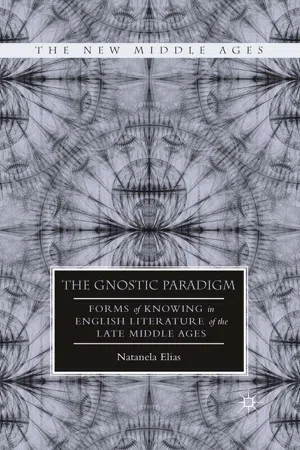
The Gnostic Paradigm
Forms of Knowing in English Literature of the Late Middle Ages
- English
- ePUB (mobile friendly)
- Available on iOS & Android
eBook - ePub
About this book
No study has been carried out examining the gnostic undercurrents in medieval England. For the first time, Natanela Elias investigates the existence of these gnostic traces, using prominent late medieval English literary works such as Piers Plowman and Confessio Amantis and ultimately shedding light on a previously overlooked religious dimension.
Information
CHAPTER 1
INTRODUCTION: GNOSTICISM AND LATE-MEDIEVAL LITERATURE
This study explores the question of whether and how elements and residues of what I call “the gnostic paradigm” appear in key English literary works of the late Middle Ages; it also tries to show the importance of such an exploration for understanding how these well-known literary expressions of Christianity are in part driven and complicated by these gnostic features. In certain ways this is an unexpected premise. Gnosticism was an ancient religion stressing the special status of the illuminated few and the basic corruption of the material world that was crushed by those early orthodox Fathers who, like its major antagonist Augustine,1 supplanted its terms with a theology in which materiality is ultimately from God and a sense of a “universal” (literally, Catholic) church in which salvation was not necessarily the measure of special illumination but unknown divine grace after death.2 By the later fourteenth century, Gnosticism and its influences seem to have dispersed almost completely, at least on the surface. Certainly the late-medieval church was vigorous in its efforts to teach orthodoxy to the laity.3 Yet a sense of simmering continuation, and outright reemergence, has figured in a number of studies of late-medieval literature.4 These studies have produced important results in how medievalists appreciate the religious outlook and the cultural interconnections of the period. What, we may ask, are these scholars responding to?
These scholars, I argue, are all responding to an underlying current in religious and literary history, in which many of the forms of thought and belief resemble, albeit in quite different circumstances and with different results and consequences, those of the ancient Gnostics. Yet to this point, no study has been carried out examining the gnostic undercurrent with specific regard to medieval England, at least not in the comprehensive sense in which I approach the topic. To be clear, “Gnosticism” (with a capital G) is a broad term that refers to a historical phenomenon, a religious, generally dualistic movement that existed approximately between the first and fourth centuries, and perceived the material world as an evil imprisoning the purity of the soul, which could be revived through the regaining of knowledge. Formally, this phenomenon was abolished by the Orthodox Church as early as the fourth century. Nevertheless, some scholars claim that certain Gnostic elements remained a part of Christianity, some in forms that are judged “orthodox” and others “heretical.”5 For these scholars, whose assumptions I build on, the “orthodox” forms may have been renamed but their origin remains steadfastly clear which would serve as a direct threat to the existing canon. In the second to the fourth centuries, during the formation of the Catholic Church, annihilating such immediate threats to its stability was paramount; since Gnosticism was one of the most influential traditions at the time, it also became one of the forming church’s central threats. In the fourteenth century, Gnosticism may have no longer existed as the historical, religious movement, but I argue that its influences and residues are clear. The residue is significant as a mode of thinking that influences writing, including Christian writing, and this is one of the main points of my research. The Gnostic residue influences Christian thought and writing despite its exile or elimination from the formal religious doctrine and ideology.
Thus, the “heterodox,” though pushed to the margins, found its way back into the center via a potent residue that makes an appearance in other forms of heresy, in prevalent orthodox traditions like mysticism, and especially in high-medieval literature. The medieval audience was able to find many answers (both personal and global) in the complex literary works, which utilized this residue in their style and content. To be clear, I am not discussing a resurgence of the actual ancient movement; rather, I am delineating a resurgence of gnostic ideas that derive from the obsolete movement and that have undergone modifications influenced by time and place. This latter resurgence shall thus be referred to as “gnosticism” (with a lower case g).
Some of the specific gnostic tenets I have chosen to focus on include the gnostic view and understanding of Gnosis (i.e., knowledge or personal, experiential insight); the process and requirements of achieving said Gnosis—a process of what I shall identify as a “Passing” into knowledge in a uniquely structured and thematized scene, from a state of ignorance to a regaining of knowledge via a required state of passivity; the notion of gnostic revelation that aims to provide a message for a select group of “good men,” an enlightened few; and the primarily dualistic nature of the world in which the physical realm serves as the root of all evil, which thus needs to be discarded, again emphasizing the collapse of the traditionally orthodox (i.e., the structure and understanding of faith, religion, its practice, and salvation) into the nonorthodox and vice versa. Moreover, I identify as a “gnostic paradigm” the process by which these features appear in the literary works. The intermingling of the concepts of the holy and the profane, the accepted and unaccepted, the natural and unnatural, the center and the margins, comes about in a series of seemingly “unnatural reversals” where the one is exchanged with the other, creating a sense of chaos, but ultimately culminating in a promise of salvation. The reversals show the instability of the previously conceived stable boundaries of dogmatic knowledge. Moreover, gnosticism’s “answer” to the search for this gnostic Truth/wisdom is not necessarily a comfortable or stable one, which is emphasized through the recurring poetic reversals and the tensions presented in the poems themselves. Ultimately, this is showcased by the failed attempts at Passing presented in the first and second chapters of this book. Nevertheless, once that knowledge is regained, the result is significant to an understanding of medieval literature and the presumed Christian influences that are nonetheless not orthodox despite their attempts to find and establish particular doxa in writing.
In this study, I analyze a representative selection of medieval English literary texts from the late fourteenth century in terms of these issues, showing how the texts adapt them through the use of a specifically chosen genre (the dream vision), the technique of subversion, and the overall function of art as “The possibility of making the invisible visible, [and] of giving presence to what can only be imagined,”6 to create what I call the “late-medieval gnostic moment.” The texts I have chosen are largely recognized for their overt and obvious religious nature and themes as well as their dream vision genre. These texts, including three poems from the Pearl manuscript (Pearl, Cleanness, and Patience), selected books from John Gower’s Confessio Amantis, and Piers Plowman, are read with an eye to their underlying gnostic structure and motifs. Namely, I will analyze attitudes toward knowledge and the possibility of (re)gaining knowledge (i.e., gnosis) in these texts by looking specifically at what I term “Scenes of gnostic Passing.”
This term deserves further introduction. The notion of “passing,” which has been appropriated by theorists of various different fields, possesses a sense of “pretending,” of “deception” where the passer partakes in that which he is not (i.e., the dominant center) and thus, subverting the dominant ideological systems and forces. Such scenes point to a recurring literary moment, a key moment that presents the possibility of achieving gnosis through a unique process. First, such scenes take place in the liminal space presented by the dream vision genre where the passivity of the candidate serves as a prerequisite for beginning the process. Friedrich Nietzsche’s existential philosophy as well as his questioning of the value and objectivity of Truth seem to raise similarly gnostic concerns where “[Man is] deeply immersed in illusions and dream images; [his] eye glid[ing] only over the surface of things and see[ing] ‘forms’” of reality, man must awaken out of his ignorance “which shrouds the eyes and senses of man in a blinding fog, [and] therefore deceives him about the value of existence.”7 Thus, the dream vision genre seems quite appropriate since dream visions form a literary combination of sleeping dreams and waking visions. In other words, the structure of the dream vision enables the necessary state of repose which ironically may lead to a reawakening in the search for Truth.
Barbara Newman claims that dreams of this kind, “like waking visions, focus less on predicting the future than on achieving self-knowledge, entering vividly into past events, or manifesting eternal truths” (8). The structure of such visionary texts can usually be outlined “in four movements: first, the narrator describes an experience that suggested his initial psychological state; second, the narrator recounts a new experience detailing a changed state of consciousness during which he encountered other characters; third, the narrator describes an exchange, in this case as a dialogue between the narrator and these other characters, through which he gained knowledge; and finally, the narrator describes the aftermath of this exchange” (62–3)8. This “new” type of knowledge and the process of achieving it bring the relationship between orthodoxy and the seemingly obsolete Gnostic heresy into sharper relief, but also complicate its perceived rigidity. The word “heresy” itself comes from the Greek hairetikos, which translates into “able to choose.” In the process of the construction of orthodox Christianity, which may be analogous to Bourdieu’s “state formation,” as it signifies the formation of a central, canonical (here, religious) mainstream, the linguistic market becomes dominated by the official language which then becomes the legitimate language (Bourdieu 1999, 45). In the process, other discourses necessarily become marginalized and thus illegitimate, which then gives rise to a form of “writing between the lines.” Bourdieu “portrays everyday linguistic exchanges as situated encounters between agents endowed with socially structured sources and competencies, in such a way that every linguistic interaction, however personal and insignificant it may seem, bears the traces of the social structure that it both expresses and helps to reproduce” (2), which entails that while every utterance is held in tandem with the canonical rhetorics, it also harbors traces of other existent institutions.9
Such gnostic “utterances” would be appealing to intellectual and well-off circles, who either were educated or sought education beyond the limiting and limited knowledge portrayed as blind faith provided by the Church and its officials. For the same reason, such inquiries (much like in the past) along with the haunting similarities in doctrine became a living threat. By promoting the official language—that is, the use of the basic units of thought and discourse of the mainstream, religious canon—it would necessarily marginalize and devalue those who did not fall under the same category. The margins are then coerced into collaborating “in the destruction of their instruments of expression” (49). Yet this is when subversive writing emerges. The covert subversive strategy emerges in response to the existing dogmatic, institutional religious limitations. The pervasively Christian culture proclaimed their dominance over the people of the Middle Ages. Nevertheless, the margins of belief managed to persevere and become influential through the subversion of the center. This required stealth and (to the extent that it was conscious at all) caution, a specific language that would “fall under the radar” and embody this relationship between the orthodox and heterodox.
Literature is never created in a void, which explains the various global influences especially in the texts under discussion, but it was necessary to adapt to the central culture as the texts were created as part of a predominantly Christian society by Christian poets. That said, there is a sense that the marginal influences are making an effort to replace, or at least impinge upon, the center. As a traditionally persecuted heresy, gnostic residues could not have appeared overtly. Leo Strauss describes this phenomenon in Persecution and the Art of Writing as “writing between the lines”: “That literature [literature of persecution] is addressed not to all readers, but to trustworthy and intelligent readers only. It has all the advantages of private communication without having its greatest disadvantage—that it reaches only the writer’s acquaintances” (25). This does not make any direct comment on the poets and their personal beliefs, but this structure seems to correlate with the specific choice of genre—the dream vision, where the subversive tends to rise in, as Pierre Bourdieu puts it, “the fact that [while] literary or artistic production appears as disinterested, as a haven for gratuitous activity that is ostentatiously opposed to the mundane world of commodities and power, [it] does not mean that it is interest-free; on the contrary, it means only that it is able more easily to conceal its interests beneath the veil of aesthetic purity” (Bourdieu, 16). In other words, the orthodox Christian literature appears “disinterested” while actually possessing elements of gnostic “interest.” On a larger scale, the gnostic discourse keeps turning up in orthodox texts so that it would ideally disappear, but it ends up having the reversed effect. Steven Kruger in The Spectral Jew discusses a similar effect with regard to Jewishness in an otherwise medieval Christian world, claiming that “Jewishness is a spectral presence, strongly felt and yet just as strongly derealized” (xvii). That is, “Even at the moment of its disappearance, the specter is, if liminally, present—as that whose disappearance is necessary for the emergence of the new, Christian self” (111). It is possible to add to this spectrality of presence a form of gnostic residue.
Since the Middle Ages are commonly perceived as essentially Christian orthodox (a term that always requires both careful and capacious definitions)10, such an exploratory endeavor obviously raises questions about how these ideas made their way into seemingly orthodox texts. As I will show throughout the rest of this chapter, these tenets may have survived, on the one hand, either through the orthodox polemics against Gnosticism or, on the other, through heretically suspect writings that may have circulated around intellectual and clerical circles which then influenced the literature. Gnosticism in terms of the paradigm that I examine should not be posited against other forms of heresy but considered as an inherent part of their structure, taking into account that “heresy,” much like Gnosticism, is a fluid term. There are many types of heresy which may not be and were not considered completely unorthodox, rather simply held by the wrong people or people in politically vulnerable situations, as R. I. Moore claims in The War on Heresy. The majority of the most influential heresies from the fourth to the fifteenth century (and beyond) alluded in one way or another to the Gnostic, seemingly obsolete and “abstract” movement. Or as Moore puts it, “The use of contemporary names [‘Cathars,’ ‘Patarenes,’ and ‘Publicani’], for the first time in a formal ecumenical pronouncement here [Lateran III] and in Ad abolendam implicitly described a contemporary phenomenon, not simply a revival of ancient error” (208).11
Moreover, authors had the prerogative of falling under the radar of censorship by seeming to present the orthodox while resonating with the unorthodox. In the same manner, Marc Michael Epstein dismisses the possibility that certain imagery was merely derivative of the art of the dominant majority (Christian) and claims that when one culture adopts the images of another, it does not blindly reproduce it but rather imbues it with new meaning. In this sense, a kind of subversion is formed which serves as a coded message.12 In this manner, I am establishing a literary scheme that was so deeply immersed in the aforementioned impinging margins that our acknowledgment of it becomes necessary for a better, more comprehensive reading of these texts. Finally, this heresy does not necessarily function as an alternative to religious dogma or as an affront to Catholic doctrine, but emerges as a dynamic force of inspirational creativity, which continually tests the “stable” boundaries of dogmatic knowledge.
What Is Gnosticism?
Gnosticism is a broad concept, referring to diverse, syncretistic religious movements and thus quite difficult to define. In this very difficulty lays the interchangability of religious “orthodoxy” and “heresy” and the way in which they are defined in relation to one another and often by reference to other matters such as social, cultural and political identity. Nevertheless, the Congress o...
Table of contents
- Cover
- Title
- 1. Introduction: Gnosticism and Late-Medieval Literature
- 2. Pearl’s Patience and Purity: Gnosticism in the Pearl Poet’s Oeuvre
- 3. The Truth about Piers Plowman
- 4. Gower’s Bower of Bliss: A Successful Passing into Hermetic Gnosis
- Conclusion: Knowing the Christian Middle Ages: A Gnostic Journey into the Self
- Notes
- Bibliography
- Index
Trusted by 375,005 students
Access to over 1.5 million titles for a fair monthly price.
Study more efficiently using our study tools.
Frequently asked questions
Yes, you can cancel anytime from the Subscription tab in your account settings on the Perlego website. Your subscription will stay active until the end of your current billing period. Learn how to cancel your subscription
No, books cannot be downloaded as external files, such as PDFs, for use outside of Perlego. However, you can download books within the Perlego app for offline reading on mobile or tablet. Learn how to download books offline
Perlego offers two plans: Essential and Complete
- Essential is ideal for learners and professionals who enjoy exploring a wide range of subjects. Access the Essential Library with 800,000+ trusted titles and best-sellers across business, personal growth, and the humanities. Includes unlimited reading time and Standard Read Aloud voice.
- Complete: Perfect for advanced learners and researchers needing full, unrestricted access. Unlock 1.5M+ books across hundreds of subjects, including academic and specialized titles. The Complete Plan also includes advanced features like Premium Read Aloud and Research Assistant.
We are an online textbook subscription service, where you can get access to an entire online library for less than the price of a single book per month. With over 1.5 million books across 990+ topics, we’ve got you covered! Learn about our mission
Look out for the read-aloud symbol on your next book to see if you can listen to it. The read-aloud tool reads text aloud for you, highlighting the text as it is being read. You can pause it, speed it up and slow it down. Learn more about Read Aloud
Yes! You can use the Perlego app on both iOS and Android devices to read anytime, anywhere — even offline. Perfect for commutes or when you’re on the go.
Please note we cannot support devices running on iOS 13 and Android 7 or earlier. Learn more about using the app
Please note we cannot support devices running on iOS 13 and Android 7 or earlier. Learn more about using the app
Yes, you can access The Gnostic Paradigm by N. Elias in PDF and/or ePUB format, as well as other popular books in Literature & European Medieval History. We have over 1.5 million books available in our catalogue for you to explore.