- English
- ePUB (mobile friendly)
- Available on iOS & Android
eBook - ePub
About this book
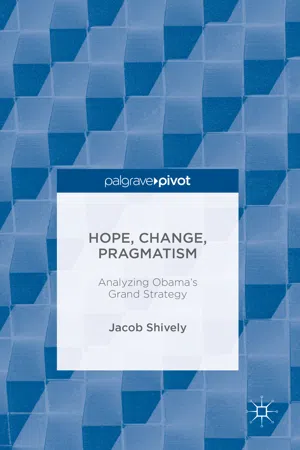
This book seeks to uncover a clear picture of Barack Obama's grand strategy, the overarching methods applied to identify and achieve national interests in a global setting. Pressed for an "Obama doctrine" during his final years in office, the President claimed a simple international relations approach: applying all tools at his disposal before resorting for military force. Critics, however, remain unimpressed. They charge the administration with strategic incoherence and weak leadership. Stepping away from ideological and theoretical commitments, Shively applies a simple framework for grand strategy, one that also deepens our systematic understanding. After untangling a complex history and narrating three cases of tumult in 2009, 2011, and 2014, Shively characterizes Obama's grand strategy as "pragmatic internationalism" and argues that it was a promising but poorly implemented approach.
Information
© The Editor(s) (if applicable) and The Author(s) 2016
Jacob ShivelyHope, Change, Pragmatism10.1057/978-1-137-57699-6_11. Introduction
Jacob Shively1
(1)
University of West Florida, Pensacola, Florida, USA
Abstract
Barack Obama was not quite the president anyone expected. This chapter sets out the debates and methods for studying his grand strategy as well as how to assess that strategy’s performance. Is there an “Obama doctrine,” and has Obama been a success or failure on this front? This review is focused on three years: 2009, 2011, and 2014. These are periods of particular salience during which grand strategy was actively challenged and deliberated. The chapter then briefly guides readers through grand strategy as a concept before describing a framework to categorize grand strategies. This framework can be applied across theories and cases. It is not married to any one theoretical approach, and it offers to help clarify or standardize grand strategy studies.
Keywords
Obama foreign policyGrand strategy definitionsObama doctrineBarack Obama was frustrated. In a combative White House interview, he was defending policies that many observers considered abject failures. This was fall 2015, and politicking for the 2016 presidential race was well underway. Obama’s foreign policy now had few defenders.
Journalist Steve Kroft of the CBS news magazine 60 Minutes prodded the president about Russia’s assertiveness under Vladimir Putin . In 2014, Russia had seized Crimea and fostered instability throughout eastern Ukraine . In a stunning development, just weeks before this interview, the Russians had also moved military assets to Syria in order to defend their old ally, President Bashar al Assad . Even more seriously, they began actively bombing what they alleged were Islamic State of Iraq and Syria (ISIS) and other terrorist installations. Most observers, however, agreed that Russia was also attacking moderate rebels, many of whom the USA supported.
“He’s challenging your leadership, Mr. President,” intoned Kroft, “He’s challenging your leadership.”
Obama, however, attempted to reframe the issue. Yes, Putin was aggressive, but like a crippled bear, he was exaggerating his power to cover his weakness. In this case, he was desperately committing precious military assets to protect his only Middle East ally. Obama continued,
This was not exactly Ronald Reagan demanding that the Communist regime in Berlin “tear down this wall,” and it certainly was not G.W. Bush ’s declaration that “the people who knocked these buildings down will hear all of us soon.”if you think that running your economy into the ground and having to send troops in in order to prop up your only ally is leadership, then we’ve got a different definition of leadership. My definition of leadership would be leading on climate change, an international accord that potentially we’ll get in Paris. My definition of leadership is mobilizing the entire world community to make sure that Iran doesn’t get a nuclear weapon. And with respect to the Middle East, we’ve got a 60-country coalition that isn’t suddenly lining up around Russia’s strategy.
Nevertheless, for Obama, this was a notion of US grand strategy that he had consistently applied since 2009. It held that US global leadership is vitally important, but such leadership must be applied within pragmatic parameters. Rather than crusading and posturing, the USA should take a clear-eyed account of US capabilities, which remained crushing relative to even other great powers, and resist the temptation to overextend those capabilities. To leverage its power, it needed to cooperate with allies and facilitate intermediaries rather than always accepting the costs of leadership. Obama’s end goal, of course, was a more humane world defined by democracy and economic justice. Before achieving that vision, though, real power should be applied, but applied judiciously. For Obama, an activist grand strategy, such as George W. Bush ’s Freedom Agenda, was equivalent to indiscriminately firing a gun into a crowd. It would do inestimable harm to both ends of the exchange. Obama’s grand strategy is frequently described as “pragmatic,” sometimes even realist. This is partially true, but it is also insufficient. Obama’s grand strategy has also coupled—sometimes awkwardly—elements of idealism with a more constrained role for US leadership.
Perhaps owing to this complexity, the administration’s approach to grand strategy has fallen under broad, persistent criticism. Political opponents always believed that Obama promised too much. In an ironic turn, their view is that the president’s push to consolidate US power and avoid overreaching US capabilities itself represented a kind of overreach. Obama’s approach assumed, in their view, too much about the president’s own ability to change facts on the ground and relied on too many presumptions that other governments would act in good faith and without active American power. “The governments of China and Russia, like most governments overseas,” wryly observes Colin Dueck (2015, 66), “are largely indifferent to Obama’s personal charms.” Even by the end of Obama’s first term, supporters worried that their man and his inner circle lacked a coherent strategy. The Obama team’s response to various 2011 Arab Spring revolutions, for example, appeared to many observers to be inconsistent at best, incoherent and dangerous at worst. By his final years in office, this concern about strategic incoherence merged with fears of weak American leadership abroad and poor foreign policy management at home, both of which, worried observers, encouraged challenges to the US-led world order.
Agenda
This book seeks to uncover a clear picture of Obama’s grand strategy. Given the controversy and emotion surrounding any current or recent presidency, the goal, here, is to step away from ideological and theoretical commitments and analyze Obama’s grand strategy as it unfolded over his two terms. Grand strategy itself, as described further below, refers to the broadest levels of foreign policy: the overarching methods that states apply to identify and achieve national interests. As a wide but concentrated lens, it draws into focus how an administration evaluates and engages the world. Clearly and (as far as it is possible) objectively identifying Obama’s grand strategy is an essential precondition for evaluating the administration’s performance as well as its relevance to scholarly and policy debates. To do this, the book introduces a simple framework that could be applied to many cases and across eras. The book also offers a preliminary evaluation of the relative success or failure of Obama’s grand strategy. To do that, it simply compares the administration’s grand strategic agenda with its actual outcomes. Did Obama’s grand strategy work based upon its own criteria?
Two unique offerings appear in this book. First, it provides a new set of narrative case studies about Obama’s grand strategy. Like any administration, Obama and his team have faced key decision periods. They have been forced to reconsider and rearticulate—if not always change—their overarching approach to US foreign policy. Thus, rather than seek to build a full history covering two presidential terms, this project’s core chapters evaluate three of these pivotal decision periods. These periods center on early precedents (2009), the Arab Spring (2011), and challenges from Russia as well as ISIS (2014). Notably, though, whereas many foreign policy case studies highlight a single-issue area, such as nonproliferation or trade, this project portrays grand strategy as a whole. Along with headlines and events dominating those years, the case studies include themes such as the “pivot” to Asia, economic and political relations with Europe, and the war in Afghanistan.
Second, the book introduces a simple, innovative framework to evaluate grand strategy. It seeks to address a weakness in grand strategy research, which is often hampered either by realism’s overly general or by liberalism’s historically contingent theorizing. Thus, the book sets forth three characteristics of any grand strategy designed to provide a simple, novel rubric to evaluate Obama’s—or any other—foreign policy. Drawing on existing research, I call these characteristics scope, substance, and orientation, and they represent a tool that can be applied across cases and theoretical approaches. Remarkably, that type of comparative project has remained underdeveloped for strategic and security studies.
Certainly, much work already addresses US foreign policy and the Obama administration; however, this project uniquely focuses on Obama’s grand strategy, which has received significant editorial but far less academic treatment. Though tightly focused, the topic extends across fields such as security studies, presidential history, foreign policy, and conflict. Just as importantly, the frameworks used to evaluate Obama’s grand strategy are designed for clarity and, ideally, unbiased application. They offer new, flexible tools for researchers, analysts, and students to apply across periods and cases. The case studies themselves provide early, readable accounts of Obama’s historical presidency and its grand strategy.
Debating Obama’s Grand Strategy
At stake throughout these pages is one basic question. How can we categorize or define Obama’s grand strategy? And, secondarily, what influenced that strategy, and did it work? This book focuses on three particularly important years for Obama’s grand strategy (for reasons explained below). Overall, the debate tends to fracture along several fault lines. Fundamentally, even sympathetic observers lack a single, shared “doctrine” to apply to Obama’s grand strategy, though consensus centers on certain characteristics, such as avoiding military entanglements, privileging regional partners to help support US leadership, and a deliberative decision-making process. Some detractors relentlessly critiqued Obama for being a weak leader and espousing an incoherent grand strategy. Others worried that while Obama’s grand strategy was reasonable and potentially effective, it was poorly managed and implemented. Supporters in and outside the administration, by contrast, argue that Obama’s grand strategy proved more effective than not during these years. US foreign relations may have felt adrift or in decline during this time, but that is in fact due to an unusually challenging inheritance from the Bush administration and an unusually complicated set of unpredictable international challenges.
Obama’s Early Foreign Policy
Obama’s early grand strategy defied easy categorization. Many Obama supporters, encouraged by the campaign’s soaring rhetoric, read dramatic foreign policy change into the future president’s intentions. Though vague, and sometimes contradictory, these visions cast the new president as a transformative figure. Obama himself made clear promises to close the detention facility in Guantánamo Bay and end the Iraq War, and he broadcast intentions to “talk” with challenging regimes in places like Havana, Tehran, and Moscow. Critics bemoaned the new president’s naïve talk and insisted that it was dangerous to succor the international systems’ problem actors. They fretted that the new president was leaning on his charm and biography to shift hard realities. By the end of 2009, though, Obama supporters worried that their candidate was betraying his potential and his promises, while detractors struggled to identify a criticism that did not also betray their own, previous positions.
Still, observers and researchers converged on a central point. After filtering the president’s rhetoric, journalists broadly agreed that “pragmatism ” defined Obama’s early foreign policy. Klaidman, for example, argues that “Obama was a foreign policy realist by the time he ran for president,” and that while a left-of-center politician, “he was skeptical of rigid ideology and pat solutions to complicated problems.” Obama and his closest advisors developed this foreign policy approach as an anti-George W. Bush movement. For them, this meant preserving US leadership through diplomacy, limited resource commitments, and precisely targeted violence. 1 Certainly, Obama and his closest advisors, as Democrats, portrayed themselves as a new generation, free from the baggage of Vietnam. ...
Table of contents
- Cover
- Frontmatter
- 1. Introduction
- 2. Hope, Change, Pragmatism
- 3. Reluctant Revolutionary
- 4. Holding the Line
- 5. Pragmatic Internationalism
- Backmatter
Trusted by 375,005 students
Access to over 1.5 million titles for a fair monthly price.
Study more efficiently using our study tools.
Frequently asked questions
Yes, you can cancel anytime from the Subscription tab in your account settings on the Perlego website. Your subscription will stay active until the end of your current billing period. Learn how to cancel your subscription
No, books cannot be downloaded as external files, such as PDFs, for use outside of Perlego. However, you can download books within the Perlego app for offline reading on mobile or tablet. Learn how to download books offline
Perlego offers two plans: Essential and Complete
- Essential is ideal for learners and professionals who enjoy exploring a wide range of subjects. Access the Essential Library with 800,000+ trusted titles and best-sellers across business, personal growth, and the humanities. Includes unlimited reading time and Standard Read Aloud voice.
- Complete: Perfect for advanced learners and researchers needing full, unrestricted access. Unlock 1.5M+ books across hundreds of subjects, including academic and specialized titles. The Complete Plan also includes advanced features like Premium Read Aloud and Research Assistant.
We are an online textbook subscription service, where you can get access to an entire online library for less than the price of a single book per month. With over 1.5 million books across 990+ topics, we’ve got you covered! Learn about our mission
Look out for the read-aloud symbol on your next book to see if you can listen to it. The read-aloud tool reads text aloud for you, highlighting the text as it is being read. You can pause it, speed it up and slow it down. Learn more about Read Aloud
Yes! You can use the Perlego app on both iOS and Android devices to read anytime, anywhere — even offline. Perfect for commutes or when you’re on the go.
Please note we cannot support devices running on iOS 13 and Android 7 or earlier. Learn more about using the app
Please note we cannot support devices running on iOS 13 and Android 7 or earlier. Learn more about using the app
Yes, you can access Hope, Change, Pragmatism by Jacob Shively in PDF and/or ePUB format, as well as other popular books in Politique et relations internationales & Gouvernement américain. We have over 1.5 million books available in our catalogue for you to explore.