The study of death has the capacity to bring together a range of policy areas. Yet death is often overlooked within policy debates in the UK and beyond, and within gerontology. Bringing together a range of scholars engaged in policy associated with death, this collection provides a holistic account of how death factors in social policy. Within this, issues covered include inheritance, palliative care, euthanasia, funeral costs, bereavement support, marginalised deaths and disposal practices. At the heart of the book, the volume recognises that the issues identified are likely to intensify and expand over the next twenty years, as death rates continue to rise.
eBook - ePub
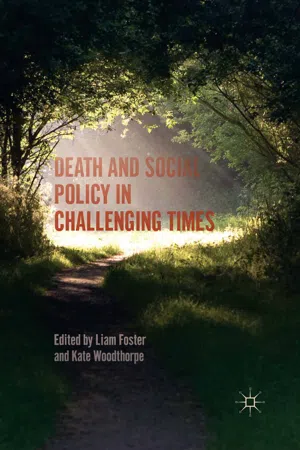
Death and Social Policy in Challenging Times
- English
- ePUB (mobile friendly)
- Available on iOS & Android
eBook - ePub
Death and Social Policy in Challenging Times
About this book
Information
1
Introduction – Why Death Matters to Policy
Liam Foster and Kate Woodthorpe
Introduction
The study of death has the capacity to bring together a considerable range of policy areas. How we handle dying, death and bereavement, as individuals, groups, organisations and even society, reflects values about our worth and contribution. It mirrors how we see ourselves and our own fragility (Kellehear, 2007). What is more, death shines a light on how we live our lives. Individuals’ experiences of death and the situation of those ‘left behind’ are the product of decisions made across a life course, not merely as one approaches death. While in some respects, given that death is a universal human experience, it may be seen as a great leveller. However, in other respects it is linked to individual characteristics and experiences. For instance, the age of death is linked to wider social policies which affect health, employment, income, participation and individuals’ overall quality of life. It is linked to social class (Howarth, 2007; Marmot, 2010), gender (Austad, 2006) and ethnicity (Holloway, 2007), all of which shape and contextualise people’s lives. History also plays a role in shaping communities and policies, which in turn impact on the resources and quality of services available to dying individuals and those close to them (Monroe et al., 2011). This is related to the prevailing political ideology and party in power, which has implications for rights and responsibilities, the extent to which support is provided by the state or the market, or indeed whether it is provided at all (Dwyer, 2010). Policy affects not only the way people near the end of life are supported but also the financial circumstances of those left behind (Grenier, 2012). As such, social policy has considerable implications for how death is experienced and our understanding of death in the modern world.
Yet death is often overlooked within policy debates in the UK and beyond, and within gerontological literature. While any conventional social policy book for undergraduates will cover a range of policy issues associated with crime, health, poverty and welfare, it is rare that the finality of life is acknowledged, let alone the ‘d-word’ mentioned. Given the expansion of death studies in academia over the last 20 years in the UK and beyond, this oversight is surprising and alarming. How can something universal be given so little attention?
Bringing together a range of scholars engaged in policy associated with death, this book seeks to add something new to these limited discussions. Appealing to policymakers, academics and students with an interest in death and social policy alike, it aims to provide and generate a more holistic account of how death factors in social policy. Within this account, diverse issues are covered, including end of life, euthanasia, funeral costs, bereavement support, marginalised deaths, disposal practices and inheritance.
The need for such a book is enhanced by the ageing of the UK population and projected increases in death rates. Underpinning the whole book is a premise that the issues identified are likely to intensify and expand over the next 20 years as the death rate rises. Indeed, the number of deaths is predicted to rise around 17 per cent in the next 20 years in England and Wales (National Audit Office, 2008), with 2010 seeing the first increase in the death rate in almost a decade in the UK (ONS, 2014a). It has continued rising ever since.
In response to this irrefutable feature of UK society, all chapters in this volume explicitly address policy implications in relation to death in the particular area they cover. They consider the current context, at a time of austerity, and briefly explore the future situation in relation to death and policy. A central tenet of this volume is that clearer policy and a more comprehensive infrastructure are required to support the potential growth in the number of people requiring support or services, either in preparation for death or in response to it. This infrastructure, we argue, should be informed by evidence regarding the most efficient means of provision so that public services that are available at the end of life or to recently bereaved people are based on solid and sustainable foundations. At the same time policy responses need to recognise the impact of inequity in access to resources and the need for the provision of services which take into account the diversity in individuals’ circumstances. These challenges are especially important at a time when:
a global recession, added to ageing populations, means that every society has to make complex, rational, yet pragmatic decisions that translate the rhetoric of progress and choice and the realities of health economics into appropriate service delivery for all groups and communities of the dying.
(Monroe et al., 2011, p. 5)
As such the provision of social policies related to death, as will be demonstrated throughout the book, often faces competing challenges of increasing financial demands (linked to increases in mortality rates) and the need to provide services that adequately meet the needs of those dying and the people left behind. These need to be delivered with attention to respect and dignity.
The very nature of death, and the fact that it eventually affects us all, means that it should be central to the policy agenda. While the life course approach to death – which recognises that death is influenced by social policies which affect people’s circumstances throughout an individual’s lifetime – needs to be acknowledged, this book focuses on policy areas explicitly related to the time of death and its immediate consequences.
In sum, the book seeks:
• to bring together numerous social policy areas associated with death and social policy never before presented in a single collection
• to consider the implications and challenges presented by an ageing UK population, where death rates are rising at a time of austerity, exploring the future situation in relation to specific policy areas
• to challenge current policy, practice and thinking about death and social policy
• to demonstrate our underpinning conviction to the principle that everyone approaching the end of their life (and those left behind) should have access to appropriate support and services
• to recognise that inequalities are embedded in social policy systems associated with death and discuss ways of limiting or eradicating them.
We hope that in achieving these aims this book will go some way to both highlight the dearth of academic work in these key areas and demonstrate the need for coherent and sustainable policy responses.
Background
The ageing of the population and death rates
One of the most important determiners of the way death is managed relates to the demographic profile. This includes who is dying, at what ages and from what causes. In 2013, of the 64.1 million UK population 11.1 million (17.4 per cent) were aged 65 years and over, an increase of 290,800 from the year before. Since 2003 this age group has grown by 17.3 per cent overall. At age 65, women can expect to live another 20.8 years and men 18.3 years on average (ONS, 2014b). Those people aged in their 70s and 80s have seen the most improvements in mortality over the course of their lifetime:
People born between 1926 and 1935, now aged in their late 70s and 80s, and in particular those born around 1930 are often referred to as the Golden Cohort. The group have experienced improvements in mortality throughout most of their lifetimes that no cohorts previously or since have experienced.
(ONS, 2014b, p. 9)
In 2012, there were estimated to be over half a million people aged 90 years or over (0.8 per cent of the population), a rise of 73 per cent over the last decade (ONS, 2014c). There were 13,350 people aged 100 years or older in the same year. Data further suggests that this ageing of the population, and particularly the growth in ‘the oldest old’, shows no sign of slowing down. ONS projections indicate that of all those babies born in 2013, a third can expect to live to their 100th birthday and beyond (ONS, 2013).
One reason for the ageing of the population is the decline in the number of deaths per year as individuals benefit from enhanced diet, sanitation and medical treatment over the course of their lives. The number of deaths in the UK has fallen steadily since 2003, reaching a low in 2009 with 553,400 deaths. Since then it has started to slowly rise (ONS, 2014a). In the year ending June 2013, there were 580,300 deaths in the UK, the highest number since mid-2005 (ONS, 2014d).
One reason for this rise in the number of deaths is that there has been an increase in the number of deaths at older ages due to the increase in the size of the older population. Indeed, in the UK in 1963, deaths were highest for males aged 70 to 74 years (15 per cent of all male deaths), whereas deaths were highest for females at ages 80 to 84 and 85 and over (each with 18 per cent of all female deaths). By 2013, deaths were highest for both males and females aged 85 and over (29 per cent of all male deaths and 48 per cent of all female deaths) (ONS, 2014a). In the early decades of the twenty-first century, the main causes of death of older age groups are diseases of the circulatory system, neoplasms and diseases of the respiratory system (Holloway, 2007).
At the same time, older people are more likely to experience co-morbidities and their illness trajectories are likely to be more fluctuant or complex, but they are less likely than younger people to have access to social networks and financial resources, or indeed to die in a place of their choosing. While increasing mortality rates are largely a result of an ageing population, it is important to recognise that death may also be ‘untimely’ (see Chapter 7). ‘Premature’ mortality, in the form of deaths between the ages of 16 and 64, accounts for 16 per cent of deaths, with deaths in childhood accounting for 1 per cent (Victor, 2010). It may also be in the form of euthanasia, not necessarily in older age (see Chapter 4). As such, work on death and policy should not exclusively focus on the needs of the oldest part of the population.
Situating the UK internationally
The UK has one of the fastest growing populations in Europe (Eurostat, 2014), although globally it has one of the lowest life expectancies at birth when compared with countries that produce comparable projected data (for instance the Netherlands, Sweden, Norway, Switzerland, USA, Japan and Australia). At the same time, the Office for National Statistics (ONS) (2013) predicts that the UK will overtake many of these countries within the next 50 years, with average life expectancy for boys born in 2062 to be 87.3 years and girls 90.3 years (compared to, for example, 86.1 for boys and 90.2 for girls in Switzerland). Indeed, the ONS project that by 2062 the UK will be second only to Japan in terms of life expectancy at birth (ONS, 2013). In other words, we can expect the population to continue to grow in the UK, including those in the oldest age groups.
The UK is not alone, however, in facing a growing and ageing population. Across Europe, it is projected that the population aged over 65 will rise over the next 50 years, with three times as many people aged 80 years and over in 2060 (Eurostat, 2014). Moreover, it is predicted that from 2015 the number of deaths across Europe will outnumber the number of births (Eurostat, 2014).
Given all of these projections – rise in death rates, growth in populations, the ageing of the populations – it is not difficult to foresee considerable strain on resources with individuals, families, organisations and the state struggling to meet the challenges. At the same time, however, we must be aware of the limitations of the ‘demographic time bomb’ debates used to justify policy retrenchment in the UK and beyond (Barr and Diamond, 2008; Foster, 2010). In practice, these trends are nothing new. There have been significant increases in longevity for over a century across Europe and beyond (excluding times of war).
Nonetheless, it is predicted that the ageing of the population throughout Europe will place significant pressure not only on state welfare but also on families:
Although the health conditions of the elderly may be expected to continue to improve, the rapid increase in the oldest-old is likely to present a challenge to social security systems. In particular, support for the elderly which has so far been forthcoming from family care may well reach its limits in the coming decades as family patterns become more ‘vertical’.
(Lanzieri, 2011, p. 4)
At the same time, however, there is a danger in emphasising the notion of dependency among older people. It is therefore important to refute the dominance of the decline and loss paradigm commonly associated with the consequences of ageing and physical decrescence (Townsend, 2007).
Such increases in an ageing population have begun to result in increases in mortality in the Westernised world (according to global predictions 91 million people will die in 2050 compared with 56 million in 2009 (Gomes et al., 2011)), particularly in older age cohorts, meaning that increasing levels of services and support are required to address the needs of those dying and those left behind. In the UK, where families are relatively small compared to many European counterparts and are more geographically mobile, concerns have been raised as to the provision of support and care for the oldest old within families (Gomes et al., 2011). Understandably, dying people can become increasingly dependent on family, friends and other caregivers for practical and emotional help. As such, enabling family members to combine caring roles with their own impending loss and grief at the same time is a fundamental challenge for social policies associated with death (Reith and Payne, 2009). The social, economic and political pressures resulting from an ageing population are also connected to perceived responsibilities, fertility, occupations, resources – both financial and material, as well as cultural expectations and so on. In recognising this, we hope to capture the complexity of the issues within this edited collection, situating policy in relation to death within broader social, demographic and economic change.
Death and the policy agenda
Importantly, with the slow decline of the UK death rate until recently, alongside the growing and ageing population, over the last decade we have borne witness to a relative ‘lull’ in discussions about death and policy. One consequence of this has been a growing ‘knowledge gap’ at both an individual and societal level as to how to handle, manage and prepare for death. Policy in this area has, arguably, been largely dropped from the political agenda (if it was ever on it) (Grenier, 2012). Prime examples of this, which are examined in Chapters 5 and 6, are the state support for funeral costs and the availability of cemetery space. With the projected growth in the death rate, there is a need for an increasing focus on policy in this area and, in part, it is into this gap that we insert this edited collection.
It is o...
Table of contents
- Cover
- Half Title
- Title Page
- Copyright
- Contents
- List of Figures and Tables
- Foreword by Alan Walker
- Acknowledgements
- Notes on Contributors
- 1. Introduction – Why Death Matters to Policy
- Part I: Managing the End of Life
- Part II: When Death Occurs
- Part III: Beyond the Point of Death: The Aftermath
- Index
Trusted by 375,005 students
Access to over 1.5 million titles for a fair monthly price.
Study more efficiently using our study tools.
Frequently asked questions
Yes, you can cancel anytime from the Subscription tab in your account settings on the Perlego website. Your subscription will stay active until the end of your current billing period. Learn how to cancel your subscription
No, books cannot be downloaded as external files, such as PDFs, for use outside of Perlego. However, you can download books within the Perlego app for offline reading on mobile or tablet. Learn how to download books offline
Perlego offers two plans: Essential and Complete
- Essential is ideal for learners and professionals who enjoy exploring a wide range of subjects. Access the Essential Library with 800,000+ trusted titles and best-sellers across business, personal growth, and the humanities. Includes unlimited reading time and Standard Read Aloud voice.
- Complete: Perfect for advanced learners and researchers needing full, unrestricted access. Unlock 1.5M+ books across hundreds of subjects, including academic and specialized titles. The Complete Plan also includes advanced features like Premium Read Aloud and Research Assistant.
We are an online textbook subscription service, where you can get access to an entire online library for less than the price of a single book per month. With over 1.5 million books across 990+ topics, we’ve got you covered! Learn about our mission
Look out for the read-aloud symbol on your next book to see if you can listen to it. The read-aloud tool reads text aloud for you, highlighting the text as it is being read. You can pause it, speed it up and slow it down. Learn more about Read Aloud
Yes! You can use the Perlego app on both iOS and Android devices to read anytime, anywhere — even offline. Perfect for commutes or when you’re on the go.
Please note we cannot support devices running on iOS 13 and Android 7 or earlier. Learn more about using the app
Please note we cannot support devices running on iOS 13 and Android 7 or earlier. Learn more about using the app
Yes, you can access Death and Social Policy in Challenging Times by Kate Woodthorpe, Liam Foster, Kate Woodthorpe,Liam Foster in PDF and/or ePUB format, as well as other popular books in Politics & International Relations & Physiology. We have over 1.5 million books available in our catalogue for you to explore.