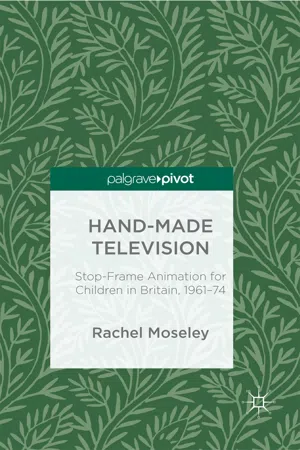
Hand-Made Television explores the ongoing enchantment of many of the much-loved stop-frame children's television programmes of 1960s and 1970s Britain. The first academic work to analyse programmes such as Pogles' Wood (1966), Clangers (1969), Bagpuss (1974) (Smallfilms) and Gordon Murray's Camberwick Green (1966), Trumpton (1967) and Chigley (1969), the book connects these series to their social and historical contexts while providing in-depth analyses of their themes and hand-made aesthetics. Hand-Made Television shows that the appeal of these programmes is rooted not only in their participatory address and evocation of a pastoral English past, but also in the connection of their stop-frame aesthetics to the actions of childhood play. This book makes a significant contribution to both Animation Studies and Television Studies; combining scholarly rigour with an accessible style, it is suitable for scholars as well as fans of these iconic British children's programmes.
- English
- ePUB (mobile friendly)
- Available on iOS & Android
eBook - ePub
About this book
Information
Subtopic
Art General1
Contexts
Abstract: There are three discursive contexts in which children’s stop-frame television should be situated. First is the critical, scholarly context within which the programmes addressed in this book can be positioned. Virtually absent from discussions of British television history generally, children’s television in particular and even from Animation Studies, this chapter repositions stop-frame television in a longer history of British practice stretching from the earliest days of cinema to the success of Aardman Animations. Second, the industrial context within which the programmes were produced is sketched via archival research which establishes an environment of collaboration and negotiation between the BBC and independent producers of animation. Finally, the counter-cultural mood of the 1960s forms a significant backdrop against which these programmes negotiated social change.
Moseley, Rachel. Hand-Made Television: Stop-Frame Animation for Children in Britain, 1961−74. Basingstoke: Palgrave Macmillan, 2016. DOI: 10.1057/9781137551634.0005.
This chapter positions children’s stop-frame television animation of the 1960s and 1970s within three key contexts: the intellectual, the industrial and the cultural. This presents an immediate challenge, given that there is little scholarship on which to draw, develop, contest or refute. Quite simply, the set of programmes addressed in this book are almost absent from any of the critical, historical literatures within which one might legitimately expect them to be situated. They do not ‘exist’ in any significant way outside of the structures and texts of popular memory, celebration and commerce set out in the Introduction. Although they are mentioned in popular histories of children’s television and the memoirs of their makers and key personnel working in the industry during the period, they do not appear in the broader works on British television history, and are rarely mentioned in scholarly accounts of children’s television. The programmes are missing, too, from work within the field of Animation Studies, and this consistent absence from scholarly literature across disciplines tells us much about their positioning in various hierarchies of cultural value. As animated television for children, characterised by a craft aesthetic which situates them outside of the discourses of ‘art’, these programmes have not been considered appropriate objects of study in any of these fields. How might we locate this body of programmes intellectually, industrially and discursively?
Critical contexts
Overarching histories of television production and programming in Britain, including those which concentrate on the individual institutions of the BBC and ITV in the period, or on the period itself, are often institutionally focused and make no mention of stop-frame children’s television in the 1960s and 1970s in their brief overviews of programming for children (Sendall 1983; Potter 1990; Briggs 1995; Thumim 2004); often, there is minimal attention to any kind of children’s television (Briggs 1985; Crisell 2002; Johnson and Turnock 2005;1 Higgins 2015). This is indicative of the lack of attention paid to children’s television in general histories of television and perhaps also of the perception of this particular form of pre-school television as simple and self-apparent in its meaning and address. The scholarship which has grown around children’s television since the 1990s is, perhaps more surprisingly, almost as inattentive to this set of programmes, focusing typically on production history, policy and ecology (Buckingham et al. 1999; Steemers 2010). In the introduction to her book, Jeanette Steemers notes the importance and influence of the early stop-frame programmes which are the subject of this book, noting that their ‘stories, which emphasised nostalgia, rural life, and industriousness in an orderly community were somewhat at variance with the social upheavals of the time’ (2010, 27), a position which I attempt to complicate throughout Hand-Made Television. Overall, however, scholarship in Television Studies has paid little attention to television animation in any of its forms, despite its ubiquity across the history of television for children in Britain, as Máire Messenger Davies has noted (2001, 225). There are two pieces of published scholarship which attend to these programmes, both focusing on the work of Smallfilms, and both attending to its relationship with other, more elevated cultural forms. Helen Bromley’s essay on the power of story (2002) is a personal and nostalgic piece in which she draws on her own memories to connect the ‘ritualistic openings and endings’ of children’s television in the 1960s and 1970s to the action of ‘opening a known and well-loved book, with the added attraction that there would be something new each time’ (209). While Bromley’s concern is to highlight the relationships between children’s literature and television, here she is in fact signalling the importance of episodicity in children’s television – its formal organisation around repetition and difference – something to which I return in more detail in Chapter 2. Bromley’s interest is in storytelling and she uses Smallfilms’ work to illustrate the power of this on television, suggesting that the programmes offered the youngest children the opportunity to ‘tune their ear’ to many different types of narrative – and hence build their confidence as future readers. They also offered children access to genres which they might not otherwise have come across. The narrative voices and language registers to be found in such programmes encompassed a vast range: different dialects, accents, tones of voice and sentence constructions appeared in dialogues, jokes, songs and poems. And, like the authors of literary texts, the creators of these programmes were of course catering for two audiences – the child and the accompanying adult – creating texts that are sophisticated and multi-layered (213).
She goes on to describe Bagpuss as ‘the original multi-modal text [in which] the combination of cartoon animation, puppetry and film offered viewers a multiplicity of points of access’ (214). Bromley’s focus, though, remains on narrative and narrativity in relation to literature and thus the programmes themselves remain somewhat invisible as animated television texts. Hayward’s 2013 essay makes a case for the originality and experimentalism of the sonic design of Clangers, offering a musicological analysis of score and soundscape in the programme to position it, usefully, as peculiarly British in its relation to what he describes as ‘the resurgence of whimsy in 1960s youth counterculture’ in its use of avant-garde sound textures, noises and sci-fi themes (64). Hayward describes Postgate’s narration of Clangers as ‘pseudo-parental’ (77) and further situates Vernon Elliott (the composer and musician who wrote the music for many of Smallfilms’ series including The Pingwings and the Pogle’s programmes) outside of the tradition of ‘dramatic and dissonant orchestral scoring for 1940s and 1950s science fiction cinema, and that developed by the BBC’s own Radiophonic Workshop for TV series such as Dr Who’ (81). Instead, Hayward positions Elliott in relation to the Western art music of Debussy and Ravel, particularly that composed for children, and through his analysis identifies Elliott’s scoring as a main source of ‘whimsy’ in the work of Smallfilms (76). Again, this close attention to the significant use of music within the programme leaves the particularity of Clangers as animated television out of sight. There is something about stop-frame animation, and perhaps animated television more generally, which places it out of reach for scholars of both television and, as we shall see, animation.
Perhaps tellingly, the writing in which the programmes are attended to as animated television is more popular than scholarly: in the maker’s memoir or commemorative volume (Postgate 2010; Trunk and Embray 2014), as part of a chronology in a producer’s history of children’s television (Home 1993), in recalling the BBC’s ‘Perfect Day’ promotional film (Buckingham 2002a, 1) and in other nostalgic, more commemorative or campy histories of children’s television addressed to an audience who share the authors’ generational and television memories and look back on the television of their childhood with fondness (Jeffries 2000; Lewis 2001; Bromley 2002; Ingliss 2003). This is not to say that such works have nothing significant to contribute; indeed, quite the opposite. The personal, occasionally flippant and yet deeply invested writing that characterises these works often reveals the enduring and powerful enchantment spun by the programmes I examine here. This enchantment is evidently of a nature (whimsical? funny? simple?) which, as has been the case with many very popular television programmes, has not been fathomable for scholars of television and animation in ways which could lead to serious engagement outside of nostalgia and camp. Consequently, this is clearly ‘invisible television’ in Brett Mills’ sense (2010). As Bettelheim notes of fairy tales, ‘the enchantment we feel, comes ... from its literary qualities - the tale itself as a work of art’ (1976, 12). This book makes these programmes critically visible by making the case for their significance in conventional aesthetic and cultural terms of relations of form and function and, in the process, aims to illuminate the nature of an enchantment which has been so evocatively expressed in nostalgic popular writing on television. Lewis’ description of the ‘lurching charm of FilmFair’s stop-motion animation’ (2001, 338) led me to investigate the precise nature of the charm of ‘lurching’ animated movement, while the discovery that Ingliss shared my sense of ‘Trumptonshire’ as ‘prosaic’ rather than magical confirmed my decision to write this book (54). Her experience of ‘several zealous women cooks in their late forties who swear that they became interested in growing herbs and cooking with them because of their early passion for The Herbs’ (2003, 32) and recollection of the seriousness with which Trumpton was sometimes taken (reflecting the importance of job demarcation lines at a time when unions were very powerful in Britain) and her reminder that The Wombles were the symbol for the ‘Keep Britain Tidy’ campaign in the 1970s reinforced my sense that the programmes were meaningful to viewers beyond my own childhood memories and that it was proper to consider them in more depth in relation to their cultural context (55, 90).
British children’s stop-frame television is similarly absent from Animation Studies, and this is clearly linked to the child/television/stop-frame nexus. Within scholarship on animation, itself less visible than live action cinema within Film Studies until relatively recently, stop-frame animation, if included at all, is limited to accounts of the technical process of animation in guides to production, or to commemorative documenting of the work of cult animators such as Ray Harryhausen (Harryhausen and Dalton 2008). Animated television is almost entirely absent, outside of attention to the cel animation of Disney and Warner’s Looney Toons, and the majority of scholarship on animation attends to films produced with an adult audience in mind. Even where stop-motion is the subject, as in the Harryhausen book, the chronology of the technique traces it through early US cinema to Aardman animation, via Czech puppet films of the 1940s, US and Japanese monster films and Gumby, revealing significant lacunae around both early British film and children’s television of the 1960s and 1970s. Apart from the small body of work on the early trick films of Charley Bowers (Solomon 2006; King 2011), the single area of literature which attends to the complexity and significance of stop-motion animation has emerged around the stop-motion work of a few Czech and Russian makers of puppet films, namely, Jiří Trnka and his animator Bretislav Pojar, Ladislas Starevich, Jan Švankmajer (Hames 2008; Pallant 2015) as well as, more recently, that of the US filmmakers the Brothers Quay (Buchan 2011; Sheehan 2012; Sobchack 2009). In this work, the focus is often on notions of the uncanny, via Freud’s famous essay (2003 [1919]) as a way of describing the affective mode of these examples, which then becomes the paradigm through which to account for any type of ‘oddness’ which attends stop-motion animation.2 Hames’ introduction and essays in the collection emphasise the significance of political regime change, folk puppetry (2008a, 2) and the important role of Czech artists within modernism and the avant-garde in Europe as formative contexts for Švankmajer’s work (Hames 2008b, 8) turning also, of course, to the uncanny (2008c, 85); Suzanne Buchan connects the work of the American Brothers Quay (2011) to the same traditions of modernism and the avant-gardes.3 Describing their films as ‘one of the most complex and rare oeuvres in cinema ... not for children, adult-oriented, complex and experimental, and the experience of watching one of their works differs significantly from what is usually understood by the term “puppet animation film” ’ (xii–xiii), Buchan carefully distinguishes their work from puppet animations addressed to children, examining them within the terms of art, modernism, authorship, experimental film-making and the key paradigm of the field: the uncanny (2011, 90). It seems, then, that scholars are able to take stop-frame animation seriously if it fulfils one or more of the following criteria: an address to an adult audience; the perception that it is ‘international’, avant-garde or, at least, art; its distribution as film. If stop-frame animation is made explicitly for children, is (for US and UK scholars) understood as national or local, or for broadcast on television, it becomes less available for critical consideration.
The first substantial scholarly attention to animation more broadly came in 1991, with the publication of Cholodenko’s collection The Illusion of Life. Cholodenko’s introdu...
Table of contents
- Cover
- Title
- Introduction
- 1 Contexts
- 2 The Pastoral Past
- 3 The Hand-Made
- 4 Magic and Movement
- Bibliography
- Filmography
- Teleography
- Index
Trusted by 375,005 students
Access to over 1.5 million titles for a fair monthly price.
Study more efficiently using our study tools.
Frequently asked questions
Yes, you can cancel anytime from the Subscription tab in your account settings on the Perlego website. Your subscription will stay active until the end of your current billing period. Learn how to cancel your subscription
No, books cannot be downloaded as external files, such as PDFs, for use outside of Perlego. However, you can download books within the Perlego app for offline reading on mobile or tablet. Learn how to download books offline
Perlego offers two plans: Essential and Complete
- Essential is ideal for learners and professionals who enjoy exploring a wide range of subjects. Access the Essential Library with 800,000+ trusted titles and best-sellers across business, personal growth, and the humanities. Includes unlimited reading time and Standard Read Aloud voice.
- Complete: Perfect for advanced learners and researchers needing full, unrestricted access. Unlock 1.5M+ books across hundreds of subjects, including academic and specialized titles. The Complete Plan also includes advanced features like Premium Read Aloud and Research Assistant.
We are an online textbook subscription service, where you can get access to an entire online library for less than the price of a single book per month. With over 1.5 million books across 990+ topics, we’ve got you covered! Learn about our mission
Look out for the read-aloud symbol on your next book to see if you can listen to it. The read-aloud tool reads text aloud for you, highlighting the text as it is being read. You can pause it, speed it up and slow it down. Learn more about Read Aloud
Yes! You can use the Perlego app on both iOS and Android devices to read anytime, anywhere — even offline. Perfect for commutes or when you’re on the go.
Please note we cannot support devices running on iOS 13 and Android 7 or earlier. Learn more about using the app
Please note we cannot support devices running on iOS 13 and Android 7 or earlier. Learn more about using the app
Yes, you can access Hand-Made Television by R. Moseley in PDF and/or ePUB format, as well as other popular books in Media & Performing Arts & Art General. We have over 1.5 million books available in our catalogue for you to explore.