eBook - ePub
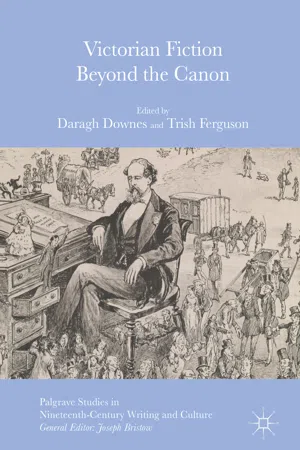
Victorian Fiction Beyond the Canon
- English
- ePUB (mobile friendly)
- Available on iOS & Android
eBook - ePub
Victorian Fiction Beyond the Canon
About this book
This book is about selected Victorian texts and authors that in many cases have never before been subject to sustained scholarly attention. Taking inspiration from the pioneeringly capacious approach to the hidden hinterland of Victorian fiction adopted by scholars like John Sutherland and Franco Moretti, this energetically revisionist volume takes advantage of recent large-scale digitisation projects that allow unprecedented access to hitherto neglected literary texts and archives. Blending lively critical engagement with individual texts and close attention to often surprising trends in the production and reception of prose fiction across the Victorian era, this book will be of use to anyone interested in re-evaluating the received meta-narratives of Victorian literary history. With an afterword by John Sutherland
Information
© The Author(s) 2016
Daragh Downes and Trish Ferguson (eds.)Victorian Fiction Beyond the CanonPalgrave Studies in Nineteenth-Century Writing and Culture10.1057/978-1-137-51823-1_11. Introduction: Exploring the Hinterland of Victorian Fiction
Daragh Downes1 and Trish Ferguson2
(1)
School of English, Trinity College Dublin, Dublin, Ireland
(2)
English Department, Liverpool Hope University, Liverpool, UK
‘Sun destroys/the interest of what’s happening in the shade’
Philip Larkin, ‘The Whitsun Weddings’
In 1886, when Sir John Lubbock drew up a list of ‘The Best Hundred Books’ for the Pall Mall Gazette, he was quick to clarify that the list represented not the hundred best books per se, ‘but, which is very different […] those which on the whole are perhaps best worth reading’. 1 His suggestion that the literary canon he was offering represented a collective view, rather than any claim on his part as to intrinsic literary merit, did nothing to temper the controversy that ensued. Readers of the Pall Mall Gazette were quick to denounce Lubbock’s list, John Ruskin famously denouncing the ‘rubbish and poison’ of his selection. 2 Ever alert to a commercially advantageous debate, W. T. Stead invited high-profile public figures, including the Prince of Wales and William Gladstone, to enter the fray with their own recommended reading. As responses were published as ‘The Hundred Best Books by the Hundred Best Judges’ and as the debate moved beyond the Pall Mall Gazette and through the pages of the national press, the question implicitly shifted from ‘What are the best books?’ to ‘Who, if anyone, has the right to determine such a question?’ While earlier efforts to offer a literary canon—such as James Pykroft’s A Course of English Reading (1844)—had been received with equanimity, Lubbock’s prescribed list had been offered to a readership alert to Walter Pater’s aestheticist reconceptualisation of criticism, which advocated moving away from according an agreed value to a work of art, or a consensus about what was ‘best worth reading’, in an increasingly diversified literary marketplace. 3 While Matthew Arnold attempted to establish a cultural hierarchy determined by the elite, Pater urged each of his readers ‘to know one’s own impression as it really is, to discriminate it, to realise it distinctly.’ 4 However, this is an injunction that, in modern scholarship, is still more often quoted than applied.
Pater’s insistence that one evaluate works of art on their own merits, rather than blindly accepting a selected canon formulated by the social and cultural elite, is no less fraught with difficulties to readers of Victorian fiction now than it was to those in the late nineteenth century, in large part simply on account of the vast scale of literature available. As Franco Moretti has pointed out, even if we set today’s canon of nineteenth-century long-form fiction at the generous figure of 200, this is only about 0.5 per cent of novels published in the century. John Sutherland, in his pioneering Stanford Companion to Victorian Fiction (1989), estimates the number of fiction titles published between 1837 and 1901 at a staggering 60,000-plus. 5 That this puts the set known as ‘Victorian fiction’ hopelessly beyond the scope of even the most avid individual reader hardly needs belabouring. To be an expert in Victorian fiction is—there is no getting around it—to be an expert in a mortifyingly small sample of Victorian fictions. To make broad critical pronouncements about ‘Victorian fiction’, and even many of its subgenres, is to take troublingly strong resort to synecdoche and extrapolation.
Thanks to large-scale digitisation, many neglected Victorian texts are now becoming amply available for the first time. Digital platforms such as the HaithiTrust and initiatives such as the British Library’s programme to digitise its collection of nineteenth-century books mean that it has never been easier to access these hitherto neglected fictions. Such unprecedented availability provides scholars with the raw materials for exploring key issues such as the role played by print culture in Victorian literary production, contemporary reviews and subsequent evaluations of Victorian fiction. At the same time, however, it enforces—or should enforce—an unprecedented cognitive humility on the individual scholar, leading each of us to ask searching questions not only as to the ideological dynamics of canon formation but also as to our own critical protocols. With such a wealth of resources made suddenly available, the simple question is: where to start? And for the individual reader keen to fulfil Pater’s desideratum of discriminating and realising the individual work ‘distinctly’, the vastness of this literary treasury only sharpens the quandary. The problem is exquisitely difficult: how to strike a balance between the intimacy of individual aesthetico-critical response and the exciting opportunities opened up by an unprecedented collective recovery campaign.
Perhaps the most obvious starting-point in looking beyond the canon of Victorian fiction is to seek out those books which enjoyed great popularity during the era but have since lost favour and fallen out of circulation. What leads a bestseller to become so ignored by posterity? Efforts to define the ‘popular’ are, however, fraught with problems. Positivistic research will only get us so far. Whether we look at ‘Best Books’ lists, bestseller lists, sales, number of editions, or what was stocked in public libraries, the radical evolution of literary publishing over the nineteenth century, coupled with a dramatic rise in the literate reading public, means that it is often very difficult to assess sales or circulation figures of literary fiction over the course of the nineteenth century in any secure way. Even the attempt to assess the popularity of Victorian fiction quantitatively in terms of sales, or authorial income, is not nearly as straightforward as it might seem. Novelists could make much more through serialisation, which could bring in an estimated five times the amount of single-volume sales, but it would be inaccurate to merely translate sales of issues of a periodical into figures of readers of a novel published therein. Nor is it easy to measure popularity through sales of single volumes, given that at the mid-point of the Victorian era so many readers accessed their fiction through the library. Lists of texts stocked by public libraries do of course provide an insight into texts that were popular with the general reading public, but it is by no means always possible to assess numbers of borrowings at any given time. 6 And even if we could, one borrower does not necessarily equate to one reader.
To attempt to assess popularity in terms of the number of editions of a literary text published is also problematic. The nineteenth-century vogue for publishing affordable reprints was a widespread practice adopted by a broad range of publishing houses that could be seen to establish a literary canon based on steady sales. However, while the ‘Cheap Classics’ series might seem a reliable indicator of what Victorians read and deemed ‘canonical’, sales of ‘classics’ may, as Jonathan Rose notes, reflect an emerging trend to acquire books as commodities to reflect cultural capital. 7 The process is rather self-confirming: publication of these ‘classics’ was in part related to the emergence of ‘Best Books’ lists, which provided an easy and attainable list for reading—or perhaps merely for display. Moreover, the trend for ‘Best Books’ lists, which originated with a lecture delivered by Sir John Lubbock at the Workingmen’s College in London, was part of an effort to influence and elevate working-class culture, thus merely reflecting elite ideological positions about literary value that did not necessarily match what books were actually enjoyed by the masses. 8
Clearly, any endeavour to assess the popularity of now neglected Victorian fiction is fraught with problems, but even if it were possible to do so based on sales, circulating figures, availability in public libraries or number of imprints published, this would be no guarantee of literary merit. Circulation figures of a periodical often reflected the success of a serial novel published therein. By the same token, a fiction published in a given issue may have had its circulation greatly boosted by dint not of its own popularity but of the inclusion elsewhere in that same issue of a more popular fiction. Furthermore, achieving resonance with the fickle reading public could be as tricky a business as lifting mercury with a fork: as Dickens on one occasion consoled Charles Lever, ‘not quite to succeed in such a strange knack, or lottery, is a very different thing from having cause to be struck in one’s self-respect and just courage.’ 9 Some novels enjoyed great popularity when first published, because they touched on particular cultural interests or anxieties, but once the frame of reference which gave them value for their contemporaries was no longer relevant, they quickly lost their currency. Other novels that were undoubtedly of literary merit were neglected at the time of their publication because of the conservatism of editors or readers. With a vastly expanding readership from the mid-nineteenth century, which was in part controlled by risk-averse circulating libraries and conservative editors concerned with family readerships of their publications, some novels may have been deemed too radical in their treatment of religion, sexuality or class, particularly if those views came from an unestablished author. While Hardy, against his artistic inclination, wrote his debut novel Desperate Remedies (1870) to capitalise on the popularity of sensation fiction, by the 1890s he had the economic freedom to write Jude the Obscure, a potentially unpublishable novel in its day that now enjoys an undisputed place in the Victorian canon. 10
Merely to seek out forgotten bestsellers on the sole basis of their commercial success would be a highly reductive approach to reassessing the Victorian canon, and one that would have been derided by writers of the era, many of whom saw themselves as above and beyond any vulgar ambition to feature on bestseller lists. Indeed, such ‘popularity’ could be understood as a measure of failure. Drawing on Andreas Huyssen’s observance of the ‘great divide’ between elite and mass culture, Aaron Jaffe notes that ‘[i]n the case of modernism […] the hero is the elite modernist art product staving off the forms of mass consumption,’ a trend that began as a response to the unprecedented commercialism of the literary marketplace in the late nineteenth century. 11 Writers committed to the principles of the ‘art for art’s sake’ movement often saw themselves as solely concerned with artistry and elevated above what Jasper Milvain in Gissing’s New Grub Street memorably calls ‘good, coarse, marketable stuff for the world’s vulgar’. 12 While writers responding to Walter Besant’s article ‘On the Rewards of Literature’ noted the difference between writing as a labour of love and writing out of financial necessity, this did not translate into a simple cultural division between proponents of aestheticism or creators of ‘art’, untainted by commercial interests, and writers of popular fiction, as might be expected. 13 Ouida refused to join the Society of Authors when it was formed to protect the financial interests of writers because she thought it commercialised art, reflecting higher aspirations than are usually associated with writers of popular fiction. 14 Thus, while it is true to say that writers seeking commercial success often followed particular trends—hence the formulaic nature of so much genre fiction such as the sensation novel or the detective story—it would be critically naïve to make assumptions based on a writer’s choice of genre.
While mindful of texts that have fallen from the heights of success to the depths of oblivion, we should also spare a thought for all those fictions that failed to come to publication in the first place. How many interesting or worthy works never saw the light of day beyond MS form? How many sensitive, diffident writers living from hand to mouth could not manage to take up even temporary residence on New Grub Street? How many threw in the towel after a spate of rejection letters? How many fell victim to survival not of the best but of the fittest? And what role was played in all this by luck (a category apt to make rather nervous the professional literary historian whose very stock in trade is the demonstrable nexus between cause and effect)? These are the unknown unknowns of Victorian literature, and they should haunt all of us working in the field and make us examine our own ideological investment in Smilesian notions of meritocracy and success.
***
The essays in Victorian Fiction Beyond the Canon explore a sample of neglected texts—several selected for ‘trans-canonical’ reasons—that have been subjected, in many cases for the first time, to critical scrutiny. In doing so, these essays do not assume a priori any differentiation between commercially successful, ‘popular’ fiction and ‘artistic’ or ‘literary’ fiction. Each essay will argue for the re-evaluation of forgotten Victorian fictional texts, on the grounds that their neglect by posterity violates an intrinsic historico-cultural and/or literary interest. Contributors have chosen to examine texts for a variety of reasons, including success in the literary marketplace, cultural impact or relationship to ‘major’ works. Some essays in th...
Table of contents
- Cover
- Frontmatter
- 1. Introduction: Exploring the Hinterland of Victorian Fiction
- 2. Prize Novelists and Condensed Novels: Thackeray and Bret Harte
- 3. Before New Grub Street: Thomas Miller and the Contingencies of Authorship
- 4. Emboldening the Weak: The Early Fiction of James Anthony Froude
- 5. George Borrow: The Scholar, The Gipsy, The Priest
- 6. Sensation Fiction as Social Activism: Charles Reade’s It Is Never Too Late to Mend and Felicia Skene’s Hidden Depths
- 7. Sheer Luck, Holmes? Clues Towards Canon Formation in Victorian Detective Fiction
- 8. Politics of the Strange and Unusual: Mesmerism and the Medical Professional in Mary Elizabeth Braddon’s ‘Dr.Carrick’ (1878)
- 9. Silas K. Hocking, Her Benny, and the Poetics of the Prolific
- 10. Henry Hawley Smart’s The Great Tontine and the Art of Book-Making
- 11. Double Standards: Reading the Revolutionary Doppelgänger in The Prophet’s Mantle
- 12. Richard Marsh and the Realist Gothic: Pursuing Traces of an Evasive Author in His Fin-de-Siècle Popular Fiction
- 13. Dat Cura Commodum or A Portrait of a Deviant Mind: Arthur Griffiths’s The Rome Express, John Milne’s ‘The Express Series’ and Late-Victorian Detective Fiction
- 14. Afterword from the Hinterland
- Backmatter
Trusted by 375,005 students
Access to over 1.5 million titles for a fair monthly price.
Study more efficiently using our study tools.
Frequently asked questions
Yes, you can cancel anytime from the Subscription tab in your account settings on the Perlego website. Your subscription will stay active until the end of your current billing period. Learn how to cancel your subscription
No, books cannot be downloaded as external files, such as PDFs, for use outside of Perlego. However, you can download books within the Perlego app for offline reading on mobile or tablet. Learn how to download books offline
Perlego offers two plans: Essential and Complete
- Essential is ideal for learners and professionals who enjoy exploring a wide range of subjects. Access the Essential Library with 800,000+ trusted titles and best-sellers across business, personal growth, and the humanities. Includes unlimited reading time and Standard Read Aloud voice.
- Complete: Perfect for advanced learners and researchers needing full, unrestricted access. Unlock 1.5M+ books across hundreds of subjects, including academic and specialized titles. The Complete Plan also includes advanced features like Premium Read Aloud and Research Assistant.
We are an online textbook subscription service, where you can get access to an entire online library for less than the price of a single book per month. With over 1.5 million books across 990+ topics, we’ve got you covered! Learn about our mission
Look out for the read-aloud symbol on your next book to see if you can listen to it. The read-aloud tool reads text aloud for you, highlighting the text as it is being read. You can pause it, speed it up and slow it down. Learn more about Read Aloud
Yes! You can use the Perlego app on both iOS and Android devices to read anytime, anywhere — even offline. Perfect for commutes or when you’re on the go.
Please note we cannot support devices running on iOS 13 and Android 7 or earlier. Learn more about using the app
Please note we cannot support devices running on iOS 13 and Android 7 or earlier. Learn more about using the app
Yes, you can access Victorian Fiction Beyond the Canon by Daragh Downes, Trish Ferguson, Daragh Downes,Trish Ferguson in PDF and/or ePUB format, as well as other popular books in Literature & European Literary Criticism. We have over 1.5 million books available in our catalogue for you to explore.