- English
- ePUB (mobile friendly)
- Available on iOS & Android
eBook - ePub
About this book
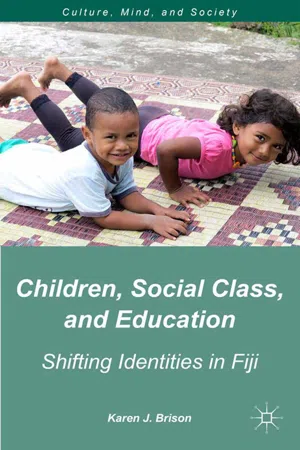
Class-based self-perception is a rising issue worldwide. Through observation in kindergartens in Fiji, Brison examines how schools instil these ideas in Suva children. Teachers have different goals depending on the social background of the families while students create friendships through shared experience of toys, gender roles, and mass media.
Information
Chapter 1
Introduction: Social Class and Mass Preschool Education in Fiji
One morning as I sat cross-legged on the floor of a kindergarten in Suva, Fiji, waiting for the morning prayer, the five-year-old girls clustered around me began explaining the ethnicity of their classmates. In the five weeks that I had observed this kindergarten, the children had rarely mentioned ethnicity in the “multiracial” class comprising roughly equal numbers of children from Fiji’s two major ethnic groups, indigenous Fijians and Indo-Fijian descendants of indentured laborers brought to Fiji in the late nineteenth and early twentieth centuries, and a smattering of children from other groups. But that day they decided to explain things to me. “This one, she’s a kai India (literally: person of India),” volunteered one girl, “and I’m a kai Viti (person of Fiji).”
“How about Whitney?” I asked, wondering how the children would deal with someone who fell between the two major ethnic categories, with an Indo-Fijian father and a mother from Rotuma, a remote island of Fiji whose residents were physically and linguistically distinct from the rest of the indigenous Fijian population.
“Whitney? Oh she’s a kai valagi (a term used to refer to Australians, Americans, and Europeans),” my informant answered without hesitation—and her friends quickly agreed. The two Indo-Fijian teachers who overheard this remark thought it was tremendously funny and repeated it eagerly to a passing friend.
Across Suva, in another kindergarten, as one young mother introduced herself and her child to Sara Melton, an American undergraduate working as my summer research assistant, she volunteered that she was an indigenous Fijian and the child’s father an Indo-Fijian. “Watch this,” she said, asking her child, “Maria, I’m Fijian and your dad is Indian. What are you?”
“Oh, I’m English,” the child quickly replied, to the amusement of her mother and the teachers.
On yet another day in another kindergarten, as a boy of indigenous Fijian and Chinese heritage arrived with his mother and baby sister, an indigenous Fijian girl, Rebecca, said, “Oh look at the cute little Chinese baby.”
“She’s Chinese, so what are you?” I asked Rebecca, prompting an odd look and the quick response, “I’m a white girl.”
I had come to Suva to study children’s emerging sense of cultural and personal identity as expressed in play. So these and other incidents caught my interest as signs of significant changes in ways of defining self and others in Fiji. Scholars and local people alike have generally focused on the ethnic divisions between indigenous Fijians and Indo-Fijians that structure political and economic life in Fiji, and have, in various ways, resulted in four coups since 1987. But children such as those in the opening examples, many of whom had little interaction with people outside their extended family before coming to school, encountered a confusing ethnic terrain in kindergarten with “mixed race” children, children from small ethnic groups such as Chinese and Rotumans, and many divisions within the Indo- and indigenous Fijian communities. Faced with peers who did not fit neatly into any category, and who spoke English as their first language, children concluded that they were “white,” “English,” or “kai valagi.” Furthermore, a growing number of children such as Rebecca preferred to speak English, saw themselves as white, and had no strong identification with any of Fiji’s ethnic cultures even if they did belong to one of the major ethnic communities. As I explored the world of Suva kindergartens, I began to suspect that white, English, and kai valagi signaled new ways of seeing oneself that had more to do with social class than with ethnicity. Indeed, kindergartens seemed to be instilling class-specific values and aspirations and ways of viewing ethnic culture and nation.
In the following pages, I use kindergartens1 as a lens to argue that new ways of defining self, community, culture, and nation are emerging in Fiji and other small Pacific Island nations. People still belong to ethnic and regional cultures and see themselves as part of networks of kin. But people also see themselves as part of a larger world and identify with transnational groups of people with similar values, aspirations, and tastes, some defined by religion, others based on a shared class-based habitus (Besnier 2009; Gewertz and Errington 1999). Kindergartens, I argue, are an expression of these new orientations since parents and teachers look to them to create new kinds of people who will succeed in the world outside of Fiji. But kindergartens create new values and new ways of seeing culture and nation, many of them tied to social class, in ways parents and teachers neither anticipate nor intend.
Kindergartens are just one of a number of institutions, largely introduced whole cloth by a wider international community, often as part of well-intentioned international aid, that form an important part of life in small Pacific Island communities. The impact of such institutions in Fiji has not been extensively studied (cf. Riles 2001). National governments, international nongovernmental organizations, and religious organizations encourage mass preschool education as a means to foster a vague and ambitious array of goals ranging from individual success to national development, to promoting national identity and multiethnic harmony. These ideas come to small island nations like Fiji through NGOs, churches, and consultants brought in by the Ministry of Education from Australia, New Zealand, and the European Union. Sometimes imported ideas make little sense to local people who often must implement them with little training or funding. And yet they bear the stamp of external expertise, and sometimes garner international funding, and appeal to local people trying to forge new ways to be both Fijian and “modern,” and to help their children to succeed in the contemporary world.
In Fiji, government officials, teachers, and parents have grand ideas about the potential impact of kindergartens on child and nation, but often are unable to explain how kindergartens produce the desired transformations. Teachers struggle to make sense of a broad and ambitious agenda for preschools in Fiji that charges them with such things as promoting “an appreciation of culture and traditions [advantageous to] greater social harmony in multicultural Fiji” and facilitating “the early development of relevant skills for the modern world . . . [in a country where] the norms that govern personal relationships, the priority placed on family and community obligations, and the rules of personal conduct are often in sharp contrast to what is required for success in the modern world” (Siwatibau 2000: 119).
The globalization of preschool and kindergartens has been extensively studied (e.g., Tobin, Wu, and Davidson 1989; Tobin, Hsueh, and Karasawa 2009; Wollons 2000). But few of these studies have considered small Pacific Island nations or even Third World countries in general even though opening preschools in such areas is a common strategy of governments and international NGOs such as the United Nations Children’s Fund (UNICEF) and Save the Children. In Fiji, I will argue, while the preschool rhetoric highlighted multiethnic understanding and tolerance, kindergartens did more to accentuate incipient social class–based identities and contributed to the formation of a middle class that was largely disinterested in local ethnic cultures and no more knowledgeable about, or tolerant of, cultural differences than their parents. They identified with a transnational community of salaried professionals and took neoliberal values stressing success through self-discipline and submission to corporate hierarchy to be universal. Indeed, in some ways, this orientation produced less understanding and tolerance of difference that the older model of ethnic pluralism where each ethnic culture had its niche.
This is the story of new ways of seeing self and society in the Pacific Islands; it is also one example among many of how imported ideologies and institutional structures are a central part of life in small island nations such as Fiji and integral to understanding traditional anthropological questions about self, society, and nation in such places. This is also the story of the impact of mass preschool education more generally. When Obama announced his “Preschool For All” initiative in 2013 pointing to the importance of preschool in leveling inequalities, he reflected a great deal of international sentiment about the importance of preschool education (Anderson-Levitt 2003: 5). Fiji is not unusual in looking to preschools to accomplish an ambitious array of goals ranging from fostering academic success to leveling the playing field for all, regardless of race, gender, and social class, to building multicultural tolerance and a national identity, to producing children with the characteristics necessary to succeed in a changing world. Tobin et al. (2009) note, for instance, that Chinese parents and educators have adopted a more “child-centered,” “Western” preschool curriculum in an effort to give their children the characteristics they feel are necessary to succeed in a rapidly expanding capitalist economy. But while the international community has high hopes for mass preschool education and an increasing amount of money is being directed toward preschools, the impact of preschools, and the extent to which they achieve the lofty goals intended, is less clear.
Here I suggest that detailed ethnographic investigations of particular preschools in particular nations, especially those outside of the industrialized world, is a necessary addition to a literature primarily based on large-scale quantitative studies in industrialized societies (Tobin 2007). While it is difficult to generalize from fine-grained participant observation studies of a small number of schools, this kind of research has the potential to reveal many things that are masked by large-scale quantitative research on outcomes. Here I argue that by conducting multisited ethnographic analysis of a range of Suva preschools, looking at them from the perspective of teachers, parents, government officials, and children themselves, one can see the trade-offs that are often made between the goals of inclusion and multiculturalism on the one hand, and desires for upward mobility on the other. In the United States, minority parents sometimes place less importance on teaching ethnic cultures and languages than do educators, as parents aspire to help their children to succeed in the majority society. In Fiji and other marginal societies, upwardly mobile parents also vote with their feet and select schools that teach in English, and promote identification with a transnational middle class over local cultures. Everyone has grand ideas about what preschools can achieve; but practice can produce quite different results. Detailed, multisited ethnographic studies can show how these processes occur in a complex interaction between the desires and experiences of government officials, teachers, parents, and children themselves. The negotiations produce results no one anticipated or intended.
Shifting Identities in Fiji
Fiji is a multiethnic nation where about 35 percent of the population comprises Indo-Fijians most of whom are descendants of indentured laborers who came to Fiji in the late nineteenth and early twentieth centuries. The British colonial government adopted a pluralistic model promoting the role of indigenous Fijians in bureaucracy, government, and the military, leaving the Indo-Fijian population, including a second wave of Gujarati business people who came as free migrants, to fend for themselves as small farmers and in business. Eighty-three percent of Fiji’s land was registered to indigenous Fijian clans and could not be sold. This land could, however, be leased out and, particularly in the “western,” sugarcane-growing side of Fiji, a great deal of land has been leased out for decades to Indo-Fijian smallholder cane farmers.
When Fiji became an independent nation in 1970, the British left in place a parliamentary system where seats were assigned by “race” and a plural society with an economy and society largely segregated by ethnicity (Lal 2006; Norton 1977). The first constitution of 1966 designated 22 parliamentary seats to Indo-Fijians and 22 to indigenous Fijians with eight reserved for general electors—a group that included Europeans, Chinese and other small ethnic groups. Voting by “race” focused peoples’ attention on ethnic divisions (Lawson 1991) and diverted attention from incipient class divisions that crosscut ethnic groups. Many speculated that two 1987 coups, and a subsequent coup against an Indo-Fijian prime minister from the Labour Party in 2000, involved economic issues rather than ethnic divisions as Labour politicians challenged entrenched business interests (Trnka 2009). However, as Trnka notes, media and political rhetoric about the coups generally highlighted ethnic conflict. A later coup, in 2006, again raised the murky relationship between class and ethnicity because this coup involved an indigenous Fijian army commander, Voreqe Bainimarama, who displaced an indigenous Fijian prime minister.
The 2006 coup was followed by a period of increasing tension as the Bainimarama government postponed democratic elections, calling first for reform in the electoral system, and then became increasingly repressive toward its critics, including local and expatriate journalists and academics. The military regime in some ways also blurred the traditional divide between Indo-Fijians and indigenous Fijians since Bainimarama was an indigenous Fijian whose apparent motivation for displacing a fellow indigenous Fijian, Qarase, was his opposition to Qarase’s policies favoring indigenous Fijians over Indo-Fijians. Bainimarama also included several prominent Indo-Fijians, among them deposed prime minister Chaudhry, in the initial interim government (although Chaudhry was later dismissed).
Against this backdrop of ethnic strife and political turmoil, I studied children, first in Rakiraki, a village on the northeastern side of Viti Levu, one of Fiji’s two main islands, and then in Suva. As I observed indigenous Fijian children play in Rakiraki over the course of two summers, I rarely heard children talk about ethnic differences even though tensions between Indo-Fijians and indigenous Fijians culminated in a national coup in May 2000 during the period of my research. Indeed, Rakiraki, a sugarcane growing area, was much immersed in one of the central tensions that led to the 2000 coup, namely the perception that the Indo-Fijian prime minister, Chaudhry, was making moves toward reforming the laws that preserved indigenous Fijian ownership of land.
But despite the fact that Rakiraki was in a cane-growing area where there were tensions over land, children were more preoccupied by differences between rural villagers and their urban and overseas relatives who seemed to embody sophisticated modernity and a life free of the constraints of the village. One day, I encountered little girls in the midst of a game of house that involved the mother bidding good-bye to her children as she boarded an airplane to go overseas. This was something that their Pentecostal pastor’s wife had done recently, and it had clearly captured the imagination of these girls whose own mothers had never ventured out of Fiji. Some time later, I observed two little boys reenacting a scene from a Jean-Claude Van Damme movie that had recently played in the community center. The boys added their own slant to the movie rivalry between the hero and the villain by boisterously accusing each other of having “red” and “smelly” teeth, the mark of a kai colo (literally: person from the interior, with similar connotations to hillbilly) who is possibly unfamiliar with urban dental hygiene (Brison 2007a, 2012).
It was likely that children’s views would become more similar to those of adults as they grew older. But I also wondered if I was witnessing a change in Fijian society where people envisioned themselves as embedded in transnational communities of Pentecostal Christians and macho male icons and were less preoccupied with local ethnic divisions and village hierarchies. So I began studying urban children in order to further explore emerging identities in a context where the influence of mass media and international churches was even greater and children were removed from the extended kin networks that shaped the experience of rural children.
I was delighted when Siteri, an indigenous Fijian relative of one of my Rakiraki friends, invited me to live in Suva with her family, a group that included her Indo-Fijian husband, her eight-year-old daughter, Connie, and four-year-old son, Josh. The family lived in the midst of a densely populated, multiethnic, Suva neighborhood, and things seemed to be unfolding smoothly on my first evening with the family as I sat on the front veranda with Connie telling me about the four children who lived on one side and the two little girls who lived on the other side. Connie was clearly interested in these children and could tell me a lot about them, including what schools they went to and when they had acquired particular toys. But Connie soon drifted back inside the house to watch television and to tease her brother, and over the days that followed I learned that she had never spoken to the four children on one side and only very occasionally played with the two girls on the other side. Siteri and her cousin Nai, who served as a live-in nanny and housekeeper while Siteri worked, told me proudly that they didn’t let the children roam around to pick up bad ways from any children they happened to meet. This was an attitude I had already encountered among rural parents, who considered letting their children play freely outside the lineage compound bad parenting. Josh and Connie, like many urban children who had no lineage compounds, stayed in the house and helped with the chores, did their homework, and watched a lot of television.
Siteri politely suggested that if I wanted to see children play I should accompany Josh to kindergarten. Josh’s interest in kindergarten increased when he had an American guest in tow, and for the next two months we attended kindergarten together. After a few days, Roshni, the Indo-Fijian owner of this small private kindergarten, Happy Days, told me firmly that the children at her center napped all afternoon. If I really wanted to understand kindergartens, I had to look at several of them. Although I didn’t see my purpose as understanding kindergartens, it seemed like a good idea to extend my observations beyond the elite, multiethnic, English-speaking group of children at Happy Days, whose parents owned large businesses, served in the government, were famous athletes, or were expatriates from Africa and Asia working in Fiji.
So I arranged to go to the afternoon session of a kindergarten associated with a Pentecostal church attended by another Rakiraki friend. This kindergarten was located in a less-affluent part of town, and the children who attended were primarily indigenous Fijians. Still unsatisfied with my agenda, Roshni took me on a whirlwind tour of ten kindergartens. When I returned to Fiji on several subsequent visits over the next three years, I attended, for periods ranging from two weeks to eight weeks each, a total of 11 kindergartens that varied in ethnicity and social class of both students and teachers. A couple of these schools were suggested by Roshni, and I found others through suggestions from parents and preschool teachers.
Fijian kindergartens exposed me in spades to the issues of identity that I had come to explore and confirmed my suspicions about changes in Fiji. Ethnicity, as I learned from and with Suva’s kindergarten children, was a bewilderingly complex category in an urban world, one that foreign academics and local adults all too often reduced to two categories—“indigenous” and “Indo” Fijian. For many Suva residents, adult and child alike, these two master categories quickly dissolved in the presence of a host of other groups such as “part-Europeans,” other Pacific Islanders, Rotumans, Rabians,...
Table of contents
- Cover
- Title
- Chapter 1 Introduction: Social Class and Mass Preschool Education in Fiji
- Chapter 2 Kindergartens and Culture in Fiji
- Chapter 3 Nurturing Multicultural Pluralism
- Chapter 4 Producing a New Middle Class
- Chapter 5 Christianity and Multiculturalism in Ordinary Kindergartens
- Chapter 6 Gender, Race, and Social Class: Shifting Social Categories
- Chapter 7 Hierarchy and Friendship among Kindergarten Children
- Epilogue
- Notes
- References
- Index
Trusted by 375,005 students
Access to over 1.5 million titles for a fair monthly price.
Study more efficiently using our study tools.
Frequently asked questions
Yes, you can cancel anytime from the Subscription tab in your account settings on the Perlego website. Your subscription will stay active until the end of your current billing period. Learn how to cancel your subscription
No, books cannot be downloaded as external files, such as PDFs, for use outside of Perlego. However, you can download books within the Perlego app for offline reading on mobile or tablet. Learn how to download books offline
Perlego offers two plans: Essential and Complete
- Essential is ideal for learners and professionals who enjoy exploring a wide range of subjects. Access the Essential Library with 800,000+ trusted titles and best-sellers across business, personal growth, and the humanities. Includes unlimited reading time and Standard Read Aloud voice.
- Complete: Perfect for advanced learners and researchers needing full, unrestricted access. Unlock 1.5M+ books across hundreds of subjects, including academic and specialized titles. The Complete Plan also includes advanced features like Premium Read Aloud and Research Assistant.
We are an online textbook subscription service, where you can get access to an entire online library for less than the price of a single book per month. With over 1.5 million books across 990+ topics, we’ve got you covered! Learn about our mission
Look out for the read-aloud symbol on your next book to see if you can listen to it. The read-aloud tool reads text aloud for you, highlighting the text as it is being read. You can pause it, speed it up and slow it down. Learn more about Read Aloud
Yes! You can use the Perlego app on both iOS and Android devices to read anytime, anywhere — even offline. Perfect for commutes or when you’re on the go.
Please note we cannot support devices running on iOS 13 and Android 7 or earlier. Learn more about using the app
Please note we cannot support devices running on iOS 13 and Android 7 or earlier. Learn more about using the app
Yes, you can access Children, Social Class, and Education by K. Brison in PDF and/or ePUB format, as well as other popular books in Social Sciences & Educational Psychology. We have over 1.5 million books available in our catalogue for you to explore.