eBook - ePub
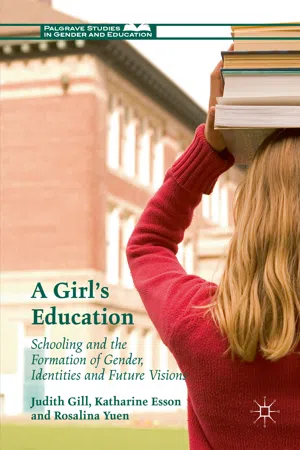
A Girl's Education
Schooling and the Formation of Gender, Identities and Future Visions
- English
- ePUB (mobile friendly)
- Available on iOS & Android
eBook - ePub
A Girl's Education
Schooling and the Formation of Gender, Identities and Future Visions
About this book
This book argues that educators and the general public have become complacent about girls' education as a consequence of the more recent fuss about problems for boys. After an analysis of persistent disquiet about girls' lifestyles, it uses theories of gender and education to demonstrate that girls are being produced in contradictory ways in current schooling. Many girls develop a sense of themselves through close connection with friendship groups but schooling processes typically require them to adopt the position of competitors in the end-of-school rankings and to act out their individualized positions in imagining themselves into the future. Ultimately the work offers insight and understanding leading to a less divisive educational pathway for girls.
Information
© The Author(s) 2016
Judith Gill, Katharine Esson and Rosalina YuenA Girl's EducationPalgrave Studies in Gender and Education10.1057/978-1-137-52487-4_11. Who Are Girls in Current Times and Is There a Problem?
Judith Gill1 , Katharine Esson2 and Rosalina Yuen3
(1)
School of Education, University of South Australia, Mawson Lakes, SA, Australia
(2)
NSW Department of Industry, Darlinghurst, NSW, Australia
(3)
Ros Yuen Psychology, Beulah Park, SA, Australia
A Whistling Woman and a Crowing Hen
Is neither good for God nor Men. (Anon: Folkloric rhyme)
Introduction
In this book, we look at the ways current girls and young women are responding to the unprecedented transformation of women’s lives from the traditional roles of earlier times to the still largely uncharted waters of the twenty-first century. We begin with a sketch of the situation.
Not so long ago across the developed world, a general understanding of the accepted role of girls was so commonplace that it drew little attention from the general population. Generations of folklore such as in the example above, nursery rhymes, fairy tales, religious and moral stories, and even popular songs combined to preach a message of girls as fundamentally different from boys and to warn of the dire situations anticipated for those who did not conform.
Traditionally, girls were understood to be primarily good, obedient, docile children, helpful to their mothers from whom they learned their domestic role. To be pretty was seen as an advantage (so long as it was not too sexy) but above all girls were destined to wait until they were chosen by a prospective husband. In English-speaking societies, the consistent message was of heterosexual coupling—not surprising because until recent times, homosexuality was considered to be morally deviant and, in many places, legally outlawed. The overarching message, namely that boys were understood to have been born to be the actors and leaders and girls the followers, was reinforced by a multitude of cultural artifacts. Boys looked for adventure while girls looked, watched, and waited for their turn to be chosen.
In recent times, girls have shed the quiet image of being on the sidelines and have emerged as first-class students, top performers in school testing and examinations, credited with being reliable in school-related tasks such as homework, neat writing, excellent bookwork, along with being well behaved in class. Teachers routinely anticipate that girls will excel in reading and writing and their diligent work habits ensure that they achieve highly in end-of-school examinations. They are model pupils whose achievements are expected to lead into high-profile positions and professions in any walk of life they choose.
Of course, the versions of ‘being girl’ presented above are themselves stereotypes—ways of seeing the world that reflect some aspects of mainstream thinking but which are not without exception. There have always been girls who did not conform to the good girl image and who chose not to be bound by the many limitations of those earlier eras. Nowadays, too, there are girls who resist the idea that you can do anything regardless of social imperatives. Some girls today hold to attitudes and values not very different from those of their grandmothers. Others aim for a fast trendy image, engage in ‘slut walks’ (protest marches against rape), and talk of wild experiences. Sexuality is ‘out there’, a part of the package, but experienced and lived in wildly divergent ways. In fact, it is harder than ever to generalize about girls in the present moment. Are they really players in a ‘female future’ or are they still preoccupied with what have traditionally been girl’s issues such as boyfriends, current fashion, looks, and style?
In the course of this book, we suggest that currently girls are faced with the difficult task of balancing features associated with traditional girlhood which are still seen as desirable with the challenges of contemporary life. Today’s adolescents are confronted with the need to sort out what matters for each individual from the range of potentially conflicting expectations held by significant others including parents, siblings, friends, teachers, and of course the girls themselves. Today’s girls must try to work out, from the range of new possibilities for themselves as grown women, the way forward to living a productive and fulfilling life. The familiar trite phrase ‘having it all’ doesn’t begin to get to grips with the compromises and concessions that form a constant dynamic in girls’ current plans and future visions. Hence the impetus for this book which will attempt to shed light on the processes involved.
We begin by analyzing the changes that have occurred in girls’ behavior and education in recent times.
A Time for Change
By the early twenty-first century, the old certainties about the position of girls have all but disappeared. No longer are there the strict rules of behavior that govern female decorum; gone too is the rigid division between public and private worlds which located most girls and women firmly in the home. Up until the mid-twentieth century, most girls across Western societies were seen as destined first and foremost to be wives and mothers and so their schooling was centrally involved with the development of domestic arts. Even those few who managed to secure enough education to demonstrate academic ability were discouraged from showing their intellectual capacities. In many places, they were barred from accessing higher education, or else only allowed in as audit students, not really able to get a degree. Sadly, this discrimination was practiced fiercely in even long established universities—at Cambridge, the highly prestigious British University, young women were not entitled to graduate with a degree until 1949. Those few who did pursue learning were labeled ‘bluestockings’ and became objects of social derision rather than being taken seriously.
Women’s involvement in paid work during two world wars began an irreversible trend that saw increasing numbers of women in employment outside the home. By the late twentieth century, the trend had become an almost universal expectation among women in the developed West that they would spend a significant amount of their adult years in the workforce. Furthermore, this development was to have important implications for the way education was conducted. Questions continue to be raised about issues of curriculum, school gender context (such as debates around coeducation or single sex schooling), career counseling, and work experience. The overarching question to be addressed here is how best to organize education for girls in the current era?
The global economy is frequently seen as the main driver of the change in the workforce, with particular reference to its gender composition. With increasingly large numbers of people moving around the world, the differences between nations as well as national boundaries themselves are becoming contested. As nations struggle to position themselves within the changed and changing globalized world, education is increasingly seen as an important basis for national development in the new knowledge economy (Lauder et al. 2012; Bradley et al. 2008). At an individual level, educational achievement is now seen as essential for all citizens, a perception which has led to the development of girls’ education in ways much closer to that of boys. In the Western world, middle-class girls appear more advantaged by the changes in gender norms than their less privileged peers, but the changed gender relations to employment operate to more or less similar degrees across class lines—at least in terms of an expectation to be engaged in paid work. Certainly, the effects of the shortage of available male labor during World War II (WWII) had meant that more women from across the social levels entered paid work, thereby demonstrating that women were capable in areas previously quarantined for men. With the breakdown of traditional gender barriers in education, middle-class girls and boys experience an education that is much more similar than earlier times. The question remains as to whether they are recognized as similar in their capacities and post-school aspirations.
Of concern for this book is the degree to which cultural change in gender relations was to lag behind the pragmatic change driven by economic conditions. By the late twentieth century, changed household conditions and lifestyle choices led to expectations that women would contribute to the family income. No longer was the responsibility to lie with the man as the sole breadwinner (Broomhill and Sharp 2004). However, despite having a paying job, women continue to be responsible for much of the domestic labor in the home, a situation that reinforces earlier household traditions. Current research continues to reveal many women working a ‘double shift’ combining home and work. Time-use surveys reveal a continuing discrimination in terms of hours spent and the types of jobs in the home that are popularly seen as women’s work as distinct from men’s work (Richardson et al. 2014).
Without the traditional rules relating to gender-appropriate behavior, young people could be seen to be at a loss to fit into the rapidly changing and increasingly complex adult world. Answers to the question of uncertain female futures such as ‘What shall I be?’ posed in popular song in the 1960s have grown beyond imagination in recent decades. First, there are the good results that girls are consistently reported as gaining in school examinations. However, judging by the amount of writing in the media and the popular press from parents, teachers, school administrators, and girls themselves, there is a high degree of current confusion about girls. In the words of a young participant in recent work on girls:
It’s pretty hard being a girl nowadays. You can’t be too smart, too dumb, too pretty, too ugly, too friendly, too coy, too aggressive, too defenceless, too individual, too programmed …. It’s like you have to be everything and nothing all at once, without knowing which you need more of. (Nora, senior school student cited in Deak 2002, 9)
It seems as though the significant social changes with respect to gender have left all those concerned with the rearing and teaching of girls and young women, not to mention the girls themselves, with an ill-defined project—what sort of lives are envisaged for women of the future? And how best to prepare girls for it? This confusion is reflected in the recent statement from a well-respected principal of a girls’ school who commented ‘There is a social and cultural normalizing of the belief that raising girls is an almost impossible task’ (Miller 2015a). Meanwhile we find that a general concern about girls pervades some of the attitudes still set in an earlier era when protection of young femininity was paramount. For example, in a recent post:
A school in the US recently sent a teenage girl home as her rather demure outfit happened to show her collarbone (this was deemed a distraction to others). Girls at a London school were told they could no longer have ‘best friends’ (such behaviour was labelled as exclusivist). Here in Australia girls at an Islamic school were banned from running (in a misguided and sexist attempt to protect their virginity), while a Year 11 student from a Victorian school was sent home from her English exam because she was wearing the wrong socks. (Miller 2015b)
These examples of the policing of young women in terms of dress and decorum seem very similar to rules from the last century or possibly earlier. A more current understanding of girls in the present moment is clearly needed.
Consequently, the aim of this book is to provide a well-theorized and nuanced body of knowledge about girls in current times and to situate this knowledge within the frame of schooling processes and girls’ experience. Our main source of empirical evidence is derived from two intensive studies of girls in the senior years of girls’ schools in two different Australian cities. These studies were consciously designed to investigate the ways in which mainstream girls are faring in an educational climate that has embraced the idea that girls ‘can do anything’ they choose and are by and large freed from the limitations and discriminations relating to the ‘gender order’ of earlier eras (Connell 1987, 1995).
In pursuing key themes of identity and choice, we argue that while the situation of current schoolgirls may be different from that of earlier generations, it is in fact not without constraints. As will be shown, new forms of a gender order are powerfully present in their minds and in their lives, even as they vigorously deny the position of victim and insist on their rightful stance as persons with agency and the power to choose. Alongside the changed social relations, as Fausto Sterling points out, there remain a good many ‘unwitting assumptions’ that are constantly conveying gender messages both overtly and implicitly (Fausto Sterling 2000, 118). As developed in the next chapter, these incidences comprise examples of, in Fine’s words, gender ‘gone underground’ (Fine 2011, 66). In the chapters that follow, we tease out some of the ways in which new forms of gender relations, developing understandings of self in a neoliberal competitive climate and the possibilities for choice within schooling combine to present tipping points for the current generation of girls.
Who Are Girls?
As this book addresses particular issues around girls’ education, we begin by identifying as clearly as possible the subjects of our study. The literal dictionary definition of girl as female child as identified by biological genitalia is of little use in the present discussion. As noted in the Foreword, the term girl has attracted a range of uses, some of which are pejorative, particularly if used to describe male behavior. These uses include throwaway lines such as acting ‘like a girl’ or ‘throwing like a girl’, being ‘girly’ all used to identify non-acceptable ways of being for boys and men. In this sense, girl as a term becomes a marker of opposition telling males how not to be, which serves to reinforce gender boundaries on behavior. On the other hand, girl can also be used in a friendly inclusive way to relate to older women friends as in ‘one of the girls’ or ‘girls’ night out’. On these occasions, the term girl refers to being part of a group, sharing a connected consciousness. There are also romantic connotations such as having a ‘girlfriend’, being ‘my girl’ with possessive inflections—as well as derogatory ones ‘the girl who served us’ referring to the ‘girl’ as one doing menial chores not warranting a name. In this book, we opt for the middle ground with a more traditional use without any of these connotations. Hence our focus is on adolescent girls, young females in secondary school, that is, at a time when young people have progressed beyond the elementary school years and are in the process of achieving physical maturity and making decisions about themselves and their possibilities that will likely affect their post-school lives.
For our purposes, the answer to the question who are girls? depends importantly on the context. A quick glance at development studies reveals enormous differences in the fates of girls and boys in the third-world countries. For example, in 2012, in Northern Ghana, 65% of girls over a...
Table of contents
- Cover
- Frontmatter
- 1. Who Are Girls in Current Times and Is There a Problem?
- 2. How We Know What We Know: Knowledge and Evidence
- 3. See How Far We’ve Come! Girls’ Education in Recent History. And Where Does This Leave Girls Now?
- 4. The Balancing Act
- 5. Girls at School: The Formation of Learning Identities
- 6. Post-school Pathways and Girls’ Imagined Futures
- 7. Girls at School: A More Complex Picture
- Backmatter
Trusted by 375,005 students
Access to over 1.5 million titles for a fair monthly price.
Study more efficiently using our study tools.
Frequently asked questions
Yes, you can cancel anytime from the Subscription tab in your account settings on the Perlego website. Your subscription will stay active until the end of your current billing period. Learn how to cancel your subscription
No, books cannot be downloaded as external files, such as PDFs, for use outside of Perlego. However, you can download books within the Perlego app for offline reading on mobile or tablet. Learn how to download books offline
Perlego offers two plans: Essential and Complete
- Essential is ideal for learners and professionals who enjoy exploring a wide range of subjects. Access the Essential Library with 800,000+ trusted titles and best-sellers across business, personal growth, and the humanities. Includes unlimited reading time and Standard Read Aloud voice.
- Complete: Perfect for advanced learners and researchers needing full, unrestricted access. Unlock 1.5M+ books across hundreds of subjects, including academic and specialized titles. The Complete Plan also includes advanced features like Premium Read Aloud and Research Assistant.
We are an online textbook subscription service, where you can get access to an entire online library for less than the price of a single book per month. With over 1.5 million books across 990+ topics, we’ve got you covered! Learn about our mission
Look out for the read-aloud symbol on your next book to see if you can listen to it. The read-aloud tool reads text aloud for you, highlighting the text as it is being read. You can pause it, speed it up and slow it down. Learn more about Read Aloud
Yes! You can use the Perlego app on both iOS and Android devices to read anytime, anywhere — even offline. Perfect for commutes or when you’re on the go.
Please note we cannot support devices running on iOS 13 and Android 7 or earlier. Learn more about using the app
Please note we cannot support devices running on iOS 13 and Android 7 or earlier. Learn more about using the app
Yes, you can access A Girl's Education by Judith Gill,Katharine Esson,Rosalina Yuen in PDF and/or ePUB format, as well as other popular books in Social Sciences & Education Theory & Practice. We have over 1.5 million books available in our catalogue for you to explore.