eBook - ePub
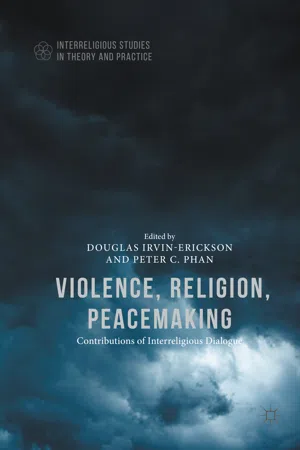
Violence, Religion, Peacemaking
- English
- ePUB (mobile friendly)
- Available on iOS & Android
eBook - ePub
Violence, Religion, Peacemaking
About this book
This volume explores how religious leaders can contribute to cultures of peace around the world. The essays are written by leading and emerging scholars and practitioners who have lived, taught, or worked in the areas of conflict about which they write. Connecting the theory and practice of religious peacebuilding to illuminate key challenges facing interreligious dialogue and interreligious peace work, the volume is explicitly interreligious, intercultural, and global in perspective. The chapters approach religion and peace from the vantage point of security studies, sociology, ethics, ecology, theology, and philosophy. A foreword by David Smock, the Vice President of Governance, Law and Society and Director of the Religion and Peacebuilding Center at the United States Institute of Peace, outlines the current state of the field.
Information
Topic
Theology & ReligionSubtopic
Peace & Global Development© The Author(s) 2016
Douglas Irvin-Erickson and Peter C. Phan (eds.)Violence, Religion, PeacemakingInterreligious Studies in Theory and Practice10.1057/978-1-137-56851-9_11. Introduction: Interfaith Contributions to Nurturing Cultures of Peace
Douglas Irvin-Erickson1
(1)
George Mason University, Fairfax, Virginia, USA
In 2005, the International Criminal Court issued an arrest warrant for Joseph Kony, the leader of the Lord’s Resistance Army (LRA).1 The warrants brought renewed notoriety to the LRA, which was founded in Uganda in 1986. Yet, most critics seemed more interested in Kony’s interpretation of Catholic Christian doctrines and the superstitions of the LRA culture, rather than examining the long-standing struggle for peace and reconciliation in Uganda.2 Kony was presented by journalists and scholars as a dark and mysterious force—a madman with a fundamentalist personality disorder who convinced a group of followers that he was a spirit medium—whose LRA was not pursuing rational ends and could not be dealt with diplomatically.3 Kony became a spectacle, a savage figure, a heart of darkness. The work of peacemakers seemed pedestrian in comparison. Yet, if there was a tale of uncommon courage, it rested in the peacemakers such as Betty Oyella Bigombe or Archbishop John Baptist Odama, who made trips into Kony’s strongholds to confront him and who risked their lives proclaiming peace.4
Outside of a circle of specialists, little progress has been made during the last decade in understanding the religious contributions to peacemaking—even after scholars around the world, and officials in the US government, proclaimed that world peace could only be won by engaging the world’s religions and religious movements.5 The Iranian Revolution in 1979 was one of the first global events to highlight the fact that academics, policymakers, and statespeople had vastly underestimated the role of religion in global politics in the twentieth century, and that religious peacemakers and conflict mediators were desperately needed.6 It was not until the end of the Cold War brought a proliferation of intrastate conflicts that interreligious violence became an object of extensive scholarship and interreligious peacebuilding became a project for activists and practitioners.7 After 2001, interfaith peacebuilding was once again championed in public by many governments. In practice, however, these same governments subordinated religious peacebuilding initiatives to counterterrorism initiatives, and supported top-down approaches to peace that privileged state institutions and treaties. In the meanwhile, religious peacemakers on the ground continued to do their work, bringing about real and lasting change in their own societies and among enemies.8
Why are religious contributions to cultures of peace overshadowed by the overwhelming focus on religious violence? One reason for this neglect is that peacemakers themselves often prefer that their work remains anonymous. A second reason is that violence carries a broad cultural and symbolic significance, as either traumatic or honorable, but nevertheless something that should be remembered. Peace, on the other hand, is mundane. The overwhelming majority of human beings never engage in deadly violence in their entire lives, while those who do engage in violence or experience violence spend most of their lives living peacefully.9
Violence is rare. Yet, it occupies a special place in our memories, our religion, our laws, and the stories we tell. Thus, we tell stories of how Agamemnon killed his daughter in sacrifice to the Gods before the Greeks could set sail to rape and pillage the Trojans. Burgundy in Shakespeare’s Henry V speaks of “that the naked, poor and mangled Peace,” while King Henry speaks of “the blast of war” that leads men to “imitate the action of the tiger.”10 And we celebrate when Russia is saved when Napoleon’s armies freeze to death in Tolstoy’s War and Peace. Social scientists and journalists also help perpetuate the assumption that violence is at the core of the human experience. Consider Edward Said’s argument in Covering Islam, for example, and it is clear that journalists, scholars, and politicians have participated in a collective act of producing cultural narratives that reduce the condition of millions of human beings from the so-called Islamic world into a monolithic experience of violence and conflict.11 The law is also guilty of spinning such narratives, too. As Walter Benjamin argued, the legitimization of violence stands at the core of the law, so that violence is seen as the source of peace in both the natural law and positive law traditions.12
This collective tendency to privilege violence in our stories and histories, and to place violence at the center of explanations of the human condition, shapes the way religion, violence, and peace are studied and conceptualized. Because religion is often thought about in reductionist terms as a closed-off belief system that explains the cosmos through circular logic, religious violence is usually presented as something that cannot be prevented through rational means. Interreligious peacemakers, moreover, are often presented as trying to unite what cannot be united, trying to resolve conflicts among groups of people who have incompatible belief sets that fate them toward violence. Yet there is no empirical or social scientific evidence to demonstrate that religion is no more or no less a source of violence than the law, or cultural narratives, or stories. And there is nothing inherent in religion and religious belief that fates religion toward violence or peace. Religion is equally capable of serving as an underlying ideology for violent extremists, as well as a source of inspiration for those whom Scott Appleby has called militants for peace.13
What is interreligious peacemaking and how can religious leaders contribute to cultures of peace in the contemporary world?
The authors in this volume take up this question in various ways, with each presenting a case study on religious contributions to cultures of peace. The chapters in this book were originally written for a conference on Nurturing Peace in Contexts of Global Violence at the New York Theological Seminary in May 2013. The goal of the conference was to promote dialogue between religious leaders of different faiths, practitioners, theologians, and scholars, to help connect the theory and reflective practice of religious peacebuilding. The scope of the contributions to this volume is reflective of the conference goals, and deals with specific case studies from a wide range of disciplinary perspectives. The chapters in the volume—which range from security studies, to sociology, ethics, and ecology, theology, and philosophy—were selected because they are interreligious, intercultural, and global in perspective.
In his contribution to this volume, Sungrae Kim presents a critical analysis of how the Neo-Confucian vision of harmony can be used as a source of interreligious peacebuilding in the contemporary world. Along similar lines, Hans Harmakaputra’s chapter on religiously motivated violence and forgiveness in the case of one Indonesian church examines the theological and sociological basis of love and forgiveness, while charting a theology of reconciliation that can be used by peacemakers in the Indonesian context and beyond. Both authors work with an implicit definition of cultures of peace that underscored the conference theme, defining cultures of peace as social values, attitudes, and behaviors that reflect and inspire social interaction based on the principles of justice, tolerance, and solidarity, that reject violence as a means of resolving conflicts and endeavor to resolve conflicts constructively through dialogue and negotiation.
Several authors take up the question of whether or not interreligious peace work could promote peace even in the context of war. Matthew Ridout, who served in a counterinsurgency mission in Afghanistan with the US Navy, evaluates the US military’s efforts to engage in dialogue with local religious leaders, providing a timely analysis of how religious leaders can be engaged in peacebuilding efforts that has implications for ongoing conflicts in Iraq and the Levant region and beyond, now and into the foreseeable future. Ezekiel Abdullahi Babagario’s chapter likewise draws on his experience in Muslim–Christian interfaith dialogue—as well as his experience as a veteran of the Nigerian Air Force and a theologian...
Table of contents
- Cover
- Frontmatter
- 1. Introduction: Interfaith Contributions to Nurturing Cultures of Peace
- 2. Peacekeeping, Peacemaking, Peacebuilding: An Interreligious Spirituality for Just Peace
- 3. Spirit Cults, Religion, and Performative Peace in Cambodia
- 4. From Tourist to Friend: Vulnerability and Accountability in Short-Term International Peacemaking Delegations
- 5. Radical Love and Forgiveness as Foundation of Reconciliation: A Theological Imagination for GKI Yasmin Case in Indonesia
- 6. Remembering Peace in Religious, Ecological, and Economic Terms
- 7. Historical and Ecological Injustices Through the Lens of Genocide: The United Church of Canada’s Acts of Contrition and the Project to Decolonize North America
- 8. Political Islam and the Darfur Conflict: Religious Violence and the Interreligious Potential for Peace in Sudan
- 9. Armed Peacebuilding: The Peacebuilding Aspects of the Counterinsurgency in Afghanistan
- 10. Religion as a Catalyst for Peacebuilding in Jos, Plateau State North Central Nigeria
- 11. The Neo-Confucian Vision of Harmony and Its Applicability to Interreligious Peacebuilding
- Erratum to: Violence, Religion, Peacemaking
- Backmatter
Trusted by 375,005 students
Access to over 1.5 million titles for a fair monthly price.
Study more efficiently using our study tools.
Frequently asked questions
Yes, you can cancel anytime from the Subscription tab in your account settings on the Perlego website. Your subscription will stay active until the end of your current billing period. Learn how to cancel your subscription
No, books cannot be downloaded as external files, such as PDFs, for use outside of Perlego. However, you can download books within the Perlego app for offline reading on mobile or tablet. Learn how to download books offline
Perlego offers two plans: Essential and Complete
- Essential is ideal for learners and professionals who enjoy exploring a wide range of subjects. Access the Essential Library with 800,000+ trusted titles and best-sellers across business, personal growth, and the humanities. Includes unlimited reading time and Standard Read Aloud voice.
- Complete: Perfect for advanced learners and researchers needing full, unrestricted access. Unlock 1.5M+ books across hundreds of subjects, including academic and specialized titles. The Complete Plan also includes advanced features like Premium Read Aloud and Research Assistant.
We are an online textbook subscription service, where you can get access to an entire online library for less than the price of a single book per month. With over 1.5 million books across 990+ topics, we’ve got you covered! Learn about our mission
Look out for the read-aloud symbol on your next book to see if you can listen to it. The read-aloud tool reads text aloud for you, highlighting the text as it is being read. You can pause it, speed it up and slow it down. Learn more about Read Aloud
Yes! You can use the Perlego app on both iOS and Android devices to read anytime, anywhere — even offline. Perfect for commutes or when you’re on the go.
Please note we cannot support devices running on iOS 13 and Android 7 or earlier. Learn more about using the app
Please note we cannot support devices running on iOS 13 and Android 7 or earlier. Learn more about using the app
Yes, you can access Violence, Religion, Peacemaking by Douglas Irvin-Erickson, Peter C. Phan, Douglas Irvin-Erickson,Peter C. Phan in PDF and/or ePUB format, as well as other popular books in Theology & Religion & Peace & Global Development. We have over 1.5 million books available in our catalogue for you to explore.