- English
- ePUB (mobile friendly)
- Available on iOS & Android
eBook - ePub
About this book
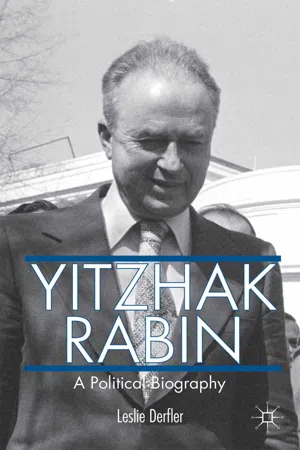
A political and analytical biography, this book examines Yizhak Rabin's longtime leadership of the military and his political direction of the Jewish state, as well as his efforts to secure a peace with Egypt and with the Palestinians.
Information
Chapter 1
Soldier
In early 1941, on Kibbutz Ramat Yohanan near Haifa in northern Israel, an 18-year-old boy, aware of the importance of water in the Jewish-populated region of British-mandated Palestine, awaited a reply to his application to study hydraulic engineering at the University of California. One day the kibbutz secretary asked him whether he wanted to volunteer for a special unit. The boy, named Yitzhak Rabin had already interrupted his high school studies to spend several months on Haganah duty (the self-defense organization of the Yishuv—the Jewish community in Palestine before the birth of Israel), but he felt he had to accept. Six weeks later, a company commander by the name of Moshe Dayan came to the kibbutz to ask him some questions:
“Do you know how to fire a rifle?”
“Yes,” answered the boy.
“Have you ever thrown a hand grenade”?
“Yes,” said a puzzled Rabin.
“Do you know how to operate a machine gun?”
“No,” came a more hesitant reply.
“Can you drive?”
“No.”
“Can you ride a motorcycle?”
“No.”
“All right,” said Dayan. “You’ll do.”1
Rabin’s professional career in the military had begun.
Yitzhak Rabin was born in Jerusalem in 1922 but grew up in Tel Aviv. His parents, both of whom came from Russia, were active in Zionist and socialist movements. After ten years in the United States, his father, born Nehemiah Robichov, had gone to Palestine in World War I to serve in the Jewish Legion created to help the allies oust Turkey from the region. Having been initially rejected because of a physical disability, Robichov changed his name to Rabin, applied again, and this time was accepted. Rabin’s mother, disillusioned by Soviet Communism, had emigrated as well. Humorless and strong willed, she continued to go by her maiden name, Rosa Cohen, and served in labor and defense movements. Much involved in the welfare of Jewish workers and forever at administrative meetings, her hectic public-service-oriented life required her to leave Yitzhak largely to himself in a sparsely furnished and entirely secular home. She, and to a lesser extent her husband, provided the young Rabin with the values of public service and, in view of their socialist orientation, an awareness of “fulfilling one’s duty for the public good.”2
Although subject to a rigorous primary education in a school for workers’ children, Rabin acknowledged that he was a shy and introverted child and that these character traits endured. Yet he was also self-confident and stubborn. The elite agricultural high school he attended—agriculture was the means relied on to make the new Jew in a new homeland—was more like a boot camp or fortress with a Haganah sergeant, Yigal Allon, responsible for military training. Formed in 1920 in view of the British inability—or reluctance—to stop Arab attacks on Jews in the Palestinian Mandate, Haganah had become a quasi-army by the 1930s and, though poorly armed, successfully defended Jewish settlements. It also engaged in bringing immigrants to Palestine, whose numbers were severely limited by the British after the “White Paper” of 1939. Recruited at the age of 18, Rabin was to serve in ever higher capacities for the next 30 years, and a military orientation stamped his diplomatic and political career. According to Hirsh Goodman, assigned to Rabin as his bodyguard in 1967, Rabin was “a soldier who became a statesman but never shed his uniform.”3
Although by 1941 the threat of a German invasion had lessened, Yishuv leaders knew that Haganah forces were composed of relatively untrained workers and farmers who served on a part-time basis. What was also needed was a semi-independent, well-equipped, and permanently mobilized strike force (subject to Haganah authority). Recruited in secrecy, Palmach (the Hebrew acronym for “shock companies)” originated as a British-trained elite unit. Made up of dedicated young men and women prepared to operate with commando-style tactics, Palmach was allowed both autonomy and anonymity for its members by the British. Both Allon and Dayan served as company commanders, and Rabin, offered the choice between the regular Haganah force and Palmach, opted for the latter. Such a force, whose membership by 1947 reached three thousand, gained much experience during the war, and in preparation for a British offensive into Syria and Lebanon the young Rabin participated in a campaign against Vichy French forces.
Unlike the back-slapping Allon, Rabin remained something of a loner in the Palmach, which was described as “a kind of kibbutz-in-arms,” with its comradeship, its own songs and folk dances, and its “in-house poets.”4 Palmach soldiers were not required to salute and could go on a first-name basis with their officers. Their highly developed sense of self-reliance was accounted for by membership in an organization forced to overcome limited numbers and arms and rely on its familiarity with the terrain and on superior analysis. Another assignment called for Rabin to lead a force to free European Jews seeking refuge in Palestine, whom the British had detained and planned to return. Arrested by the British, he was serving a six-month prison sentence when World War II came to an end. Aware that the Yishuv would soon be fighting Arabs in a struggle for independence, he gave up plans to study hydraulic engineering and chose to remain a soldier.
On November 29, 1947, the UN General Assembly proposed a partition of Palestine into separate Jewish and Arab states. When the plan was rejected by the Arab Higher Committee created in 1941, fighting broke out. Six months later, on May 14, 1948, Yishuv leader and head of the Zionist movement during the mandate era, David Ben-Gurion, proclaimed the independence of a Jewish state. When the British Mandate expired the following day, five Arab countries attacked, and Rabin recalled that the prospect of now fighting on four or five fronts persuaded the exhausted members of his unit to switch off the broadcast of (newly named Prime Minister) Ben-Gurion’s speech. The day before the proclamation, Haganah ordered the surrender of four isolated settlements. The defenders of the settlement Kfar Etzion, consisting of 97 men and 27 women, were nevertheless killed by Arab irregular forces who then looted their homes.5
Less than two weeks later, Ben-Gurion’s provisional government created the Israeli Defense Force (IDF) out of the former Haganah. Rabin, now a brigade commander who impressed his superiors with his intelligence and analytical skill, was assigned to help clear and secure the vital Tel Aviv–Jerusalem road, although the attempt to liberate the city failed. He was also involved in the expulsion of Palestinian Arabs from the villages of Lydda and Ramle, which he described in his memoirs as “a troublesome problem,” an expulsion together with others at the end of 1948 that was long denied in Israeli accounts of the war.6
In what the Israelis call the War of Independence (for Palestinian Arabs, it was the Naqba, the “Disaster”), Rabin was already displaying the character traits that were to endure: little patience with, and a harsh and an almost contemptuous attitude toward, those who opposed him (although he seldom raised his voice or lost his temper); disdain for politicians; and resentment of misguided orders, lack of preparedness, and poor training. It was as a Palmach commander in the 1948 War that he was horrified by young, untrained Holocaust survivors sent into combat only to be killed shortly after arriving in the country.7 Although taking pride in the war’s successful outcome and in his own promotions, he always regretted the loss of Eastern Jerusalem, the Old City, to Jordan.
Four years earlier, Rabin had met Leah Schlossberg, the daughter of a German immigrant and then a high school student. Impressed by the handsome soldier and believing ardently in the struggle for independence, she joined the Palmach after graduation. The two were married during a truce in the summer of 1948, just weeks after the invasion of the newly created Jewish state by the armies of Egypt, Syria, Lebanon, and what was then called Transjordan—the emirate originally included in the British Mandate of Palestine. The blond, blue-eyed officer and his attractive wife appeared as typical of the new Israelis, resembling those on posters for the United Jewish Appeal.8
Most controversial was Rabin’s role in the June 22 attack against the Altalena, the ship anchored off Tel Aviv carrying weapons intended for Menachem Begin’s Irgun, an independent resistance force that had opposed the partition and resorted to acts of terror against the British. Despite promises to integrate his forces into the Israeli army, Begin had refused to hand over the cargo of arms (from France). In what amounted to a nascent civil war, Allon and his deputy Rabin secured Prime Minister Ben-Gurion’s authorization to open fire in an effort to persuade the crew to surrender. The Altalena was wrecked, and the episode furthered the end of Irgun as a separate military force. Rabin commanded the forces on the beach, and in a 1994 documentary he called the action against fellow Jews one of the most difficult moments of his life. However, he defended Ben-Gurion’s decision that a state must have only one army, and he never doubted the morality of the government’s decision.
An armistice declared in January 1949 brought an end to a war that had proved costly to both sides. Although the Jewish state proclaimed the previous May signified a victorious outcome for the Yishuv, six thousand Jewish soldiers and civilians, or nearly 1 percent of the population, had been killed. Moreover, the new government headed by Ben-Gurion, whom Israelis compared to George Washington as the founder of the nation, had to overcome a hard-line Right composed of diverse groups, the most prominent of which was led by Begin. Between three hundred thousand and seven hundred thousand Palestinian Arabs had fled (long the Israeli explanation) or were driven from their homes (the Arab explanation). The most infamous incident was the earlier attack on the Arab village of Deir Yassin by unprofessional underground irregulars who slaughtered civilians in the battle to take the town, which tagged Begin with a terrorist reputation. The Palestinians who left massed in refugee camps in neighboring countries, in the Gaza strip (under Egyptian rule), or on the West Bank of the Jordan River (controlled by Jordan), and never relinquished the dream of returning.9
That Israeli forces defeated vastly superior enemy armies has been enshrined in the country’s history as the victory of “the few against the many.” In reality, the Yishuv military outnumbered the opposition, whose leaders kept most troops at home for fear of revolution or military coup; whose armies were poorly led and equipped, after the British obeyed an injunction to stop selling weapons to them; and who lacked motivation—in contrast to Israel, for whom victory meant survival. Still, this superiority in numbers should not minimize the astonishing mobilization of 17 percent of the population, of nearly 100,000 in a total population of 650,000. It is also true, as acknowledged by historian and future minister of foreign affairs Shlomo Ben-Ami, that with successes on the ground, a war of defense turned to one of expansion when Israeli forces pushed beyond the lines established by the UN resolution partitioning Palestine.10
Rabin’s first exposure to diplomacy took place during the armistice, when Egyptian and Israeli delegates met on the island of Rhodes in January 1949. As part of the Israeli delegation representing the southern front and now a lieutenant colonel, he found the peace premature and refused to sign the treaty (his signature was not needed for it to become effective). As a soldier, he played a role in preventing the return of Palestinians who had either voluntarily fled their homes or were encouraged to do so by Palestinian leaders who exaggerated the atrocities they said would follow. The Israeli army evictions that drove others away were not often the result of orders specifically given to do so but reflective of an attitude inspired by the wish to create a Jewish contiguity beyond the partition lines initially called for. As a “diplomat,” Rabin approved of the government’s decision to achieve “secure frontiers” and to make the right of Jews—not Arabs—to return to Israel official policy, one that would remain a major source of controversy in future Israeli-Palestinian negotiations.11
Ben-Gurion’s order to disband the Palmach in November 1948 and integrate it into a unified military force dismayed Rabin and his fellow officers. A furious Allon preferred to leave Israel, temporarily as it turned out, and he and most other Palmach commanders resigned from the army (the reason for his deputizing Rabin to replace him at Rhodes.)12 The Jewish state’s first prime minister insisted on the dismantling of the Palmach because he believed in Mamlachtiut, “statism,” and wanted one united country and one united army. The Yishuv, to take another example, was torn apart ideologically with separate school systems for separate political parties. Ben-Gurion wanted neither this nor an army led by “Palmach youngsters,” whose affinity for the kibbutz as a way of life and whose support for the far-left Marxist and pro-Soviet Mapam party smacked of excessive independence. There was to be no separate workers’ army, only a single national command, the IDF. Whether, like Rabin, they remained in the military (where they were initially made to feel unwelcome) or whether they returned to civilian life, former Palmachniks remained associated with Mapam, the second-largest party and one that opposed Ben-Gurion’s ruling Zionist Mapai. Begin’s Herut Party, a continuation of the Irgun in civilian dress, was the third largest.
Rabin attended the Palmach veterans’ annual get-together the following year despite Ben-Gurion’s clearly stated opposition to the gathering. For Rabin it was a question of loyalty to his old comrades, and he believed that his disobedience prompted the resentful prime minister’s decision a decade later to hold up his appointment as chief of staff, a decision initially recommended and strongly supported, according to Rabin, by the young technocrat who worked for Ben-Gurion and handled military procurement, Shimon Peres.13
Dedicated to the army (where he tended to shun political activity), a dedication fully understood and aided by his wife, Rabin could spend little time with a growing family, which now included a daughter, Dalia, born in 1950, and a son, Yuval, born four years later. Inasmuch as Israeli strategy was based on instant reprisal if attacked, Rabin heavily involved himself with training troops in preparation for what he and many in the government believed was the coming next war.
The armistice that brought an end to the War of Independence did not bring peace. The Arab countries contiguous to Israel closed their borders to the Jewish state. Egypt also closed the Suez Canal to Israeli shipping as well as the Straits of Tiran, which provided access to the Gulf of Aqaba. Other Arab countries joined with Egypt in boycotting trade to Israel. The new state was indeed “under siege.”14
Having been placed in charge of the Northern Command, Rabin played no direct part in the Sinai campaign of 1956. His belief that withdrawal from the peninsula and the adjacent Gaza Strip in 1948 would lead to renewed warfare was vindicated (and was to persuade him in a 1975 negotiation with Henry Kissinger that a third withdrawal required absolute evidence of Egypt’s peaceful intentions). As commander in the north he fought in several small battles with the Syrians and took pride that in none of them had he yielded territory. Yet he found the Israeli invasion of Egyptian territory, however brilliantly conducted, “a serious political mistake.” In an interview with journalist Milton Viorst years later, Rabin said that “Ben-Gurion, together with the British and the French” believed the “the war would bring down [Egypt’s new leader, Colonel Abdel Gamal] Nasser, and we would get the whole of the Sinai as part of Israel.”15
These far-reaching political and territorial goals, however, were not achieved and could not be: “A small country like Israel, tough as its army might be, could destroy all the Arab forces and still lack the means to impose its political will.”16
Rabin went on to say that “with enormous reserves in population and territory, the Arabs can fight on indefinitely, after their armies are destroyed [and] that the several years of respite from a future war that Israel won in the Sinai campaign may not have been worth the losses.”17 The intervention of the superpowers, which put pressure on Israel to return the Sinai and Gaza to Egypt, provided Rabin with the evidence, as Viorst put it, “to validate his contention.”18 Insofar as Rabin stated these convictions well before Viorst published them in 1987, it is not accurate to identify the Intifada (which broke out in December of that year) as responsible for Rabin’s change of mind regarding the improbability of a military solution to Israel’s security problems: he was already convinced that only a political solution could solve them.
The Israeli decision to invade Egypt at the end of 1956 is explained by historians as a consequence of both Palestinian infiltration into the Negev from Gaza—that is, stepped-up fedayeen (Arab infiltrators responsible for hit-and-run raids) activity dur...
Table of contents
- Title Page
- Copyright Page
- Contents
- Preface
- 1. Soldier
- 2. Hero
- 3. Ambassador
- 4. Prime Minister
- 5. Termination
- 6. Interment
- 7. Defense Minister
- 8. Intifada
- 9. Resurrection
- 10. Oslo
- 11. Assassination
- Epilogue
- Notes
- Works Cited
Trusted by 375,005 students
Access to over 1.5 million titles for a fair monthly price.
Study more efficiently using our study tools.
Frequently asked questions
Yes, you can cancel anytime from the Subscription tab in your account settings on the Perlego website. Your subscription will stay active until the end of your current billing period. Learn how to cancel your subscription
No, books cannot be downloaded as external files, such as PDFs, for use outside of Perlego. However, you can download books within the Perlego app for offline reading on mobile or tablet. Learn how to download books offline
Perlego offers two plans: Essential and Complete
- Essential is ideal for learners and professionals who enjoy exploring a wide range of subjects. Access the Essential Library with 800,000+ trusted titles and best-sellers across business, personal growth, and the humanities. Includes unlimited reading time and Standard Read Aloud voice.
- Complete: Perfect for advanced learners and researchers needing full, unrestricted access. Unlock 1.5M+ books across hundreds of subjects, including academic and specialized titles. The Complete Plan also includes advanced features like Premium Read Aloud and Research Assistant.
We are an online textbook subscription service, where you can get access to an entire online library for less than the price of a single book per month. With over 1.5 million books across 990+ topics, we’ve got you covered! Learn about our mission
Look out for the read-aloud symbol on your next book to see if you can listen to it. The read-aloud tool reads text aloud for you, highlighting the text as it is being read. You can pause it, speed it up and slow it down. Learn more about Read Aloud
Yes! You can use the Perlego app on both iOS and Android devices to read anytime, anywhere — even offline. Perfect for commutes or when you’re on the go.
Please note we cannot support devices running on iOS 13 and Android 7 or earlier. Learn more about using the app
Please note we cannot support devices running on iOS 13 and Android 7 or earlier. Learn more about using the app
Yes, you can access Yitzhak Rabin by L. Derfler in PDF and/or ePUB format, as well as other popular books in Politics & International Relations & Middle Eastern History. We have over 1.5 million books available in our catalogue for you to explore.