- English
- ePUB (mobile friendly)
- Available on iOS & Android
eBook - ePub
About this book
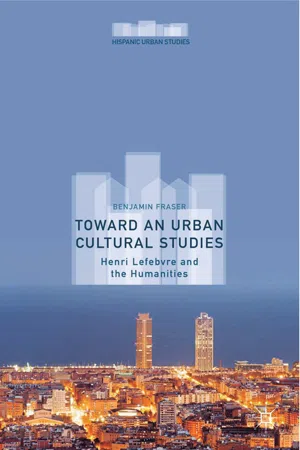
Toward an Urban Cultural Studies is a call for a new interdisciplinary area of research and teaching. Blending Urban Studies and Cultural Studies, this book grounds readers in the extensive theory of the prolific French philosopher Henri Lefebvre.
Information
PART I
Theoretical Ground
CHAPTER 1
Why Urban Cultural Studies? Why Henri Lefebvre?
From the outset it is necessary to point out that any definition of “urban cultural studies” is likely to be as polemical as those of its two constituent parts—“cultural studies” and “urban studies.” The meanings and significance of these terms themselves have been and continue to be hotly and widely debated within and across a number of increasingly interdisciplinary fields. And yet, taking a moment to sketch out the nature of the debates—even if briefly and in general terms—is necessary if we are to understand the current need for an urban cultural studies method, a method that might bridge both humanities and social science scholarship on the culture(s) of cities. The starting point for Toward an Urban Cultural Studies is, thus, to formulate a provisional definition of urban cultural studies. This requires, first, identifying a generalized, but also representative and relevant, thesis of cultural studies method and, second, subsequently applying this thesis to interdisciplinary research on the city in broad terms.
Continuing debates over the nature and relevance of “cultural studies” and “urban studies” involve a similar set of questions, or perhaps better yet a set of relationships. “Cultural studies,” as Raymond Williams wrote in 1986 reflecting on its origins, consists of “the refusal to give priority to either the project or the formation—or, in older terms, the art or the society” (2007a, 152). This is to say that
you cannot understand an intellectual or artistic project without also understanding its formation; that the relation between a project and a formation is always decisive; and that the emphasis of Cultural Studies is precisely that it engages with both, rather than specializing itself to one or the other . . . Project and formation in this sense are different ways of materializing—different ways, then, of describing, what is in fact a common disposition of energy and direction. (Williams 2007a, 151)
From this perspective, to take on a “cultural studies” method is thus to address the relationship between a project and its formation, between art and society. Of course, both in the present work and also in Williams’s original text, this necessary simplification is intended as a point of entry into what is in reality a more complex set of questions. Put in a way that allows us to generalize this central thesis of cultural studies and apply it to interdisciplinary research on the city, the relationship in question is one between material conditions and cultural imaginaries. There is an understanding within cultural studies method that material conditions influence cultural imaginaries and that cultural imaginaries in turn influence material conditions—an understanding that each influences the other, at the very least, and that each may in fact even include the other. For a number of cultural studies theorists, the notion of culture as a process stands as a welcome correction to a legacy of instrumentalist applications of Marxist thought that subordinated culture as a “superstructure” to an economic base that was taken (somewhat shortsightedly) to be purely material.1
The case of “urban studies” serves as an interesting (and, perhaps, an inverse) point of comparison as regards the role of culture in urban research. A recent and prominently placed article, titled “What Is ‘Urban Studies’: Context, Internal Structure and Content,” illustrates how culture is being undervalued, if not left out of the study of cities altogether. The authors of that article list the following seven subfields as constituting the “elements of the corpus of knowledge in the field”: (1) Urban Sociology, (2) Urban Geography, (3) Urban Economics, (4) Housing and Neighborhood Development, (5) Environmental Studies, (6) Urban Governance, Politics and Administration, and finally (7) Urban Planning, Design, and Architecture (Bowen et al. 2010, 200). In this model of urban studies, culture is relevant only to the degree that it is seen as a concern of Urban Sociology or Urban Geography—and, of course, the possibility exists that it may not, in fact, be very much of a concern at all for some scholars in those fields. It is important to recognize that both disciplines are themselves sharply divided into two subgroups, consisting of those who do quantitative, statistical, “hard” research and those who do more qualitative, human, or “soft” research. Whether within sociology or geography, battle lines have often been drawn such that the quantitative “hard science” work on city infrastructures and built environments, on the one hand, has hardly been able to grapple with qualitative, theoretical, humanist, and even cultural explorations of urban life, on the other. Although there may be a number of urban studies departments or programs where culture is explicitly folded into the curriculum in one way or another, as a whole, this growing and highly interdisciplinary field, nonetheless, remains quite far from realizing a full structural or methodological integration of insights gleaned from cultural studies. In fact, the divisions within and across the disciplines associated with the most inclusive iteration of urban studies do little more than perpetuate the disconnect between the humanities and the sciences evident in the Snow–Leavis controversy (see this book’s introduction).2
The use of the term “urban cultural studies” thus points to the subtle but meaningful shift of method that comes from resituating cultural studies research within an urban frame. Within this urban frame, what Raymond Williams called the investigation of “culture” and “society” is rendered as the investigation of “urban culture” and “urban society.” Urban cultural studies, thus, seeks to explore the relationship between a project and its formation in the context of a necessarily and unavoidably urbanized (and urbanizing) society. Returning to Williams’s definition (above), it must be said that “you cannot understand an intellectual or artistic [urban] project without also understanding its [urban] formation; that the relation between [an urban] project and [an urban] formation is always decisive; and that the emphasis of [Urban] Cultural Studies is precisely that it engages with both” (2007a, 151). In addition, there are a number of corollaries that follow from this proposition, each of which will be explored in turn here. For instance, it is important to recognize that urban cultural studies research is not limited to investigating the spaces of cities themselves—in opposition to spaces of the countryside—nor does it treat the built environment of urban locales in isolation from mental formations or matters of (urbanized) consciousness. Moreover, urban cultural studies—in the present formulation—insists on the relevance and value of close readings of cultural texts, whether those are traditionally literary texts, filmic texts, graphic novels, popular music forms (albums, songs, etc.), visual representations of the city (photography, digital media, video games, etc.), or any other concrete form of urban social practice whatsoever.
The approach that results from this proposition and its corollaries clearly underscores the importance of humanities scholarship. As such, it may be seen as an argument for reasserting the value of the humanities in what are perennially troubling economic times. But it is also worth emphasizing that its driving force is of a quite different character. Far from owing its genesis to the need for a timely response to the discourse centered on the perceived waning strength of the humanities, the urgency for formulating an urban cultural studies method has grown organically from existing struggles over the value and directions of interdisciplinary scholarship.3 In this sense, there may be some who come to see the notion of an urban cultural studies—as it is outlined here—itself as an affront to the humanities, and perhaps even as a call to assimilate the humanities into the social sciences altogether. Make no mistake; those who would take this view end by betraying my intentions.
There are three important corollaries to the urban cultural studies proposition as it has been outlined above. First—as did Williams—urban cultural studies recognizes that the rural and the urban should be held in dialectical tension (Williams, The Country and the City [1975]; Lefebvre, The Urban Revolution [2003a]). Or as Louis Wirth of the Chicago School of Urban Sociology put it in his essay “Urbanism as a Way of Life” much more plainly (but no less significantly), “The degree to which the contemporary world may be said to be ‘urban’ is not fully or accurately measured by the proportion of the total population living in cities” (1938, 2).4 This is to suggest that the progressive urbanization of society has resulted in a sea-change shift that affects individual areas spanning the entire globe—urban or not. Wirth continues:
The influences which cities exert upon the social life of man are greater than the ratio of the urban population would indicate, for the city is not only in ever larger degrees the dwelling-place and the workshop of modern man, but it is the initiating and controlling center of economic, political, and cultural life that has drawn the most remote parts of the world into its orbit and woven diverse areas, peoples, and activities into a cosmos. (1938, 2)
This observation is necessarily more significant today than when originally written (over 70 years ago) given that we have passed the “tipping point” of urbanization. As of 2007, more than 50 percent of the world’s population lives in cities. David Harvey’s most recent book, Rebel Cities (2012), interestingly reports even that China’s rural population has decreased from 74 percent to 50 percent over the period spanning 1990 and 2010, and he rightly emphasizes that “Though there are plenty of residual spaces in the global economy where the process is far from complete, the mass of humanity is thus increasingly being absorbed within the ferments and cross-currents of urbanized life” (2012, xv). In this context, it is quite hard indeed to deny that understanding urbanization and its cultural expressions is a worthwhile endeavor, or, for that matter, to suggest that rural populations somehow persist in the state of isolation or relative autonomy with regard to global urban processes.
Second, whether one gains insight from the canonical essay “The Metropolis and Mental Life” written by Georg Simmel at the turn of the twentieth century (2010; originally published 1903), or Harvey’s relatively recent (and more explicitly Marxist) text The Urban Experience (1989; originally published 1985), the progressive urbanization of society has been accompanied by a corresponding urbanization of consciousness.5 The material conditions of urbanization have evolved hand in hand with the development of an urbanized cultural imaginary. These two cohabitating aspects of contemporary urban life reveal a dialectical premise at work, one that is moreover, in general terms, embraced by a wide spectrum of urban thinkers. Certain spatial thinkers such as Lefebvrian urban theorist Harvey and Marxist urban philosopher Henri Lefebvre invoke a specifically (and in my view appropriately) Marxian avatar of this dialectical premise. Such thinking is also evident, to some degree, in the work of urban thinkers Lewis Mumford and Sharon Zukin, for example.6 But Marxian or not, acknowledging this dialectical process remains a hallmark of approaches that attempt to think the city, broadly speaking. As Harvey notes, Robert E. Park—also of the Chicago School—once stated clearly that “indirectly, and without any clear sense of the nature of his task, in making the city man has remade himself” (1967, 3; quoted in Harvey 2012, 4).7 I find there is no way of explaining the modern activity of urban planning that does not admit the following: that ideas about cities shape city plans, which physically shape cities, which in turn engender ideas about cities, and so on—forming a dialectical urban circuit of sorts. To think otherwise is to accept a very simplistic understanding of the planning process that renders it ideologically neutral. Such an understanding has been critiqued heavily by Richard Sennett (e.g., The Conscience of the Eye [1992]; The Craftsman [2008]; Flesh and Stone [1994]) and, of course, by Henri Lefebvre, as well, as the chapters of this book will explore (see also Fraser 2011a; Lefebvre 2003a, 1996). To think otherwise is also to perpetuate the discourse that privileges urban planning as a specialized activity that purportedly operates independently of wider social contexts, material conditions, and cultural practices.
Third, urban cultural studies seeks to bridge discussions of material conditions and cultural imaginaries in a broader social context. It achieves this both by asserting the importance of an interdisciplinary framework inspired by the potential and promise of urban studies—one that values both theoretical and practical knowledge of the city—and also by maintaining the humanities emphasis on cultural texts. This operation is rendered necessary by the current lackluster state of dialogue crossing the humanities/social science divide. Even in the best of cases, discussions of culture in Urban Sociology or Urban Geography writ large may (and, in fact, tend to) fall short of sustaining a rigorous engagement with the humanities.8 In truth, neither of these two (inter)disciplinary discourses systematically reserves a privileged place for close “textual” readings of cultural products themselves (individual novels, films, albums, graphic novels, visual representations, digital media, etc.).
A brief look at the ambivalence of Harvey’s engagement with literary and filmic texts in his own work (or, alternately, the relative lack thereof), for example, will illustrate what is at stake when working across disciplinary boundaries. In the essay “City Future in City Past: Balzac’s Cartographic Imagination,” for example, Harvey rightly points out that novels “have inspired the imagination, influenced conception of, for example, the city, and thereby affected material processes of urbanization” (2003, 24). And yet, he is not always so culture-savvy. When it came to discussing the cinema in The Condition of Postmodernity, he had famously suggested that film is “in the final analysis, a spectacle projected within an enclosed space on a depthless screen” (Harvey 1990, 308), a position that has provoked decades of sustained protests by cinema scholars.9 He is right, of course, to argue that the “cultural turn has been accompanied by a certain depoliticization of academia in recent times” (Harvey 2003, 23). And yet, precisely what urban cultural studies (and cultural studies, more generally) has accomplished is a repoliticization of cultural inquiry—as Harvey himself admits on the same page, singling out the work by Williams, Stuart Hall, and Fredric Jameson as exemplary.10
The lack of an unambiguous, rigorous, and sustained engagement of the humanities areas with which urban theorists should be attempting to dialogue is troubling. This is not merely because it leaves the humanities out of the discussion (this is, after all, a conversation to which we humanists would very much like to be invited), but moreover because the humanities themselves are in fact central to what this discussion is all about. First and foremost, given the dialectical premise through which archit...
Table of contents
- Cover
- Title
- Introduction
- Part I Theoretical Ground
- Part II Textual Variations
- Conclusion
- Notes
- References
- Index
Trusted by 375,005 students
Access to over 1.5 million titles for a fair monthly price.
Study more efficiently using our study tools.
Frequently asked questions
Yes, you can cancel anytime from the Subscription tab in your account settings on the Perlego website. Your subscription will stay active until the end of your current billing period. Learn how to cancel your subscription
No, books cannot be downloaded as external files, such as PDFs, for use outside of Perlego. However, you can download books within the Perlego app for offline reading on mobile or tablet. Learn how to download books offline
Perlego offers two plans: Essential and Complete
- Essential is ideal for learners and professionals who enjoy exploring a wide range of subjects. Access the Essential Library with 800,000+ trusted titles and best-sellers across business, personal growth, and the humanities. Includes unlimited reading time and Standard Read Aloud voice.
- Complete: Perfect for advanced learners and researchers needing full, unrestricted access. Unlock 1.5M+ books across hundreds of subjects, including academic and specialized titles. The Complete Plan also includes advanced features like Premium Read Aloud and Research Assistant.
We are an online textbook subscription service, where you can get access to an entire online library for less than the price of a single book per month. With over 1.5 million books across 990+ topics, we’ve got you covered! Learn about our mission
Look out for the read-aloud symbol on your next book to see if you can listen to it. The read-aloud tool reads text aloud for you, highlighting the text as it is being read. You can pause it, speed it up and slow it down. Learn more about Read Aloud
Yes! You can use the Perlego app on both iOS and Android devices to read anytime, anywhere — even offline. Perfect for commutes or when you’re on the go.
Please note we cannot support devices running on iOS 13 and Android 7 or earlier. Learn more about using the app
Please note we cannot support devices running on iOS 13 and Android 7 or earlier. Learn more about using the app
Yes, you can access Toward an Urban Cultural Studies by Benjamin Fraser in PDF and/or ePUB format, as well as other popular books in Social Sciences & Social History. We have over 1.5 million books available in our catalogue for you to explore.