eBook - ePub
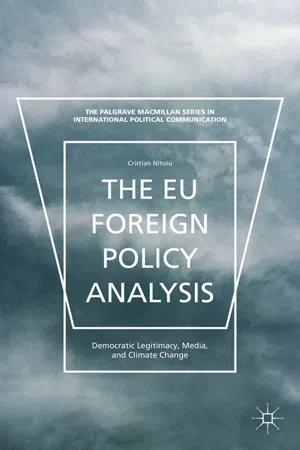
The EU Foreign Policy Analysis
Democratic Legitimacy, Media, and Climate Change
- English
- ePUB (mobile friendly)
- Available on iOS & Android
eBook - ePub
About this book
The book presents a model of interaction effects between policymakers and the media which can shed light on the former's ability to enhance democratic legitimacy in foreign policy decision-making. It shows that the media enhanced the democratic legitimacy of the EU's foreign policy in relation to its climate policy and its approach towards Russia.
Information
C H A P T E R 1
Democratic Legitimacy and EU Foreign Policy: Is Such a Link Conceivable?
Introduction
Even though the lack of democratic legitimacy that the European Union (EU) is widely perceived to suffer from has concerned scholars, students, and practitioners, attention has been only recently directed toward the area of foreign policy. The book aims to fill this gap by inquiring into the way in which the media through its activity and interactions with policymakers in the European public sphere (EPS) has the potential to endow the EU’s foreign policy with democratic legitimacy. In focusing on the media and its role within the public sphere, this book provides a robust understanding of democratic legitimacy, complementing approaches constructed around the principle of representation. The emphasis on democratic representation has characterized the few studies that have inquired into the link between the EU’s foreign policy and democracy. The notion of democratic legitimacy is here seen to encompass multiple aspects—transparency, accountability, responsiveness, and openness to public debate. The first part of this chapter provides an overview of the current debates on the foreign policy of the EU and the way they deal with the issue of democratic legitimacy. Three broad debates are identified, centered on the idea of the nation-state and the EU, the role of the Union’s institutions, and finally the role of the ontology on which the EU is predicated. In doing so, the first section positions the argument developed within the debates regarding the EU foreign policy and defines its key concepts. Then it moves on to surveying the way foreign policy analysts have aimed to account for the relationship between media and democratic legitimacy in foreign policy. The aim of the second part of the chapter is to develop the idea of the public sphere and the way in which the actions of the media (within the public sphere) have the potential of endowing foreign policy decision making with democratic legitimacy. By introducing the notion of the EPS, this chapter highlights the ability of the media through its interactions with policymakers to enhance the democratic legitimacy of the EU’s foreign policy. Through the EPS decision-making processes are opened up to public debate and scrutiny, boosting in this way their accountability and transparency.
Debating the Nature of the Eu’s Foreign Policy
By inquiring into the way in which the EU’s foreign policy is endowed with democratic legitimacy through the activity of the media within the EPS, this book is also implicitly challenging the wide consensus that the foreign policy of the EU is an elite-driven domain where only states, institutions, and national or supranational identities matter. Rather than asking how any of these three aspects construct the foreign policy of the Union and influence its effectiveness, it looks at the way the EU’s ontological commitment to democracy is translated into practice in this policy area. The need for such an endeavor is justified by the pervasiveness of democratic values within the makeup of the European project: being present in the EU’s treaties and, at least theoretically, informing its policy practice. Throughout this book, EU foreign policy is understood to be the result of the fusion between member states and the EU institutions’ actions and interest, and their interactions within the dynamic and multilevel setting of the Union. This choice is also justified by the myriad approaches found throughout the literature and the consensus regarding the complexity that characterizes EU foreign policy. This section provides a review of the literature on EU foreign policy and positions the argument of the book within it. Although not exhaustive, a list of three main areas of focus can be identified within this scholarship: a focus on the nation-state that involves either comparing it to the EU or analyzing the role the member states, an interest for internal processes—mainly institutional realities—and a focus on ontology and the way identities, polities, and narratives are constructed and employed. At the same time, the theme of effectiveness or whether the foreign policy of the EU actually works is present throughout all three perspectives. The last part of the section explores the way in which scholars have recently inquired into the impact of the decline of intergovernmentalism on the relationship between democracy and the EU’s foreign policy.
The EU and the State
The broader focus on the nation-state has spawned two types of debates in the EU foreign policy literature: the first aims to account for the nature of the foreign policy of the EU in relation to the nation-state, while the second analyzes the way the national interests of member states influence the foreign policy of the Union. Despite the recent focus on processes,1 scholars of European Studies have always tried to figure out the “nature of the beast” (Risse-Kappen, 1996). Questions inquiring into the nature of the EU have been posed in relation to all of its policy areas: from justice or foreign policy to migration and agriculture. In this sense, during the 1990s and the beginning of the 2000s the challenge for many was to evaluate whether developments in foreign policy analysis (FPA) can be used in order to analyze the Union’s foreign policy (Allen and Smith, 1990; Hill, 1993; White, 2001; Carlsnaes, Sjursen, and White, 2004). The question whether the EU’s foreign policy resembled that of the nation-state was crucial here. The literature became divided between the idea that the EU is a new kind of international actor and the perspective that it is similar to or should be analyzed in a way same as the nation-state. In support of the latter argument, Hazel Smith contends that the EU needs a foreign policy “much the same as that of the nation-state” (Smith, 2002, p. 7). She goes on to propose that scholars should spend more time conceptualizing the ways in which the EU can become as effective as the nation-state and not on the nature of the Union as an international actor.
In his review of the arguments put forward in the literature, White (1999, p. 46) stresses that the foreign policy of the EU differs from that of the nation-state in a number of important aspects: it is not a fully sovereign entity, its actors are more complex than within the state spanning from institutions, to interest groups and the member states themselves; and, as a result of the diverse mixture of actors involved in foreign policy, its processes differ, having a direct impact on the way in which the international agenda of the EU is constructed. The Union also lacks a coherent military capacity and has only recently started developing a diplomatic body (the EEAS), making its available instruments more limited than those of the nation-state—which has a more coherent diplomatic system and is traditionally equipped with instruments of both soft and hard power. Thus, the instruments that are in the hands of the Union seem to be not as effective as those of the nation-state (White, 1999, p. 48). Moreover, many scholars have highlighted the gap that exists between the EU’s own expectations of its role in the international arena and its capabilities or instruments (Hill, 1993; Hyde-Price, 2006; Rynning, 2011). The issue of effectiveness has also been linked with the coherence of the coordinative processes between the EU’s institutions and the member states, with an emphasis on the nation-state’s superior ability (Biscop and Andersson, 2007). Consequently, a discussion of the differences between the EU and the nation-state (from a sui generis perspective or not) finds the Union searching for a more effective foreign policy that could provide concrete policy outcomes and successes.
The comparison with the foreign policy of the Westphalian nation-state has proven to be very fruitful at an intellectual level, giving birth to ideas spanning from views that posit that the complexity of the EU makes it have a sui generis foreign policy, to the perspective that its foreign policy is similar to that of nation-states—only weaker—or that the Union should strive to have a more Westphalian type of foreign policy. However, this negative identification with the nation-state has mostly overlooked the way the EU has shifted the boundaries and links between state, society, and politics, transnationalizing its foreign policy and opening it up to a transformed type of engagement with democratic legitimacy. Hence, the question of the presence of democratic legitimacy and the way it is enacted in the EU’s foreign policy is ignored here altogether.
The second strand of arguments which focuses on the foreign policies of the member states also sidelines the issue of democratic legitimacy, as most contributions draw their assumption from the realist tradition in international relations (IR) theory. Democratic legitimacy is largely irrelevant here, as domestic factors more broadly are generally considered to be less salient for the construction of the EU’s foreign policy. Member states and the way they pursue their national foreign policy strategies have also been a focus in scholarship. Disagreements regarding the policy toward Russia or about the degree of Atlanticism that the EU should convey have been frequent among the member states (Biscop and Andersson, 2007). Traditionally, it has been considered that foreign policy is a domain of high politics where cooperation still remains intergovernmental (Bull, 1982; Moravcsik, 1997). As conflicts tend to be pervasive, little agreement can be forged on foreign policy issues within the EU which becomes the result of the “lowest common denominator” between the national interests of the member states (Nuttall, 2000).
Moreover, Hyde-Price (2006, 2007) contends that the EU is a “calculator, not a crusader” in that it behaves like a normal interest maximizer in the international arena and almost never shows signs of being altruistic. This happens because the member states are still very keen to protect their sovereignty and wish to pursue their individual interests. As such, from Hyde-Price’s view, the foreign policy of the EU is prone to remain intergovernmental. Moreover, big member states such as France or Germany engage in developing and accept EU foreign policy only when it promotes their interests or it does not endanger them—in instances when second-order interests and issues, such as human rights or humanitarian aid, are involved. While the variety of diverging national interests has made it almost impossible for these member states to settle on important foreign policy issues, they have been quite successful in developing—at least rhetorically—common normative goals in marginal issue areas. These have included the promotion of human rights, democracy, rule of law, environmental protection, or tackling climate change and poverty (Hyde-Price, 2008). Drawing on the realist tradition in IR theory, Hyde-Price’s view legitimates the idea that only the three big EU member states—France, Germany, and Great Britain—have the capacity of developing the EU into a strong international actor. They can achieve this only if they work together to pool all their influence in order to successfully shape the international agenda on pressing issues like Iran or North Korea (Hyde-Price, 2007). What this ultimately suggests is that the member states are considered to have a central role in forging the foreign policy of the EU. This book acknowledges the salience of member states and includes two sample states which vary regarding the level of commitment, power and influence in shaping EU foreign policy, but also other characteristics—detailed in chapter 3—such as the political system or the media culture: the United Kingdom and Romania.
Institutional Approaches
Recent years have shifted the focus more toward processes and assessing the institutional realities that contribute to the creation of the EU’s foreign policy. The foreign policy of the EU is viewed in this literature as epiphenomenal to the institutional processes internal to the Union, being one of its byproducts. Within this scholarship, sociological institutionalist approaches which have become increasingly popular during the last two decades are based on the social constructivist theories of institutional building and learning developed in IR scholarship for the study of international organizations (Ruggie, 1998; Wendt, 1994, 1999; Guzzini and Leander, 2006). These perspectives advocate a greater focus on the decentralized nature of the Common Foreign and Security Policy (CFSP), where decisions and expertise are shared among various institutions, committees, and policy groups. This approach also gives a higher degree of attention to the way in which member states contribute to the institutional processes behind foreign policy as entrepreneurs, implementers, drives, or barriers (Smith, 2004; Aggestam, 2008). Accordingly, foreign policy in the EU is not always the result of the lowest common denominator, but tends to balance toward a consensus from which decisions can derive. EU foreign policy is seen as being characterized by “a constant rule-governed process of negotiation between actors which produces policy positions and international outcomes” (Smith, 2005, p. 55).
While advocating a more inward perspective that looks at the internal processes of the EU’s foreign policy, the institutionalist scholarship tends to equate issues of democratic legitimacy with the way in which decisions are adopted. But, as Hill and Wallace have pointed out, foreign policy encompasses more than formal processes. According to them, an “effective foreign policy rests upon a shared sense of national identity, of nation states’ place in the world, its friends and enemies, its interests and aspirations” (Hill and Wallace, 1996, p. 8). In the case of the Union, where national identity is itself contested, the idea of effectiveness framed in this way becomes misleading. The key question here is whether the lack of a coherent identity that could sustain an effective foreign policy validates the recent focus on institutional processes in the literature. A closer look at the Union points to the fact that one cannot separate ontology from praxis in its foreign policy (Bickerton, 2011a, p. 118). An institutional approach looks only at one side, at a technical and very complex area of EU foreign policy, overshadowing and taking for granted other components of the EU’s ontological constitution, such as the need for democratic legitimacy.
Although only marginal at this point, more critical institutionalist approaches share an emphasis on discourse in shaping the foreign policy of the EU. Drawing on Bourdieu’s (1992) sociology, discourse refers here not only to the structure, the text or the ideas that are put forward, but also to the agents that create them. In its broader scope, this literature seeks to understand the relationships between ideas and policy, and the way ideas bring about change in institutions. The focus is on agents rather than on structure, as “ideas provide us with interpretive frameworks that make us see some facts as important and others as less so” (Beland and Cox, 2010, p. 3). Hence, ideas provide individuals, through communication, with a shared understanding of what represents legitimate political action within institutions. The link between ideas and policy is researched by looking at the ideas that construct or deconstruct political institutions and the way they are interpreted and enacted. According to Schmidt’s (2001, 2008b, 2010) conceptualization of discursive institutionalism, ideas are always the result of discursive processes that take place within discursive contexts. Discourse shapes the behavior of actors within their field, but ultimately their existence and reification is linked to their intentionality. Schmidt (2008b) differentiates between coordinative discourses which describe practices that take place within institutions far from the public eye, and communicative discourses through which elites and institutions communicate political ideas to the general public. She goes on to argue that the more structural coordinative discourses are central to the construction of the EU’s foreign policy. This happens because complex polities need to spend a significant degree of time and resources on internal coordination, in this way putting more emphasis on coordinative discourses and less on trying to build popular support and legitimacy. Conversely, in simple polities where political activity is usually concentrated around a single authority (such as in Britain), the communicative strategies of institutions toward the general public tend to be more elaborate than those devised in order to coordinate policy actors.
The Focus on Ontology
The EU’s search for meaning has driven scholars to inquire into the way the ontology of the Union predisposes it to behave in certain ways in the international arena. This has prompted a debate regarding the way in which the EU’s foreign policy is endowed with democratic legitimacy stemming from its internal makeup and citizens (Sjursen, 2007, 2011, 2012; Manners, 2010c; Bickerton, 2011b). However, a focus on democratic legitimacy has been only marginal, and at times ignored in favor of the view that the EU is inherently democratic—due to the deep commitment to principles of democracy inscribed in its treaties—which constrains it to behave normatively and altruistically in the international arena. The idea that the EU is a postmodern power which acts normatively in its IR has become very popular during the last ten years. Manners (2002) first introduced the idea in his 2002 seminal article which has been developed and criticized by a whole array of scholars. When asked to state his opinion about the idea that the EU acts as a normative power in the international arena, the former president of the European Commission Jose Manuel Barroso argued that “the EU might be one of the most important normative powers in the world because of its ability to establish normative principles and apply them to different realities” (quoted in Manners, 2008a, p. 60). Barroso agrees here with Manners’s idea that the EU projects its power in the international system by shaping various principles and norms, and persuading different actors to adopt them. By endowing its norms with universality and imposing them on others, the EU is spreading a culture that transcends the state-centric approach which is commonly believed to characterize international politics (Manners, 2008b, p. 55).
Terms such as force for good or Normative Power Europe have been advanced in order to create this self-image of the EU (Eriksen, 2006; Wagnsson, 2010; Forsberg, 2011). During the Cold War, as Manners (2010b) claims, the hybrid polity was still searching for a different foreign policy avenue through which it could establish the EU as a strong international actor. During that period, the hybrid polity opted at times either for the development of a civilian power, or for that of a military power—a political and conceptual dance that was regulated by the relations between the two superpowers of the time, the United States and the Soviet Union. As such, in times of tension the development of a military force was favored, while during the détente, relying on civilian power was seen as a much better option (Manners, 2010a). Manners goes on to argue that after the Cold War these two views lost ground to the idea of the EU behaving in a normative way in the international arena. The hybrid polity tried to achieve this by constructing different narrative norms aimed at shaping perceptions within the international arena of different states and regimes. They portrayed different states as evil or threatening, but never gambled with the option of intervening with military forces in order to make them more secure (Sjursen, 2006; Rogers, 2009; Selden, 2010). Manners (2002, 2008a, 2008b) unfolds this argument in order to show that the fact that the EU acts in a normative way does not stem from the nature of the hybrid polity that governs it, but from its politico-legal constitution that constrains its policies and actions.
Criticizing the EU’s normative self-im...
Table of contents
- Cover
- Title
- Introduction
- 1 Democratic Legitimacy and EU Foreign Policy: Is Such a Link Conceivable?
- 2 Mapping Interaction Effects within the Media/Foreign Policy Nexus
- 3 Research Framework and Methods
- 4 The Transnational Level
- 5 The United Kingdom
- 6 Romania
- Conclusions
- Annex A
- Annex B
- Notes
- Bibliography
- Index
Trusted by 375,005 students
Access to over 1.5 million titles for a fair monthly price.
Study more efficiently using our study tools.
Frequently asked questions
Yes, you can cancel anytime from the Subscription tab in your account settings on the Perlego website. Your subscription will stay active until the end of your current billing period. Learn how to cancel your subscription
No, books cannot be downloaded as external files, such as PDFs, for use outside of Perlego. However, you can download books within the Perlego app for offline reading on mobile or tablet. Learn how to download books offline
Perlego offers two plans: Essential and Complete
- Essential is ideal for learners and professionals who enjoy exploring a wide range of subjects. Access the Essential Library with 800,000+ trusted titles and best-sellers across business, personal growth, and the humanities. Includes unlimited reading time and Standard Read Aloud voice.
- Complete: Perfect for advanced learners and researchers needing full, unrestricted access. Unlock 1.5M+ books across hundreds of subjects, including academic and specialized titles. The Complete Plan also includes advanced features like Premium Read Aloud and Research Assistant.
We are an online textbook subscription service, where you can get access to an entire online library for less than the price of a single book per month. With over 1.5 million books across 990+ topics, we’ve got you covered! Learn about our mission
Look out for the read-aloud symbol on your next book to see if you can listen to it. The read-aloud tool reads text aloud for you, highlighting the text as it is being read. You can pause it, speed it up and slow it down. Learn more about Read Aloud
Yes! You can use the Perlego app on both iOS and Android devices to read anytime, anywhere — even offline. Perfect for commutes or when you’re on the go.
Please note we cannot support devices running on iOS 13 and Android 7 or earlier. Learn more about using the app
Please note we cannot support devices running on iOS 13 and Android 7 or earlier. Learn more about using the app
Yes, you can access The EU Foreign Policy Analysis by C. Nitoiu in PDF and/or ePUB format, as well as other popular books in Politics & International Relations & Diplomacy & Treaties. We have over 1.5 million books available in our catalogue for you to explore.