- English
- ePUB (mobile friendly)
- Available on iOS & Android
eBook - ePub
About this book
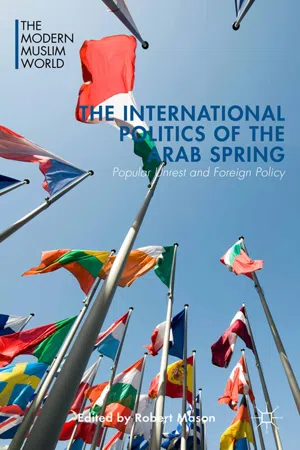
This book explores and analyzes how the Arab Spring has affected the political and economic relationships between the West, the BRICs (Brazil, Russia, India, China, and South Africa) and the MENA (Middle Eastern and North African states). It locates continuity and change in these relations within the broader context of democratization, energy, security, arms relationships, and the shift towards a multi-polar system. Each chapter charts a history of ideological engagement, which has generally given way to more pragmatic energy, economic, and security interests, and defines and analyzes the fundamental and emerging factors that shape foreign policy. The volume pays special attention to the UN Security Council authorization of "all necessary measures" against Qaddafi's Libya and the subsequent deadlock in getting China and Russia to pass further Resolutions for intervention in Syria.
Information
C H A P T E R 1
The Arab Spring as a Challenge to Political Science
Martin Beck
INTRODUCTION
The critical descriptions, explanations, and analyses of the Arab Spring rank among the major recent challenges within political science. Thus, this chapter aims to contribute to the identification and discussion of those important areas for research within the discipline. The fact that the social scientific research on the Middle East failed to predict the Arab Spring serves as a starting point of the analysis. Yet, the aim of this contribution is neither a collective (self-)accusation nor apologia. Rather, it shall discuss which aspects of the Arab Spring took the research community by surprise. It will thereby identify empirical evidence and unpack theoretical constructs on which to contribute to a satisfactory analysis of the Arab Spring.
In the following chapter, the most important of the surprising effects of the Arab Spring are to be investigated. Then, the following research questions shall be discussed in more detail: Is the Arab Spring of epochal relevance; what role is played by Islamism and civil society; what is the relationship between the Arab Spring and globalization; how can the new political diversification in the Arab Middle East be grasped and explained; and what are the future prospects? The chapter ends with a short summary.
THE ARAB SPRING IN THE LIGHT OF POLITICAL, SCIENTIFIC RESEARCH QUESTIONS
Some prominent academics of the social sciences and Middle East studies, for example, Gregory Gause III, dealt early on and productively with the issue of what lessons the Arab Spring taught us about academic research on Middle Eastern social and political affairs.1 There is, however, a danger that a rigorous debate on the Arab Spring could be obstructed by attitudes of a defensive nature. It is indeed true that (despite higher funding) the prognostic performances of other disciplines (such as economics) have also been rather modest (for instance, in terms of predicting the recent global financial crisis). Moreover, rather than generating forecasts, the most prominent task of the social sciences is to describe and explain actors and their behavior.2 In that way “Arab exceptionalism”—the Arab Middle East as the only major world region that has not been substantially affected by any of the major waves of democratization in the twentieth century—constitutes a desideratum for research that is not simply settled by the Arab Spring. Rather, both the decades-long Arab exceptionalism and its possible termination need a social scientific and satisfactory explanation.
In the immediate years before the Arab Spring, there was a periodically recurring demand of some groups within the oriented Middle East research community to abandon the empirically flawed democratization paradigm, labeled as “demo-crazy.”3 It was further argued that research on the Middle East should be based on concepts that are suitable to analyze the nondemocratic realities of the Middle East. No matter what changes are ushered in by the Arab Spring, this line of research has not been made obsolete: First, research on the Middle East must continue dealing with the period before the Arab Spring. Second (for the time being), the Arab Spring has triggered a variety of changes in some Arab countries, from regime modification to regime change, but not in all. Therefore, researchers on the Middle East are well advised to be self-critical and become engaged in concepts of political change. Yet, concepts of authoritarianism are not obsolete for analyses of the Middle East.
Gause’s point of leverage in investigating the failure of the Middle East research community to predict the Arab Spring is based on why political science overestimated the stability of the pre–Arab Spring regimes and what conclusions should now be drawn upon for political advisory (policy analyses).4 As distinguished from him, the present chapter attempts to identify what specific aspects of the Arab Spring are relevant from the perspective of political science and what specific aspects were not predicted, concluding on what that means for social-scientific basic research on the Arab Middle East. The reason to apply this perspective derives from the shortcomings of the “comprehensive” approach that research on the Middle East in general did not predict the Arab Spring. The latter perspective invites scholars to find, through their own research, hints of structural problems in Middle Eastern politics that led to the Arab Spring. However, the fact that many in the Middle East research community may very well have described the political, social, and economic development of the pre–Arab Spring Middle East as crisis-laden subject should not be confused with predicting the Arab Spring. Many of the shadows that the Arab Spring cast were seen and documented by many Middle East researchers—but few were conceived as signs of an imminent upheaval.
First to be discussed in this chapter is the issue of the Arab Spring’s historical significance. In the light of a long-lasting political and socioeconomic crisis of the Middle East, it is more surprising not that there were upheavals but who they have been often caused by: Although Islamist parties have enjoyed by far the highest organizational capabilities of many opposition groups in the Arab World for decades, at the beginning of the Arab Spring it was primarily secular (and according to conventional criteria, unorganized) forces that demanded political change. In some countries these forces terminated the social contract that had severely curtailed political participation in exchange for material benefits for decades. The domestic actors of the Arab Spring used ideas and instruments that—contrary to the last major revolution in the region, the Islamic Revolution in Iran—were hardly specific to the Middle East. Rather, they bore the signature of globalization against which the Middle East had been rather resilient. In demonstrations organized with some of the most advanced social media, people of different social backgrounds demanded political change, thereby invoking ideals that were congruent with those of the global concept of good governance. Moreover, political change has not been fundamental in all the countries in which it has been initiated. The Middle East research community was taken by surprise insofar as the Arab Spring spread from Tunisia—a country that due to its rather small population and marginal location in Northwestern Africa could have been dismissed as peripheral—to all over the Arab world. This regional phenomenon has thereby challenged regimes whose differences rather than commonalities had been emphasized by pre–Arab Spring research. Herewith and closely connected is the issue of why some regimes fell whereas others did not. Before the Arab Spring, the scientific literature was attempting to pinpoint reasons for the survival of most, if not all, of the authoritarian regimes in the Arab Middle East. Since 2010/11, one of the major scientific challenges is to try to clarify why only some regimes have survived the threat “from below.”
The chapter goes on to cover the political diversification of the Arab world following the Arab Spring, with special reference to new(ly emerging) political systems. Due to the unfinished nature of the Arab Spring, we are not in a position to come up with final assessments on its results. However, three years after the beginning of the Arab Spring it is safe to state that some political systems in the Arab Middle East are still consolidated authoritarian regimes and some others are in a process of political change. Whether the latter ones—or some of them—are in a transition process in terms of democratization with the approaching terminus of a “consolidated democracy” is—in principle—to be considered an open question. There are, however, strong arguments both for empirical and normative research to establish the exact elements of democratization as a benchmark set both by central actors of the Arab Spring and external observers. Such research should recognize the continuity of authoritarianism and the prospects for more and substantial change through further international engagement.
CENTRAL ASPECTS OF THE ARAB SPRING
The Arab Spring as an Epochal Event?
Lisa Anderson deserves the credit for having demanded the “demystifying” of the Arab Spring.5 By doing so, she forced those who claim that the demonstrations in Tunisia and Egypt marked a watershed to sharpen their argument. By pointing to US president Woodrow Wilson’s Fourteen Points speech, Anderson argues that the Arab Spring does not constitute a genuinely new phenomenon. Rather, as she claims, they form part of a chain of civil disobedience actions that Arab nationalists have employed since World War I. Moreover, she emphasizes the differences between the upheavals in Tunisia, Egypt, and Libya, which do not constitute a “cohesive Arab revolt.”6
Anderson certainly makes the Middle East research community take note of an important issue, since, as will be argued in the next chapters, the upheavals in the countries of the Arab Spring sometimes manifested themselves in very different ways. However, contrary to Anderson, it is to be stressed, first, that all three cases examined by her are similar insofar as civil society movements decisively turned against their respective authoritarian regimes and demanded regime change with reference to the principles of universal rights and good governance. They thereby clearly differentiated themselves from previous demonstrations when either no political program could be recognized (as in the case of the so-called bread riots) or they were inspired by ideologies (such as pan-Arabism or pan-Islamism) that were indifferent toward authoritarianism or even proauthoritarianism. Second, the civil-based demonstrations of the Arab Spring proved to be much more effective than their forerunners. In some countries civil society managed to initiate the downfall of authoritarian regimes (some of which enjoyed Western support until the very end) that had been consolidating power over decades.
In order to emphasize the epochal character of the Arab Spring, Jack Goldstone applies the concept of a revolution to the Arab Spring.7 Yet, if revolutions are defined as fundamental changes of the political and socioeconomic fundaments of a system, it is much too early to ascertain whether the Arab Spring is a revolutionary process.8 In the realm of politics, in some cases, regime change has occurred, but representatives of the old forces still play a major role not only in Egypt but even in Libya.9 Whether the change that was initiated will lead to a transition process and finally to institutionalization of democratic systems, which would qualify the Arab Spring for the label “political revolution,” is to be considered an open question. Even if answered in the affirmative, it would most likely be the result of a long-term process. Moreover, there are few, if any, indicators that the Arab Spring established deep socioeconomic change and, again, only if that is proven could the Arab Spring be called a “comprehensive revolution.”
The concept of transition is often associated with the attribute of democratization, which does not reflect the empirical diversity of such processes of political change after the removal of authoritarian regimes in other regions.10 The process of change triggered by the Arab Spring could also end up establishing hybrid regimes or new forms of authorit...
Table of contents
- Cover
- Title
- Introduction
- 1 The Arab Spring as a Challenge to Political Science
- 2 The Obama Administration and the Arab Spring: Waiting for a Doctrine
- 3 The European Neighborhood Policy: Going Full Circle?
- 4 Russia and the Middle East: Adjusting to a New Political Vista
- 5 Diversity behind Unity: Latin America’s Response to the Arab Spring
- 6 India and the Middle East: Before and After the Arab Spring
- 7 Chinese Policies on the Arab Spring
- Conclusion: Conceptualizing the International Community’s Approach to the MENA Region
- Notes on Contributors
- Index
Trusted by 375,005 students
Access to over 1.5 million titles for a fair monthly price.
Study more efficiently using our study tools.
Frequently asked questions
Yes, you can cancel anytime from the Subscription tab in your account settings on the Perlego website. Your subscription will stay active until the end of your current billing period. Learn how to cancel your subscription
No, books cannot be downloaded as external files, such as PDFs, for use outside of Perlego. However, you can download books within the Perlego app for offline reading on mobile or tablet. Learn how to download books offline
Perlego offers two plans: Essential and Complete
- Essential is ideal for learners and professionals who enjoy exploring a wide range of subjects. Access the Essential Library with 800,000+ trusted titles and best-sellers across business, personal growth, and the humanities. Includes unlimited reading time and Standard Read Aloud voice.
- Complete: Perfect for advanced learners and researchers needing full, unrestricted access. Unlock 1.5M+ books across hundreds of subjects, including academic and specialized titles. The Complete Plan also includes advanced features like Premium Read Aloud and Research Assistant.
We are an online textbook subscription service, where you can get access to an entire online library for less than the price of a single book per month. With over 1.5 million books across 990+ topics, we’ve got you covered! Learn about our mission
Look out for the read-aloud symbol on your next book to see if you can listen to it. The read-aloud tool reads text aloud for you, highlighting the text as it is being read. You can pause it, speed it up and slow it down. Learn more about Read Aloud
Yes! You can use the Perlego app on both iOS and Android devices to read anytime, anywhere — even offline. Perfect for commutes or when you’re on the go.
Please note we cannot support devices running on iOS 13 and Android 7 or earlier. Learn more about using the app
Please note we cannot support devices running on iOS 13 and Android 7 or earlier. Learn more about using the app
Yes, you can access The International Politics of the Arab Spring by R. Mason in PDF and/or ePUB format, as well as other popular books in Politics & International Relations & International Relations. We have over 1.5 million books available in our catalogue for you to explore.