eBook - ePub
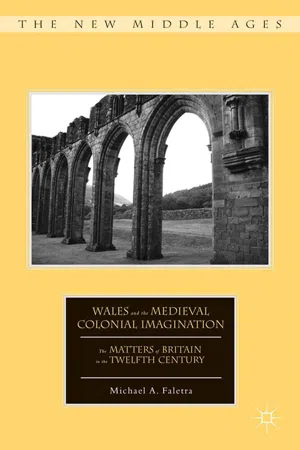
Wales and the Medieval Colonial Imagination
The Matters of Britain in the Twelfth Century
- English
- ePUB (mobile friendly)
- Available on iOS & Android
eBook - ePub
About this book
Focusing on works by some of the major literary figures of the period, Faletra argues that the legendary history of Britain that flourished in medieval chronicles and Arthurian romances traces its origins to twelfth-century Anglo-Norman colonial interest in Wales and the Welsh.
Information
Topic
LetteraturaSubtopic
Letteratura generaleCHAPTER 1
GEOFFREY OF MONMOUTH AND THE MATTER OF WALES
The reconstruction of the literary history of the Matter of Britain was one of the most fertile of scholarly preoccupations in terms of twentieth-century popular culture, and writers like Jessie L. Weston and later R. S. Loomis made their careers out of tracing the origins of the seemingly “courtly” and “civilized” Arthurian romances of Chrétien and Malory to pre-Christian fertility myths and rituals practiced by the ancient Celts. Their chief inspiration in this was doubtless James Frazer’s The Golden Bough, which offered glimpses of savage rituals and chthonic fertility cults lurking beneath the surface of Christian pieties. While the Matter of Britain as the subject of these sometimes pseudo-scholarly endeavors saw its apotheosis in the quixotic reconstructions of lost histories that we see in Robert Graves’s The White Goddess, perhaps their most telling and ironic embodiment comes in T. S. Eliot’s 1922 The Waste Land, a postepic and post-Arthurian poem about the sterility of modern life that parodies the hunt for sources, making many coy references to Weston, Frazer, or Grail romances in its several pages of “scholarly” footnotes.
Probably because of the preeminence of such myth-critical approaches to the Matter of Britain in the earlier twentieth century, more recent medievalists have been relatively agnostic about the place of Geoffrey of Monmouth’s Historia Regum Britanniae, or History of the Kings of Britain, in literary history.1 Extant in at least 217 manuscripts, the Historia stands as one of the most well-attested secular works of the Middle Ages, yet its impact has in many ways failed to be appreciated.2 For example, Gransden’s magisterial study of medieval English historical writing barely gives the book a second glance, while histories of medieval English literature either deemphasize Anglo-Latin writing as a whole or skip lightly over the twelfth century.3 In the recent Cambridge History of Medieval English Literature, Geoffrey merits only a little over a page, and it was only recently that popular textbooks such as The Norton Anthology began to include any materials written in the centuries between Wulfstan and Langland.4 All this relegates Geoffrey’s work almost exclusively to scholars of Arthurian literature, who mainly read the Historia as a forerunner to the great explosion of Arthurian romance a generation later. However, Geoffrey of Monmouth’s Historia is far more foundational and influential a text than scholars, critics, and literary historians have generally considered. Not merely a conduit through which some strands of the Matter of Britain may have flowed, the Historia stands as the sine qua non without which the Matter of Britain would never have thrived or survived, and it constitutes a major intervention in the way that the medieval English thought about and related to the insular British past. By extending the pre-Saxon history of insular Britain by some fifteen hundred, it not only provides the peoples of the British Isles with a bona fide Trojan ancestry, but it also, most importantly, establishes a series of tropes or discourses about the pre-Saxon Britons and their descendants, the medieval Welsh, that would persist throughout the Middle Ages and, in varied but recognizable forms, right on into the twenty-first century.
The Historia’s emergence at its particular historical moment cannot be emphasized enough: it is the product of the late 1130s, those tumultuous years during which the Anglo-Norman advance throughout Britain received its first significant check. In the wake of Stephen and Matilda’s dispute over the succession to the English throne—a political debacle of which Geoffrey was by no means innocent5—the Welsh princes made a series of perhaps coordinated attacks upon Norman-controlled territories in lowland Wales starting in 1136, months after Henry I’s untimely death. By 1138, although the Welsh had not eradicated the Norman presence in Wales completely, they had made significant inroads toward regaining ancestral territories, especially in Glamorgan, Cardiganshire, and the northeast, in many cases seizing back lands held by the Normans since the days of the Conqueror. It is precisely during these years that Geoffrey composed and first published his Historia Regum Britanniae, a book that spuriously claims to translate “a certain very ancient book in the British language” and thus purporting to recount for Anglo-Norman elite audiences the story that the Welsh tell themselves about themselves. Geoffrey’s reliance upon various Welsh and Breton sources notwithstanding, his claims about the ancient British book allegedly given to him by Walter of Oxford could hardly be further from the truth. Rather than relating British history as the Welsh understood it (as Nennius had done in his Historia Brittonum), Geoffrey’s Historia instead provides testimony to English audiences of Welsh barbarity, of the marginality of Wales to Christian civilization, and of the theological fitness of English hegemony over all of Britain, Wales included.
Such arguments about the political pointedness of Geoffrey’s imaginative endeavor may complement, but may also enter into friction with, current critical understandings of the Historia. One major school of thought on Geoffrey, including Valerie Flint, Robert Hanning, Nancy Partner, Monika Otter, and Siân Echard, see him as a writer mainly interested in challenging and subverting the norms of English historiography, injecting a kind of playfulness into the high moral seriousness of the chronicle histories written by his contemporaries, especially by William of Malmesbury, Henry of Huntingdon, and Orderic Vitalis. Flint, for instance, calls Geoffrey “an artist and a parodist of enormous skill,” and Otter remarks that, in comparison with his contemporaries, including even the very creative minds that concocted the Book of Llandaff, Geoffrey “does not have nearly as much invested in the referentiality of his narrative, its ties to historical reality.”6 Other scholars, less interested in Geoffrey’s sense of humor or his skepticism about historiography, do focus on his political seemingly ambiguous political alignment: was Geoffrey a “Welshman,” as A. O. H. Jarman puts it, writing the glorious history of his people, or was he a Norman writer, deeply invested in the controversies of England?7 Scholars have often sought to resolve the Historia’s interpretive difficulties by turning to the author’s biographical biases. Many would see Geoffrey as a faithful Celt, patching together what he can of Welsh historical traditions in order to supply his native land with a past of its own, much as Bede or William of Malmesbury may have done for the English.8 Others, emphasizing that Geoffrey lived and worked most of his adult life in Oxford and moved in elite Anglo-Norman circles, view him as essentially an Anglo-Norman with idiosyncratic historical interests.9 In 1950, a compromise position was suggested by J. S. P. Tatlock, namely that Geoffrey, though probably born in the Marcher town of Monmouth, was himself of Breton extraction.10 This sort of “dual citizenship”—born in Wales but not of Wales, not Welsh—allows Geoffrey both to glorify the ancient Britons out of a sense of supposed pan-Celtic pride and to engage as an ally of the Normans with issues of topical concern to his English patrons. It is certainly from Tatlock’s compromise position that the great twentieth-century commonplace about Geoffrey emerges, namely that Geoffrey writes in order to endow the new territories of his Norman patrons with a glorious past worthy of their conquerors. Of the many other critics who have since considered Geoffrey’s ethnic politics, only John Gillingham takes a stance that would resolve ambiguity about the Historia’s political alignment by attempting to read it against a particular historical context.11 According to Gillingham, Geoffrey can be both pro-Norman and pro-Welsh at the same time because, as a partisan of the Empress Matilda and of her powerful half-brother Robert of Gloucester, he saw the strategic potential of an alliance with the Welsh princes: Welsh allies could quite possibly help put Matilda on the English throne.12 Hence, for Gillingham, the Historia is a text that, in praising the ancient Britons, would seem to praise both their genealogical heirs, the Welsh, and their political heirs, the Normans, at the same time.
I believe that the Geoffrey of Monmouth that emerges as the composite between these major scholarly models—the antifoundationalist trickster, the politicized courtier, the Celt with Norman sympathies—poses some intriguing possibilities. We can glimpse a historically minded writer whose general attitude toward the recounting of the past, and perhaps even about the very possibility of writing “history,” is marked with a wry, even proto-Chaucerian sense of subversiveness. On the other hand, as a clerk operating within aristocratic and royal circles (to judge by the cartulary evidence), who also cultivated the patronage of the historically minded and politically astute Bishop Alexander of Lincoln, and who himself likely harbored ambitions of ecclesiastical advancement (achieved only too late with his appointment to the Welsh bishopric of St. Asaph’s), Geoffrey is doubtless aware of the ways in which his wholesale creation of an insular past could have deep contemporary significance and consequences. The pages that follow argue, first, that Geoffrey’s representation of Wales and the Welsh in the Historia Regum Britanniae perpetuates the subordination of the Welsh people to the Anglo-Normans of Geoffrey’s day and the annexation of the geographical territory of Wales into the Norman polity. In a larger sense, this chapter will also demonstrate that the representation of the ancient Britons within the text cannot, in the end, be separated from Geoffrey’s construction of Wales and the Welsh. Indeed, the categories “British” and “Welsh” emerge from Geoffrey’s work as largely synonymous, and they work in tandem to further the subordination of Wales and to imagine an Anglo-Norman future of total domination over the island of Britain. Indeed, for Geoffrey the ancient Britons have to be either eradicated or contained in order for the Anglo-Norman political order to remain in the ascendant.
The Long Defeat
Far from being a textbook of English colonialism, a sort of Heart of Darkness of the Middle Ages, the Historia Regum Britanniae is a book riddled, on the surface at least, with ambiguities—from the mysterious “death” of King Arthur (who, though letaliter vulneratus, still travels to the isle of Avalon to be healed), to the notoriously indecipherable Prophecies of Merlin, which make claims about the British past, present, and future in language that proves impossible to pin down. In attempting to gauge the cumulative effect of the text as a whole, however, one would do well, as the Athenian sage Solon advises the Lydian king Croesus, to “look to the end.”13 Viewed in its entirety, the narrative trajectory of the Historia is both relentlessly linear, and also, predictably, teleological.14 Although the book is in many ways about victories (the ancient Britons three times conquer Rome) and especially about foundations—the foundations of Britain itself, the foundation of cities (Trinovant, Leicester, Bath, etc.), the foundation of customs and of institutions (the wassail, tournaments, law codes)—it is also about betrayal and corruption and the loss of sovereignty. In essence, the Historia narrates the Britons fighting the long defeat, and in this sense, the tragic ending of the book is of the utmost importance. The Historia’s culminating moment is of a double historical transition. On the one hand, the hitherto pagan English begin to dominate the country in the last lines of the Historia, themselves becoming the founders where they had been the destroyers:
At Saxones, sapientius agentes, pacem etiam et concordiam inter se habentes, agros colentes, ciuitates et oppida reaedificantes, et sic abiecto dominio Britonum iam toti Loegriae imperauerant duce Adelstano, qui primus inter eos diadema portauit.
[The Saxons acted more wisely. They established peace and concord among themselves, and they tilled the fields and rebuilt cities and towns. Casting aside the power of the Britons, they ruled all of Logres under their leader, Athelstan, who was the first to wear the royal crown.]15
Saxon (English) ascendancy is concomitant with the fall of the Britons, and Geoffrey shows us the last days of the final British king, Cadwallader, as he dies as a pilgrim/exile in Rome, having been informed by an Angel that Nolebat enim Deus Britones in insulam Britanniae diutius regnare [“God did not want the Britons to rule in Britain any longer”].16 The historical passage of imperium over the island of Britain, in other words, receives divine sanction. At the same time that the British lose their country and their last king, Geoffrey also describes their transformation into the Welsh:
lxix. annis gentem Anglorum saeuissima inquietatione affecerunt. Sed non multum profuit. Supradicta namque mortalitas et fames atque consuetudinarium discidium in tantum coegerat populum superbum degenerare quod hostes longius arcere nequiuerant. Barbarie etiam irrepente, iam non uocabantur Britones sed Gualenses, uocabulum siue a Gu...
Table of contents
- Cover
- Title
- Introduction: The Scrap-Heap of History
- 1. Geoffrey of Monmouth and the Matter of Wales
- 2. Fairies at the Bottom of the Garden: Courtly Britain and Its Others
- 3. Chrétien de Troyes, Wales, and the Matiere of Britain
- 4. Crooked Greeks: Hybridity, History, and Gerald of Wales
- Epilogue: The Birds of Rhiannon
- Notes
- Bibliography
- Index
Trusted by 375,005 students
Access to over 1.5 million titles for a fair monthly price.
Study more efficiently using our study tools.
Frequently asked questions
Yes, you can cancel anytime from the Subscription tab in your account settings on the Perlego website. Your subscription will stay active until the end of your current billing period. Learn how to cancel your subscription
No, books cannot be downloaded as external files, such as PDFs, for use outside of Perlego. However, you can download books within the Perlego app for offline reading on mobile or tablet. Learn how to download books offline
Perlego offers two plans: Essential and Complete
- Essential is ideal for learners and professionals who enjoy exploring a wide range of subjects. Access the Essential Library with 800,000+ trusted titles and best-sellers across business, personal growth, and the humanities. Includes unlimited reading time and Standard Read Aloud voice.
- Complete: Perfect for advanced learners and researchers needing full, unrestricted access. Unlock 1.5M+ books across hundreds of subjects, including academic and specialized titles. The Complete Plan also includes advanced features like Premium Read Aloud and Research Assistant.
We are an online textbook subscription service, where you can get access to an entire online library for less than the price of a single book per month. With over 1.5 million books across 990+ topics, we’ve got you covered! Learn about our mission
Look out for the read-aloud symbol on your next book to see if you can listen to it. The read-aloud tool reads text aloud for you, highlighting the text as it is being read. You can pause it, speed it up and slow it down. Learn more about Read Aloud
Yes! You can use the Perlego app on both iOS and Android devices to read anytime, anywhere — even offline. Perfect for commutes or when you’re on the go.
Please note we cannot support devices running on iOS 13 and Android 7 or earlier. Learn more about using the app
Please note we cannot support devices running on iOS 13 and Android 7 or earlier. Learn more about using the app
Yes, you can access Wales and the Medieval Colonial Imagination by M. Faletra in PDF and/or ePUB format, as well as other popular books in Letteratura & Letteratura generale. We have over 1.5 million books available in our catalogue for you to explore.