eBook - ePub
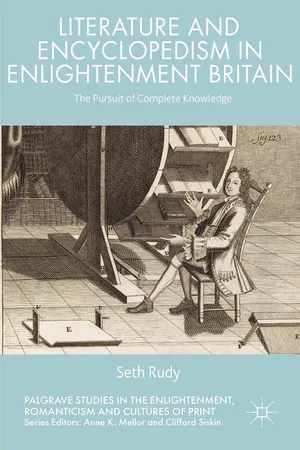
Literature and Encyclopedism in Enlightenment Britain
The Pursuit of Complete Knowledge
- English
- ePUB (mobile friendly)
- Available on iOS & Android
eBook - ePub
About this book
Literature and Encyclopedism in Enlightenment Britain tells the story of long-term aspirations to comprehend, record, and disseminate complete knowledge of the world. It draws on a wide range of literary and non-literary works from the early modern era and British Enlightenment.
Information
1
Introduction: Concepts of Completeness
In 1710, the author and biographer Richard Ward summarized his thoughts on the limits of human comprehension with a phrase he claimed to have borrowed from antiquity. “When a Man shall be join’d to Intellect, or Understanding,” he wrote, “by a sort of Complete Knowledge of all things, then a God (or, as I would interpret it, an extraordinary Heroe) may be said to sojourn in a Human Body.”1 Ward’s assessment implies that such a joining is improbable if not impossible—that neither the single human memory nor the single human lifespan is suited to achieving a perfect understanding of all knowledge in all its complexity. The future tense and ancient pedigree of the remark cast the pursuit of complete knowledge as part of a venerable tradition of frustrated ambition; by the early eighteenth century, it seemed, humanity had already sought it for millennia and either altogether failed to achieve it or simply lost what it once supposedly knew.
At a moment when Google seeks “to organize the world’s information and make it universally accessible and useful,” this book tells the story of long-term aspirations to comprehend, record, and disseminate “complete” knowledge of the world. It explores the persistent failure of these ambitions, their collapse in the third quarter of the eighteenth century, and the subsequent redefinition of completeness in modern literary and disciplinary terms. The pursuit of complete knowledge in ancient epic and then in epics and discursive works of the seventeenth and eighteenth centuries advanced the separation of encyclopedism from epic poetry, epic poems from novels, literature from “Literature,” and the sciences from the humanities; the distinctions between “high” and “low,” ephemeral and eternal, useful and useless that still persist today all stem from the concepts of completeness that emerged during and as a result of the Enlightenment.
The reputation of Homer and Virgil’s comprehensive knowledge in antiquity and the Middle Ages—a reputation neither always unchallenged nor entirely defeated, even as late as the early eighteenth century—helped make epic an enduring signifier of great magnitude and longevity, if no longer one of truly universal scope. Now, as new technologies bring with them new modes and forms of knowledge production and transmission, scholars have again begun to look to epic as the ancestor of an emerging genre that has the potential to redefine the standards, value, and possibilities of complete knowledge. Database, as Ed Folsom argues in ‘Database as Genre: The Epic Transformation of Archives,’ may be gaining recognition as “the genre of the twenty-first century,” but in truth it “has been with us all along, in the guises of those literary works we have always had trouble assigning to a genre,” and in the phenomenological life of epic.2 The ancient commonplaces praising Homer and Virgil’s more-than-human capacities connect epic and its history to everything from the Iliad, Odyssey, and Aeneid to Francis Bacon’s Great Instauration, and from the encyclopedias of the Enlightenment to the reputation of Google’s PageRank as an “all-knowing” algorithm.3 This study charts the historical process by which different kinds of completeness came to be associated with such different forms and methods of knowledge production and suggests both how and why those associations continue to inform our understanding of their purposes and value.
Even at its most basic, the concept of completeness carries two contradictory meanings. On the one hand, “complete” indicates comprehensive: a full account of every part of knowledge or every article relevant to a given subject or subjects of inquiry. On the other hand, it also implies cohesion: the connection of all those parts or articles together into a unified whole without defect. As numerous readers and writers of the seventeenth and eighteenth centuries observed, however, the more comprehensive an account became, the more difficult it became for that account to achieve cohesiveness. Thus, what a work gained in one sense of completion it often lost in the other. As the volume and kinds of information in and about the world both changed and proliferated with the emergence of new modes of knowledge production and the expansion of the literary marketplace, these two aspects of completeness tended more and more towards mutual exclusivity. Sacrificing too much detail in the name of overall coherence might leave readers without valuable content, but then again, attempting to render a full and dedicated treatment of even one subject might simply overwhelm. Simply put, too much could present as much an obstacle to understanding as too little.
A vast field of literary potential lay between the extremes. According to the numerous plans, prefaces, dedications, and advertisements written to justify the presence of yet another book in an already overcrowded marketplace, either extreme unacceptably jeopardized the usefulness of the work and any knowledge it contained. Horace, in his Ars Poetica, had declared usefulness one of the two characteristics fundamental to successful poetry, and throughout much of the Enlightenment achieving some version of dulce et utile remained the aspiration (and self-proclaimed accomplishment) of all kinds of literature, from poems and pamphlets to encyclopedias and enchiridia.4 Writers of all kinds sought to manage the proliferation of print and the expansion of knowledge; they attempted to establish or reconstitute the utility of their texts as durable mechanisms of literary organization and as effective mediators of complete knowledge as they construed it.
The “experience of overabundance” and the simultaneous attempts to alleviate it via collection, organization, distinction, and abridgment, then, are no more new now than they were in the seventeenth century, when John Milton surrounded his Adam with an entirely new world and found himself surrounded by new ways of knowing it.5 There has been “too much to know” (to borrow a phrase from historian Ann Blair) for hundreds or perhaps thousands of years, and for just as long there have been thinkers, writers, and readers concerned with the potential as well as the potential danger of accumulating knowledge and texts. The practices of compilation and summary developed in antiquity to stem the tide (or harness its power) were joined in the Middle Ages by a host of supplementary tools including indices, concordances, alphabetical and systematic arrangements, tables of contents, and textual subdivisions. The dictionaries, florilegia, and other compendia that employed these tools remained staple genres throughout the Early Modern period, when print technology and the rapid production of books it enabled made complaints about volume and variety a regular feature of texts beyond the scholarly world.6 In the seventeenth and eighteenth centuries, as the print market continued to expand, such complaints gained new cultural significance and became influential forces in a broadening swathe of literary as well as scientific, historical, and technical discourses.
Despite their seeming differences, a host of writers and titles made similar attempts to identify, collect, and preserve what they deemed the true and worthwhile parts of human knowledge and literary history even as they changed, added to, and became part of the past they captured. Bacon knew that the limitations of mortality and memory would not permit him to record or comprehend all the phenomena of the universe in his lifetime; John Milton made the origins of those limitations central to the plot of Paradise Lost. The authors and editors of universal histories recommended or supplied charts that represented all of human history “at one view” in order to make their narratives more comprehensible; Laurence Sterne suggested that it would take more time to write a complete account of just one life than it would take to live it. Alexander Pope wrote that a full exploration of even so small a part of the universe as “Man” was beyond his power as a poet to complete; William Wordsworth’s autobiographical epic simply leaves a great deal out of the record. Dictionary-makers and encyclopedists throughout the century variously relied upon trees, cross-references, indices, alphabetization, supplementation, systemization, and division to help readers manage and make sense of the knowledge they provided. While these and other authors frequently disagreed with one another, both implicitly and explicitly, about the proper pathway to complete knowledge, the best way to represent that knowledge, and even what completeness itself entailed, they are all connected by their involvement in the modeling and mediation of that concept—the realization of which we have sought, if one takes Milton for a guide, since Creation, and which has continued to elude us since the Fall.
According to some, only the mind of a truly gifted poet could forge a picture of the whole world both as it was and as it should be. According to others, the power of a single brain could “go but a little way” when compared to the combined intellectual efforts of a whole country.7 On the one hand, the synthesized narrative of a poem or novel could theoretically provide the cohesiveness left wanting by mere alphabetization; on the other hand, alphabetization theoretically allowed for the relatively easy incorporation of new material by multiple contributors. Alphabetical encyclopedias and other such compendia could function according to a program of planned obsolescence, with each new edition introducing the latest discoveries while simultaneously carrying forth and re-authorizing whatever their compilers deemed the durable content of earlier versions. When Pope found a new dunce in Colley Cibber, though, he brought forth a New Dunciad to accommodate him, and Richardson too continued to expand his “finished” Clarissa in subsequent editions.
“Complete” knowledge, then, did not come in a single form. The range and breadth of titles and projects promising some version of completeness have problematized the concept in scholarly and vernacular literatures since at least the early seventeenth century, when their numbers, kinds, and availability began to increase. Specific features responsible for increasing sweetness or entertainment value, especially with respect to what modern readers would more readily recognize as “traditional” reference works, generally went without much explanation beyond authorial assurance and the presumption that learning was a pleasure in itself. Articulations of what made a work more useful, however, frequently went into greater detail and offered a rationale for an author’s claim to completeness whatever the scope, subject, or nature of his or her text. No uniform standard of what constitutes a genuinely complete body of knowledge prevailed then or now, and attempts to apply such a standard almost immediately make little sense even within single works.
Thomas Cooper, for example, advertised The universal pocket-book (1740) as “the most comprehensive, useful, and compleat book of the kind, ever yet publish’d.” It contained just under 300 pages duodecimo of material “designed for the use, benefit, and convenience of all sorts of persons” and included a map of the world, an account of all the stage coaches and carriers in England and Scotland, a list of members of the House of Peers, and a treatise on gardening. Somewhat less practically, it also provided readers with a table of “remarkable events” from the creation of the world to the time of Julius Caesar, brief descriptions of the Seven Wonders of the World, a truncated history of England, and “short definitions of all the arts and sciences.”8 The fifth and final edition of the book appeared in 1745, a year after the publication of A supplement to Dr. Harris’s Dictionary of arts and sciences, the full title of which deployed several similar terms but nevertheless operated according to very different standards of completeness. Its title page declared it “more copious and extensive than any Work of this Kind” and insisted that, when joined with Harris’s earlier volumes, it would “make the most useful Set of Books, and compleat Body of Arts and Sciences yet extant.”9 Given that Harris’s volumes collectively comprised roughly 2600 pages and plates, the thousand pages of the folio supplement represented a significant step towards comprehensive completeness that, at least in terms of size, must have made Cooper’s pocket-book seem somewhat less than truly universal.
That any two works of such radically disproportionate lengths should equally trumpet their completeness might simply appear to evacuate the word of any substantive meaning. Like their Early Modern and Enlightenment antecedents, modern authors and booksellers still offer thousands of “complete” histories, narratives, guides, dictionaries, encyclopedias, and other compendia covering every category from Business and Investing to Literature and Fiction to Religion and Spirituality.10 In many, if not most, the presence of the word “complete” in their titles is always already ironic and typically indicative of a mass-market rather than scholarly appeal. It seems improbable, for instance, that The Times Complete History of the World (2010), a 432-page book that supposedly “has all the answers” and covers everything “from cavemen to the Cold War, from Alexander the Great to global warming, from warfare through the ages to the great voyages of exploration” is in fact “the most comprehensive, authoritative and accessible work on world history available today”—especially given that Sir Walter Raleigh’s widely read The history of the world (1614) had 400 fewer years to cover but still ran to nearly 800 pages in half-folio.11 Raleigh’s unfinished history in fact never made it past the second century BC, and that despite his having had all the free time afforded by a prolonged stay in the Tower.
The ambiguity and perceived ubiquity of the term “complete,” then, somewhat justly occasioned cynical responses to it less than twenty years after its first English-title appearance in Henry Peacham’s The compleat gentleman (1622). As Peter de Bolla points out, however, a distinction must be made between a “concept” and merely “the use of a word.”12 The frequent appearance and casual use of “complete” and its variants in the titles and prefaces of seventeenth-century guidebooks for example—a subject I will examine further in Chapter 2—helped to establish “complete” less as a determinate quality than as a way of thinking about the order, organization, transmission, and progress of human learning—particularly as mediated by literature. The completeness of knowledge in general and the completeness of a “Literary” work in terms of formal structure and generic propriety, moreover, were not always already divided, particularly in the cases of epic and encyclopedic endeavors. The distinction and its naturalization to what became different kinds of literature are the results of the historical processes of pursuit, collapse, and reconstitution that this book recovers.
The concept of completeness remained (and remains) part of literature and knowledge production in part because its definition depended not only upon the extent of coverage, but also upon the extent to which that coverage served the designs of the work as well as the needs of its readers. In other words, to be complete, whole, or universal had as much to do with the utility of knowledge as it did with knowledge itself—a concept that also defied (and defies) simple explanation and which term I use throughout this book in a very general sense capable of accommodating its historical and contextual contingency. I share the concern expressed by Alan Rauch in Useful Knowledge that “the concept knowledge may strike the reader as too sweeping, particularly given the breadth of its meaning,” but like Rauch I believe that “no better term exists.”13 There are important distinctions to be made among data, information, and knowledge, but those distinctions were not always precise or stable—Johnson’s dictionary, for example, lists “information; power of knowing” as a definition of “knowledge.”14 The substance of what counted as knowledge, I argue, depended in part upon the relationship between completeness and utility.
The unmanageably comprehensive and the superficially concise were both potentially opposite to usefulness. In purely quantitative terms, Cooper’s universal pocket-book necessarily contained altogether less content than Harris’s universal dictionary, but with respect to mobility, affordability, and comprehensibility, it may well have been more useful to some readers and therefore more complete. Similarly, an architect, artilleryman, midwife, navigator, or lawyer might have had need of all the knowledge about those arts and sciences contained in a multi-volume encyclopedia, but if that encyclopedia allowed alphabetical organization to scatter them across thousands of pages without adequate regard to coherence, then the user could not necessarily come away with a “complete” understanding of his or her chosen subject. Single works often promised to do the work of many: some encyclopedias promised to do the work of entire libraries, and when encyclopedias became too large, at least one, The new royal encyclopædia (1788), promised to do the work of all encyclopedias.15 If the latter could lay greater claims to completeness because they were larger, then the former could do so because it was smaller.
Descriptions and defenses of plans and methods all designed to digest “valuable” learning and make it useful echoed throughout a range of works intended to supplant proliferating and competing forms of instruction and entertainment. The literary engagement with what we might call “encyclopedic” knowledge extended far beyond what we now recognize as conventional encyclopedias. The relative stability of t...
Table of contents
- Cover
- Title
- Copyright
- Contents
- Acknowledgments
- 1 Introduction: Concepts of Completeness
- 2 Complete Bodies, Whole Arts, and the Limits of Epic
- 3 Worlds Apart: Epic and Encyclopedia in the Augustan Age
- 4 Mid-Century Experiments in Encyclopedism
- 5 Collapse and Reconstitution: Epic and Encyclopedia Revisited
- Appendix
- Notes
- Bibliography
- Index
Trusted by 375,005 students
Access to over 1.5 million titles for a fair monthly price.
Study more efficiently using our study tools.
Frequently asked questions
Yes, you can cancel anytime from the Subscription tab in your account settings on the Perlego website. Your subscription will stay active until the end of your current billing period. Learn how to cancel your subscription
No, books cannot be downloaded as external files, such as PDFs, for use outside of Perlego. However, you can download books within the Perlego app for offline reading on mobile or tablet. Learn how to download books offline
Perlego offers two plans: Essential and Complete
- Essential is ideal for learners and professionals who enjoy exploring a wide range of subjects. Access the Essential Library with 800,000+ trusted titles and best-sellers across business, personal growth, and the humanities. Includes unlimited reading time and Standard Read Aloud voice.
- Complete: Perfect for advanced learners and researchers needing full, unrestricted access. Unlock 1.5M+ books across hundreds of subjects, including academic and specialized titles. The Complete Plan also includes advanced features like Premium Read Aloud and Research Assistant.
We are an online textbook subscription service, where you can get access to an entire online library for less than the price of a single book per month. With over 1.5 million books across 990+ topics, we’ve got you covered! Learn about our mission
Look out for the read-aloud symbol on your next book to see if you can listen to it. The read-aloud tool reads text aloud for you, highlighting the text as it is being read. You can pause it, speed it up and slow it down. Learn more about Read Aloud
Yes! You can use the Perlego app on both iOS and Android devices to read anytime, anywhere — even offline. Perfect for commutes or when you’re on the go.
Please note we cannot support devices running on iOS 13 and Android 7 or earlier. Learn more about using the app
Please note we cannot support devices running on iOS 13 and Android 7 or earlier. Learn more about using the app
Yes, you can access Literature and Encyclopedism in Enlightenment Britain by Seth Rudy in PDF and/or ePUB format, as well as other popular books in Literature & Literature General. We have over 1.5 million books available in our catalogue for you to explore.