- English
- ePUB (mobile friendly)
- Available on iOS & Android
eBook - ePub
About this book
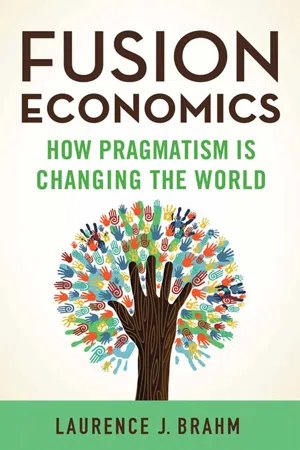
The current international financial system has created a huge gap between the wealthy and the rest. Grounded and straightforward in his approach, Brahm calls for a turn away from economic systems dangerously steeped in ideology and stymied by politics, outlining a new global consensus based on pragmatism, common sense, and grass-roots realities.
Information
PART I
FUSION ECONOMICS: Burying Ideology, Dumping Theory, and Adopting Pragmatism
Fire in the Lake is the Image of Revolution.
The image is a leopard being transformed into a tiger.
The symbol is to reform the old to the new.
—I Ching (The Book of Changes)
We need pragmatic holistic economics to replace theory and put an end to the dogma of market fundamentalism. It’s time for an economic middle way.
There are two Chinese “takeaways” (a new kind of Group A and Group B). First, there is no one single model to be applied universally. Second, ideologically premised economics is impractical. The fortune cookie message is simple: end the socialist versus capitalist debate, dump the theory, and do what works.
The Chinese government lets the market run its course. When it runs out of control, they rein it in. If fiscal measures, taxes, and interest rates don’t work, they slap on administrative measures, fees, and quotas. They don’t care what you call it, as long as the methods used get a result.
Eyeing the China experiment, other countries across Asia began adopting their own version of this “fusion” economics, mixing tools of market and central planning, sometimes more, sometimes less. Vietnam, Laos, and Malaysia have been examples of mixed economies. Each did it their own way, based on their own local circumstances. They sought “sequenced,” step-by-step reforms, and did not use “shock.” Brazil, Russia, India, China, and South Africa (BRICS) and the Group of 77 (G77) take China’s approach seriously. They borrow what is useful and discard what is not. They don’t get hung up on ideology or theory.
China, despite all of its problems, demonstrated that an alternative is possible. It unabashedly both used the tools of market and planning and transformed its economy from scarcity to oversupply, from poverty to conspicuous consumption wealth. It also made a lot of mistakes.
Within two decades, China pulled more people out of poverty than any other country in history, and also became the world’s worst polluter. Environmental degradation and the loss of culture and identity (the very roots of a people’s soul) are examples of what can go wrong when there is overreliance on economic growth. Stuffing homes with brands did not bring happiness in China, as it did not bring happiness in America either. In both countries, conspicuous consumption has created greed conundrums and distorted values.
Excessiveness in any form, whether neoliberalism, socialism, or state capitalism, will ultimately work against itself. There is a negative karma effect in any form of extremism—economic or political.
We need an economic middle way, one that is more pragmatic and more holistic. Enter the Tao of fusion economics.
CHAPTER 1
REENGINEERING CHINA: Ending Ideology and Getting Pragmatic
ECONOMIC DISTORTIONS AND DISTRUST
Beijing, 1981. In late spring 1981, I first arrived in Beijing. The airport felt like an oven, baking in stifling flat heat. Sweat poured. There was no conveyor belt for luggage. Scowling airport staff just threw luggage off a cart. They could not care less what was inside your bag. There was no concept of service. That was the work ethic after the Cultural Revolution. Nobody cared about anything.
I remember walking out of the cavernous Soviet-era airport that had art deco red stars on the ceiling, right into Beijing’s broiling summer heat. I later learned there was no spring season in this city. Everyone in the crowd waiting outside wore either green army or blue worker pants. Men and women alike wore short-sleeve shirts so poor in quality they were see-through. I tried speaking some broken Mandarin to find my way. Nobody answered. They simply stared at me.
I felt like an alien who had dropped from space. It was like a science fiction movie, Planet of the Apes or something like that.
The old narrow road from Capital Airport into Beijing seemed long. There were poplar trees lining both sides. The bus broke down several times. Each time, everybody got out talking all at once and tried to fix it. China’s economy was like that bus!
My first stop, like that of most foreigners in those days, was the Friendship Store, a five-story, cavernous department store reserved for foreigners. It was then the tallest building on Chang An Avenue. I bought a Coke. It was imported and cost one dollar. That would have been more than any Chinese could have ever conceived of spending on a drink. At that time, there was only one local soft drink, called qishui’er, meaning “gas water.” It tasted like it sounded. It came in green and orange colors, with a spectrum of shades like teenage punk rockers might dye their hair. My Chinese teachers were distraught that I had paid one dollar for a Coke. It was totally decadent, and told me so to my face. In those days, ordinary Chinese citizens were not permitted to enter the Friendship Store. And, of course, nobody could afford an imported Coke.
On that stiflingly hot day, that simple act of buying a Coke brought into sharp focus the distortions and disconnected perceptions between the developed and the underdeveloped world. That one-dollar Coke juxtaposed all of the economic assumptions I had been brought up with.
Most Chinese did not have access to money, because in 1981 China hardly had any money in circulation. And even if someone had money, there were few commodities to buy. Aside from the Friendship Store, most state-run department stores had empty shelves, or just blue and green pants.
It was an economy of scarcity.
I was a fresh, idealistic university exchange student. The idea of improving China’s economic condition started as a vision I had. It was the main thing that motivated me each day as I filled up a cheap white tin cup with sticky venomous Shanghai-produced instant coffee. Soon I learned to drink tea. Slinging a green army bag over my shoulder, I went off to Mandarin class each day, determined to learn this language, as the key to opening up the Pandora’s box that was this nation’s predicament.
China’s economic backwardness struck me. Coming from America, then the most affluent society in the world, I had to get my mind around China’s lack of everything. Was it possible to change this condition? Along the lake at Nankai University each afternoon, Chinese students gave me their Red Books as gifts. Was it to share Mao’s thoughts? Actually, they wanted to get rid of the books.
Joking and smoking, these Chinese classmates in their burr haircuts were actually military officials and cadres undergoing training for future careers in international relations. Part of their training was befriending me, unbeknownst to me until years later. The friendships seemed so innocent, they practicing their English, I practicing Chinese.
Some of these friendships lasted through my life, becoming keys that opened doors into the labyrinth of China’s corridors of power. These classmates would rise to positions of power. Some would keep rising and go very deep into the system. They became my guarantors in a political culture of tense security, suspicion, and schizophrenia. It was all about passing through doors and gates of trust in an atmosphere of complete distrust.
THE HONORABLE TEACHINGS OF MASTER VICTOR LI
When I was supporting myself through school as a tour guide, a couple from Honolulu on one of my tours told me about Victor Li, the president of the East-West Center in Hawaii. Li served as translator for the American Ping-Pong team that broke the diplomatic ice with China. The leading expert on Chinese law, he authored a book called Law without Lawyers (the title says it all). He was also professor at the University of Hawaii law school.
So in 1983, I showed up at a round table on Chinese law at the East-West Center, located amid the lush green University of Hawaii campus. Catching Victor Li over coffee, I offered myself as his research assistant. Taken off guard by my spoken Mandarin, he immediately agreed. I soon entered the University of Hawaii school of law, living in a local tenement behind Japanese mom-and-pop shops and an organic farm market, in a rundown strip called Puck’s Alley.
Victor Li was soft-spoken, an almost introverted thinker who always seemed in balance with himself. Li taught how to look at any single issue—economy, law, politics, or business—from a multiple set of different ethnic, cultural, and geographic coordinates at once. This way of thinking was the crucible of fusion economics.
Under his guidance, I became a lawyer and economist, specializing in China. However, China business had little to do with law (remember Li’s book title?).
One day, as I entered Li’s office, he was rubbing his eyes with frustration. I started to brief him on a new law China had issued. He pointed at a map of the Asia-Pacific region. “I am no longer interested in China laws. I am already looking at this.”
“At what?”
“At the Asia-Pacific region and how China will transform these countries and the alignment of power by its sheer economic weight over the next decade.” Li was looking way ahead of the curve, seeing issues on the horizon that others in the 1980s could not even guess.
During Premier Zhao Ziyang’s maiden visit to America in January 1984, his first stop was Honolulu, and it was Li who received him at the East-West Center. The Chinese totally bought into the symbolism of all this. Li subtly let me join his meeting with Zhao. I quietly stood in the back of the room taking notes. That moment was arguably the pinnacle of American-Chinese relations. Nobody imagined that these relations would sour in only five years. In the wake of Tiananmen on June 4, 1989, the US-China honeymoon ended abruptly. In many ways the relationship, despite its mutual dependence, never really recovered the spirit of trust and hope that characterized those earlier years.
When I returned to China after graduation, old classmates appeared when least expected. They invited me to attend meetings where economic questions were asked in a roundabout way.
For China’s leaders, spouting socialist rhetoric was just a façade. They could hardly care less. The desire to get ahead put pragmatism first. China’s policymakers were open to fresh perspectives, even though they stared at you through thick black horn-rimmed glasses and wore Mao suits in the winter to assure warmth from the political cold.
Within two decades, China would shift from a position of complete scarcity to one of oversupply of virtually every product and service. Three decades later, it would become the second-largest economy in the world, the most powerful economic force to be reckoned with next to the United States.
It was unimaginable that this would happen so quickly, or that I might play a part in this process. The thought was furthest from my mind on that dry hot day, drinking a Coke in the Friendship Store, its dreary staff staring from behind dusty counters stacked with grotesque jade carvings and box-like imported Japanese television sets.
THE RICKETY BICYCLE AND PRAGMATIC ECONOMICS
In 1979, a tiny experiment occurred in far-off Anhui Province. Against the backdrop of three decades of impoverishing communalization, 18 village families agreed by contract that they would pool resources. As simple as it sounds, it was a bold breakthrough against the harsh socialist policies of that time. The pact among these families was turn over to the state only their quota of crops harvested, sell the rest, and retain the proceeds. Wan Li, then provincial party secretary, supported their defiant move. It was later dubbed the “self-responsibility system.”
This little experiment, allowing one small group the right to grow their own rice and cabbage, transformed China.
Wan Li was promoted to the top by Deng Xiaoping. Our paths would cross. In 1992, Wan Li at the height of his power was chairman of the National People’s Congress, China’s rubber stamp parliament. He controlled the stamp. He received me in the Great Hall of the People because I was advising Chinese enterprises in Hong Kong, where the arrival of red capital would change the corporate and capital market landscape.
Wan Li met me in one of those vast dreary rooms with overstuffed sofas and dusty red curtains. He had one burning question: how to transform China’s debt-ridden rusty state-owned enterprises into global conglomerates that could compete with American corporations for international markets? Five years later, I would be on the ground in Anhui Province, where his own reforms first began, blueprinting the “corporatization” of China’s state-owned enterprises.
A decade and a half later, the far-flung dream of an old revolutionary became a reality that would shake the economic order of our planet.
Following Wan Li’s “self-responsibility” experiment in Anhui, Chinese in the street whispered the words “free market.” But what did it really mean? A few bold peasants brought vegetables and peanuts folded in rough cloth—because they had no bags. Squatting on the curbside, they sold them for cash. Remarkably, they kept the money. People talked about it excitedly.
It was the beginning of the free market. But nobody dared to openly say “market economy.” The free market was on the fringes of China’s economy. It was something on the curbside.
When I was studying in Tianjin in 1981, there was a fledgling free market near the university gate. There were few other choices. People queued every day to buy food because there were no refrigerators. State-distributed food supplies were sparse and irregular; state store employees were dour and irascible. Each day people lined up at those state-run stores with tickets to exchange for staples. Even with money, you could not buy rice or dough without quota-rationed coupons.
However, across the street the free market farmers had all sorts of fruits and vegetables. There was variety. People could just see the difference right in front of them
When the student cafeteria served scraps of pork fat, we students were very happy, because there was no meat on the market. Together with a classmate, I found a small roasted baby chicken in the window of one of these state-run stores. We had not seen one before. Little did we realize that that little skinny chicken in ...
Table of contents
- Cover
- Title
- INTRODUCTION The Washington Consensus Is Dead!
- Part I Fusion Economics: Burying Ideology, Dumping Theory, and Adopting Pragmatism
- Part II Pragmatic Idealism: Compassionate Capital, Stakeholder Value, and Social Enterprise
- Part III Diversified Localization: Empowering People Brings Sustainable Security
- Part IV The New Earth Consensus: Community Consciousness and Planetary Survival
- Notes
- Index
Trusted by 375,005 students
Access to over 1.5 million titles for a fair monthly price.
Study more efficiently using our study tools.
Frequently asked questions
Yes, you can cancel anytime from the Subscription tab in your account settings on the Perlego website. Your subscription will stay active until the end of your current billing period. Learn how to cancel your subscription
No, books cannot be downloaded as external files, such as PDFs, for use outside of Perlego. However, you can download books within the Perlego app for offline reading on mobile or tablet. Learn how to download books offline
Perlego offers two plans: Essential and Complete
- Essential is ideal for learners and professionals who enjoy exploring a wide range of subjects. Access the Essential Library with 800,000+ trusted titles and best-sellers across business, personal growth, and the humanities. Includes unlimited reading time and Standard Read Aloud voice.
- Complete: Perfect for advanced learners and researchers needing full, unrestricted access. Unlock 1.5M+ books across hundreds of subjects, including academic and specialized titles. The Complete Plan also includes advanced features like Premium Read Aloud and Research Assistant.
We are an online textbook subscription service, where you can get access to an entire online library for less than the price of a single book per month. With over 1.5 million books across 990+ topics, we’ve got you covered! Learn about our mission
Look out for the read-aloud symbol on your next book to see if you can listen to it. The read-aloud tool reads text aloud for you, highlighting the text as it is being read. You can pause it, speed it up and slow it down. Learn more about Read Aloud
Yes! You can use the Perlego app on both iOS and Android devices to read anytime, anywhere — even offline. Perfect for commutes or when you’re on the go.
Please note we cannot support devices running on iOS 13 and Android 7 or earlier. Learn more about using the app
Please note we cannot support devices running on iOS 13 and Android 7 or earlier. Learn more about using the app
Yes, you can access Fusion Economics by L. Brahm in PDF and/or ePUB format, as well as other popular books in Economics & International Business. We have over 1.5 million books available in our catalogue for you to explore.